Austin Frakt, Author at Â鶹ŮÓÅ Health News Â鶹ŮÓÅ Health News produces in-depth journalism on health issues and is a core operating program of Â鶹ŮÓÅ. Thu, 16 Apr 2026 06:06:19 +0000 en-US hourly 1 https://wordpress.org/?v=6.8.5 /wp-content/uploads/sites/8/2023/04/kffhealthnews-icon.png?w=32 Austin Frakt, Author at Â鶹ŮÓÅ Health News 32 32 161476233 After The Deluge: Health Reform Without An Individual Mandate /insurance/022411fraktoutterson/ /insurance/022411fraktoutterson/#respond Thu, 24 Feb 2011 00:30:00 +0000 http://khn.wp.alley.ws/news/022411fraktoutterson/ Kevin Outterson is an associate professor at Boston University’s School of Law. Austin Frakt is a health economist and an assistant professor of health policy and management at Boston University’s School of Public Health. Both blog at

.Ìý

Two federal judges now tell us that the federal health law’s individual mandate is . Three others , and soon we will start to hear from appellate courts. But what if we put the legal arguments aside for the moment and focus on the real question: what happens to health reform if the individual mandate is ultimately struck down?

Some claim that, without the mandate, the overhaul will collapse. Opponents certainly hope that is true, and Judge Roger Vinson of the Northern District Court of Florida decided to – explaining that the measure’s other provisions cannot be separated from the requirement to buy insurance. Even the White House and its lawyers have on occasion agreed, perhaps only as a rhetorical device. But they are mistaken. Health reform can survive without it.

The individual mandate serves an important function in (that individuals would buy insurance only when sick, driving up premiums for everyone). But so long as the rest of the Affordable Care Act remains in place, the impact will be tolerable and will improve over time. The federal government and reform-minded states have several tools at hand.

The people most directly affected by the legal challenges are uninsured individuals —Ìý — who would be able to purchase health coverage through the law’s health insurance exchanges. The health law would be imperiled only if a large, relatively healthy subset of these individuals do not purchase coverage, but wait until they are sick to do so, driving premiums up.Ìý

This consequence is avoided if healthy individuals contribute premiums throughout their lifetimes, not just when they begin to need care. But most of the 16 million people at issue qualify for substantial federal subsidies. The subsidies have two effects: first, they encourage some to purchase health coverage through the exchanges, even in the absence of an individual mandate. Second, subsidies blunt the premium-increasing impact of free riding on the insurance market, especially if some of the federal subsidies could be paid into the exchanges whether or not the individuals enroll.Ìý

States can also do their part to bring the remaining free riders into the system.ÌýMassachusetts has an individual state mandate in place, which .Ìý Some “blue states” can follow Massachusetts’s lead and pass a state-level individual mandate. Others, like Vermont, are exploring single-payer reforms. A natural experiment is unfolding, with additional encouragement from recently introduced in the Senate by Sen. Ron Wyden, D-Ore., and Sen. Scott Brown, R-Mass., that would permit immediate flexibility for coverage expansion under the health law.

The Centers for Medicare and Medicaid Services also has some plausible regulatory options, even without new federal legislation. Under existing law, CMS can grant such waivers, but they become effective no earlier than 2017. The following suggestions could partially bridge the gap until waivers become possible or the Wyden-Brown bill is passed.

One idea is to follow the examples set by Medicare Part B, which covers outpatient physician services, and Medicare Part D, the prescription drug program. CMS could permit “qualified health plans” in the exchanges to impose on customers who delay obtaining coverage. The mechanism would be through an exception to the anti-discrimination rules, and the law gives the secretary of Health and Human Services some flexibility to issue regulations to limit adverse selection.

Another possible regulatory adjustment is the definition of “qualified individual” in the law. The definition currently excludes undocumented aliens, and CMS also could try to exclude free riders unless they pay a surcharge to rejoin the system. While there is little direct textual support for this rule itself, the ACA grants significant rule-making authority to implement the law.

A complementary approach would be to amend the definition of a “qualified individual” under state law. The defines “qualified individual.” The suggestion would be to exclude free riders from this definition, with the state law approved by CMS. Exceptions might be necessary for individuals who lacked the financial capacity to have previously purchased insurance, but as seen above, these people aren’t really free riders in the classic sense.

Others have , like after failing to enroll, or significantly higher copays or deductibles for late enrollees. These ideas would require federal statutory amendments to implement them properly.

The end result could be that losing the individual mandate primarily hurts “red state” individual insurance markets, while blue states would enjoy more coverage and stability. After a couple years of that transparent dynamic, red states (and their residents) might be willing to gradually follow suit. While the absence of an individual mandate will certainly slow coverage expansions, it does not spell the doom of health reform.

Â鶹ŮÓÅ Health News is a national newsroom that produces in-depth journalism about health issues and is one of the core operating programs at Â鶹ŮÓÅ—an independent source of health policy research, polling, and journalism. Learn more about .

This <a target="_blank" href="/insurance/022411fraktoutterson/">article</a&gt; first appeared on <a target="_blank" href="">Â鶹ŮÓÅ Health News</a> and is republished here under a <a target="_blank" href=" Commons Attribution-NonCommercial-NoDerivatives 4.0 International License</a>.<img src="/wp-content/uploads/sites/8/2023/04/kffhealthnews-icon.png?w=150&quot; style="width:1em;height:1em;margin-left:10px;">

<img id="republication-tracker-tool-source" src="/?republication-pixel=true&post=9240&amp;ga4=G-J74WWTKFM0&quot; style="width:1px;height:1px;">]]>
/insurance/022411fraktoutterson/feed/ 0 9240
Insurance Reform Is Not Cost Control /insurance/020911frakt/ /insurance/020911frakt/#respond Wed, 09 Feb 2011 00:30:15 +0000 http://khn.wp.alley.ws/news/020911frakt/ Austin Frakt
is a health economist and an Assistant Professor of Health Policy and Management at Boston University” School of Public Health. He blogs atÌý.

Now that House Republicans, along with a few Democrats, have passed a bill to repeal last year’s health reform law, they are planning to offer some alternatives for . Not unexpectedly, health care spending — high and growing premiums and government expenditures — are dominant concerns among policymakers. But how can we tell if their plans are likely to tackle this problem?

Some ideas are hard to judge. That’s one reason why the Congressional Budget Office is so valuable. It provides a nonpartisan estimate of the budgetary effects of legislative proposals.

However, in some cases, one doesn’t need fancy math or computers to determine if an idea is likely to make a significant impact on the cost of care to families, businesses and taxpayers. Sometimes one only needs to know one simple fact. It’s this: In each of the past 50 years payment to health care providers has accounted for . Thus, only a small fraction of spending on health insurance premiums is consumed as a cost of insurance. I have no doubt that there are ways to squeeze some efficiency out of the insurance system. But doing so is not likely to make a substantial, long-term impact on the inflation of health care costs.

Sure, there are things that could be done to make health insurance premiums cheaper for some people, . Some of those things are in the new health reform law. In combination, the mandate, the new exchanges and subsidies will put downward pressure on premiums, particularly for those participating in the non- or small-group markets.

Ideas not in the health law and frequently endorsed by Republicans, such as increasing competition among insurance companies and encouraging enrollment into higher deductible plans, can also reduce costs for some people, particularly those with low risk of high health care spending.

But can any of these approaches — those in the law and others — lower costs or reduce cost growth for everyone, system-wide? In thinking about this question, we need only recall the simple fact provided above. The vast majority of private-sector spending is not tied up in the insurance system. Thus, focusing on insurance reforms alone while claiming to seriously address the long-term spending issues for everyone ignores this basic math.

This is precisely why last year’s health overhaul, which is mostly an insurance reform law, may not do that much on cost control. A lot depends on the new, experimental ideas in it, like bundled payments, accountable care organizations and the Cadillac tax. And that is why we need to let those experiments play out — keeping at the cost problem.

To begin to address health care spending growth we need to follow the money. Providers, not just insurers,Ìý, and a big part of it — most of it, actually. Last I checked they have some very politically powerful organizations representing their interests, which makes this both technically and politically challenging. Reducing payments to providers takes money out of someone’s pocket.

The key question is, how might we get health care providers to go along with additional cost-saving reform? In fact, nobody knows the answer. If there is one, it’s likely to be through a slow and steady, decades-long process, not the firing of a magic bullet. How many people do you know will accept a dramatically lower income tomorrow?

Just because we don’t know how to solve the health care spending growth problem doesn’t mean we need to accept wrong answers as right. When you hear a health reform proposal, listen to how the proponents claim health care spending will be controlled or reduced. Apply this simple litmus test: if they’re talking only about insurance market reforms and innovations, . That’s not where the big money is so it can’t be the full solution.

That’s not to say the insurance market isn’t in need of some reform. It is! But that’s not enough. And it takes knowing only one simple fact to see that: we spend a lot on health care — our premiums and per beneficiary spending are high — but we’re mostly not paying for insurance, despite who collects our premiums.

Â鶹ŮÓÅ Health News is a national newsroom that produces in-depth journalism about health issues and is one of the core operating programs at Â鶹ŮÓÅ—an independent source of health policy research, polling, and journalism. Learn more about .

This <a target="_blank" href="/insurance/020911frakt/">article</a&gt; first appeared on <a target="_blank" href="">Â鶹ŮÓÅ Health News</a> and is republished here under a <a target="_blank" href=" Commons Attribution-NonCommercial-NoDerivatives 4.0 International License</a>.<img src="/wp-content/uploads/sites/8/2023/04/kffhealthnews-icon.png?w=150&quot; style="width:1em;height:1em;margin-left:10px;">

<img id="republication-tracker-tool-source" src="/?republication-pixel=true&post=9220&amp;ga4=G-J74WWTKFM0&quot; style="width:1px;height:1px;">]]>
/insurance/020911frakt/feed/ 0 9220
The CBO Is Telling Us Something. Is Anybody Listening? /news/011111frakt/ /news/011111frakt/#respond Tue, 11 Jan 2011 11:18:00 +0000 http://khn.wp.alley.ws/news/011111frakt/ The Congressional Budget Office’s budgetary scoring of the health reform law has . At issue is whether health reform will really reduce the deficit by $143 billion through 2019 as the . It’s a legitimate question, but focusing on it misses the most important message conveyed by CBO estimates.

Republicans in the House, who are intent to repeal the new health law, contend that eliminating it wouldn’t really increase the deficit. It’s an argument that makes sense if one is willing to reject the CBO’s deficit-reducing score of the law, and many are. There are good reasons to be skeptical that the law will in fact reduce the deficit.

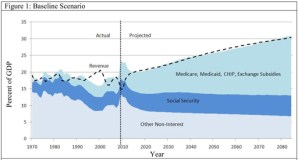
The CBO recognized this and produced not one, but two long-term projections of the overhaul’s impact. Using CBO data, I depict their so-called “baseline scenario” in Figure 1, below. It shows actual and predicted federal government revenue and spending from 1970 through 2085.

Under the baseline scenario, deficits are negative or very small from 2015 through 2085. However, to accomplish this balancing of the books, government revenue (taxes) must increase dramatically to keep pace with the growth in spending on health care programs. In fact, tax receipts must roughly double in the next 75 years, growing well beyond the stable postwar level, which has . By the way, don’t assume that the growth in health care costs depicted in the figure is due to health reform. It was several years before reform passed.
The CBO Is Telling Us Something. Is Anybody Listening?


Note: Figures exclude interest on the national debt.
Source: Author’s graph of data.

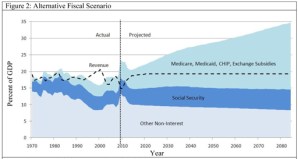
Perhaps Americans will be amenable to supplying ever greater revenue to the federal government. After all, tax rates are . But I’m skeptical that America will stand for it. The CBO was, too, so they produced a second forecast called the “alternative fiscal scenario.” The long-term implications of it are depicted in Figure 2, below.
The CBO Is Telling Us Something. Is Anybody Listening?


Note: Figures exclude interest on the national debt.
Source: Author’s graph of data.

In the alternative fiscal scenario, the CBO assumed that tax revenue would eventually flat-line at about 19 percent of GDP, not far from the historical average. Additionally, they assumed that many of the cost control features of the new health reform law would not be as effective as assumed in the baseline scenario. Thus, deficits grow ever larger due to even faster growing health care costs and constant revenue levels. Deficits would likely if too.

Here’s the state of the debate over these CBO health-reform estimates: which is right, the baseline scenario or the alternative fiscal scenario? It’s the wrong question! It doesn’t matter which scenario you think is right. Likely neither is when examined in any detail, and both are horrible in broad sweep. Choose your poison: massive taxation or massive debt.

Actually, though, there’s a third option: recognition of the underlying problem and dealing with it.

The problem is health care costs. They’ll cause budgetary distress with or without health reform. The CBO’s estimates, both of them, show it clearly. Health care costs have been the source of budgetary woes for decades, and there’s no end in sight under any realistic scoring of any serious health reform proposal.

Proposals that simply declare that rates of Medicare spending cannot exceed economic growth by a certain amount are not credible unless they also suggest a mechanism by which such spending growth targets will be achieved. Any such mechanism, to be believed, must escape the forces that have caused prior cost control efforts to fail, including congressional meddling driven by the interests of key stakeholders.

One way to get serious is to embrace the cost control provisions of the new law and to protect them from the likely efforts of future policymakers to undo them. In this, I agree with health economist Henry Aaron, who ,

That is, the cost controls on the books should be strengthened, not repealed or demagogued. We need them to work, and to work even better than shown in Figure 1. Changes to Medicare and Medicaid payment systems, the Cadillac tax and the creation of the Independent Payment Advisory Board can all be effective tools to reduce federal, state and private health care costs — if used wisely and to their fullest.

It won’t be easy, and more laws may need to be passed to give government programs and private insurers additional cost-cutting tools. With each proposal to do so, the CBO may be asked to predict the consequences. When they do, don’t just listen to how politicians and pundits debate the anticipated effect on deficits, but also look closely at the rate of health care cost growth. If the projections look like either Figures 1 or 2 above, CBO is still telling us we’re in trouble. Will anyone quiet down long enough to listen? More importantly, are we willing to do something about it?

Austin Frakt is a health economist and an Assistant Professor of Health Policy and Management at Boston University’s School of Public Health. He blogs atÌý.

Â鶹ŮÓÅ Health News is a national newsroom that produces in-depth journalism about health issues and is one of the core operating programs at Â鶹ŮÓÅ—an independent source of health policy research, polling, and journalism. Learn more about .

This <a target="_blank" href="/news/011111frakt/">article</a&gt; first appeared on <a target="_blank" href="">Â鶹ŮÓÅ Health News</a> and is republished here under a <a target="_blank" href=" Commons Attribution-NonCommercial-NoDerivatives 4.0 International License</a>.<img src="/wp-content/uploads/sites/8/2023/04/kffhealthnews-icon.png?w=150&quot; style="width:1em;height:1em;margin-left:10px;">

<img id="republication-tracker-tool-source" src="/?republication-pixel=true&post=9304&amp;ga4=G-J74WWTKFM0&quot; style="width:1px;height:1px;">]]>
/news/011111frakt/feed/ 0 9304
How The Health Reform Game Has Changed /news/120610fraktcarroll/ /news/120610fraktcarroll/#respond Thu, 09 Dec 2010 00:30:00 +0000 http://khn.wp.alley.ws/news/120610fraktcarroll/ By some accounts, the Republican takeover of the House is a game changer for health reform. Already, it has reinvigorated debate over the law, and the media have focused on what federal legislators can or will do to alter it. But more attention should be directed elsewhere. The future trajectory of health reform will be shaped far more by interest group agendas and state-level actions than by the new House leadership’s stated plans. Not only has the game changed, but so have the most important players.

When the new RepublicanÌýHouse majority gets to work next year, they will likely continue their rhetoric of repeal and, perhaps, even vote on it. The media attention they receive for these actions may satisfy the GOP base, but with Democratic control of the Senate and presidency, actual repeal is extremely unlikely. In addition, Americans . More importantly, so do key interest groups.

It shouldn’t be a surprise that hospitals, insurers, large employers, and the pharmaceutical industry do not favor repeal. The health law took the shape it did for a reason: interest groups were reasonably successful in achieving their goals with respect to the fundamental structure of the law. Insurers and hospitals (even if Americans oppose it) because it promises greater revenue and a more attractive risk pool for the former and a reduction in uncompensated care for the latter. The pharmaceutical industry is because it will lead to increased drug sales. that will reduce costs and increase quality, both for Medicare and for the supplements that large employers sponsor for their retirees.

If these interest groups opposed health reform, they would have killed it last winter, if not earlier. They didn’t. It’s unlikely theÌýRepublican House leadership will take tangible steps to cross them now, despite what they say.

However, just because health reform won’t be repealed, that doesn’t mean there might not be significant changes during implementation, or that Republicans won’t have influence over those changes. Many of the key implementation decisions won’t be made at the federal level because insurance is regulated to a large extent by .ÌýState insurance commissioners are not appointed by the president or by Congress; they are generally appointed by governors.ÌýIn the November mid-term elections, RepublicansÌý, and will, as a result, control that office in 29 states. And, in the states where insurance commissioner is an elected position, the GOP also made gains.

The exchanges, which still have to be set up, areÌý, as are Medicaid programs.ÌýState insurance commissioners will have a lot of power and control to set regulations on how the exchanges will work.ÌýThat will make a big difference in how reform functions in the individual insurance market – where many of the uninsured are expected to get insurance.

While the overhaul sets national standards for minimum benefits that insurers must offer in the exchanges, them. States could demand that insurers meet certain criteria, such as benefits requirements, or decline to set any at all.ÌýEach state will also have to determine whether to administer the exchange itself, let a private entity do so, or decline entirely and submit to federal intervention. Additionally, the law provides states much leeway in determining what is an “unreasonable” premium increase. States could go as far as to refuse any increases without justification, or merely require justification only for severe increases, and then, perhaps, after the fact.Ìý The medical loss ratio can be changed on a state-by-state basis with approval from the Department of Health and Human Services.

Finally, it’s important to remember that Medicaid is a state-run program, and how changes are made to contain costs within it is entirely at the discretion of governors and their state legislatures. As we’ve already seen in the news, Republican governors of some states are seeking flexibility to significantly modify their states’ Medicaid program.

No one should be under the illusion that health reform is complete just because a law was passed last March. The degree to which objectives of the law are realized continues to depend on implementation. In contrast to the rhetoric from newly elected or re-elected Republican members of the House, or the intense media attention they enjoy, legislative action and implementation will be constrained and shaped by interested groups and action by the states. That doesn’t by any means guarantee success or imply certain failure; it means only that the game has changed. Congress may still be in it, but many other players, some at the state level, are now also on the field.

Austin Frakt is a health economist and an Assistant Professor of Health Policy and Management at Boston University’s School of Public Health.
Aaron Carroll is
associate professor of Pediatrics, the associate director of
Ìý
Children’s Health Services Research
,
and
the director of the Center for Health Policy and Professionalism Research at Indiana University School of Medicine.ÌýB
oth blog at
Ìý


.

Â鶹ŮÓÅ Health News is a national newsroom that produces in-depth journalism about health issues and is one of the core operating programs at Â鶹ŮÓÅ—an independent source of health policy research, polling, and journalism. Learn more about .

This <a target="_blank" href="/news/120610fraktcarroll/">article</a&gt; first appeared on <a target="_blank" href="">Â鶹ŮÓÅ Health News</a> and is republished here under a <a target="_blank" href=" Commons Attribution-NonCommercial-NoDerivatives 4.0 International License</a>.<img src="/wp-content/uploads/sites/8/2023/04/kffhealthnews-icon.png?w=150&quot; style="width:1em;height:1em;margin-left:10px;">

<img id="republication-tracker-tool-source" src="/?republication-pixel=true&post=8583&amp;ga4=G-J74WWTKFM0&quot; style="width:1px;height:1px;">]]>
/news/120610fraktcarroll/feed/ 0 8583
Health Care Cost Control Is Hard, And Humbling /health-industry/110310frakt/ /health-industry/110310frakt/#respond Wed, 03 Nov 2010 15:28:40 +0000 http://khn.wp.alley.ws/news/110310frakt/ Let’s be honest. We really don’t know what’s going to control health care costs, long term. Today’s politically winning idea could be tomorrow’s platter of humble pie.

There are lots of different thoughts about how best to do it. But which of them deserve political and legislative support? On the private side, one big idea centers on high-deductible plans, sometimes coupled with health savings accounts. The theory is that individuals, acting as prudent purchasers and spending their own money, will make more efficient health care decisions. This approach, the consumer-directed health plan concept, puts more of the cost risk on individuals.

On the public side there are accountable care organizations. Under this model, an integrated delivery system would be responsible for providing all the health care required by a defined population. Higher quality and lower cost would be rewarded through a new type of administrative payment system, yet to be developed and tested.ÌýThis could put more of the cost risk on providers.

But will either consumer-directed plans or accountable care organizations really help solve the health care cost problem? Before we answer with confidence, keep in mind that our past track record with potentially cost-saving innovations is not good.

One such innovation began in California and was replicated elsewhere in the 1980s when Ìýto permit insurers to selectively contract with hospitals. The network-based HMO was born and, by the 1990s, it looked like managed care would finally crush health care cost inflation. And it did, for a few years. Perhaps some politicians and health policy wonks had predicted just that. Perhaps some thought the battle had been won. They were wrong.

HMO market share grew and the plans keptÌýratchetingÌýup constraints on providers and consumers, trying to maintain profitability. Then they went too far.Ìý. The kinder, gentler PPO replaced the HMO, politicians supported benefits mandates and patients’ bill of rights laws and high health care cost inflation returned.ÌýAs hopeful as some might have been about managed care, and as promising as the concept seemed, HMOs ultimately proved to be a failed model.

And what aboutÌý, Congress’s best attempt yet at controlling Medicare costs? They were implemented first for hospitals in the early 1980s and, later, for physicians and post-acute and long-term care facilities. They too had some years of success, keeping Medicare prices in check. But with no direct control over volume, they ultimately could not tame costs. Their original objective and flawed design makes a mockery of the notion of public health care cost control as, each year, Congress overrides scheduled cuts to physician payments.

The story of comprehensive, private Medicare health plans is no different. Once touted as cost savers, and paid at ratesÌýguaranteeingÌýjust that, the payment system under which they operate has spun out of control.ÌýPolitical meddlingÌýin response to special interests pushed payments to Medicare Advantage plans well above the cost of traditional Medicare. Congress has resistedÌýa more efficient, competitive bidding payment system that would be immune from this problem.

We could not have known in 1995 what we know today about how each of these ideas would suffer a market or political failure. Perhaps some experts and policymakers were not duped, but enough were that these innovations were accepted by legislators, supported by businesses, and generally regarded as reasonable steps forward on health care cost control.

Is the same outcome the destiny of consumer-directed health plans and accountable care organizations or any other model we envision today? Even if they work here and there or with low market share, will they serve us well over the long term and as dominant models for the financing and provision of health care? Or will they suffer the same fate as managed care, prospective payment and private Medicare plans — becoming victims of their own success, their own limitations, or political meddling? We can’t know. But that doesn’t mean we shouldn’t try or that some of those ideas can’t work if tweaked in certain ways. It just means that we should be humble, prepared to fail and keep thinking of new ideas to replace the ones that don’t work out.

The history of health care cost control suggests that the chances of long-term success of any particular idea are low. This concept or that may be a political winner today, but that doesn’t make it a fiscal winner of tomorrow. Do you think you know how to control health care costs? Don’t bet on it.

Austin Frakt is a health economist and an Assistant Professor of Health Policy and Management at Boston University’s School of Public Health. He blogs at .

Â鶹ŮÓÅ Health News is a national newsroom that produces in-depth journalism about health issues and is one of the core operating programs at Â鶹ŮÓÅ—an independent source of health policy research, polling, and journalism. Learn more about .

This <a target="_blank" href="/health-industry/110310frakt/">article</a&gt; first appeared on <a target="_blank" href="">Â鶹ŮÓÅ Health News</a> and is republished here under a <a target="_blank" href=" Commons Attribution-NonCommercial-NoDerivatives 4.0 International License</a>.<img src="/wp-content/uploads/sites/8/2023/04/kffhealthnews-icon.png?w=150&quot; style="width:1em;height:1em;margin-left:10px;">

<img id="republication-tracker-tool-source" src="/?republication-pixel=true&post=8815&amp;ga4=G-J74WWTKFM0&quot; style="width:1px;height:1px;">]]>
/health-industry/110310frakt/feed/ 0 8815
Competition On Access: A Role For Government In Health Care Markets /health-industry/092310fraktsanterre/ /health-industry/092310fraktsanterre/#respond Fri, 24 Sep 2010 00:30:00 +0000 http://khn.wp.alley.ws/news/092310fraktsanterre/ In late August, Ìýreported that government-owned hospitals are “drowning in debt” due to high health care costs, high rates of uninsured patients and cuts in public payments. Some government facilities are closing while others are being sold to private-sector firms. These developments may result from normal market competition that tends to drive inefficiencies from the system. But something important could be lost when public facilities disappear from the marketplace: access.

Health facilities of different ownership types — private for-profit, private nonprofit or government — coexist in many markets. For example, St. Joseph Medical Center, the Harris County Hospital District and Methodist Willowbrook System are all acute-care hospitals operating in Houston. Palm-Gardens, Dr. Susan Smith McKinney and Rutland are nursing care facilities coexisting in Brooklyn, New York. Each is organized on a different legal basis. Specifically, the first within each group represents a for-profit organization; whereas, the other two are public and nonprofit entities, respectively. Other health care organizations, such as substance abuse centers, dialysis facilities and community health clinics, also sometimes take on different legal ownership forms.

Mixtures of ownership add competition along different dimensions. Economic scholars have how the various organization types pursue alternative goals and behave differently regarding choices such as setting prices, quality and mix of patients (i.e., uninsured, Medicaid, Medicare, private-pay). Welfare-enhancing competitive effects along these dimensions ÌýÌýin markets in which mixes of ownership type exist for certain kinds of health care organizations.

One theory for why health care markets have evolved to include mixtures of firms with different ownership, advanced by Nobel-laureate economist Kenneth Arrow,Ìýis that medical care (like education) is a personal good for which quality is often hard to measure and judge.

If all medical care was provided by for-profit organizations, consumers might worry that providers would skimp on costs by compromising quality in the pursuit of higher profits.

Nonprofit providers, in contrast, are supposed to use any financial surplus for the express purpose for which the organization was formed. For example, a nonprofit hospital may use the surplus to install additional beds, provide uncompensated care or offer unpaid community benefits, but not to pay bonuses to decision-makers within the hospital, such as managers, employees or board members. Because of this “nondistribution constraint,” nonprofit hospitals supposedly face a softer incentive to compromise quality, but given the absence of any well-defined property rights, may produce with higher costs than truly necessary.

Taken together, Arrow’s view suggests that when operating in isolation the typical for-profit health care organization faces an incentive to mind the bottom line. In doing so, it may skimp on quality in the face of “asymmetry of information” or the inability of consumers to measure and judge quality at least as well as health care providers. Nonprofit health care organizations face the opposite incentive — to produce with higher costs and quality. This incentive is particularly strong when decision-makers in those organizations receive personal benefits or prestige from running or working in a business with higher levels of structural, process or outcome quality.

Some health care researchers have ,Ìýand others , that the mixture of ownership forms help to more efficiently balance costs and quality. That is, given the trade-off between the two, as previously described, in for-profit and nonprofit organizations, the mixture of ownership forms may lead to some beneficial “competitive spillovers.” In particular, because of the competition among the ownership types, for-profits may operate with higher quality and nonprofits may produce with lower costs than they would have otherwise. Thus the mixture of for-profit and nonprofit companies brings about a better balancing of costs and quality from a consumer perspective.

What do public or government health care institutions bring to the table under this competitive spillover theory? One possibility is that when it comes to human capital services like health care or education, consumers value costs and quality, but also access. Government, often as the provider of last resort, directly provides greater access or pressures for it, either by coexisting in the market or threatening to enter it. Notice the important role that community colleges and community hospitals provide in this regard. The competitive spillovers from the three legal types of organizations may help to bring about a more efficient balancing of costs, quality and access from a societal perspective.

The effects of the current economic climate on government health care facilities bears watching, as do the effects on access that result from their closure or takeover by private firms. If levels of access fall, consumers may suffer harm, particularly vulnerable or underserved populations that disproportionately depend on public institutions. Government is often viewed as the antithesis of the market. But when it comes to health care, it may be more appropriately viewed as a critical player in it, though in potential balance with facilities of other ownership types.

Austin Frakt is a health economist and an Assistant Professor of Health Policy and Management at Boston University’s School of Public Health. He blogs at . Rexford Santerre is a professor of finance and health care management at the University of Connecticut.

Â鶹ŮÓÅ Health News is a national newsroom that produces in-depth journalism about health issues and is one of the core operating programs at Â鶹ŮÓÅ—an independent source of health policy research, polling, and journalism. Learn more about .

This <a target="_blank" href="/health-industry/092310fraktsanterre/">article</a&gt; first appeared on <a target="_blank" href="">Â鶹ŮÓÅ Health News</a> and is republished here under a <a target="_blank" href=" Commons Attribution-NonCommercial-NoDerivatives 4.0 International License</a>.<img src="/wp-content/uploads/sites/8/2023/04/kffhealthnews-icon.png?w=150&quot; style="width:1em;height:1em;margin-left:10px;">

<img id="republication-tracker-tool-source" src="/?republication-pixel=true&post=8765&amp;ga4=G-J74WWTKFM0&quot; style="width:1px;height:1px;">]]>
/health-industry/092310fraktsanterre/feed/ 0 8765
Tomorrow’s Medicare: The Efficient Hybrid? /medicare/090910frakt/ /medicare/090910frakt/#respond Thu, 09 Sep 2010 08:46:45 +0000 http://khn.wp.alley.ws/news/090910frakt/ Since the inception of Medicare, policymakers have wrestled with the problem of how the program can best pay for beneficiaries’ medical services. The result of this decades-long struggle has been increasing costs and a Byzantine set of payment methods. However, today’s Medicare includes the elements of a more efficient payment system. Ironically, that efficient system would be based on one of the program’s most complex and controversial features: its public-private duality.

Today’s Medicare includes a fee-for-service plan for which the government sets the payment for each service and any willing provider may participate. It also includes private Medicare Advantage plans for which the government sets a capitated (per member) payment. In turn, Advantage plans negotiate provider payments and establish restricted networks. The two arms of this public-private hybrid exist in seeming political equilibrium and have their own specific strengths and weaknesses.

The fee-for-service arm, for instance, is available everywhere and provides a uniform, standard set of benefits. Because it is immune from the effects of provider market power, it is able to establish low prices in some markets, though it has poor control over volume. It also is slow to innovate and to adopt new modes of treatment, as evidenced by the fact that a prescription drug benefit was added to the program decades after such benefits were the norm in commercial insurance.

Meanwhile, private Advantage plans are more nimble. They can adapt as permitted by regulation to beneficiary demand and offer benefits beyond those of fee-for-service Medicare. Advantage plans also selectively contract with providers and are able to obtain low prices for health services in some urban areas where the threat of network exclusion is credible. However, the per-beneficiary taxpayer cost of providing coverage through an Advantage plan exceeds that of fee-for-service Medicare by 13% on average.

It begs the question: which is better – a government-run fee-for-service program or a system based on private plans? Reasonable people can disagree. But when it comes to taxpayer costs, the answer may be, “both.” Counter-intuitively, the program’s messy duality may include the potential for savings and efficiency.

Because health care markets are not all alike, what is best for one market may not be best for another. Within a model of competition across all Medicare plan types, the co-existence of private plans and a public fee-for-service option can be harnessed to reduce program costs.

According to analysis by taxpayers could save 8% or about $50 billion per year (based on a ) through a competitive pricing system in which all plans, fee-for-service included, offer bids for a standardized set of benefits and the government pays all plans based on the lowest of these cost estimates. These potential savings come from the fact that Advantage plans can achieve lower costs in some markets, while fee-for-service can in others. As a result, with payments pegged to whatever plan type has the lowest cost in each local market, taxpayer dollars are used in the most efficient manner.

Under the bidding model preferred by these AEI analysts the lowest bid in a market – whether from a private plan or from fee-for-service Medicare – would be used to establish the government’s base payment to plans. This amount would then be risk-adjusted according to beneficiary health status. Beneficiaries opting for plans with higher costs or additional benefits would pay the additional cost. Means testing or a low-income subsidy program, as exists in today’s Medicare, could be incorporated to protect poorer beneficiaries from high residual out-of-pocket costs.

Competitive bidding can save money, but it is not a panacea for all of Medicare’s ills, and it doesn’t address every issue associated with the program. It cannot tell us what the standard, required set of benefits upon which plans bid ought to be – only that we need consensus on such a benefit. It would mean that the beneficiary cost of fee-for-service coverage, as well as private plan coverage, would vary across markets, a feature some might consider inequitable. It also cannot, by itself, change the growth rate of health care costs. For that, further reforms to how fee-for-service and Advantage plans pay for care would be required, as well as changes system-wide, well beyond Medicare. However, bidding would ensure that taxpayers get the best value per dollar within the framework of the program’s hybrid public and private structure.

Given the seeming political equilibrium that has given rise to Medicare’s hybrid structure, most or all of tomorrow’s beneficiaries will likely be able to choose between public and private options. A shift to competitive bidding can help deliver those benefits more efficiently.

Austin Frakt is a health economist and an Assistant Professor of Health Policy and Management at Boston University’s School of Public Health. He blogs at .

Â鶹ŮÓÅ Health News is a national newsroom that produces in-depth journalism about health issues and is one of the core operating programs at Â鶹ŮÓÅ—an independent source of health policy research, polling, and journalism. Learn more about .

This <a target="_blank" href="/medicare/090910frakt/">article</a&gt; first appeared on <a target="_blank" href="">Â鶹ŮÓÅ Health News</a> and is republished here under a <a target="_blank" href=" Commons Attribution-NonCommercial-NoDerivatives 4.0 International License</a>.<img src="/wp-content/uploads/sites/8/2023/04/kffhealthnews-icon.png?w=150&quot; style="width:1em;height:1em;margin-left:10px;">

<img id="republication-tracker-tool-source" src="/?republication-pixel=true&post=8732&amp;ga4=G-J74WWTKFM0&quot; style="width:1px;height:1px;">]]>
/medicare/090910frakt/feed/ 0 8732
For Cost Control, Vouchers and Medicare Don’t Mix /medicare/081910frakt/ /medicare/081910frakt/#respond Thu, 19 Aug 2010 00:30:10 +0000 http://khn.wp.alley.ws/news/081910frakt/ With the ambition of reducing the federal debt, Congressman Paul Ryan has offered a to convert Medicare to a voucher-based program. Under the plan, in time all Medicare beneficiaries would receive program benefits from private plans subsidized by government payments (vouchers). In principle, such a system could reduce federal Medicare costs if the subsidy grows more slowly than medical inflation, shifting more of the costs to care to individuals. The history of Medicare and its politics suggest it is unlikely to work out that way.

About Ryan’s plan, economist Paul Krugman in the New York Times, “[W]e already know, from experience with the Medicare Advantage program, that a voucher system would have higher, not lower, costs than our current system.” Krugman is correct: When it comes to Medicare, vouchers and cost control, it seems you can’t get all three.

Though rarely described this way, the private Medicare AdvantageÌýplans areÌýa (voluntary) voucher system. When covering a beneficiary, an Advantage plan receives a fixed monthly payment from Medicare that depends on the beneficiary’s county of residence and health status. That fixed monthly payment is tantamount to a voucher. With it, beneficiaries can select from any Advantage plan operating in their county. They can also stick with traditional fee-for-service Medicare–and about three in four beneficiaries do so.

But today, the market-based arm of the program costs more, not less, per beneficiary. Those fixed monthly payments to Advantage plans are, on average,ÌýÌýfee-for-service Medicare costs. It didn’t start out that way. Originally, private Medicare plans were paid 95 percent of per beneficiary fee-for-service costs.ÌýThe logic was that private plans ought to be able to provide Medicare services more efficiently than traditional Medicare through a combination of controlling utilization and driving hard bargains with providers. So, Medicare used to take five percent off the top.

Then Congress began to ratchet up payments, first with the 1997 Balanced Budget Act and more recently with the 2003 Medicare Modernization Act. (This year’s health reform law aims to , though still not below 100 percent of fee-for-service costs on average.) Ironically, traditional Medicare payment regulatory reforms–like the prospective payment of hospitals and home health agencies–have been more successful (even if not anywhere near successful enough) in mollifying the rate of growth in the program’s costs.

What’s going on? Why is the market-based Advantage voucher system not helping to control Medicare costs? The answer is that health care cost control is tough, technically and politically. Provider groups typically resist it. When it pertains to Medicare, beneficiaries resist it too. By adding another private-sector layer to the program–health insurers–the Advantage program invites a third source of political pressure. Rent-seeking by providers and insurers, as well as the power of the beneficiary constituency, align in their encouragement of higher Advantage payments. Congress, apparently, is willing to yield to that encouragement.

So, it’s really no surprise that Advantage plans have not, to date, been part of a Medicare cost control solution. Congress has not consistently been willing to say no to the combination of powerful interests that advocate for higher payments to private plans. Given the track record, it is also not unreasonable to conclude the mandatory voucher program Ryan advocates wouldn’t save money either. As Krugman suggests, it could even be worse because in time 100% of beneficiaries would be enrolled in vouchers, not theÌýÌýthat are enrolled today.

The politics of Medicare are such that Ryan’s idea, paying for care entirely through private plans, costs more. That’s not due to a market failure, but a political one. Congress likes to spend money; insurers, providers and beneficiaries like to receive it. Congress spends even more when it can satisfy those interests under the guise of a seemingly pro-market, pro-competitive program.

When it comes to cost control and considering the political calculus of
Congress, vouchers and Medicare don’t add up.

Austin Frakt is a health economist and an Assistant
Professor of Health Policy and Management at Boston University’s School
of Public Health. He blogs at


.

Â鶹ŮÓÅ Health News is a national newsroom that produces in-depth journalism about health issues and is one of the core operating programs at Â鶹ŮÓÅ—an independent source of health policy research, polling, and journalism. Learn more about .

This <a target="_blank" href="/medicare/081910frakt/">article</a&gt; first appeared on <a target="_blank" href="">Â鶹ŮÓÅ Health News</a> and is republished here under a <a target="_blank" href=" Commons Attribution-NonCommercial-NoDerivatives 4.0 International License</a>.<img src="/wp-content/uploads/sites/8/2023/04/kffhealthnews-icon.png?w=150&quot; style="width:1em;height:1em;margin-left:10px;">

<img id="republication-tracker-tool-source" src="/?republication-pixel=true&post=8525&amp;ga4=G-J74WWTKFM0&quot; style="width:1px;height:1px;">]]>
/medicare/081910frakt/feed/ 0 8525
Senate Dysfunction and Health Care Cost Control: In Private Sector We Trust? /news/080910frakt/ /news/080910frakt/#respond Mon, 09 Aug 2010 09:33:00 +0000 http://khn.wp.alley.ws/news/080910frakt/ There’s good news and bad news. The good news is that if cost-saving provisions of the new health reform law work, Medicare solvency will beÌýextended by 12 years, according to the program’s trustees. The bad news is that the new law will only extend Medicare solvency by 12 years: it’sÌýstillÌýpredicted to go bust,Ìýin 2029.Ìý

Worse yet, the Senate has reachedÌýsuchÌýaÌýlevel of dysfunctionÌýthat itÌýrequiresÌý60 votes under normal procedure to pass any significant bill or amendment (as George PackerÌýÌýin The New Yorker last week). The new health law that promises just a dozen more years of Medicare solvencyÌýonly passed the Senate because Democrats had those 60 votes last December. They no longer do and likely won’t for theÌýforeseeableÌýfuture. Under these legislative conditions, can more health cost control legislation pass?Ìý

This is not just about Medicare. States, business and family budgets are also straining from the high costs of care. Public and private health care costs are linked. In a recentÌý, Harvard University health economist Joe Newhouse argued that there are limits to how far Medicare payments to providers can fall below those of the private-sector ones. If they are too low, providers may turn away Medicare patients, creating problems for beneficiaries’ access to necessary care. Given the political power of the Medicare constituency, that’s not something politicians are likely to get away with.

Thus, Medicare’s cost problems will not be solved without solving those of the entire system, which will involve paying providers less. It’s a daunting technical challenge and a politically difficult one. Nobody likes a pay cut. Can government be part of the solution?

Notice the sense of this question. ÌýI am not questioning whether governmentÌýshouldÌýbe part of the solution. I am not asking whether governmentÌýcan proposeÌýsolutions. I am considering our government’s apparent inability to address serious, long-term problems (except in cases of historically rare levels of single-party control), and asking whether itÌýcan passÌýa solution, or part thereof.

If not,ÌýthisÌýleaves a vacuum for private-sector approaches. Employers and individuals are not going to stand for double-digit percentage premium increases for much longer. Gradually, they will begin to demand that something be done. Just as Americans turned toward managed care in the 1990s after Congress failed to vote on Clinton’s proposed reforms to the system, they will again seek innovative health plan designs that promise lower premiums.

The hottest trend in health plan design is the consumer-directed health plan, higher deductible plans sometimes coupled with a health savings account. Among the 700 firms that participated in aÌý, the proportion for which high deductible plans were the most popular plan type offered more than doubled fromÌýsix percentÌýin 2008 to 13ÌýpercentÌýin 2010. In theory, shifting greater risk of health care costs from insurers to policyholders in exchange for lower premiums should lower those costs. When you have to pay out-of-pocket for something, you buy less and seek good deals.

Will this theoretical expectation work and, if so, for whom and for how long? To date theÌýÌýbutÌý. Questions remain about long-term implications and the extent to which such plans can really control costs for severe and costly acute care (for which prices far exceed the deductible), whether they make sense for low-income individuals or whether they will lead persons with chronic illnesses or disabilities to forgo necessary care.

Equally important, however, is whether theseÌýconsumer-directed plans (or whatever private-sector innovations that fill the cost control policy void)Ìýwill enjoy a long-term embrace by Americans.ÌýRemember, managed care worked too, until it becameÌýintolerably rigid for many people.

It’s clear that the private sector,ÌýunencumberedÌýby a requirement to overcome a filibuster, can implement changes. So, when it comes to the thorny problem of health care costs and with theÌýSenate in seemingly endless deliberation, do we, must we, say, “In the private sector we trust?” If you find that unappealing,Ìýgood luck trying to fixÌýtheÌýSenate.

Austin Frakt is a health economist and an Assistant Professor of Health Policy and Management at Boston University’s School of Public Health. He blogs at

.

Â鶹ŮÓÅ Health News is a national newsroom that produces in-depth journalism about health issues and is one of the core operating programs at Â鶹ŮÓÅ—an independent source of health policy research, polling, and journalism. Learn more about .

This <a target="_blank" href="/news/080910frakt/">article</a&gt; first appeared on <a target="_blank" href="">Â鶹ŮÓÅ Health News</a> and is republished here under a <a target="_blank" href=" Commons Attribution-NonCommercial-NoDerivatives 4.0 International License</a>.<img src="/wp-content/uploads/sites/8/2023/04/kffhealthnews-icon.png?w=150&quot; style="width:1em;height:1em;margin-left:10px;">

<img id="republication-tracker-tool-source" src="/?republication-pixel=true&post=8556&amp;ga4=G-J74WWTKFM0&quot; style="width:1px;height:1px;">]]>
/news/080910frakt/feed/ 0 8556
Dispatch from Massachusetts: The Individual Mandate Is Working /news/072210frakt/ /news/072210frakt/#respond Thu, 22 Jul 2010 00:30:00 +0000 http://khn.wp.alley.ws/news/072210frakt/ Â鶹ŮÓÅ Health News is a national newsroom that produces in-depth journalism about health issues and is one of the core operating programs at Â鶹ŮÓÅ—an independent source of health policy research, polling, and journalism. Learn more about .

This <a target="_blank" href="/news/072210frakt/">article</a&gt; first appeared on <a target="_blank" href="">Â鶹ŮÓÅ Health News</a> and is republished here under a <a target="_blank" href=" Commons Attribution-NonCommercial-NoDerivatives 4.0 International License</a>.<img src="/wp-content/uploads/sites/8/2023/04/kffhealthnews-icon.png?w=150&quot; style="width:1em;height:1em;margin-left:10px;">

<img id="republication-tracker-tool-source" src="/?republication-pixel=true&post=8504&amp;ga4=G-J74WWTKFM0&quot; style="width:1px;height:1px;">]]>
/news/072210frakt/feed/ 0 8504
Austin Frakt, Author at Â鶹ŮÓÅ Health News Â鶹ŮÓÅ Health News produces in-depth journalism on health issues and is a core operating program of Â鶹ŮÓÅ. Thu, 16 Apr 2026 06:06:19 +0000 en-US hourly 1 https://wordpress.org/?v=6.8.5 /wp-content/uploads/sites/8/2023/04/kffhealthnews-icon.png?w=32 Austin Frakt, Author at Â鶹ŮÓÅ Health News 32 32 161476233 After The Deluge: Health Reform Without An Individual Mandate /insurance/022411fraktoutterson/ /insurance/022411fraktoutterson/#respond Thu, 24 Feb 2011 00:30:00 +0000 http://khn.wp.alley.ws/news/022411fraktoutterson/ Kevin Outterson is an associate professor at Boston University’s School of Law. Austin Frakt is a health economist and an assistant professor of health policy and management at Boston University’s School of Public Health. Both blog at

.Ìý

Two federal judges now tell us that the federal health law’s individual mandate is . Three others , and soon we will start to hear from appellate courts. But what if we put the legal arguments aside for the moment and focus on the real question: what happens to health reform if the individual mandate is ultimately struck down?

Some claim that, without the mandate, the overhaul will collapse. Opponents certainly hope that is true, and Judge Roger Vinson of the Northern District Court of Florida decided to – explaining that the measure’s other provisions cannot be separated from the requirement to buy insurance. Even the White House and its lawyers have on occasion agreed, perhaps only as a rhetorical device. But they are mistaken. Health reform can survive without it.

The individual mandate serves an important function in (that individuals would buy insurance only when sick, driving up premiums for everyone). But so long as the rest of the Affordable Care Act remains in place, the impact will be tolerable and will improve over time. The federal government and reform-minded states have several tools at hand.

The people most directly affected by the legal challenges are uninsured individuals —Ìý — who would be able to purchase health coverage through the law’s health insurance exchanges. The health law would be imperiled only if a large, relatively healthy subset of these individuals do not purchase coverage, but wait until they are sick to do so, driving premiums up.Ìý

This consequence is avoided if healthy individuals contribute premiums throughout their lifetimes, not just when they begin to need care. But most of the 16 million people at issue qualify for substantial federal subsidies. The subsidies have two effects: first, they encourage some to purchase health coverage through the exchanges, even in the absence of an individual mandate. Second, subsidies blunt the premium-increasing impact of free riding on the insurance market, especially if some of the federal subsidies could be paid into the exchanges whether or not the individuals enroll.Ìý

States can also do their part to bring the remaining free riders into the system.ÌýMassachusetts has an individual state mandate in place, which .Ìý Some “blue states” can follow Massachusetts’s lead and pass a state-level individual mandate. Others, like Vermont, are exploring single-payer reforms. A natural experiment is unfolding, with additional encouragement from recently introduced in the Senate by Sen. Ron Wyden, D-Ore., and Sen. Scott Brown, R-Mass., that would permit immediate flexibility for coverage expansion under the health law.

The Centers for Medicare and Medicaid Services also has some plausible regulatory options, even without new federal legislation. Under existing law, CMS can grant such waivers, but they become effective no earlier than 2017. The following suggestions could partially bridge the gap until waivers become possible or the Wyden-Brown bill is passed.

One idea is to follow the examples set by Medicare Part B, which covers outpatient physician services, and Medicare Part D, the prescription drug program. CMS could permit “qualified health plans” in the exchanges to impose on customers who delay obtaining coverage. The mechanism would be through an exception to the anti-discrimination rules, and the law gives the secretary of Health and Human Services some flexibility to issue regulations to limit adverse selection.

Another possible regulatory adjustment is the definition of “qualified individual” in the law. The definition currently excludes undocumented aliens, and CMS also could try to exclude free riders unless they pay a surcharge to rejoin the system. While there is little direct textual support for this rule itself, the ACA grants significant rule-making authority to implement the law.

A complementary approach would be to amend the definition of a “qualified individual” under state law. The defines “qualified individual.” The suggestion would be to exclude free riders from this definition, with the state law approved by CMS. Exceptions might be necessary for individuals who lacked the financial capacity to have previously purchased insurance, but as seen above, these people aren’t really free riders in the classic sense.

Others have , like after failing to enroll, or significantly higher copays or deductibles for late enrollees. These ideas would require federal statutory amendments to implement them properly.

The end result could be that losing the individual mandate primarily hurts “red state” individual insurance markets, while blue states would enjoy more coverage and stability. After a couple years of that transparent dynamic, red states (and their residents) might be willing to gradually follow suit. While the absence of an individual mandate will certainly slow coverage expansions, it does not spell the doom of health reform.

Â鶹ŮÓÅ Health News is a national newsroom that produces in-depth journalism about health issues and is one of the core operating programs at Â鶹ŮÓÅ—an independent source of health policy research, polling, and journalism. Learn more about .

This <a target="_blank" href="/insurance/022411fraktoutterson/">article</a&gt; first appeared on <a target="_blank" href="">Â鶹ŮÓÅ Health News</a> and is republished here under a <a target="_blank" href=" Commons Attribution-NonCommercial-NoDerivatives 4.0 International License</a>.<img src="/wp-content/uploads/sites/8/2023/04/kffhealthnews-icon.png?w=150&quot; style="width:1em;height:1em;margin-left:10px;">

<img id="republication-tracker-tool-source" src="/?republication-pixel=true&post=9240&amp;ga4=G-J74WWTKFM0&quot; style="width:1px;height:1px;">]]>
/insurance/022411fraktoutterson/feed/ 0 9240
Insurance Reform Is Not Cost Control /insurance/020911frakt/ /insurance/020911frakt/#respond Wed, 09 Feb 2011 00:30:15 +0000 http://khn.wp.alley.ws/news/020911frakt/ Austin Frakt
is a health economist and an Assistant Professor of Health Policy and Management at Boston University” School of Public Health. He blogs atÌý.

Now that House Republicans, along with a few Democrats, have passed a bill to repeal last year’s health reform law, they are planning to offer some alternatives for . Not unexpectedly, health care spending — high and growing premiums and government expenditures — are dominant concerns among policymakers. But how can we tell if their plans are likely to tackle this problem?

Some ideas are hard to judge. That’s one reason why the Congressional Budget Office is so valuable. It provides a nonpartisan estimate of the budgetary effects of legislative proposals.

However, in some cases, one doesn’t need fancy math or computers to determine if an idea is likely to make a significant impact on the cost of care to families, businesses and taxpayers. Sometimes one only needs to know one simple fact. It’s this: In each of the past 50 years payment to health care providers has accounted for . Thus, only a small fraction of spending on health insurance premiums is consumed as a cost of insurance. I have no doubt that there are ways to squeeze some efficiency out of the insurance system. But doing so is not likely to make a substantial, long-term impact on the inflation of health care costs.

Sure, there are things that could be done to make health insurance premiums cheaper for some people, . Some of those things are in the new health reform law. In combination, the mandate, the new exchanges and subsidies will put downward pressure on premiums, particularly for those participating in the non- or small-group markets.

Ideas not in the health law and frequently endorsed by Republicans, such as increasing competition among insurance companies and encouraging enrollment into higher deductible plans, can also reduce costs for some people, particularly those with low risk of high health care spending.

But can any of these approaches — those in the law and others — lower costs or reduce cost growth for everyone, system-wide? In thinking about this question, we need only recall the simple fact provided above. The vast majority of private-sector spending is not tied up in the insurance system. Thus, focusing on insurance reforms alone while claiming to seriously address the long-term spending issues for everyone ignores this basic math.

This is precisely why last year’s health overhaul, which is mostly an insurance reform law, may not do that much on cost control. A lot depends on the new, experimental ideas in it, like bundled payments, accountable care organizations and the Cadillac tax. And that is why we need to let those experiments play out — keeping at the cost problem.

To begin to address health care spending growth we need to follow the money. Providers, not just insurers,Ìý, and a big part of it — most of it, actually. Last I checked they have some very politically powerful organizations representing their interests, which makes this both technically and politically challenging. Reducing payments to providers takes money out of someone’s pocket.

The key question is, how might we get health care providers to go along with additional cost-saving reform? In fact, nobody knows the answer. If there is one, it’s likely to be through a slow and steady, decades-long process, not the firing of a magic bullet. How many people do you know will accept a dramatically lower income tomorrow?

Just because we don’t know how to solve the health care spending growth problem doesn’t mean we need to accept wrong answers as right. When you hear a health reform proposal, listen to how the proponents claim health care spending will be controlled or reduced. Apply this simple litmus test: if they’re talking only about insurance market reforms and innovations, . That’s not where the big money is so it can’t be the full solution.

That’s not to say the insurance market isn’t in need of some reform. It is! But that’s not enough. And it takes knowing only one simple fact to see that: we spend a lot on health care — our premiums and per beneficiary spending are high — but we’re mostly not paying for insurance, despite who collects our premiums.

Â鶹ŮÓÅ Health News is a national newsroom that produces in-depth journalism about health issues and is one of the core operating programs at Â鶹ŮÓÅ—an independent source of health policy research, polling, and journalism. Learn more about .

This <a target="_blank" href="/insurance/020911frakt/">article</a&gt; first appeared on <a target="_blank" href="">Â鶹ŮÓÅ Health News</a> and is republished here under a <a target="_blank" href=" Commons Attribution-NonCommercial-NoDerivatives 4.0 International License</a>.<img src="/wp-content/uploads/sites/8/2023/04/kffhealthnews-icon.png?w=150&quot; style="width:1em;height:1em;margin-left:10px;">

<img id="republication-tracker-tool-source" src="/?republication-pixel=true&post=9220&amp;ga4=G-J74WWTKFM0&quot; style="width:1px;height:1px;">]]>
/insurance/020911frakt/feed/ 0 9220
The CBO Is Telling Us Something. Is Anybody Listening? /news/011111frakt/ /news/011111frakt/#respond Tue, 11 Jan 2011 11:18:00 +0000 http://khn.wp.alley.ws/news/011111frakt/ The Congressional Budget Office’s budgetary scoring of the health reform law has . At issue is whether health reform will really reduce the deficit by $143 billion through 2019 as the . It’s a legitimate question, but focusing on it misses the most important message conveyed by CBO estimates.

Republicans in the House, who are intent to repeal the new health law, contend that eliminating it wouldn’t really increase the deficit. It’s an argument that makes sense if one is willing to reject the CBO’s deficit-reducing score of the law, and many are. There are good reasons to be skeptical that the law will in fact reduce the deficit.

The CBO recognized this and produced not one, but two long-term projections of the overhaul’s impact. Using CBO data, I depict their so-called “baseline scenario” in Figure 1, below. It shows actual and predicted federal government revenue and spending from 1970 through 2085.

Under the baseline scenario, deficits are negative or very small from 2015 through 2085. However, to accomplish this balancing of the books, government revenue (taxes) must increase dramatically to keep pace with the growth in spending on health care programs. In fact, tax receipts must roughly double in the next 75 years, growing well beyond the stable postwar level, which has . By the way, don’t assume that the growth in health care costs depicted in the figure is due to health reform. It was several years before reform passed.

The CBO Is Telling Us Something. Is Anybody Listening?


Note: Figures exclude interest on the national debt.
Source: Author’s graph of data.

Perhaps Americans will be amenable to supplying ever greater revenue to the federal government. After all, tax rates are . But I’m skeptical that America will stand for it. The CBO was, too, so they produced a second forecast called the “alternative fiscal scenario.” The long-term implications of it are depicted in Figure 2, below.

The CBO Is Telling Us Something. Is Anybody Listening?


Note: Figures exclude interest on the national debt.
Source: Author’s graph of data.

In the alternative fiscal scenario, the CBO assumed that tax revenue would eventually flat-line at about 19 percent of GDP, not far from the historical average. Additionally, they assumed that many of the cost control features of the new health reform law would not be as effective as assumed in the baseline scenario. Thus, deficits grow ever larger due to even faster growing health care costs and constant revenue levels. Deficits would likely if too.

Here’s the state of the debate over these CBO health-reform estimates: which is right, the baseline scenario or the alternative fiscal scenario? It’s the wrong question! It doesn’t matter which scenario you think is right. Likely neither is when examined in any detail, and both are horrible in broad sweep. Choose your poison: massive taxation or massive debt.

Actually, though, there’s a third option: recognition of the underlying problem and dealing with it.

The problem is health care costs. They’ll cause budgetary distress with or without health reform. The CBO’s estimates, both of them, show it clearly. Health care costs have been the source of budgetary woes for decades, and there’s no end in sight under any realistic scoring of any serious health reform proposal.

Proposals that simply declare that rates of Medicare spending cannot exceed economic growth by a certain amount are not credible unless they also suggest a mechanism by which such spending growth targets will be achieved. Any such mechanism, to be believed, must escape the forces that have caused prior cost control efforts to fail, including congressional meddling driven by the interests of key stakeholders.

One way to get serious is to embrace the cost control provisions of the new law and to protect them from the likely efforts of future policymakers to undo them. In this, I agree with health economist Henry Aaron, who ,

That is, the cost controls on the books should be strengthened, not repealed or demagogued. We need them to work, and to work even better than shown in Figure 1. Changes to Medicare and Medicaid payment systems, the Cadillac tax and the creation of the Independent Payment Advisory Board can all be effective tools to reduce federal, state and private health care costs — if used wisely and to their fullest.

It won’t be easy, and more laws may need to be passed to give government programs and private insurers additional cost-cutting tools. With each proposal to do so, the CBO may be asked to predict the consequences. When they do, don’t just listen to how politicians and pundits debate the anticipated effect on deficits, but also look closely at the rate of health care cost growth. If the projections look like either Figures 1 or 2 above, CBO is still telling us we’re in trouble. Will anyone quiet down long enough to listen? More importantly, are we willing to do something about it?

Austin Frakt is a health economist and an Assistant Professor of Health Policy and Management at Boston University’s School of Public Health. He blogs atÌý.

Â鶹ŮÓÅ Health News is a national newsroom that produces in-depth journalism about health issues and is one of the core operating programs at Â鶹ŮÓÅ—an independent source of health policy research, polling, and journalism. Learn more about .

This <a target="_blank" href="/news/011111frakt/">article</a&gt; first appeared on <a target="_blank" href="">Â鶹ŮÓÅ Health News</a> and is republished here under a <a target="_blank" href=" Commons Attribution-NonCommercial-NoDerivatives 4.0 International License</a>.<img src="/wp-content/uploads/sites/8/2023/04/kffhealthnews-icon.png?w=150&quot; style="width:1em;height:1em;margin-left:10px;">

<img id="republication-tracker-tool-source" src="/?republication-pixel=true&post=9304&amp;ga4=G-J74WWTKFM0&quot; style="width:1px;height:1px;">]]>
/news/011111frakt/feed/ 0 9304
How The Health Reform Game Has Changed /news/120610fraktcarroll/ /news/120610fraktcarroll/#respond Thu, 09 Dec 2010 00:30:00 +0000 http://khn.wp.alley.ws/news/120610fraktcarroll/ By some accounts, the Republican takeover of the House is a game changer for health reform. Already, it has reinvigorated debate over the law, and the media have focused on what federal legislators can or will do to alter it. But more attention should be directed elsewhere. The future trajectory of health reform will be shaped far more by interest group agendas and state-level actions than by the new House leadership’s stated plans. Not only has the game changed, but so have the most important players.

When the new RepublicanÌýHouse majority gets to work next year, they will likely continue their rhetoric of repeal and, perhaps, even vote on it. The media attention they receive for these actions may satisfy the GOP base, but with Democratic control of the Senate and presidency, actual repeal is extremely unlikely. In addition, Americans . More importantly, so do key interest groups.

It shouldn’t be a surprise that hospitals, insurers, large employers, and the pharmaceutical industry do not favor repeal. The health law took the shape it did for a reason: interest groups were reasonably successful in achieving their goals with respect to the fundamental structure of the law. Insurers and hospitals (even if Americans oppose it) because it promises greater revenue and a more attractive risk pool for the former and a reduction in uncompensated care for the latter. The pharmaceutical industry is because it will lead to increased drug sales. that will reduce costs and increase quality, both for Medicare and for the supplements that large employers sponsor for their retirees.

If these interest groups opposed health reform, they would have killed it last winter, if not earlier. They didn’t. It’s unlikely theÌýRepublican House leadership will take tangible steps to cross them now, despite what they say.

However, just because health reform won’t be repealed, that doesn’t mean there might not be significant changes during implementation, or that Republicans won’t have influence over those changes. Many of the key implementation decisions won’t be made at the federal level because insurance is regulated to a large extent by .ÌýState insurance commissioners are not appointed by the president or by Congress; they are generally appointed by governors.ÌýIn the November mid-term elections, RepublicansÌý, and will, as a result, control that office in 29 states. And, in the states where insurance commissioner is an elected position, the GOP also made gains.

The exchanges, which still have to be set up, areÌý, as are Medicaid programs.ÌýState insurance commissioners will have a lot of power and control to set regulations on how the exchanges will work.ÌýThat will make a big difference in how reform functions in the individual insurance market – where many of the uninsured are expected to get insurance.

While the overhaul sets national standards for minimum benefits that insurers must offer in the exchanges, them. States could demand that insurers meet certain criteria, such as benefits requirements, or decline to set any at all.ÌýEach state will also have to determine whether to administer the exchange itself, let a private entity do so, or decline entirely and submit to federal intervention. Additionally, the law provides states much leeway in determining what is an “unreasonable” premium increase. States could go as far as to refuse any increases without justification, or merely require justification only for severe increases, and then, perhaps, after the fact.Ìý The medical loss ratio can be changed on a state-by-state basis with approval from the Department of Health and Human Services.

Finally, it’s important to remember that Medicaid is a state-run program, and how changes are made to contain costs within it is entirely at the discretion of governors and their state legislatures. As we’ve already seen in the news, Republican governors of some states are seeking flexibility to significantly modify their states’ Medicaid program.

No one should be under the illusion that health reform is complete just because a law was passed last March. The degree to which objectives of the law are realized continues to depend on implementation. In contrast to the rhetoric from newly elected or re-elected Republican members of the House, or the intense media attention they enjoy, legislative action and implementation will be constrained and shaped by interested groups and action by the states. That doesn’t by any means guarantee success or imply certain failure; it means only that the game has changed. Congress may still be in it, but many other players, some at the state level, are now also on the field.

Austin Frakt is a health economist and an Assistant Professor of Health Policy and Management at Boston University’s School of Public Health.
Aaron Carroll is
associate professor of Pediatrics, the associate director of
Ìý
Children’s Health Services Research
,
and
the director of the Center for Health Policy and Professionalism Research at Indiana University School of Medicine.ÌýB
oth blog at
Ìý


.

Â鶹ŮÓÅ Health News is a national newsroom that produces in-depth journalism about health issues and is one of the core operating programs at Â鶹ŮÓÅ—an independent source of health policy research, polling, and journalism. Learn more about .

This <a target="_blank" href="/news/120610fraktcarroll/">article</a&gt; first appeared on <a target="_blank" href="">Â鶹ŮÓÅ Health News</a> and is republished here under a <a target="_blank" href=" Commons Attribution-NonCommercial-NoDerivatives 4.0 International License</a>.<img src="/wp-content/uploads/sites/8/2023/04/kffhealthnews-icon.png?w=150&quot; style="width:1em;height:1em;margin-left:10px;">

<img id="republication-tracker-tool-source" src="/?republication-pixel=true&post=8583&amp;ga4=G-J74WWTKFM0&quot; style="width:1px;height:1px;">]]>
/news/120610fraktcarroll/feed/ 0 8583
Health Care Cost Control Is Hard, And Humbling /health-industry/110310frakt/ /health-industry/110310frakt/#respond Wed, 03 Nov 2010 15:28:40 +0000 http://khn.wp.alley.ws/news/110310frakt/ Let’s be honest. We really don’t know what’s going to control health care costs, long term. Today’s politically winning idea could be tomorrow’s platter of humble pie.

There are lots of different thoughts about how best to do it. But which of them deserve political and legislative support? On the private side, one big idea centers on high-deductible plans, sometimes coupled with health savings accounts. The theory is that individuals, acting as prudent purchasers and spending their own money, will make more efficient health care decisions. This approach, the consumer-directed health plan concept, puts more of the cost risk on individuals.

On the public side there are accountable care organizations. Under this model, an integrated delivery system would be responsible for providing all the health care required by a defined population. Higher quality and lower cost would be rewarded through a new type of administrative payment system, yet to be developed and tested.ÌýThis could put more of the cost risk on providers.

But will either consumer-directed plans or accountable care organizations really help solve the health care cost problem? Before we answer with confidence, keep in mind that our past track record with potentially cost-saving innovations is not good.

One such innovation began in California and was replicated elsewhere in the 1980s when Ìýto permit insurers to selectively contract with hospitals. The network-based HMO was born and, by the 1990s, it looked like managed care would finally crush health care cost inflation. And it did, for a few years. Perhaps some politicians and health policy wonks had predicted just that. Perhaps some thought the battle had been won. They were wrong.

HMO market share grew and the plans keptÌýratchetingÌýup constraints on providers and consumers, trying to maintain profitability. Then they went too far.Ìý. The kinder, gentler PPO replaced the HMO, politicians supported benefits mandates and patients’ bill of rights laws and high health care cost inflation returned.ÌýAs hopeful as some might have been about managed care, and as promising as the concept seemed, HMOs ultimately proved to be a failed model.

And what aboutÌý, Congress’s best attempt yet at controlling Medicare costs? They were implemented first for hospitals in the early 1980s and, later, for physicians and post-acute and long-term care facilities. They too had some years of success, keeping Medicare prices in check. But with no direct control over volume, they ultimately could not tame costs. Their original objective and flawed design makes a mockery of the notion of public health care cost control as, each year, Congress overrides scheduled cuts to physician payments.

The story of comprehensive, private Medicare health plans is no different. Once touted as cost savers, and paid at ratesÌýguaranteeingÌýjust that, the payment system under which they operate has spun out of control.ÌýPolitical meddlingÌýin response to special interests pushed payments to Medicare Advantage plans well above the cost of traditional Medicare. Congress has resistedÌýa more efficient, competitive bidding payment system that would be immune from this problem.

We could not have known in 1995 what we know today about how each of these ideas would suffer a market or political failure. Perhaps some experts and policymakers were not duped, but enough were that these innovations were accepted by legislators, supported by businesses, and generally regarded as reasonable steps forward on health care cost control.

Is the same outcome the destiny of consumer-directed health plans and accountable care organizations or any other model we envision today? Even if they work here and there or with low market share, will they serve us well over the long term and as dominant models for the financing and provision of health care? Or will they suffer the same fate as managed care, prospective payment and private Medicare plans — becoming victims of their own success, their own limitations, or political meddling? We can’t know. But that doesn’t mean we shouldn’t try or that some of those ideas can’t work if tweaked in certain ways. It just means that we should be humble, prepared to fail and keep thinking of new ideas to replace the ones that don’t work out.

The history of health care cost control suggests that the chances of long-term success of any particular idea are low. This concept or that may be a political winner today, but that doesn’t make it a fiscal winner of tomorrow. Do you think you know how to control health care costs? Don’t bet on it.

Austin Frakt is a health economist and an Assistant Professor of Health Policy and Management at Boston University’s School of Public Health. He blogs at .

Â鶹ŮÓÅ Health News is a national newsroom that produces in-depth journalism about health issues and is one of the core operating programs at Â鶹ŮÓÅ—an independent source of health policy research, polling, and journalism. Learn more about .

This <a target="_blank" href="/health-industry/110310frakt/">article</a&gt; first appeared on <a target="_blank" href="">Â鶹ŮÓÅ Health News</a> and is republished here under a <a target="_blank" href=" Commons Attribution-NonCommercial-NoDerivatives 4.0 International License</a>.<img src="/wp-content/uploads/sites/8/2023/04/kffhealthnews-icon.png?w=150&quot; style="width:1em;height:1em;margin-left:10px;">

<img id="republication-tracker-tool-source" src="/?republication-pixel=true&post=8815&amp;ga4=G-J74WWTKFM0&quot; style="width:1px;height:1px;">]]>
/health-industry/110310frakt/feed/ 0 8815
Competition On Access: A Role For Government In Health Care Markets /health-industry/092310fraktsanterre/ /health-industry/092310fraktsanterre/#respond Fri, 24 Sep 2010 00:30:00 +0000 http://khn.wp.alley.ws/news/092310fraktsanterre/ In late August, Ìýreported that government-owned hospitals are “drowning in debt” due to high health care costs, high rates of uninsured patients and cuts in public payments. Some government facilities are closing while others are being sold to private-sector firms. These developments may result from normal market competition that tends to drive inefficiencies from the system. But something important could be lost when public facilities disappear from the marketplace: access.

Health facilities of different ownership types — private for-profit, private nonprofit or government — coexist in many markets. For example, St. Joseph Medical Center, the Harris County Hospital District and Methodist Willowbrook System are all acute-care hospitals operating in Houston. Palm-Gardens, Dr. Susan Smith McKinney and Rutland are nursing care facilities coexisting in Brooklyn, New York. Each is organized on a different legal basis. Specifically, the first within each group represents a for-profit organization; whereas, the other two are public and nonprofit entities, respectively. Other health care organizations, such as substance abuse centers, dialysis facilities and community health clinics, also sometimes take on different legal ownership forms.

Mixtures of ownership add competition along different dimensions. Economic scholars have how the various organization types pursue alternative goals and behave differently regarding choices such as setting prices, quality and mix of patients (i.e., uninsured, Medicaid, Medicare, private-pay). Welfare-enhancing competitive effects along these dimensions ÌýÌýin markets in which mixes of ownership type exist for certain kinds of health care organizations.

One theory for why health care markets have evolved to include mixtures of firms with different ownership, advanced by Nobel-laureate economist Kenneth Arrow,Ìýis that medical care (like education) is a personal good for which quality is often hard to measure and judge.

If all medical care was provided by for-profit organizations, consumers might worry that providers would skimp on costs by compromising quality in the pursuit of higher profits.

Nonprofit providers, in contrast, are supposed to use any financial surplus for the express purpose for which the organization was formed. For example, a nonprofit hospital may use the surplus to install additional beds, provide uncompensated care or offer unpaid community benefits, but not to pay bonuses to decision-makers within the hospital, such as managers, employees or board members. Because of this “nondistribution constraint,” nonprofit hospitals supposedly face a softer incentive to compromise quality, but given the absence of any well-defined property rights, may produce with higher costs than truly necessary.

Taken together, Arrow’s view suggests that when operating in isolation the typical for-profit health care organization faces an incentive to mind the bottom line. In doing so, it may skimp on quality in the face of “asymmetry of information” or the inability of consumers to measure and judge quality at least as well as health care providers. Nonprofit health care organizations face the opposite incentive — to produce with higher costs and quality. This incentive is particularly strong when decision-makers in those organizations receive personal benefits or prestige from running or working in a business with higher levels of structural, process or outcome quality.

Some health care researchers have ,Ìýand others , that the mixture of ownership forms help to more efficiently balance costs and quality. That is, given the trade-off between the two, as previously described, in for-profit and nonprofit organizations, the mixture of ownership forms may lead to some beneficial “competitive spillovers.” In particular, because of the competition among the ownership types, for-profits may operate with higher quality and nonprofits may produce with lower costs than they would have otherwise. Thus the mixture of for-profit and nonprofit companies brings about a better balancing of costs and quality from a consumer perspective.

What do public or government health care institutions bring to the table under this competitive spillover theory? One possibility is that when it comes to human capital services like health care or education, consumers value costs and quality, but also access. Government, often as the provider of last resort, directly provides greater access or pressures for it, either by coexisting in the market or threatening to enter it. Notice the important role that community colleges and community hospitals provide in this regard. The competitive spillovers from the three legal types of organizations may help to bring about a more efficient balancing of costs, quality and access from a societal perspective.

The effects of the current economic climate on government health care facilities bears watching, as do the effects on access that result from their closure or takeover by private firms. If levels of access fall, consumers may suffer harm, particularly vulnerable or underserved populations that disproportionately depend on public institutions. Government is often viewed as the antithesis of the market. But when it comes to health care, it may be more appropriately viewed as a critical player in it, though in potential balance with facilities of other ownership types.

Austin Frakt is a health economist and an Assistant Professor of Health Policy and Management at Boston University’s School of Public Health. He blogs at . Rexford Santerre is a professor of finance and health care management at the University of Connecticut.

Â鶹ŮÓÅ Health News is a national newsroom that produces in-depth journalism about health issues and is one of the core operating programs at Â鶹ŮÓÅ—an independent source of health policy research, polling, and journalism. Learn more about .

This <a target="_blank" href="/health-industry/092310fraktsanterre/">article</a&gt; first appeared on <a target="_blank" href="">Â鶹ŮÓÅ Health News</a> and is republished here under a <a target="_blank" href=" Commons Attribution-NonCommercial-NoDerivatives 4.0 International License</a>.<img src="/wp-content/uploads/sites/8/2023/04/kffhealthnews-icon.png?w=150&quot; style="width:1em;height:1em;margin-left:10px;">

<img id="republication-tracker-tool-source" src="/?republication-pixel=true&post=8765&amp;ga4=G-J74WWTKFM0&quot; style="width:1px;height:1px;">]]>
/health-industry/092310fraktsanterre/feed/ 0 8765
Tomorrow’s Medicare: The Efficient Hybrid? /medicare/090910frakt/ /medicare/090910frakt/#respond Thu, 09 Sep 2010 08:46:45 +0000 http://khn.wp.alley.ws/news/090910frakt/ Since the inception of Medicare, policymakers have wrestled with the problem of how the program can best pay for beneficiaries’ medical services. The result of this decades-long struggle has been increasing costs and a Byzantine set of payment methods. However, today’s Medicare includes the elements of a more efficient payment system. Ironically, that efficient system would be based on one of the program’s most complex and controversial features: its public-private duality.

Today’s Medicare includes a fee-for-service plan for which the government sets the payment for each service and any willing provider may participate. It also includes private Medicare Advantage plans for which the government sets a capitated (per member) payment. In turn, Advantage plans negotiate provider payments and establish restricted networks. The two arms of this public-private hybrid exist in seeming political equilibrium and have their own specific strengths and weaknesses.

The fee-for-service arm, for instance, is available everywhere and provides a uniform, standard set of benefits. Because it is immune from the effects of provider market power, it is able to establish low prices in some markets, though it has poor control over volume. It also is slow to innovate and to adopt new modes of treatment, as evidenced by the fact that a prescription drug benefit was added to the program decades after such benefits were the norm in commercial insurance.

Meanwhile, private Advantage plans are more nimble. They can adapt as permitted by regulation to beneficiary demand and offer benefits beyond those of fee-for-service Medicare. Advantage plans also selectively contract with providers and are able to obtain low prices for health services in some urban areas where the threat of network exclusion is credible. However, the per-beneficiary taxpayer cost of providing coverage through an Advantage plan exceeds that of fee-for-service Medicare by 13% on average.

It begs the question: which is better – a government-run fee-for-service program or a system based on private plans? Reasonable people can disagree. But when it comes to taxpayer costs, the answer may be, “both.” Counter-intuitively, the program’s messy duality may include the potential for savings and efficiency.

Because health care markets are not all alike, what is best for one market may not be best for another. Within a model of competition across all Medicare plan types, the co-existence of private plans and a public fee-for-service option can be harnessed to reduce program costs.

According to analysis by taxpayers could save 8% or about $50 billion per year (based on a ) through a competitive pricing system in which all plans, fee-for-service included, offer bids for a standardized set of benefits and the government pays all plans based on the lowest of these cost estimates. These potential savings come from the fact that Advantage plans can achieve lower costs in some markets, while fee-for-service can in others. As a result, with payments pegged to whatever plan type has the lowest cost in each local market, taxpayer dollars are used in the most efficient manner.

Under the bidding model preferred by these AEI analysts the lowest bid in a market – whether from a private plan or from fee-for-service Medicare – would be used to establish the government’s base payment to plans. This amount would then be risk-adjusted according to beneficiary health status. Beneficiaries opting for plans with higher costs or additional benefits would pay the additional cost. Means testing or a low-income subsidy program, as exists in today’s Medicare, could be incorporated to protect poorer beneficiaries from high residual out-of-pocket costs.

Competitive bidding can save money, but it is not a panacea for all of Medicare’s ills, and it doesn’t address every issue associated with the program. It cannot tell us what the standard, required set of benefits upon which plans bid ought to be – only that we need consensus on such a benefit. It would mean that the beneficiary cost of fee-for-service coverage, as well as private plan coverage, would vary across markets, a feature some might consider inequitable. It also cannot, by itself, change the growth rate of health care costs. For that, further reforms to how fee-for-service and Advantage plans pay for care would be required, as well as changes system-wide, well beyond Medicare. However, bidding would ensure that taxpayers get the best value per dollar within the framework of the program’s hybrid public and private structure.

Given the seeming political equilibrium that has given rise to Medicare’s hybrid structure, most or all of tomorrow’s beneficiaries will likely be able to choose between public and private options. A shift to competitive bidding can help deliver those benefits more efficiently.

Austin Frakt is a health economist and an Assistant Professor of Health Policy and Management at Boston University’s School of Public Health. He blogs at .

Â鶹ŮÓÅ Health News is a national newsroom that produces in-depth journalism about health issues and is one of the core operating programs at Â鶹ŮÓÅ—an independent source of health policy research, polling, and journalism. Learn more about .

This <a target="_blank" href="/medicare/090910frakt/">article</a&gt; first appeared on <a target="_blank" href="">Â鶹ŮÓÅ Health News</a> and is republished here under a <a target="_blank" href=" Commons Attribution-NonCommercial-NoDerivatives 4.0 International License</a>.<img src="/wp-content/uploads/sites/8/2023/04/kffhealthnews-icon.png?w=150&quot; style="width:1em;height:1em;margin-left:10px;">

<img id="republication-tracker-tool-source" src="/?republication-pixel=true&post=8732&amp;ga4=G-J74WWTKFM0&quot; style="width:1px;height:1px;">]]>
/medicare/090910frakt/feed/ 0 8732
For Cost Control, Vouchers and Medicare Don’t Mix /medicare/081910frakt/ /medicare/081910frakt/#respond Thu, 19 Aug 2010 00:30:10 +0000 http://khn.wp.alley.ws/news/081910frakt/ With the ambition of reducing the federal debt, Congressman Paul Ryan has offered a to convert Medicare to a voucher-based program. Under the plan, in time all Medicare beneficiaries would receive program benefits from private plans subsidized by government payments (vouchers). In principle, such a system could reduce federal Medicare costs if the subsidy grows more slowly than medical inflation, shifting more of the costs to care to individuals. The history of Medicare and its politics suggest it is unlikely to work out that way.

About Ryan’s plan, economist Paul Krugman in the New York Times, “[W]e already know, from experience with the Medicare Advantage program, that a voucher system would have higher, not lower, costs than our current system.” Krugman is correct: When it comes to Medicare, vouchers and cost control, it seems you can’t get all three.

Though rarely described this way, the private Medicare AdvantageÌýplans areÌýa (voluntary) voucher system. When covering a beneficiary, an Advantage plan receives a fixed monthly payment from Medicare that depends on the beneficiary’s county of residence and health status. That fixed monthly payment is tantamount to a voucher. With it, beneficiaries can select from any Advantage plan operating in their county. They can also stick with traditional fee-for-service Medicare–and about three in four beneficiaries do so.

But today, the market-based arm of the program costs more, not less, per beneficiary. Those fixed monthly payments to Advantage plans are, on average,ÌýÌýfee-for-service Medicare costs. It didn’t start out that way. Originally, private Medicare plans were paid 95 percent of per beneficiary fee-for-service costs.ÌýThe logic was that private plans ought to be able to provide Medicare services more efficiently than traditional Medicare through a combination of controlling utilization and driving hard bargains with providers. So, Medicare used to take five percent off the top.

Then Congress began to ratchet up payments, first with the 1997 Balanced Budget Act and more recently with the 2003 Medicare Modernization Act. (This year’s health reform law aims to , though still not below 100 percent of fee-for-service costs on average.) Ironically, traditional Medicare payment regulatory reforms–like the prospective payment of hospitals and home health agencies–have been more successful (even if not anywhere near successful enough) in mollifying the rate of growth in the program’s costs.

What’s going on? Why is the market-based Advantage voucher system not helping to control Medicare costs? The answer is that health care cost control is tough, technically and politically. Provider groups typically resist it. When it pertains to Medicare, beneficiaries resist it too. By adding another private-sector layer to the program–health insurers–the Advantage program invites a third source of political pressure. Rent-seeking by providers and insurers, as well as the power of the beneficiary constituency, align in their encouragement of higher Advantage payments. Congress, apparently, is willing to yield to that encouragement.

So, it’s really no surprise that Advantage plans have not, to date, been part of a Medicare cost control solution. Congress has not consistently been willing to say no to the combination of powerful interests that advocate for higher payments to private plans. Given the track record, it is also not unreasonable to conclude the mandatory voucher program Ryan advocates wouldn’t save money either. As Krugman suggests, it could even be worse because in time 100% of beneficiaries would be enrolled in vouchers, not theÌýÌýthat are enrolled today.

The politics of Medicare are such that Ryan’s idea, paying for care entirely through private plans, costs more. That’s not due to a market failure, but a political one. Congress likes to spend money; insurers, providers and beneficiaries like to receive it. Congress spends even more when it can satisfy those interests under the guise of a seemingly pro-market, pro-competitive program.

When it comes to cost control and considering the political calculus of
Congress, vouchers and Medicare don’t add up.

Austin Frakt is a health economist and an Assistant
Professor of Health Policy and Management at Boston University’s School
of Public Health. He blogs at


.

Â鶹ŮÓÅ Health News is a national newsroom that produces in-depth journalism about health issues and is one of the core operating programs at Â鶹ŮÓÅ—an independent source of health policy research, polling, and journalism. Learn more about .

This <a target="_blank" href="/medicare/081910frakt/">article</a&gt; first appeared on <a target="_blank" href="">Â鶹ŮÓÅ Health News</a> and is republished here under a <a target="_blank" href=" Commons Attribution-NonCommercial-NoDerivatives 4.0 International License</a>.<img src="/wp-content/uploads/sites/8/2023/04/kffhealthnews-icon.png?w=150&quot; style="width:1em;height:1em;margin-left:10px;">

<img id="republication-tracker-tool-source" src="/?republication-pixel=true&post=8525&amp;ga4=G-J74WWTKFM0&quot; style="width:1px;height:1px;">]]>
/medicare/081910frakt/feed/ 0 8525
Senate Dysfunction and Health Care Cost Control: In Private Sector We Trust? /news/080910frakt/ /news/080910frakt/#respond Mon, 09 Aug 2010 09:33:00 +0000 http://khn.wp.alley.ws/news/080910frakt/ There’s good news and bad news. The good news is that if cost-saving provisions of the new health reform law work, Medicare solvency will beÌýextended by 12 years, according to the program’s trustees. The bad news is that the new law will only extend Medicare solvency by 12 years: it’sÌýstillÌýpredicted to go bust,Ìýin 2029.Ìý

Worse yet, the Senate has reachedÌýsuchÌýaÌýlevel of dysfunctionÌýthat itÌýrequiresÌý60 votes under normal procedure to pass any significant bill or amendment (as George PackerÌýÌýin The New Yorker last week). The new health law that promises just a dozen more years of Medicare solvencyÌýonly passed the Senate because Democrats had those 60 votes last December. They no longer do and likely won’t for theÌýforeseeableÌýfuture. Under these legislative conditions, can more health cost control legislation pass?Ìý

This is not just about Medicare. States, business and family budgets are also straining from the high costs of care. Public and private health care costs are linked. In a recentÌý, Harvard University health economist Joe Newhouse argued that there are limits to how far Medicare payments to providers can fall below those of the private-sector ones. If they are too low, providers may turn away Medicare patients, creating problems for beneficiaries’ access to necessary care. Given the political power of the Medicare constituency, that’s not something politicians are likely to get away with.

Thus, Medicare’s cost problems will not be solved without solving those of the entire system, which will involve paying providers less. It’s a daunting technical challenge and a politically difficult one. Nobody likes a pay cut. Can government be part of the solution?

Notice the sense of this question. ÌýI am not questioning whether governmentÌýshouldÌýbe part of the solution. I am not asking whether governmentÌýcan proposeÌýsolutions. I am considering our government’s apparent inability to address serious, long-term problems (except in cases of historically rare levels of single-party control), and asking whether itÌýcan passÌýa solution, or part thereof.

If not,ÌýthisÌýleaves a vacuum for private-sector approaches. Employers and individuals are not going to stand for double-digit percentage premium increases for much longer. Gradually, they will begin to demand that something be done. Just as Americans turned toward managed care in the 1990s after Congress failed to vote on Clinton’s proposed reforms to the system, they will again seek innovative health plan designs that promise lower premiums.

The hottest trend in health plan design is the consumer-directed health plan, higher deductible plans sometimes coupled with a health savings account. Among the 700 firms that participated in aÌý, the proportion for which high deductible plans were the most popular plan type offered more than doubled fromÌýsix percentÌýin 2008 to 13ÌýpercentÌýin 2010. In theory, shifting greater risk of health care costs from insurers to policyholders in exchange for lower premiums should lower those costs. When you have to pay out-of-pocket for something, you buy less and seek good deals.

Will this theoretical expectation work and, if so, for whom and for how long? To date theÌýÌýbutÌý. Questions remain about long-term implications and the extent to which such plans can really control costs for severe and costly acute care (for which prices far exceed the deductible), whether they make sense for low-income individuals or whether they will lead persons with chronic illnesses or disabilities to forgo necessary care.

Equally important, however, is whether theseÌýconsumer-directed plans (or whatever private-sector innovations that fill the cost control policy void)Ìýwill enjoy a long-term embrace by Americans.ÌýRemember, managed care worked too, until it becameÌýintolerably rigid for many people.

It’s clear that the private sector,ÌýunencumberedÌýby a requirement to overcome a filibuster, can implement changes. So, when it comes to the thorny problem of health care costs and with theÌýSenate in seemingly endless deliberation, do we, must we, say, “In the private sector we trust?” If you find that unappealing,Ìýgood luck trying to fixÌýtheÌýSenate.

Austin Frakt is a health economist and an Assistant Professor of Health Policy and Management at Boston University’s School of Public Health. He blogs at

.

Â鶹ŮÓÅ Health News is a national newsroom that produces in-depth journalism about health issues and is one of the core operating programs at Â鶹ŮÓÅ—an independent source of health policy research, polling, and journalism. Learn more about .

This <a target="_blank" href="/news/080910frakt/">article</a&gt; first appeared on <a target="_blank" href="">Â鶹ŮÓÅ Health News</a> and is republished here under a <a target="_blank" href=" Commons Attribution-NonCommercial-NoDerivatives 4.0 International License</a>.<img src="/wp-content/uploads/sites/8/2023/04/kffhealthnews-icon.png?w=150&quot; style="width:1em;height:1em;margin-left:10px;">

<img id="republication-tracker-tool-source" src="/?republication-pixel=true&post=8556&amp;ga4=G-J74WWTKFM0&quot; style="width:1px;height:1px;">]]>
/news/080910frakt/feed/ 0 8556
Dispatch from Massachusetts: The Individual Mandate Is Working /news/072210frakt/ /news/072210frakt/#respond Thu, 22 Jul 2010 00:30:00 +0000 http://khn.wp.alley.ws/news/072210frakt/ Â鶹ŮÓÅ Health News is a national newsroom that produces in-depth journalism about health issues and is one of the core operating programs at Â鶹ŮÓÅ—an independent source of health policy research, polling, and journalism. Learn more about .

This <a target="_blank" href="/news/072210frakt/">article</a&gt; first appeared on <a target="_blank" href="">Â鶹ŮÓÅ Health News</a> and is republished here under a <a target="_blank" href=" Commons Attribution-NonCommercial-NoDerivatives 4.0 International License</a>.<img src="/wp-content/uploads/sites/8/2023/04/kffhealthnews-icon.png?w=150&quot; style="width:1em;height:1em;margin-left:10px;">

<img id="republication-tracker-tool-source" src="/?republication-pixel=true&post=8504&amp;ga4=G-J74WWTKFM0&quot; style="width:1px;height:1px;">]]>
/news/072210frakt/feed/ 0 8504