This story comes from our partner, .
Medicaid expansion for 1 million low-income adults in Florida may technically be dead, after committees in both the House and Senate voted to kill it. And yet, chances for an alternative plan that would accomplish the same goals are looking up.
On Wednesday, federal health officials signaled interest in seeing Florida’s alternative plan, which is still just aÌýgleam in the eye of a powerful state senator, as soon as the state has something in writing.
And a report on how much it would cost the state to offer coverage to private plans to the newly insured estimated that it would costÌý3 percent to 4 percent less than for the current Medicaid population.
Even House Speaker Will Weatherford, a vocal opponent of Medicaid expansion, moderated his tone somewhat in speaking to reporters this week.
“We’re very pleased the Senate … has taken off the table the idea of expanding Medicaid. Now the conversation has shifted from that to how do we make sure more Floridians have access to insurance? That’s a very worthy conversation to have,” said Weatherford, R-Wesley Chapel.
“They’re talking about private sector ideas, innovative ideas … that’s something the House is interested in talking about,” he said.
In an op-ed published Wednesday in theÌý, Weatherford wrote:Ìý“Although I personally oppose the expansion of Medicaid, I also recognize it’s not enough to simply say no. The state has an obligation to investigate and pursue viable alternatives that will be in the best interest of all Floridians. And that’s exactly what we’re doing in the Florida House.”
The not-Medicaid plan for those who would be newly covered is still being drafted and apparently doesn’t yet have a name. In describing it Monday, Sen. Joe Negron just called it the “Florida Plan.” Other Senators called it the “Negron Plan.”
The consultants’ report on which Negron based his savings forecast called it the “Medicaid Benchmark Plan for Potential Adult Medicaid Expansion.” That report was done before the Legislature banished the word “Medicaid.”
Feds: “We’re Flexible”
Negron, chair of the Senate Select Committee on the Affordable Care Act, talked about the not-Medicaid plan on Monday as an alternative to expanding Medicaid the way the ACA describes. He said it wouldn’t be right to just leave the 1 million poorest of Florida’s 4 million uninsured without access to health care — the confounding result if states vote no on the Medicaid expansion under ACA.
The committee followed his suggestion and voted 7-4 — along party lines, with Republicans in the majority — to turn it down. Headlines around the nation took that as a definite no.
But there were numerous reasons why that vote was instead a “maybe,” apart from Negron’s stated angst about leaving hard-working poor people without access to health care.Ìý One is that leaving an estimated $51 billion over 10 years on the table wouldn’t play well with many Floridians. The law calls for 100 percent federal funding for the Medicaid expansion group for three years, and at least 90 percent thereafter.
Another reason the vote likely isn’t a definite no is that it would leave Republican Gov. Rick Scott, who voiced support for the Medicaid expansion, looking ineffectual as he heads into the 2014 re-election campaign.
Still another is that budget experts both inside and outside state government have warned the Legislature that if Florida doesn’t cover that 1 million people somehow, hospitals and employers will pay the price. The ACA took some money away from hospitals on the assumption that low-income working adults would be covered under Medicaid.
And employers will be charged a penalty if their workers sign up for subsidized coverage on the health exchange — which is likely if Florida doesn’t cover them. That is why two large employer groups, Associated Industries and the Chamber of Commerce, have recently expressed support for some form of Medicaid expansion.
In his remarks to the committee on Monday, Negron noted that several other states, including Indiana and Arkansas, have been talking to the federalÌýDepartment of Health and Human Services about the prospect of using the Medicaid expansion funds for their own state-created plans.
He referred to aÌýÌýon Nov. 20, which says that states have “significant flexibility to design Medicaid benefit packages.”
Speaking of costs …
The Milliman health-care consulting company in Brookfield, WI, producedÌý that showed a “Medicaid Benchmark Plan” could be opened to the working poor at a lower cost than the state spends on its current Medicaid plans.
The Milliman study, which uses AHCA numbers, assumes that the new enrollees would use the health-care system at about the same rate as the current population and would have significant co-pays for big-ticket items.
The co-pays would be greater for the new group than for current Medicaid patients.ÌýFor example, a hospital stay would cost $2 for current Medicaid enrollees, $3.80 for Benchmark Plan members with incomes under the federal poverty level, and 10 percent for those with incomes between 100 and 138 percent of poverty.
The same cost arrangement holds for a visit to a physician, chiropractor, eye doctor or physical therapist.ÌýThere would be no charge for emergency services.
Out-of-pocket costs would be capped at 5 percent of family income in the Benchmark Plan.
The Milliman report assumes the cost of covering the new expansion enrollees would be about the same as those now enrolled in Medicaid. If so, the report says, the savings could be 3-to-4 percent, or between $109 million and $145 million, in 2014-15, the first year of the expansion program.
Â鶹ŮÓÅ Health News is a national newsroom that produces in-depth journalism about health issues and is one of the core operating programs at Â鶹ŮÓÅ—an independent source of health policy research, polling, and journalism. Learn more about .This <a target="_blank" href="/insurance/medicaid-expansion-plan-florida/">article</a> first appeared on <a target="_blank" href="">Â鶹ŮÓÅ Health News</a> and is republished here under a <a target="_blank" href=" Commons Attribution-NonCommercial-NoDerivatives 4.0 International License</a>.<img src="/wp-content/uploads/sites/8/2023/04/kffhealthnews-icon.png?w=150" style="width:1em;height:1em;margin-left:10px;">
<img id="republication-tracker-tool-source" src="/?republication-pixel=true&post=25412&ga4=G-J74WWTKFM0" style="width:1px;height:1px;">]]>This story comes from our partner, .
Gov. Rick Scott is willing to look at estimates on the cost of Medicaid expansion other than the ones he has been using, according to a releaseÌýTuesday evening. Ìý
The statement from Scott’s Communications Director Melissa Sellers came in apparent reaction toÌý early Tuesday headlined “Legislative Analysts told Scott His Medicaid Estimates Are Wrong (But He’s Using Them Anyway).”
That report, based on a series of e-mails among state officials, was picked up by numerous other publications, including the Associated Press.ÌýÌý looked at the source of Scott’s numbers and found it so flawed it ruled Scott’s statements “false.” And some public officials, including U.S. Rep. Kathy Castor, D-Tampa, issued statements critical of the governor.
In several public statements, Scott has cited $26 billion as the 10-year cost of Medicaid expansion, saying he got it from the Agency for Health Care Administration. AHCA estimated the total state and federal 10-year cost at $63 billion.
AHCA is part of the executive branch and its chief, Liz Dudek, reports to Scott.Ìý
The state’s chief economist Amy Baker and Eric Pridgeon, a House budget analyst, sent e-mails to AHCA and Scott’s staff Dec. 20 advising that the estimates could not be used because they’re based on a flawed assumption. AHCA assumed that the federal government would not come through with the money promised under the Affordable Care Act to states that expand Medicaid.
Baker and Pridgeon asked AHCA to correct the assumptions and re-do the estimates. That work, by Medicaid Finance Bureau Chief Tom Wallace and his staff, is reportedly under way.
Last Friday, Scott’s health policy and budget staffer Mike Anway sent an e-mail to Baker saying he wants to present the AHCA numbers as an alternative estimate to whatever AHCA comes up with. Anway said he believes the AHCA estimates because he doesn’t trust the federal government to come through with the money.
Tuesday evening, after a day of criticism provoked by the article, Scott spokeswoman Sellers released this statement:
“The discussion underway now about the cost of adding people in Medicaid under the new healthcare law is incredibly important.Ìý Gov. Scott is focused on improving the cost, quality and access of healthcare for Florida families. When he met with (Health and Human Services Secretary) Sebelius yesterday in Washington, they discussed the AHCA cost estimate report and the Governor’s concerns about how taxpayers could afford to nearly double the number of people in Medicaid.
“AHCA’s report concluded that adding people to Medicaid under the new law would cost Florida $26 billion over 10 years. Others have asked AHCA to use different assumptions to calculate different cost estimates. We look forward to reviewing those cost estimates as well.
“There are three things the Governor has stressed that remain unchanging in this important discussion about cost estimates. First, growing government is never free. Second, the number of people in Medicaid would nearly double with the new law (from approximately 3.3 million today to over 6 million). And third, once government grows, it is almost never undone. The fiscal cliff debate in Washington is proof enough of that. Additionally, as the AHCA report points out, federal projections on growing government have a long history of being much lower than actual costs.
“Beyond understanding the cost of adding people in Medicaid, the Governor believes it is important that any healthcare decision improve the quality of services available to Floridians at a cost they can afford.”
Shortly before the Scott statement came out, Rep. Castor released one saying she was “outraged” when she read the information in theÌýHealth News FloridaÌýreport. She obtained the e-mails that the article was based on to review them herself.
“Not only did Gov. Scott manufacture flawed cost estimates, but it appears he had been advised that the numbers were flawed and used them anyway,” Castor said. “Florida Legislative Appropriations staff advised the governor’s office that the numbers were misleading, but it appears that the governor ignored it.”Ìý
“Clearly this was not a mistake,” Castor said in the statement. “Knowing that the numbers are wrong and using them anyway is.”
Â鶹ŮÓÅ Health News is a national newsroom that produces in-depth journalism about health issues and is one of the core operating programs at Â鶹ŮÓÅ—an independent source of health policy research, polling, and journalism. Learn more about .This <a target="_blank" href="/medicaid/florida-medicaid-expansion-cost-estimates/">article</a> first appeared on <a target="_blank" href="">Â鶹ŮÓÅ Health News</a> and is republished here under a <a target="_blank" href=" Commons Attribution-NonCommercial-NoDerivatives 4.0 International License</a>.<img src="/wp-content/uploads/sites/8/2023/04/kffhealthnews-icon.png?w=150" style="width:1em;height:1em;margin-left:10px;">
<img id="republication-tracker-tool-source" src="/?republication-pixel=true&post=26865&ga4=G-J74WWTKFM0" style="width:1px;height:1px;">]]>TheyÌýdescribe what one court officer described as a “very special case, very difficult.”ÌýAmong other things, itÌýprovides a cautionary tale for those deciding onÌýa health-care surrogate.
Tameka Campbell, in her mid-20sÌýwhen she was admitted to Tampa General, spent five years there only because the hospital could not find any placeÌýthat would take her.ÌýIt couldn’t get financial helpÌýfrom the state, records show, nor cooperation fromÌýCampbell’s mother.
The case is a good example of a paradox of the health-care system: A dyingÌýpatient can be kept alive on a ventilator with a feeding tube almost indefinitely,Ìýyet there areÌýfew places for such a patient to go for care and often no way to pay for it.
Â鶹ŮÓÅ Health News is a national newsroom that produces in-depth journalism about health issues and is one of the core operating programs at Â鶹ŮÓÅ—an independent source of health policy research, polling, and journalism. Learn more about .This <a target="_blank" href="/news/9m-hospital-bill-caps-strange-tale/">article</a> first appeared on <a target="_blank" href="">Â鶹ŮÓÅ Health News</a> and is republished here under a <a target="_blank" href=" Commons Attribution-NonCommercial-NoDerivatives 4.0 International License</a>.<img src="/wp-content/uploads/sites/8/2023/04/kffhealthnews-icon.png?w=150" style="width:1em;height:1em;margin-left:10px;">
<img id="republication-tracker-tool-source" src="/?republication-pixel=true&post=472&ga4=G-J74WWTKFM0" style="width:1px;height:1px;">]]>This story comes from
The Florida Medical Association’s controversial decision to express a lack of confidence in the American Medical Association is drawing criticism from its northern counterpart in Maine, whichÌýsays it’s time to support AMA leaders. In response, an unrepentant FMA says it hopes the medical establishment is not “circling the wagons.”
The brouhaha began before the FMA’s annual meeting in August, with a motion introduced by Fort Myers plastic surgeon Douglas Stevens calling for a with the AMA over its support for the new law.
Stevens said he felt the government was trying to take over the health care system and that physicians should form a new organization that would more actively fight the changes. HeÌýcomplained that AMA’s support for recent reforms was “a severe intrusion in the patient-physician relationship and allows government control over essentially all aspects of medical care.”
When the FMA House of Delegates met behind closed doors, it voted to amend the resolution to a less-drastic alternative: a letter conveying a vote of ‘no confidence.’ A written statement Ìýstated: “The FMA House of Delegates strongly believes that the American Medical Association has failed to represent practicing physicians on the issue of health care reform.”
Just lastÌýweek, Maine’s Medical Association responded, writingÌýin a to the national organization: “At a time when it is critically important for physicians, as a profession, to stand together, [the FMA]Ìýaction threatens the very principles that our AMA was founded upon.”
While each state society has the opportunity to participate in electing trustees and officers to the national group, the Sept. 23 letter says, it’s smart to support those leaders when the votes are counted.
“A football team whose members brawl among themselves will not win,” the letter says. “A country whose elections are followed by secession attempts will not survive. A divided medical community will not be relevant.”
“Now is not the time to squander our influence in petty bickering,” said the letter, signed by the Maine society’s President Jo E. Linder, MD, and Executive Committee Chair Kenneth Christian, MD. They thanked the AMA for its efforts on behalf of America’s physicians.
FMA received a copy of the letter from the Maine group, said spokeswomanÌýErin Van Sickle, whoÌýreleasedÌýa statement, saying that the Maine Medical Association should “respect the right of other state medical associations” to express their opinions.Ìý The statement added:
“The AMA should use this as an opportunity to get better rather than circling the wagons and attempting to squash a dissenting point of view. … The medical community in Maine is homogeneous. The majority of Maine’s physicians practice in a much different environment than Florida’s physicians. By contrast, the FMA represents a diverse group of physicians who practice in many different settings.
“Maine Medical Association represents around 2,000 physicians. With all due respect, we have several counties in Florida that have more physicians than the entire State of Maine.
“The facts speak for themselves – the AMA was unable to leverage their endorsement of the Federal health care reform bill into any substantial victories for physicians. Every other group – hospitals, insurance companies, pharmaceutical companies and even trial lawyers – were able to negotiate significant concessions in the final bill.
“However, physicians are still stuck with the flawed (payment formula) for Medicare and no meaningful medical liability reforms. … The FMA’s letter does not weaken the AMA. AMA membership has been in decline for the last few years and their effectiveness as an advocacy organization has been called into question by many independent commentators who closely follow the activities on Capital Hill.
“The FMA is simply saying what the vast majority of physicians already think and what many members of Congress have already stated publicly. The FMA’s hope is that the letter will serve the purpose of sending the AMA a wake-up call and inspire the AMA leadership to take a critical look inward to improve the organization.”
Â鶹ŮÓÅ Health News is a national newsroom that produces in-depth journalism about health issues and is one of the core operating programs at Â鶹ŮÓÅ—an independent source of health policy research, polling, and journalism. Learn more about .This <a target="_blank" href="/news/ama-dispute-health-news-florida/">article</a> first appeared on <a target="_blank" href="">Â鶹ŮÓÅ Health News</a> and is republished here under a <a target="_blank" href=" Commons Attribution-NonCommercial-NoDerivatives 4.0 International License</a>.<img src="/wp-content/uploads/sites/8/2023/04/kffhealthnews-icon.png?w=150" style="width:1em;height:1em;margin-left:10px;">
<img id="republication-tracker-tool-source" src="/?republication-pixel=true&post=30762&ga4=G-J74WWTKFM0" style="width:1px;height:1px;">]]>This story comes from our partner
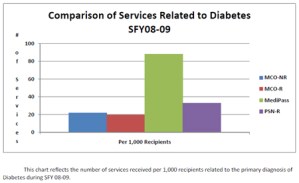
Medicaid patients in traditional fee-for-service care get some services at two to three times the frequency of those who are in managed care, especially HMOs, a preliminary report from state officials suggests. But it doesn’t answer the essential question: Is that good or bad?
In the hurried draft, produced under pressure with unverified data, Florida’sÌýAgency for Health Care Administration compares the rate of services that some Medicaid patients with chronic diseases receive in managed-care-organizations with those who use the traditional fee-for-service system, called MediPass.
The draft report suggests that the rate of services for Medicaid patients in all types of managed-care organizations, regardless of how they’re paid, is lower than in MediPass.
It appears to bolster arguments for the importance of coordination of care for patients who have chronic diseases.
This holds true in both the “Reform” counties – Duval (in the northeastern part of the state), Broward (the Ft. Lauderdale area) and three small ones – and in the rest of the state. In Reform counties, virtually all Medicaid recipients must be enrolled in managed care.
The Florida legislature faces a vote next week on whether to start taking that Medicaid Reform model statewide – a move that many see as necessary to balance the budget.
“This absolutely supports all our arguments,” said Michael Garner, president and CEO of Florida Association of Health Plans. He called the difference in rates of use “dramatic.”
“MediPass is not coordinated, has overutilization, and leads to rampant fraud and abuse,” Garner said. “It’s exactly what we’ve been saying.”
But the report is a Rohrshach test. Critics of Medicaid Reform expansion say the report demonstrates that patients in managed care plans may have difficulties getting access to needed services.
‘Taking this data at face value, cringing in the process, it`s clear that the level of access to care is significantly greater in MediPass than in Medicaid HMOs (both Reform and non-Reform),” said Greg Mellowe, policy director for Florida CHAIN.
It’s unwise to throw around charges of over-utilization in Medipass, he said, given that the patients who are being counted have serious chronic diseases. He pointed to the example of patients with hypertension: those in Medipass had 2.6 services a month versus 1.2 for patients in Reform HMOs.
“Remember, that includes all medical services,” he said: doctor visits, hospital stays, emergency care, pharmacy use and non-emergency transportation. “All other things being equal, under-utilization by HMOs seems the much more reasonable conclusion.”
Health-care consultant Brady Augustine of Tallahassee, who specializes in Medicaid issues, said it’s possible that the data reflect difficulty in receiving care, but another factor is important: “case mix.” In general, he said, patients who are the sickest tend not to be enrolled in HMOs.
The difference in service levels jumps out in the chart (where MCO stands for managed-care organization, R stands for Reform county, NR stands for non-Reform and PSN stands for provider-service networks, which have been paid under a fee-for-service arrangement in the Reform counties.)
Chart 5 indicates that diabetics in the non-managed system, MediPass, received more than 80 services per 1,000 patients, while the rate of services in managed-care organizations was only a fraction of that.
Consultant Augustine notes that performance measures as reported by independent agencies, listed at , show HMOs scoring slightly lower on diabetes preventive care than the provider service networks.
“HMOs probably have fewer recipients who need diabetic care but for those that they do manage, they do not perform as well as their PSN counterparts,” he said.
While the data in the draft report need refinement, he said, at least the report “appears to show that managed care plans are getting their data in to the system.”
To the health plans, it’s about time they got credit for that. “We continue to hear advocates screaming that encounter data do not exist,” Garner said. “It’s not true; it’s simply a misrepresentation.”
Plans are required under their contracts with the state to reports the encounters, and AHCA is required by law to validate the data.
AHCA spokeswoman Tiffany Vause stressed that the agency created the preliminary analysis at the request of a legislator and that it “is NOT conclusive.” She said AHCA is working to validate the data so that they can be used to make policy decisions.
Â鶹ŮÓÅ Health News is a national newsroom that produces in-depth journalism about health issues and is one of the core operating programs at Â鶹ŮÓÅ—an independent source of health policy research, polling, and journalism. Learn more about .This <a target="_blank" href="/health-industry/medicaid-managed-care-health-news-florida/">article</a> first appeared on <a target="_blank" href="">Â鶹ŮÓÅ Health News</a> and is republished here under a <a target="_blank" href=" Commons Attribution-NonCommercial-NoDerivatives 4.0 International License</a>.<img src="/wp-content/uploads/sites/8/2023/04/kffhealthnews-icon.png?w=150" style="width:1em;height:1em;margin-left:10px;">
<img id="republication-tracker-tool-source" src="/?republication-pixel=true&post=31672&ga4=G-J74WWTKFM0" style="width:1px;height:1px;">]]>This story comes from our partner
A multinational company and two members of the Fortune 500 were named among six insurers found in violation of Medicare marketing rules when federal inspectors checked their books and sat in on presentations as “secret shoppers,” documents show.
All six of the companies checked were found to be breaking the rules in some way, according to a released this month by the Office of the Inspector General of Health and Human Services. Five of the six plans were faulted for the ways in which they paid sales agents, directly or through field marketing organizations.
Among the six were Aetna Inc., Universal American Corp., and Munich American Holding Corp., which sells Medicare products under the name of Sterling Insurance.
The others were Freedom Health Plans, which operates in Florida; MD Care in California; and Blue Cross and Blue Shield of South Carolina.
Together, the six plans account for seven percent of Medicare Advantage enrollees nationwide. (Editor’s note: The Office of Inspector General had given a higher estimate earlier, but corrected it this afternoon).
Release of the names came as a shock to the plans, according to three that responded to Health News Florida. “We’ve had regular audits and they’ve been perfect,” said Elizabeth Hammond of BCBS-SC. “We’re just baffled.”
Aetna and Freedom say they, too, have very strict oversight over their agents.
Freedom Heath’s Chief Operating Officer Sidd Pagidipati said the company sends its agent-compensation plan to the Centers for Medicare and Medicaid Services (CMS) every year and has heard no objections. “In general, we, as a health plan, are very sensitive to protecting Medicare beneficiaries and their rights. In fact, we have secret shoppers attending 100% of our independent sales seminars.” Anyone who breaks rules goes through immediate retraining or gets fired, he said.
“Aetna is confident that it was fully compliant” with CMS rules on agent commissions, Aetna said in a statement. The company said its staff has concluded after reading the Inspector General’s report that it “does not allege or even suggest that Aetna was not in compliance.”
In fact, the CMS rules on agent compensation are not all that clear, according to the Inspector General’s report. The staff recommended that CMS clarify them; CMS responded that it had already done so during the time the report was being prepared.
CMS spokesman Peter Ashkenaz said the agency is “going through all the data the Inspector General has provided to us to verify or confirm their findings. When we finish that, we will then take action if and where it’s necessary.”
The six companies were among 266 Medicare Advantage plan sponsors that contracted with HHS’s Centers for Medicare and Medicaid Services last year. While the Inspector General chose the six for scrutiny because of past complaints, the report said, there is no reason to suppose that their behavior was vastly different from the rest.
In fact, while auditors and beneficiary-imitators were checking out these six companies, complaints were coming in to CMS about marketing problems with “numerous” others, said Robin Brooks of the Inspector General’s office. The Inspector General’s report pegged that number at 84.
Brooks made the comment in a letter Tuesday sent along with the documents that identified the companies mentioned – but not identified – in the report made public at the beginning of the month. She provided the identities to Health News Florida in response to a request under the Freedom of Information Act.
HNF requested that the identities be released before the open-enrollment and plan-switching season for 2010 closes. Today is the last day; the lock-in period begins April 1 and lasts through Dec. 31. But CMS spokesman Peter Ashkenaz said the agency can open a “special enrollment period” for beneficiaries who have been tricked into signing up for the wrong plan through unfair marketing practices.
The evaluation of the six plans found “gaps in their oversight and a failure to fully implement the regulations” on sales agents, Brooks said in her letter.
A Sept. 2 memo on the project summarizes the key findings:
–Three of the companies that used independent sales agents paid them more than they were allowed to under CMS commission guidelines. They were: Freedom, BCBS of South Carolina, and MD Care.
— Three of the companies made payments to marketing organizations that “may have created inappropriate financial incentives” for agents to steer beneficiaries toward those plans. They were Aetna, Universal American and BCBS of South Carolina.
The only reference to Sterling was in a chart listing plans that had some “unqualified” sales agents. There was no elaboration.
The Inspector General’s staff conducted the evaluation to learn whether the strict new CMS rules governing agents’ pay and marketing behavior that came out in November 2008 were being followed. The rules were created in response to three years of scandals in which some beneficiaries were pressured or tricked into enrolling in high-commission plans or even enrolled without their knowledge.
The title of the report sums up the Inspector General’s staff’s conclusion: “Beneficiaries Remain Vulnerable to Sales Agents’ Marketing of Medicare Advantage Plans.”
Â鶹ŮÓÅ Health News is a national newsroom that produces in-depth journalism about health issues and is one of the core operating programs at Â鶹ŮÓÅ—an independent source of health policy research, polling, and journalism. Learn more about .This <a target="_blank" href="/medicare/medicare-plans/">article</a> first appeared on <a target="_blank" href="">Â鶹ŮÓÅ Health News</a> and is republished here under a <a target="_blank" href=" Commons Attribution-NonCommercial-NoDerivatives 4.0 International License</a>.<img src="/wp-content/uploads/sites/8/2023/04/kffhealthnews-icon.png?w=150" style="width:1em;height:1em;margin-left:10px;">
<img id="republication-tracker-tool-source" src="/?republication-pixel=true&post=30206&ga4=G-J74WWTKFM0" style="width:1px;height:1px;">]]>This story comes from
Six Medicare Advantage plans that have been in trouble in the past are still breaking marketing rules in ways that place beneficiaries at risk, according to a report by the Inspector General of the U.S. Department of Health and Human Services.
The companies found in violation have 12 percent of the enrollees in Medicare Advantage plans nationally, according to HHS.Ìý Those selected for the investigation were among those who had drawn the most complaints in the past for such matters as tricking beneficiaries into signing up for the wrong plan,Ìýand sometimes even enrolling them without their knowledge.
In many cases the actions were by independent sales agents trying to boost their sales commissions, but under the plans’ contracts with theÌýCenters for Medicare and Medicaid Services (CMS), they were responsible for monitoring them. (CMS is part of Health and Human Services).
But HHS will notÌýsay which six plans it checked — Health News Florida‘s Freedom of Information Act request has been pending since March 3 —ÌýandÌýit’s only a week until the end of annual enrollment for Medicare plans.
Donald White, spokesman for the Inspector General’s office, apologized for the delay, saying there were “several very large requests that came in before yours.”
The delay didn’t seem right to Joe Baker, president of theÌýMedicare Rights Center, who said:Ìý“Consumers have the right to know when Medicare private health plans are in serious violation of Medicare’s standards, particularly those rules governing marketing practices.”
Open enrollment season ends March 31; after that, beneficiaries are “locked in” to the plan they’ve selected until Jan. 1, 2011.
But CMS spokesman Peter Ashkenaz said the agency can open a “special enrollment period” for beneficiaries who have been tricked into signing up for the wrong plan through unfair marketing practices.
WhatÌýthe report says
After three years of scandals in the marketing of Medicare Advantage plans, the federal government came out with strict new rules in November 2008 on agents’ qualifications, behavior and pay.
But they haven’t worked at all, according to the , “Beneficiaries Remain Vulnerable to Sales Agents’ Marketing of Medicare Advantage Plans.” All six Medicare Advantage plans reviewed by the inspector general during 2009 enrollment season were violating the rules, the report says. The federal office used “secret shoppers” to check up on the plans at public information sessions and also took part in one-on-one marketing sessions. The report didn’t say how the investigators pulled that off, but apparently they posed as beneficiaries interested in a plan.
The surveillance showed:
–All five plans that used independent sales agents were found to have problems in their pay incentives, either from the plan itself or through the field organization that managed the agents. The pay incentives placed beneficiaries at risk of being steered to the wrong plans, the report said.
— Five of the six plans used unqualified sales agents who had either not passed the marketing test or were not licensed at the time they took Medicare beneficiaries’ enrollment applications
— About 13,000 complaints to CMS about sales agents were reported to CMS in the 2009 annual enrollment period – about the same number as the sales season before the rules were put into effect.
Between January 2008 and September 2009, enrollment in MA plans increased from 9.2 million Medicare beneficiaries to over 11.2 million, or nearly a quarter of the more than 45 million Medicare beneficiaries.
Complaints about marketing for MA plans – particularly a loose type of plan that had no network, called “private fee-for-service” – grew so great that Congress held three hearings over a year starting June 2007.
Witnesses testified that sales agents who were enrolling beneficiaries sometimes had no license, pretended to be from Medicare itself, and misled beneficiaries about the plan’s benefits. One memorable scam involved enrolling the dead.
In July 2008, Congress enacted the Medicare Improvements for Patients and Providers Act of 2008 (MIPPA), which barred sales agents and plans from certain marketing activities. Rules specifying activities that were prohibited were first issued in September but were contested and finally emerged after sales season began in November that year.
The guidelines required that all sales agents be state-licensed, trained by the plan and tested annually.
They also barred payment arrangements for agents that gave them an incentive to switch members of one plan to another to collect the extra commission – a practice called “churn” that had generated many of the complaints.Ìý
This <a target="_blank" href="/medicare/fhn-medicare-plans-broke-rules/">article</a> first appeared on <a target="_blank" href="">Â鶹ŮÓÅ Health News</a> and is republished here under a <a target="_blank" href=" Commons Attribution-NonCommercial-NoDerivatives 4.0 International License</a>.<img src="/wp-content/uploads/sites/8/2023/04/kffhealthnews-icon.png?w=150" style="width:1em;height:1em;margin-left:10px;">
<img id="republication-tracker-tool-source" src="/?republication-pixel=true&post=30198&ga4=G-J74WWTKFM0" style="width:1px;height:1px;">]]>This story comes from our partner, .
Medicaid expansion for 1 million low-income adults in Florida may technically be dead, after committees in both the House and Senate voted to kill it. And yet, chances for an alternative plan that would accomplish the same goals are looking up.
On Wednesday, federal health officials signaled interest in seeing Florida’s alternative plan, which is still just aÌýgleam in the eye of a powerful state senator, as soon as the state has something in writing.
And a report on how much it would cost the state to offer coverage to private plans to the newly insured estimated that it would costÌý3 percent to 4 percent less than for the current Medicaid population.
Even House Speaker Will Weatherford, a vocal opponent of Medicaid expansion, moderated his tone somewhat in speaking to reporters this week.
“We’re very pleased the Senate … has taken off the table the idea of expanding Medicaid. Now the conversation has shifted from that to how do we make sure more Floridians have access to insurance? That’s a very worthy conversation to have,” said Weatherford, R-Wesley Chapel.
“They’re talking about private sector ideas, innovative ideas … that’s something the House is interested in talking about,” he said.
In an op-ed published Wednesday in theÌý, Weatherford wrote:Ìý“Although I personally oppose the expansion of Medicaid, I also recognize it’s not enough to simply say no. The state has an obligation to investigate and pursue viable alternatives that will be in the best interest of all Floridians. And that’s exactly what we’re doing in the Florida House.”
The not-Medicaid plan for those who would be newly covered is still being drafted and apparently doesn’t yet have a name. In describing it Monday, Sen. Joe Negron just called it the “Florida Plan.” Other Senators called it the “Negron Plan.”
The consultants’ report on which Negron based his savings forecast called it the “Medicaid Benchmark Plan for Potential Adult Medicaid Expansion.” That report was done before the Legislature banished the word “Medicaid.”
Feds: “We’re Flexible”
Negron, chair of the Senate Select Committee on the Affordable Care Act, talked about the not-Medicaid plan on Monday as an alternative to expanding Medicaid the way the ACA describes. He said it wouldn’t be right to just leave the 1 million poorest of Florida’s 4 million uninsured without access to health care — the confounding result if states vote no on the Medicaid expansion under ACA.
The committee followed his suggestion and voted 7-4 — along party lines, with Republicans in the majority — to turn it down. Headlines around the nation took that as a definite no.
But there were numerous reasons why that vote was instead a “maybe,” apart from Negron’s stated angst about leaving hard-working poor people without access to health care.Ìý One is that leaving an estimated $51 billion over 10 years on the table wouldn’t play well with many Floridians. The law calls for 100 percent federal funding for the Medicaid expansion group for three years, and at least 90 percent thereafter.
Another reason the vote likely isn’t a definite no is that it would leave Republican Gov. Rick Scott, who voiced support for the Medicaid expansion, looking ineffectual as he heads into the 2014 re-election campaign.
Still another is that budget experts both inside and outside state government have warned the Legislature that if Florida doesn’t cover that 1 million people somehow, hospitals and employers will pay the price. The ACA took some money away from hospitals on the assumption that low-income working adults would be covered under Medicaid.
And employers will be charged a penalty if their workers sign up for subsidized coverage on the health exchange — which is likely if Florida doesn’t cover them. That is why two large employer groups, Associated Industries and the Chamber of Commerce, have recently expressed support for some form of Medicaid expansion.
In his remarks to the committee on Monday, Negron noted that several other states, including Indiana and Arkansas, have been talking to the federalÌýDepartment of Health and Human Services about the prospect of using the Medicaid expansion funds for their own state-created plans.
He referred to aÌýÌýon Nov. 20, which says that states have “significant flexibility to design Medicaid benefit packages.”
Speaking of costs …
The Milliman health-care consulting company in Brookfield, WI, producedÌý that showed a “Medicaid Benchmark Plan” could be opened to the working poor at a lower cost than the state spends on its current Medicaid plans.
The Milliman study, which uses AHCA numbers, assumes that the new enrollees would use the health-care system at about the same rate as the current population and would have significant co-pays for big-ticket items.
The co-pays would be greater for the new group than for current Medicaid patients.ÌýFor example, a hospital stay would cost $2 for current Medicaid enrollees, $3.80 for Benchmark Plan members with incomes under the federal poverty level, and 10 percent for those with incomes between 100 and 138 percent of poverty.
The same cost arrangement holds for a visit to a physician, chiropractor, eye doctor or physical therapist.ÌýThere would be no charge for emergency services.
Out-of-pocket costs would be capped at 5 percent of family income in the Benchmark Plan.
The Milliman report assumes the cost of covering the new expansion enrollees would be about the same as those now enrolled in Medicaid. If so, the report says, the savings could be 3-to-4 percent, or between $109 million and $145 million, in 2014-15, the first year of the expansion program.
Â鶹ŮÓÅ Health News is a national newsroom that produces in-depth journalism about health issues and is one of the core operating programs at Â鶹ŮÓÅ—an independent source of health policy research, polling, and journalism. Learn more about .This <a target="_blank" href="/insurance/medicaid-expansion-plan-florida/">article</a> first appeared on <a target="_blank" href="">Â鶹ŮÓÅ Health News</a> and is republished here under a <a target="_blank" href=" Commons Attribution-NonCommercial-NoDerivatives 4.0 International License</a>.<img src="/wp-content/uploads/sites/8/2023/04/kffhealthnews-icon.png?w=150" style="width:1em;height:1em;margin-left:10px;">
<img id="republication-tracker-tool-source" src="/?republication-pixel=true&post=25412&ga4=G-J74WWTKFM0" style="width:1px;height:1px;">]]>This story comes from our partner, .
Gov. Rick Scott is willing to look at estimates on the cost of Medicaid expansion other than the ones he has been using, according to a releaseÌýTuesday evening. Ìý
The statement from Scott’s Communications Director Melissa Sellers came in apparent reaction toÌý early Tuesday headlined “Legislative Analysts told Scott His Medicaid Estimates Are Wrong (But He’s Using Them Anyway).”
That report, based on a series of e-mails among state officials, was picked up by numerous other publications, including the Associated Press.ÌýÌý looked at the source of Scott’s numbers and found it so flawed it ruled Scott’s statements “false.” And some public officials, including U.S. Rep. Kathy Castor, D-Tampa, issued statements critical of the governor.
In several public statements, Scott has cited $26 billion as the 10-year cost of Medicaid expansion, saying he got it from the Agency for Health Care Administration. AHCA estimated the total state and federal 10-year cost at $63 billion.
AHCA is part of the executive branch and its chief, Liz Dudek, reports to Scott.Ìý
The state’s chief economist Amy Baker and Eric Pridgeon, a House budget analyst, sent e-mails to AHCA and Scott’s staff Dec. 20 advising that the estimates could not be used because they’re based on a flawed assumption. AHCA assumed that the federal government would not come through with the money promised under the Affordable Care Act to states that expand Medicaid.
Baker and Pridgeon asked AHCA to correct the assumptions and re-do the estimates. That work, by Medicaid Finance Bureau Chief Tom Wallace and his staff, is reportedly under way.
Last Friday, Scott’s health policy and budget staffer Mike Anway sent an e-mail to Baker saying he wants to present the AHCA numbers as an alternative estimate to whatever AHCA comes up with. Anway said he believes the AHCA estimates because he doesn’t trust the federal government to come through with the money.
Tuesday evening, after a day of criticism provoked by the article, Scott spokeswoman Sellers released this statement:
“The discussion underway now about the cost of adding people in Medicaid under the new healthcare law is incredibly important.Ìý Gov. Scott is focused on improving the cost, quality and access of healthcare for Florida families. When he met with (Health and Human Services Secretary) Sebelius yesterday in Washington, they discussed the AHCA cost estimate report and the Governor’s concerns about how taxpayers could afford to nearly double the number of people in Medicaid.
“AHCA’s report concluded that adding people to Medicaid under the new law would cost Florida $26 billion over 10 years. Others have asked AHCA to use different assumptions to calculate different cost estimates. We look forward to reviewing those cost estimates as well.
“There are three things the Governor has stressed that remain unchanging in this important discussion about cost estimates. First, growing government is never free. Second, the number of people in Medicaid would nearly double with the new law (from approximately 3.3 million today to over 6 million). And third, once government grows, it is almost never undone. The fiscal cliff debate in Washington is proof enough of that. Additionally, as the AHCA report points out, federal projections on growing government have a long history of being much lower than actual costs.
“Beyond understanding the cost of adding people in Medicaid, the Governor believes it is important that any healthcare decision improve the quality of services available to Floridians at a cost they can afford.”
Shortly before the Scott statement came out, Rep. Castor released one saying she was “outraged” when she read the information in theÌýHealth News FloridaÌýreport. She obtained the e-mails that the article was based on to review them herself.
“Not only did Gov. Scott manufacture flawed cost estimates, but it appears he had been advised that the numbers were flawed and used them anyway,” Castor said. “Florida Legislative Appropriations staff advised the governor’s office that the numbers were misleading, but it appears that the governor ignored it.”Ìý
“Clearly this was not a mistake,” Castor said in the statement. “Knowing that the numbers are wrong and using them anyway is.”
Â鶹ŮÓÅ Health News is a national newsroom that produces in-depth journalism about health issues and is one of the core operating programs at Â鶹ŮÓÅ—an independent source of health policy research, polling, and journalism. Learn more about .This <a target="_blank" href="/medicaid/florida-medicaid-expansion-cost-estimates/">article</a> first appeared on <a target="_blank" href="">Â鶹ŮÓÅ Health News</a> and is republished here under a <a target="_blank" href=" Commons Attribution-NonCommercial-NoDerivatives 4.0 International License</a>.<img src="/wp-content/uploads/sites/8/2023/04/kffhealthnews-icon.png?w=150" style="width:1em;height:1em;margin-left:10px;">
<img id="republication-tracker-tool-source" src="/?republication-pixel=true&post=26865&ga4=G-J74WWTKFM0" style="width:1px;height:1px;">]]>TheyÌýdescribe what one court officer described as a “very special case, very difficult.”ÌýAmong other things, itÌýprovides a cautionary tale for those deciding onÌýa health-care surrogate.
Tameka Campbell, in her mid-20sÌýwhen she was admitted to Tampa General, spent five years there only because the hospital could not find any placeÌýthat would take her.ÌýIt couldn’t get financial helpÌýfrom the state, records show, nor cooperation fromÌýCampbell’s mother.
The case is a good example of a paradox of the health-care system: A dyingÌýpatient can be kept alive on a ventilator with a feeding tube almost indefinitely,Ìýyet there areÌýfew places for such a patient to go for care and often no way to pay for it.
Â鶹ŮÓÅ Health News is a national newsroom that produces in-depth journalism about health issues and is one of the core operating programs at Â鶹ŮÓÅ—an independent source of health policy research, polling, and journalism. Learn more about .This <a target="_blank" href="/news/9m-hospital-bill-caps-strange-tale/">article</a> first appeared on <a target="_blank" href="">Â鶹ŮÓÅ Health News</a> and is republished here under a <a target="_blank" href=" Commons Attribution-NonCommercial-NoDerivatives 4.0 International License</a>.<img src="/wp-content/uploads/sites/8/2023/04/kffhealthnews-icon.png?w=150" style="width:1em;height:1em;margin-left:10px;">
<img id="republication-tracker-tool-source" src="/?republication-pixel=true&post=472&ga4=G-J74WWTKFM0" style="width:1px;height:1px;">]]>This story comes from
The Florida Medical Association’s controversial decision to express a lack of confidence in the American Medical Association is drawing criticism from its northern counterpart in Maine, whichÌýsays it’s time to support AMA leaders. In response, an unrepentant FMA says it hopes the medical establishment is not “circling the wagons.”
The brouhaha began before the FMA’s annual meeting in August, with a motion introduced by Fort Myers plastic surgeon Douglas Stevens calling for a with the AMA over its support for the new law.
Stevens said he felt the government was trying to take over the health care system and that physicians should form a new organization that would more actively fight the changes. HeÌýcomplained that AMA’s support for recent reforms was “a severe intrusion in the patient-physician relationship and allows government control over essentially all aspects of medical care.”
When the FMA House of Delegates met behind closed doors, it voted to amend the resolution to a less-drastic alternative: a letter conveying a vote of ‘no confidence.’ A written statement Ìýstated: “The FMA House of Delegates strongly believes that the American Medical Association has failed to represent practicing physicians on the issue of health care reform.”
Just lastÌýweek, Maine’s Medical Association responded, writingÌýin a to the national organization: “At a time when it is critically important for physicians, as a profession, to stand together, [the FMA]Ìýaction threatens the very principles that our AMA was founded upon.”
While each state society has the opportunity to participate in electing trustees and officers to the national group, the Sept. 23 letter says, it’s smart to support those leaders when the votes are counted.
“A football team whose members brawl among themselves will not win,” the letter says. “A country whose elections are followed by secession attempts will not survive. A divided medical community will not be relevant.”
“Now is not the time to squander our influence in petty bickering,” said the letter, signed by the Maine society’s President Jo E. Linder, MD, and Executive Committee Chair Kenneth Christian, MD. They thanked the AMA for its efforts on behalf of America’s physicians.
FMA received a copy of the letter from the Maine group, said spokeswomanÌýErin Van Sickle, whoÌýreleasedÌýa statement, saying that the Maine Medical Association should “respect the right of other state medical associations” to express their opinions.Ìý The statement added:
“The AMA should use this as an opportunity to get better rather than circling the wagons and attempting to squash a dissenting point of view. … The medical community in Maine is homogeneous. The majority of Maine’s physicians practice in a much different environment than Florida’s physicians. By contrast, the FMA represents a diverse group of physicians who practice in many different settings.
“Maine Medical Association represents around 2,000 physicians. With all due respect, we have several counties in Florida that have more physicians than the entire State of Maine.
“The facts speak for themselves – the AMA was unable to leverage their endorsement of the Federal health care reform bill into any substantial victories for physicians. Every other group – hospitals, insurance companies, pharmaceutical companies and even trial lawyers – were able to negotiate significant concessions in the final bill.
“However, physicians are still stuck with the flawed (payment formula) for Medicare and no meaningful medical liability reforms. … The FMA’s letter does not weaken the AMA. AMA membership has been in decline for the last few years and their effectiveness as an advocacy organization has been called into question by many independent commentators who closely follow the activities on Capital Hill.
“The FMA is simply saying what the vast majority of physicians already think and what many members of Congress have already stated publicly. The FMA’s hope is that the letter will serve the purpose of sending the AMA a wake-up call and inspire the AMA leadership to take a critical look inward to improve the organization.”
Â鶹ŮÓÅ Health News is a national newsroom that produces in-depth journalism about health issues and is one of the core operating programs at Â鶹ŮÓÅ—an independent source of health policy research, polling, and journalism. Learn more about .This <a target="_blank" href="/news/ama-dispute-health-news-florida/">article</a> first appeared on <a target="_blank" href="">Â鶹ŮÓÅ Health News</a> and is republished here under a <a target="_blank" href=" Commons Attribution-NonCommercial-NoDerivatives 4.0 International License</a>.<img src="/wp-content/uploads/sites/8/2023/04/kffhealthnews-icon.png?w=150" style="width:1em;height:1em;margin-left:10px;">
<img id="republication-tracker-tool-source" src="/?republication-pixel=true&post=30762&ga4=G-J74WWTKFM0" style="width:1px;height:1px;">]]>This story comes from our partner
Medicaid patients in traditional fee-for-service care get some services at two to three times the frequency of those who are in managed care, especially HMOs, a preliminary report from state officials suggests. But it doesn’t answer the essential question: Is that good or bad?
In the hurried draft, produced under pressure with unverified data, Florida’sÌýAgency for Health Care Administration compares the rate of services that some Medicaid patients with chronic diseases receive in managed-care-organizations with those who use the traditional fee-for-service system, called MediPass.
The draft report suggests that the rate of services for Medicaid patients in all types of managed-care organizations, regardless of how they’re paid, is lower than in MediPass.

It appears to bolster arguments for the importance of coordination of care for patients who have chronic diseases.
This holds true in both the “Reform” counties – Duval (in the northeastern part of the state), Broward (the Ft. Lauderdale area) and three small ones – and in the rest of the state. In Reform counties, virtually all Medicaid recipients must be enrolled in managed care.
The Florida legislature faces a vote next week on whether to start taking that Medicaid Reform model statewide – a move that many see as necessary to balance the budget.
“This absolutely supports all our arguments,” said Michael Garner, president and CEO of Florida Association of Health Plans. He called the difference in rates of use “dramatic.”
“MediPass is not coordinated, has overutilization, and leads to rampant fraud and abuse,” Garner said. “It’s exactly what we’ve been saying.”
But the report is a Rohrshach test. Critics of Medicaid Reform expansion say the report demonstrates that patients in managed care plans may have difficulties getting access to needed services.
‘Taking this data at face value, cringing in the process, it`s clear that the level of access to care is significantly greater in MediPass than in Medicaid HMOs (both Reform and non-Reform),” said Greg Mellowe, policy director for Florida CHAIN.
It’s unwise to throw around charges of over-utilization in Medipass, he said, given that the patients who are being counted have serious chronic diseases. He pointed to the example of patients with hypertension: those in Medipass had 2.6 services a month versus 1.2 for patients in Reform HMOs.
“Remember, that includes all medical services,” he said: doctor visits, hospital stays, emergency care, pharmacy use and non-emergency transportation. “All other things being equal, under-utilization by HMOs seems the much more reasonable conclusion.”
Health-care consultant Brady Augustine of Tallahassee, who specializes in Medicaid issues, said it’s possible that the data reflect difficulty in receiving care, but another factor is important: “case mix.” In general, he said, patients who are the sickest tend not to be enrolled in HMOs.
The difference in service levels jumps out in the chart (where MCO stands for managed-care organization, R stands for Reform county, NR stands for non-Reform and PSN stands for provider-service networks, which have been paid under a fee-for-service arrangement in the Reform counties.)
Chart 5 indicates that diabetics in the non-managed system, MediPass, received more than 80 services per 1,000 patients, while the rate of services in managed-care organizations was only a fraction of that.
Consultant Augustine notes that performance measures as reported by independent agencies, listed at , show HMOs scoring slightly lower on diabetes preventive care than the provider service networks.
“HMOs probably have fewer recipients who need diabetic care but for those that they do manage, they do not perform as well as their PSN counterparts,” he said.
While the data in the draft report need refinement, he said, at least the report “appears to show that managed care plans are getting their data in to the system.”
To the health plans, it’s about time they got credit for that. “We continue to hear advocates screaming that encounter data do not exist,” Garner said. “It’s not true; it’s simply a misrepresentation.”
Plans are required under their contracts with the state to reports the encounters, and AHCA is required by law to validate the data.
AHCA spokeswoman Tiffany Vause stressed that the agency created the preliminary analysis at the request of a legislator and that it “is NOT conclusive.” She said AHCA is working to validate the data so that they can be used to make policy decisions.
Â鶹ŮÓÅ Health News is a national newsroom that produces in-depth journalism about health issues and is one of the core operating programs at Â鶹ŮÓÅ—an independent source of health policy research, polling, and journalism. Learn more about .This <a target="_blank" href="/health-industry/medicaid-managed-care-health-news-florida/">article</a> first appeared on <a target="_blank" href="">Â鶹ŮÓÅ Health News</a> and is republished here under a <a target="_blank" href=" Commons Attribution-NonCommercial-NoDerivatives 4.0 International License</a>.<img src="/wp-content/uploads/sites/8/2023/04/kffhealthnews-icon.png?w=150" style="width:1em;height:1em;margin-left:10px;">
<img id="republication-tracker-tool-source" src="/?republication-pixel=true&post=31672&ga4=G-J74WWTKFM0" style="width:1px;height:1px;">]]>This story comes from our partner
A multinational company and two members of the Fortune 500 were named among six insurers found in violation of Medicare marketing rules when federal inspectors checked their books and sat in on presentations as “secret shoppers,” documents show.
All six of the companies checked were found to be breaking the rules in some way, according to a released this month by the Office of the Inspector General of Health and Human Services. Five of the six plans were faulted for the ways in which they paid sales agents, directly or through field marketing organizations.
Among the six were Aetna Inc., Universal American Corp., and Munich American Holding Corp., which sells Medicare products under the name of Sterling Insurance.
The others were Freedom Health Plans, which operates in Florida; MD Care in California; and Blue Cross and Blue Shield of South Carolina.
Together, the six plans account for seven percent of Medicare Advantage enrollees nationwide. (Editor’s note: The Office of Inspector General had given a higher estimate earlier, but corrected it this afternoon).
Release of the names came as a shock to the plans, according to three that responded to Health News Florida. “We’ve had regular audits and they’ve been perfect,” said Elizabeth Hammond of BCBS-SC. “We’re just baffled.”
Aetna and Freedom say they, too, have very strict oversight over their agents.
Freedom Heath’s Chief Operating Officer Sidd Pagidipati said the company sends its agent-compensation plan to the Centers for Medicare and Medicaid Services (CMS) every year and has heard no objections. “In general, we, as a health plan, are very sensitive to protecting Medicare beneficiaries and their rights. In fact, we have secret shoppers attending 100% of our independent sales seminars.” Anyone who breaks rules goes through immediate retraining or gets fired, he said.
“Aetna is confident that it was fully compliant” with CMS rules on agent commissions, Aetna said in a statement. The company said its staff has concluded after reading the Inspector General’s report that it “does not allege or even suggest that Aetna was not in compliance.”
In fact, the CMS rules on agent compensation are not all that clear, according to the Inspector General’s report. The staff recommended that CMS clarify them; CMS responded that it had already done so during the time the report was being prepared.
CMS spokesman Peter Ashkenaz said the agency is “going through all the data the Inspector General has provided to us to verify or confirm their findings. When we finish that, we will then take action if and where it’s necessary.”
The six companies were among 266 Medicare Advantage plan sponsors that contracted with HHS’s Centers for Medicare and Medicaid Services last year. While the Inspector General chose the six for scrutiny because of past complaints, the report said, there is no reason to suppose that their behavior was vastly different from the rest.
In fact, while auditors and beneficiary-imitators were checking out these six companies, complaints were coming in to CMS about marketing problems with “numerous” others, said Robin Brooks of the Inspector General’s office. The Inspector General’s report pegged that number at 84.
Brooks made the comment in a letter Tuesday sent along with the documents that identified the companies mentioned – but not identified – in the report made public at the beginning of the month. She provided the identities to Health News Florida in response to a request under the Freedom of Information Act.
HNF requested that the identities be released before the open-enrollment and plan-switching season for 2010 closes. Today is the last day; the lock-in period begins April 1 and lasts through Dec. 31. But CMS spokesman Peter Ashkenaz said the agency can open a “special enrollment period” for beneficiaries who have been tricked into signing up for the wrong plan through unfair marketing practices.
The evaluation of the six plans found “gaps in their oversight and a failure to fully implement the regulations” on sales agents, Brooks said in her letter.
A Sept. 2 memo on the project summarizes the key findings:
–Three of the companies that used independent sales agents paid them more than they were allowed to under CMS commission guidelines. They were: Freedom, BCBS of South Carolina, and MD Care.
— Three of the companies made payments to marketing organizations that “may have created inappropriate financial incentives” for agents to steer beneficiaries toward those plans. They were Aetna, Universal American and BCBS of South Carolina.
The only reference to Sterling was in a chart listing plans that had some “unqualified” sales agents. There was no elaboration.
The Inspector General’s staff conducted the evaluation to learn whether the strict new CMS rules governing agents’ pay and marketing behavior that came out in November 2008 were being followed. The rules were created in response to three years of scandals in which some beneficiaries were pressured or tricked into enrolling in high-commission plans or even enrolled without their knowledge.
The title of the report sums up the Inspector General’s staff’s conclusion: “Beneficiaries Remain Vulnerable to Sales Agents’ Marketing of Medicare Advantage Plans.”
Â鶹ŮÓÅ Health News is a national newsroom that produces in-depth journalism about health issues and is one of the core operating programs at Â鶹ŮÓÅ—an independent source of health policy research, polling, and journalism. Learn more about .This <a target="_blank" href="/medicare/medicare-plans/">article</a> first appeared on <a target="_blank" href="">Â鶹ŮÓÅ Health News</a> and is republished here under a <a target="_blank" href=" Commons Attribution-NonCommercial-NoDerivatives 4.0 International License</a>.<img src="/wp-content/uploads/sites/8/2023/04/kffhealthnews-icon.png?w=150" style="width:1em;height:1em;margin-left:10px;">
<img id="republication-tracker-tool-source" src="/?republication-pixel=true&post=30206&ga4=G-J74WWTKFM0" style="width:1px;height:1px;">]]>This story comes from
Six Medicare Advantage plans that have been in trouble in the past are still breaking marketing rules in ways that place beneficiaries at risk, according to a report by the Inspector General of the U.S. Department of Health and Human Services.
The companies found in violation have 12 percent of the enrollees in Medicare Advantage plans nationally, according to HHS.Ìý Those selected for the investigation were among those who had drawn the most complaints in the past for such matters as tricking beneficiaries into signing up for the wrong plan,Ìýand sometimes even enrolling them without their knowledge.
In many cases the actions were by independent sales agents trying to boost their sales commissions, but under the plans’ contracts with theÌýCenters for Medicare and Medicaid Services (CMS), they were responsible for monitoring them. (CMS is part of Health and Human Services).
But HHS will notÌýsay which six plans it checked — Health News Florida‘s Freedom of Information Act request has been pending since March 3 —ÌýandÌýit’s only a week until the end of annual enrollment for Medicare plans.
Donald White, spokesman for the Inspector General’s office, apologized for the delay, saying there were “several very large requests that came in before yours.”
The delay didn’t seem right to Joe Baker, president of theÌýMedicare Rights Center, who said:Ìý“Consumers have the right to know when Medicare private health plans are in serious violation of Medicare’s standards, particularly those rules governing marketing practices.”
Open enrollment season ends March 31; after that, beneficiaries are “locked in” to the plan they’ve selected until Jan. 1, 2011.
But CMS spokesman Peter Ashkenaz said the agency can open a “special enrollment period” for beneficiaries who have been tricked into signing up for the wrong plan through unfair marketing practices.
WhatÌýthe report says
After three years of scandals in the marketing of Medicare Advantage plans, the federal government came out with strict new rules in November 2008 on agents’ qualifications, behavior and pay.
But they haven’t worked at all, according to the , “Beneficiaries Remain Vulnerable to Sales Agents’ Marketing of Medicare Advantage Plans.” All six Medicare Advantage plans reviewed by the inspector general during 2009 enrollment season were violating the rules, the report says. The federal office used “secret shoppers” to check up on the plans at public information sessions and also took part in one-on-one marketing sessions. The report didn’t say how the investigators pulled that off, but apparently they posed as beneficiaries interested in a plan.
The surveillance showed:
–All five plans that used independent sales agents were found to have problems in their pay incentives, either from the plan itself or through the field organization that managed the agents. The pay incentives placed beneficiaries at risk of being steered to the wrong plans, the report said.
— Five of the six plans used unqualified sales agents who had either not passed the marketing test or were not licensed at the time they took Medicare beneficiaries’ enrollment applications
— About 13,000 complaints to CMS about sales agents were reported to CMS in the 2009 annual enrollment period – about the same number as the sales season before the rules were put into effect.
Between January 2008 and September 2009, enrollment in MA plans increased from 9.2 million Medicare beneficiaries to over 11.2 million, or nearly a quarter of the more than 45 million Medicare beneficiaries.
Complaints about marketing for MA plans – particularly a loose type of plan that had no network, called “private fee-for-service” – grew so great that Congress held three hearings over a year starting June 2007.
Witnesses testified that sales agents who were enrolling beneficiaries sometimes had no license, pretended to be from Medicare itself, and misled beneficiaries about the plan’s benefits. One memorable scam involved enrolling the dead.
In July 2008, Congress enacted the Medicare Improvements for Patients and Providers Act of 2008 (MIPPA), which barred sales agents and plans from certain marketing activities. Rules specifying activities that were prohibited were first issued in September but were contested and finally emerged after sales season began in November that year.
The guidelines required that all sales agents be state-licensed, trained by the plan and tested annually.
They also barred payment arrangements for agents that gave them an incentive to switch members of one plan to another to collect the extra commission – a practice called “churn” that had generated many of the complaints.Ìý
This <a target="_blank" href="/medicare/fhn-medicare-plans-broke-rules/">article</a> first appeared on <a target="_blank" href="">Â鶹ŮÓÅ Health News</a> and is republished here under a <a target="_blank" href=" Commons Attribution-NonCommercial-NoDerivatives 4.0 International License</a>.<img src="/wp-content/uploads/sites/8/2023/04/kffhealthnews-icon.png?w=150" style="width:1em;height:1em;margin-left:10px;">
<img id="republication-tracker-tool-source" src="/?republication-pixel=true&post=30198&ga4=G-J74WWTKFM0" style="width:1px;height:1px;">]]>