Don Sapatkin, Philadelphia Inquirer , Author at Â鶹ŮÓÅ Health News Â鶹ŮÓÅ Health News produces in-depth journalism on health issues and is a core operating program of Â鶹ŮÓÅ. Thu, 16 Apr 2026 04:54:14 +0000 en-US hourly 1 https://wordpress.org/?v=6.8.5 /wp-content/uploads/sites/8/2023/04/kffhealthnews-icon.png?w=32 Don Sapatkin, Philadelphia Inquirer , Author at Â鶹ŮÓÅ Health News 32 32 161476233 Pennsylvania Governor Plans State Insurance Exchange To Protect Subsidies /insurance/pennsylvania-governor-plans-state-insurance-exchange-to-protect-subsidies/ Wed, 03 Jun 2015 20:52:49 +0000 http://khn.org/?p=545279 Governor Tom Wolf this week formally proposed setting up a state-based insurance marketplace, potentially protecting hundreds of thousands of Pennsylvania residents from the consequences of a Supreme Court decision that could gut Obamacare later this month.

A ruling against the Affordable Care Act could end insurance subsidies for millions of people who live in the 37 states – including Pennsylvania, New Jersey, and Delaware – that rely on the federal marketplace. The 13 that set up state marketplaces two years ago would not be affected.

Pennsylvania is one of two states to apply to set up an exchange. Delaware also submitted a “blueprint” application to potentially run a state-based exchange while continuing to rely on the federal government’s enrollment platform.

Governors in a handful of other states have discussed the idea but, in the face of extreme partisanship, are waiting for the court’s decision before stepping into a situation that all sides agree could create chaos for consumers, health-care providers, and the insurance industry.

“I think it will take an adverse ruling for anything to happen in these states, whereas Gov. Wolf has taken proactive steps,” Jennifer Tolbert, director of state health reform at the Kaiser Family Foundation, said Tuesday. There has been no public discussion of alternatives in New Jersey.

The highly anticipated Supreme Court decision revolves around whether the specific wording of the Affordable Care Act enables the federal government to use tax credits to subsidize insurance premiums for coverage purchased on an exchange operated by the federal government rather than the states. Without subsidies, the premiums would likely be unaffordable for many if not most of those who purchased coverage.

A ruling against subsidies would raise multiple unknowns, including whether it would take effect immediately. Although Republicans generally oppose Obamacare, there are fears of a backlash if millions suddenly lose coverage. If the court decided against the subsidies but delayed the effect of its ruling, it would give Congress time to negotiate with President Obama on a compromise.

Wolf, in a statement Tuesday, described his application for a state-based marketplace “as part of my contingency plan, in order to protect 382,000 Pennsylvanians from potentially losing subsidies that help them afford health-care coverage.”

But he said he was keeping all options open, including staying with the federal marketplace – or creating a state marketplace even if the court upholds subsidies.

Kaiser released an analysis Tuesday of the state-by-state impact of a decision against subsidies. The foundation estimated that 348,823 Pennsylvanians could lose an average of $227 a month. In New Jersey, 172,345 people could lose an average $313 monthly subsidy.

Discussion of a state marketplace had begun under former Democratic Gov. Ed Rendell but ended when Tom Corbett, a Republican and an opponent of Obamacare, was elected governor. While state-based exchanges allow for more local autonomy, several have struggled to stay afloat on premium assessments. The federal exchange works the same way, taking 3.5 percent.

“Our hope would be to do it for less than 3.5 percent,” said Ronald Ruman, spokesman for the state Department of Insurance.

Tolbert, the Kaiser analyst, said that technology was a huge cost for most of the state exchanges.

Pennsylvania has proposed using the federal technology already in place, now that it is operating smoothly. What it would have to pay for using it is not known. Pennsylvania also could save money by using the federal call center. But the acting state insurance commissioner, Teresa Miller, believes that “we could provide a better service,” Ruman said.

It is unclear whether the Republican-dominated General Assembly would have to approve Wolf’s proposal, although it does control funding.

Neither the administration nor Republicans in the legislature indicated any urgency in moving forward until the Supreme Court rules.

“There is no reason to deal with it right now,” said Steve Miskin, spokesman for House Republicans.

Jennifer Kocher, a spokeswoman for Senate Majority Leader Jake Corman, said the governor had not consulted with the legislature before announcing a month ago that he intended to apply to create a state-based marketplace, “so the efforts to work with us on this so far have been disappointing at best.”

Throughout the country, state decisions about many aspects of the Affordable Care Act, from expanding the Medicaid program to allowing certified “navigators” to assist people with subsidized insurance, have depended on which party was in control. Planning for a Supreme Court decision that could end subsidies faced the same hurdles in many states.

“I think a lot of this is politics,” Tolbert said.

Â鶹ŮÓÅ Health News is a national newsroom that produces in-depth journalism about health issues and is one of the core operating programs at Â鶹ŮÓÅ—an independent source of health policy research, polling, and journalism. Learn more about .

This <a target="_blank" href="/insurance/pennsylvania-governor-plans-state-insurance-exchange-to-protect-subsidies/">article</a&gt; first appeared on <a target="_blank" href="">Â鶹ŮÓÅ Health News</a> and is republished here under a <a target="_blank" href=" Commons Attribution-NonCommercial-NoDerivatives 4.0 International License</a>.<img src="/wp-content/uploads/sites/8/2023/04/kffhealthnews-icon.png?w=150&quot; style="width:1em;height:1em;margin-left:10px;">

<img id="republication-tracker-tool-source" src="/?republication-pixel=true&post=545279&amp;ga4=G-J74WWTKFM0&quot; style="width:1px;height:1px;">]]>
545279
Pennsylvania’s Medicaid Expansion To Require 723 New Workers /medicaid/philadelphia-inquirer-medicaid-and-state-workers/ /medicaid/philadelphia-inquirer-medicaid-and-state-workers/#comments Thu, 15 May 2014 14:00:53 +0000 http://khn.wp.alley.ws/news/philadelphia-inquirer-medicaid-and-state-workers/

This story was produced in partnership with

Pennsylvania’s ambitious alternative to expanding Medicaid — a private-market initiative that Gov. Tom Corbett says is designed to save money — would require 723 new state workers, about one percent of the current workforce.
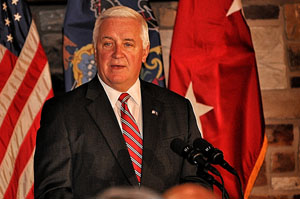
Pennsylvania's Medicaid Expansion To Require 723 New Workers

Gov. Tom Corbett (Photo by Pennsylvania National Guard Maj. Ed Shank via Flickr).

The projected number of hires, detailed by state officials, is far higher than most states have needed and surprised some public-policy experts.Ìý

Many states are adding employees to review applications and confirm eligibility, and to implement all the changes required by federal law. Those new hires typically are in the dozens. New Jersey, for example, said the contractor that coordinates its health benefits hired 38 permanent employees and 62 temps.

“The enrollment system is heavily automated for Medicaid,” said Sara Rosenbaum, a professor of health law and policy at George Washington University. “This is not being done by ladies with shoe boxes and pieces of paper.”

The governor’s initiative led to often-contentious negotiations with the Obama administration. State officials nevertheless moved forward last week with requests for submissions from insurers, saying they were optimistic it would be approved.

The proposal to use federal Medicaid dollars to buy commercial coverage, rather than expanding the current program, has been criticized as unnecessarily costly. It includes several provisions, such as financial incentives for healthy behavior and for seeking work, that opponents deride as bureaucratic.

Corbett says the incentives, along with sweeping changes that include benefits cuts for some current and future participants, are necessary to make the program sustainable.

But Public Welfare Secretary Beverly Mackereth said none of that factored into calculations that her department would need 716 new staff positions and seven temporaries. Most would be caseworkers in more than 80 offices around the state, where 4,057 are employed now.

Tracking healthy behavior and work-search progress would be automated and based on “random checks,” Mackereth said.

Indeed, “the private coverage option is potentially less burdensome on our caseworkers than Medicaid expansion,” department spokeswoman Kait Gillis said in an e-mail.

The projected number of hires, they said, was based on a formula. It considered current caseloads, with 2.2 million Medicaid recipients, and estimates of how many would be newly eligible. The state estimated 605,000, which includes people who might switch from employer-provided or other insurance. That is significantly higher than the more common estimate of 500,000ÌýÌý.

Mackereth said the new employees would cost the state $30.5 million in the first fiscal year, much of it matched by the federal government. Even with budget and payment cycles that push the bulk of the cost reductions into the following year, that expense would be more than covered by “the $125 million that we believe we will have from the savings from doing Healthy Pennsylvania,” Mackereth said, referring to the governor’s overall initiative.

Officials said the projected cost was included in the governor’s budget request for the fiscal year that begins July 1. Although no one could be hired until then, Gillis said, the state was “actively recruiting staff” in hopes training could begin over the summer.

If approved by Washington, the new insurance program would begin in January, one year later than in most of the 27 states expanding Medicaid.

In responses to inquiries about staffing needs from 17 of those states, only one – California, which has enrolled 1.9 million Medicaid recipients since Oct. 1 – reported hiring about 100 workers. Counties handle enrollment there, and they hired about 2,500.

Michigan, which predicts enrollment about half to three-quarters of Pennsylvania’s and which won federal approval for similar incentives for healthy behavior, added 10 temporary workers to launch its expansion and is hiring 30 full-time employees, a spokeswoman said.

Maryland did not hire anybody extra, said Secretary of Health Joshua M. Sharfstein, adding that his experience meant nothing about Pennsylvania.

Although federal law dating to 1965 sets a common framework for Medicaid, states have vastly different programs, benefits, and eligibilities; Delaware, for example, implemented most of the “Obamacare”-type expansion in 1996. Administrative structures are especially varied.

Benjamin Sommers, a health economist at Harvard and former adviser to the federal government on the Affordable Care Act, led a team that interviewed top Medicaid officials in most expansion states last year. They did not hear “a lot of evidence to suggest that states were adding huge numbers of employees,” he said.

After being told of Mackereth’s formula, however, Sommers looked up some numbers.

“Given that Pennsylvania is expecting to increase its Medicaid enrollment by about 25 percent compared to pre-ACA totals, adding 700 or so workers to a staff of 4,000 doesn’t sound outrageous,” he wrote in an e-mail. “But it’s tough to know exactly what is a reasonable number compared to other places, since Medicaid differs so widely across states.”

Perhaps other states’ fewer hires was the result of “wishful thinking,” said Eileen Griffin, a researcher at the University of Southern Maine’s Edmund S. Muskie School of Public Service. “But, of course,” she added, “we haven’t heard that the volume has broken the bank.”

Pennsylvania’s benefits programs are more centralized than most states’. Caseworkers who handle Medicaid are also responsible for food stamps, cash assistance, employment training, heating help, and programs for the homeless – each with its own eligibility criteria.

“It’s an incredibly complicated job,” said Estelle Richman, secretary of public welfare under Gov. Ed Rendell. She said the County Assistance Offices were understaffed when she left in 2009 but still termed the notion of adding 700 more employees “mind-boggling.”

Having the same workers determine eligibility for various benefits would seem efficient. Mackereth noted it also should allow them to enroll recipients in other programs they may not realize they are eligible for.

But she also said her department was undergoing a broad review of how it operates and seeking efficiencies from other states.

Meanwhile, the projected workforce expansion – about one percent of the state’s 73,800 employees – would need to be based on the current setup.

“Once we get our efficiencies, hopefully that will change,” Mackereth said. “But if we don’t do it right at first, we’re in trouble.”

dsapatkin@phillynews.com

Â鶹ŮÓÅ Health News is a national newsroom that produces in-depth journalism about health issues and is one of the core operating programs at Â鶹ŮÓÅ—an independent source of health policy research, polling, and journalism. Learn more about .

This <a target="_blank" href="/medicaid/philadelphia-inquirer-medicaid-and-state-workers/">article</a&gt; first appeared on <a target="_blank" href="">Â鶹ŮÓÅ Health News</a> and is republished here under a <a target="_blank" href=" Commons Attribution-NonCommercial-NoDerivatives 4.0 International License</a>.<img src="/wp-content/uploads/sites/8/2023/04/kffhealthnews-icon.png?w=150&quot; style="width:1em;height:1em;margin-left:10px;">

<img id="republication-tracker-tool-source" src="/?republication-pixel=true&post=33757&amp;ga4=G-J74WWTKFM0&quot; style="width:1px;height:1px;">]]>
/medicaid/philadelphia-inquirer-medicaid-and-state-workers/feed/ 1 33757
Philadelphia To Launch Health-Insurance Outreach /insurance/marketplace-consumer-outreach-philadelphia/ /insurance/marketplace-consumer-outreach-philadelphia/#respond Tue, 26 Nov 2013 13:01:00 +0000 http://khn.wp.alley.ws/news/marketplace-consumer-outreach-philadelphia/

This story was produced in partnership with

Come into city offices ranging from the Free Library to the Department of Records over the next few months and you will, in theory, be asked whether you have health insurance and offered information about Obamacare, including the option of getting a call from a specialist trained in enrollment.

The outreach, described by Enroll America, a national nonprofit, as its biggest partnership with a city in support of the Affordable Care Act, will be announced Tuesday by Mayor Nutter.

“It is an amazing way to extend the reach that we have in coming into contact with consumers who have no insurance and may be eligible for insurance in the marketplace,” said Bill England, Pennsylvania director for Enroll America. “We know that we are going to come in contact with thousands of people.”

He said the move, in the works for months, was a creative way to provide information and was unrelated to the highly publicized woes of Healthcare.gov, the government website.

Mark Duggan, a health economist at the University of Pennsylvania’s Wharton School, said that when Massachusetts’ version of universal coverage began, it took a long time to get the word out.

“I think outreach about the Affordable Care Act is really important, because my sense is that there are a lot of people out there who could potentially benefit from it who don’t know much about it,” said Duggan, who was senior economist for health-care policy at the White House Council of Economic Advisers in 2009 and 2010.

Enroll America, which receives no government funding in Pennsylvania, is concentrating on 11 states, including New Jersey, with large numbers of uninsured residents eligible for subsidized insurance purchased through the exchanges set up by the federal law. England called the Philadelphia initiative a pilot program that would be watched by chapters in other states.

Under the plan, all people who come into any of seven city offices to do business – Housing and Community Development, Records, Community Life Improvement Programs, the Mayor’s Commission on Aging, Community Empowerment Offices, Free Library branches, and City Council offices – will be asked whether they have insurance. If they say no, they will be given a brief description of the Affordable Care Act, offered literature, and told that an enrollment specialist from a different nonprofit will contact them if they want.

England said that 70 city employees had been trained so far, and that they were already asking visitors about health coverage.

The organization, with 11 staffers in Pennsylvania, has tried various ways to get the word out, including faith-based efforts and working with community colleges. It has had about 5,000 direct contacts with consumers since Sept. 1, England said.

In New Jersey, where an additional 11 staff members have reached almost as many people, pastors have been preaching about the importance of health insurance on the second Sunday of every month, said Justine Ceserano, the state director there, as they have in some other states.

About 210,000 Philadelphia residents, 18 percent of the city’s population, are uninsured, and roughly half are eligible for subsidies on the exchange, said Donald F. Schwarz, deputy mayor for health and opportunity. The city already was training enrollment experts in community health centers and libraries, he said, “because the number-one reason people go to libraries is for health information.”

The new partnership “is an important effort by the city to do everything possible” to ensure that uninsured residents get insurance, he said. “I think that we would be irresponsible not to try everything.”

Â鶹ŮÓÅ Health News is a national newsroom that produces in-depth journalism about health issues and is one of the core operating programs at Â鶹ŮÓÅ—an independent source of health policy research, polling, and journalism. Learn more about .

This <a target="_blank" href="/insurance/marketplace-consumer-outreach-philadelphia/">article</a&gt; first appeared on <a target="_blank" href="">Â鶹ŮÓÅ Health News</a> and is republished here under a <a target="_blank" href=" Commons Attribution-NonCommercial-NoDerivatives 4.0 International License</a>.<img src="/wp-content/uploads/sites/8/2023/04/kffhealthnews-icon.png?w=150&quot; style="width:1em;height:1em;margin-left:10px;">

<img id="republication-tracker-tool-source" src="/?republication-pixel=true&post=26070&amp;ga4=G-J74WWTKFM0&quot; style="width:1px;height:1px;">]]>
/insurance/marketplace-consumer-outreach-philadelphia/feed/ 0 26070
Don Sapatkin, Philadelphia Inquirer , Author at Â鶹ŮÓÅ Health News Â鶹ŮÓÅ Health News produces in-depth journalism on health issues and is a core operating program of Â鶹ŮÓÅ. Thu, 16 Apr 2026 04:54:14 +0000 en-US hourly 1 https://wordpress.org/?v=6.8.5 /wp-content/uploads/sites/8/2023/04/kffhealthnews-icon.png?w=32 Don Sapatkin, Philadelphia Inquirer , Author at Â鶹ŮÓÅ Health News 32 32 161476233 Pennsylvania Governor Plans State Insurance Exchange To Protect Subsidies /insurance/pennsylvania-governor-plans-state-insurance-exchange-to-protect-subsidies/ Wed, 03 Jun 2015 20:52:49 +0000 http://khn.org/?p=545279 Governor Tom Wolf this week formally proposed setting up a state-based insurance marketplace, potentially protecting hundreds of thousands of Pennsylvania residents from the consequences of a Supreme Court decision that could gut Obamacare later this month.

A ruling against the Affordable Care Act could end insurance subsidies for millions of people who live in the 37 states – including Pennsylvania, New Jersey, and Delaware – that rely on the federal marketplace. The 13 that set up state marketplaces two years ago would not be affected.

Pennsylvania is one of two states to apply to set up an exchange. Delaware also submitted a “blueprint” application to potentially run a state-based exchange while continuing to rely on the federal government’s enrollment platform.

Governors in a handful of other states have discussed the idea but, in the face of extreme partisanship, are waiting for the court’s decision before stepping into a situation that all sides agree could create chaos for consumers, health-care providers, and the insurance industry.

“I think it will take an adverse ruling for anything to happen in these states, whereas Gov. Wolf has taken proactive steps,” Jennifer Tolbert, director of state health reform at the Kaiser Family Foundation, said Tuesday. There has been no public discussion of alternatives in New Jersey.

The highly anticipated Supreme Court decision revolves around whether the specific wording of the Affordable Care Act enables the federal government to use tax credits to subsidize insurance premiums for coverage purchased on an exchange operated by the federal government rather than the states. Without subsidies, the premiums would likely be unaffordable for many if not most of those who purchased coverage.

A ruling against subsidies would raise multiple unknowns, including whether it would take effect immediately. Although Republicans generally oppose Obamacare, there are fears of a backlash if millions suddenly lose coverage. If the court decided against the subsidies but delayed the effect of its ruling, it would give Congress time to negotiate with President Obama on a compromise.

Wolf, in a statement Tuesday, described his application for a state-based marketplace “as part of my contingency plan, in order to protect 382,000 Pennsylvanians from potentially losing subsidies that help them afford health-care coverage.”

But he said he was keeping all options open, including staying with the federal marketplace – or creating a state marketplace even if the court upholds subsidies.

Kaiser released an analysis Tuesday of the state-by-state impact of a decision against subsidies. The foundation estimated that 348,823 Pennsylvanians could lose an average of $227 a month. In New Jersey, 172,345 people could lose an average $313 monthly subsidy.

Discussion of a state marketplace had begun under former Democratic Gov. Ed Rendell but ended when Tom Corbett, a Republican and an opponent of Obamacare, was elected governor. While state-based exchanges allow for more local autonomy, several have struggled to stay afloat on premium assessments. The federal exchange works the same way, taking 3.5 percent.

“Our hope would be to do it for less than 3.5 percent,” said Ronald Ruman, spokesman for the state Department of Insurance.

Tolbert, the Kaiser analyst, said that technology was a huge cost for most of the state exchanges.

Pennsylvania has proposed using the federal technology already in place, now that it is operating smoothly. What it would have to pay for using it is not known. Pennsylvania also could save money by using the federal call center. But the acting state insurance commissioner, Teresa Miller, believes that “we could provide a better service,” Ruman said.

It is unclear whether the Republican-dominated General Assembly would have to approve Wolf’s proposal, although it does control funding.

Neither the administration nor Republicans in the legislature indicated any urgency in moving forward until the Supreme Court rules.

“There is no reason to deal with it right now,” said Steve Miskin, spokesman for House Republicans.

Jennifer Kocher, a spokeswoman for Senate Majority Leader Jake Corman, said the governor had not consulted with the legislature before announcing a month ago that he intended to apply to create a state-based marketplace, “so the efforts to work with us on this so far have been disappointing at best.”

Throughout the country, state decisions about many aspects of the Affordable Care Act, from expanding the Medicaid program to allowing certified “navigators” to assist people with subsidized insurance, have depended on which party was in control. Planning for a Supreme Court decision that could end subsidies faced the same hurdles in many states.

“I think a lot of this is politics,” Tolbert said.

Â鶹ŮÓÅ Health News is a national newsroom that produces in-depth journalism about health issues and is one of the core operating programs at Â鶹ŮÓÅ—an independent source of health policy research, polling, and journalism. Learn more about .

This <a target="_blank" href="/insurance/pennsylvania-governor-plans-state-insurance-exchange-to-protect-subsidies/">article</a&gt; first appeared on <a target="_blank" href="">Â鶹ŮÓÅ Health News</a> and is republished here under a <a target="_blank" href=" Commons Attribution-NonCommercial-NoDerivatives 4.0 International License</a>.<img src="/wp-content/uploads/sites/8/2023/04/kffhealthnews-icon.png?w=150&quot; style="width:1em;height:1em;margin-left:10px;">

<img id="republication-tracker-tool-source" src="/?republication-pixel=true&post=545279&amp;ga4=G-J74WWTKFM0&quot; style="width:1px;height:1px;">]]>
545279
Pennsylvania’s Medicaid Expansion To Require 723 New Workers /medicaid/philadelphia-inquirer-medicaid-and-state-workers/ /medicaid/philadelphia-inquirer-medicaid-and-state-workers/#comments Thu, 15 May 2014 14:00:53 +0000 http://khn.wp.alley.ws/news/philadelphia-inquirer-medicaid-and-state-workers/

This story was produced in partnership with

Pennsylvania’s ambitious alternative to expanding Medicaid — a private-market initiative that Gov. Tom Corbett says is designed to save money — would require 723 new state workers, about one percent of the current workforce.

Pennsylvania's Medicaid Expansion To Require 723 New Workers

Gov. Tom Corbett (Photo by Pennsylvania National Guard Maj. Ed Shank via Flickr).

The projected number of hires, detailed by state officials, is far higher than most states have needed and surprised some public-policy experts.Ìý

Many states are adding employees to review applications and confirm eligibility, and to implement all the changes required by federal law. Those new hires typically are in the dozens. New Jersey, for example, said the contractor that coordinates its health benefits hired 38 permanent employees and 62 temps.

“The enrollment system is heavily automated for Medicaid,” said Sara Rosenbaum, a professor of health law and policy at George Washington University. “This is not being done by ladies with shoe boxes and pieces of paper.”

The governor’s initiative led to often-contentious negotiations with the Obama administration. State officials nevertheless moved forward last week with requests for submissions from insurers, saying they were optimistic it would be approved.

The proposal to use federal Medicaid dollars to buy commercial coverage, rather than expanding the current program, has been criticized as unnecessarily costly. It includes several provisions, such as financial incentives for healthy behavior and for seeking work, that opponents deride as bureaucratic.

Corbett says the incentives, along with sweeping changes that include benefits cuts for some current and future participants, are necessary to make the program sustainable.

But Public Welfare Secretary Beverly Mackereth said none of that factored into calculations that her department would need 716 new staff positions and seven temporaries. Most would be caseworkers in more than 80 offices around the state, where 4,057 are employed now.

Tracking healthy behavior and work-search progress would be automated and based on “random checks,” Mackereth said.

Indeed, “the private coverage option is potentially less burdensome on our caseworkers than Medicaid expansion,” department spokeswoman Kait Gillis said in an e-mail.

The projected number of hires, they said, was based on a formula. It considered current caseloads, with 2.2 million Medicaid recipients, and estimates of how many would be newly eligible. The state estimated 605,000, which includes people who might switch from employer-provided or other insurance. That is significantly higher than the more common estimate of 500,000ÌýÌý.

Mackereth said the new employees would cost the state $30.5 million in the first fiscal year, much of it matched by the federal government. Even with budget and payment cycles that push the bulk of the cost reductions into the following year, that expense would be more than covered by “the $125 million that we believe we will have from the savings from doing Healthy Pennsylvania,” Mackereth said, referring to the governor’s overall initiative.

Officials said the projected cost was included in the governor’s budget request for the fiscal year that begins July 1. Although no one could be hired until then, Gillis said, the state was “actively recruiting staff” in hopes training could begin over the summer.

If approved by Washington, the new insurance program would begin in January, one year later than in most of the 27 states expanding Medicaid.

In responses to inquiries about staffing needs from 17 of those states, only one – California, which has enrolled 1.9 million Medicaid recipients since Oct. 1 – reported hiring about 100 workers. Counties handle enrollment there, and they hired about 2,500.

Michigan, which predicts enrollment about half to three-quarters of Pennsylvania’s and which won federal approval for similar incentives for healthy behavior, added 10 temporary workers to launch its expansion and is hiring 30 full-time employees, a spokeswoman said.

Maryland did not hire anybody extra, said Secretary of Health Joshua M. Sharfstein, adding that his experience meant nothing about Pennsylvania.

Although federal law dating to 1965 sets a common framework for Medicaid, states have vastly different programs, benefits, and eligibilities; Delaware, for example, implemented most of the “Obamacare”-type expansion in 1996. Administrative structures are especially varied.

Benjamin Sommers, a health economist at Harvard and former adviser to the federal government on the Affordable Care Act, led a team that interviewed top Medicaid officials in most expansion states last year. They did not hear “a lot of evidence to suggest that states were adding huge numbers of employees,” he said.

After being told of Mackereth’s formula, however, Sommers looked up some numbers.

“Given that Pennsylvania is expecting to increase its Medicaid enrollment by about 25 percent compared to pre-ACA totals, adding 700 or so workers to a staff of 4,000 doesn’t sound outrageous,” he wrote in an e-mail. “But it’s tough to know exactly what is a reasonable number compared to other places, since Medicaid differs so widely across states.”

Perhaps other states’ fewer hires was the result of “wishful thinking,” said Eileen Griffin, a researcher at the University of Southern Maine’s Edmund S. Muskie School of Public Service. “But, of course,” she added, “we haven’t heard that the volume has broken the bank.”

Pennsylvania’s benefits programs are more centralized than most states’. Caseworkers who handle Medicaid are also responsible for food stamps, cash assistance, employment training, heating help, and programs for the homeless – each with its own eligibility criteria.

“It’s an incredibly complicated job,” said Estelle Richman, secretary of public welfare under Gov. Ed Rendell. She said the County Assistance Offices were understaffed when she left in 2009 but still termed the notion of adding 700 more employees “mind-boggling.”

Having the same workers determine eligibility for various benefits would seem efficient. Mackereth noted it also should allow them to enroll recipients in other programs they may not realize they are eligible for.

But she also said her department was undergoing a broad review of how it operates and seeking efficiencies from other states.

Meanwhile, the projected workforce expansion – about one percent of the state’s 73,800 employees – would need to be based on the current setup.

“Once we get our efficiencies, hopefully that will change,” Mackereth said. “But if we don’t do it right at first, we’re in trouble.”

dsapatkin@phillynews.com

Â鶹ŮÓÅ Health News is a national newsroom that produces in-depth journalism about health issues and is one of the core operating programs at Â鶹ŮÓÅ—an independent source of health policy research, polling, and journalism. Learn more about .

This <a target="_blank" href="/medicaid/philadelphia-inquirer-medicaid-and-state-workers/">article</a&gt; first appeared on <a target="_blank" href="">Â鶹ŮÓÅ Health News</a> and is republished here under a <a target="_blank" href=" Commons Attribution-NonCommercial-NoDerivatives 4.0 International License</a>.<img src="/wp-content/uploads/sites/8/2023/04/kffhealthnews-icon.png?w=150&quot; style="width:1em;height:1em;margin-left:10px;">

<img id="republication-tracker-tool-source" src="/?republication-pixel=true&post=33757&amp;ga4=G-J74WWTKFM0&quot; style="width:1px;height:1px;">]]>
/medicaid/philadelphia-inquirer-medicaid-and-state-workers/feed/ 1 33757
Philadelphia To Launch Health-Insurance Outreach /insurance/marketplace-consumer-outreach-philadelphia/ /insurance/marketplace-consumer-outreach-philadelphia/#respond Tue, 26 Nov 2013 13:01:00 +0000 http://khn.wp.alley.ws/news/marketplace-consumer-outreach-philadelphia/

This story was produced in partnership with

Come into city offices ranging from the Free Library to the Department of Records over the next few months and you will, in theory, be asked whether you have health insurance and offered information about Obamacare, including the option of getting a call from a specialist trained in enrollment.

The outreach, described by Enroll America, a national nonprofit, as its biggest partnership with a city in support of the Affordable Care Act, will be announced Tuesday by Mayor Nutter.

“It is an amazing way to extend the reach that we have in coming into contact with consumers who have no insurance and may be eligible for insurance in the marketplace,” said Bill England, Pennsylvania director for Enroll America. “We know that we are going to come in contact with thousands of people.”

He said the move, in the works for months, was a creative way to provide information and was unrelated to the highly publicized woes of Healthcare.gov, the government website.

Mark Duggan, a health economist at the University of Pennsylvania’s Wharton School, said that when Massachusetts’ version of universal coverage began, it took a long time to get the word out.

“I think outreach about the Affordable Care Act is really important, because my sense is that there are a lot of people out there who could potentially benefit from it who don’t know much about it,” said Duggan, who was senior economist for health-care policy at the White House Council of Economic Advisers in 2009 and 2010.

Enroll America, which receives no government funding in Pennsylvania, is concentrating on 11 states, including New Jersey, with large numbers of uninsured residents eligible for subsidized insurance purchased through the exchanges set up by the federal law. England called the Philadelphia initiative a pilot program that would be watched by chapters in other states.

Under the plan, all people who come into any of seven city offices to do business – Housing and Community Development, Records, Community Life Improvement Programs, the Mayor’s Commission on Aging, Community Empowerment Offices, Free Library branches, and City Council offices – will be asked whether they have insurance. If they say no, they will be given a brief description of the Affordable Care Act, offered literature, and told that an enrollment specialist from a different nonprofit will contact them if they want.

England said that 70 city employees had been trained so far, and that they were already asking visitors about health coverage.

The organization, with 11 staffers in Pennsylvania, has tried various ways to get the word out, including faith-based efforts and working with community colleges. It has had about 5,000 direct contacts with consumers since Sept. 1, England said.

In New Jersey, where an additional 11 staff members have reached almost as many people, pastors have been preaching about the importance of health insurance on the second Sunday of every month, said Justine Ceserano, the state director there, as they have in some other states.

About 210,000 Philadelphia residents, 18 percent of the city’s population, are uninsured, and roughly half are eligible for subsidies on the exchange, said Donald F. Schwarz, deputy mayor for health and opportunity. The city already was training enrollment experts in community health centers and libraries, he said, “because the number-one reason people go to libraries is for health information.”

The new partnership “is an important effort by the city to do everything possible” to ensure that uninsured residents get insurance, he said. “I think that we would be irresponsible not to try everything.”

Â鶹ŮÓÅ Health News is a national newsroom that produces in-depth journalism about health issues and is one of the core operating programs at Â鶹ŮÓÅ—an independent source of health policy research, polling, and journalism. Learn more about .

This <a target="_blank" href="/insurance/marketplace-consumer-outreach-philadelphia/">article</a&gt; first appeared on <a target="_blank" href="">Â鶹ŮÓÅ Health News</a> and is republished here under a <a target="_blank" href=" Commons Attribution-NonCommercial-NoDerivatives 4.0 International License</a>.<img src="/wp-content/uploads/sites/8/2023/04/kffhealthnews-icon.png?w=150&quot; style="width:1em;height:1em;margin-left:10px;">

<img id="republication-tracker-tool-source" src="/?republication-pixel=true&post=26070&amp;ga4=G-J74WWTKFM0&quot; style="width:1px;height:1px;">]]>
/insurance/marketplace-consumer-outreach-philadelphia/feed/ 0 26070