Jenni Bergal, Author at Â鶹ŮÓÅ Health News Â鶹ŮÓÅ Health News produces in-depth journalism on health issues and is a core operating program of Â鶹ŮÓÅ. Thu, 16 Apr 2026 05:27:20 +0000 en-US hourly 1 https://wordpress.org/?v=6.8.5 /wp-content/uploads/sites/8/2023/04/kffhealthnews-icon.png?w=32 Jenni Bergal, Author at Â鶹ŮÓÅ Health News 32 32 161476233 Millions Of Lower-Income People Expected To Shift Between Exchanges And Medicaid /insurance/low-income-health-insurance-churn-medicaid-exchange/ /insurance/low-income-health-insurance-churn-medicaid-exchange/#respond Mon, 06 Jan 2014 09:06:53 +0000 http://khn.wp.alley.ws/news/low-income-health-insurance-churn-medicaid-exchange/

This KHN story was produced in collaboration with

While government officials have spent months scrambling to fix the federal health law’s botched rollout, another issue is looming that could create new headaches for states, health plans – and patients.

In 2014, millions of people are expected to shift between the health exchanges and Medicaid, as their income fluctuates over the year. That could be costly for states and insurance companies, and patients could wind up having gaps in coverage or having to switch health plans or doctors.

The process — called “churning” – is common in Medicaid, the state-federal program for the poor and disabled. Typically, people lose Medicaid eligibility after their income spikes temporarily, such as when they get a seasonal job or pick up extra hours at certain times of the year. They re-enroll when their income drops.

Until now, people who churn out of Medicaid because of an income bump often wound up uninsured because they can’t afford private insurance. Starting this month under the Affordable Care Act, many will become eligible for insurance and subsidies through the exchanges.

Millions Of Lower-Income People Expected To Shift Between Exchanges And Medicaid

But experts warn that churning will continue to be a problem, as patients bounce between Medicaid and the exchanges. Patients in an exchange plan may end up in a Medicaid managed care plan run by another company, with different doctors – or vice versa.

“This is a critical issue for the states and the providers. They are worried about patients experiencing gaps in coverage,” said Jenna Stento, a senior manager who tracks the federal health law at Avalere Health, a consulting firm. “It could be a very significant population that is moving back and forth.”

Matthew Buettgens, a senior research analyst at the Urban Institute who studies churning, estimates nine million people will shift between Medicaid and the exchanges over the course of a year.

Nearly 30 million Americans on Medicaid ,Ìýwhich are designed to help reduce costs by providing administrative control over health-care services and are becoming the coverage of choice for state Medicaid operations.Ìý Millions more will become eligible for Medicaid this year under the federal health law. Many will be put in managed care. States pay managed care plans a fixed amount per member each month to set up networks of doctors and hospitals to provide services.

Buettgens said most states are only now beginning to think about ways to deal with the upcoming dilemma.

“It took a backseat to Medicaid expansion decisions and launching the marketplaces. Now it’s starting to get more practical attention,” he said. “The churning issue is going to become much more visible this year.”

Jeff Myers, president of Medicaid Health Plans of America, a trade group representing about 120 members, called the problem “serious” both for patients’ continuity of care and for the plans’ stability. Companies not only face administrative cost burdens, but they won’t be able to predict what their financial risk will be, he said.

“The challenge is how the states want to address the churning issue,” Myers added. “As far as we know, we haven’t gotten any guidance about how they intend to do that yet. They haven’t really given us any guidelines. We are on the front line.”

Matt Salo, executive director of the National Association of Medicaid Directors, said states are anxious to seek solutions.

“You want people to have consistent insurance coverage, whether you’re dealing with someone who’s got mental health and substance abuse issues or a variety of undertreated chronic conditions,” Salo said. “If you get them into Medicaid at one point and get them stable and on a plan of care, you don’t want a transition into a different plan to set them back, and then have those people rebound back into Medicaid.”

Some states have tried to tackle the problem.

Nevada will require Medicaid managed care companies to offer a comparable plan on the exchanges starting this year.

Washington has created a program to help health care companies in the exchange also become Medicaid plans if they provide an identical network for patients.

In Delaware, companies in the exchange must continue to cover approved medical treatment and medications for new members coming from Medicaid during a transition period.

In Congress, a bill sponsored by Democratic Rep. Gene Green and Republican Rep. Joe Barton, both of Texas, to people on Medicaid, to help reduce churning. About two dozen states already require that for children on Medicaid and in the Children’s Health Insurance Program.Ìý

While the bill is enthusiastically supported by groups including the Children’s Hospital Association, many states are skeptical because they believe it will be costly.

All sides agree, however, that churning affects quality and interrupts care for Medicaid patients.

An April 2013 study by George Washington University researchers noted that interruptions in Medicaid coverage or pay for prescription drugs. They wind up delaying or avoiding treatment, such as vaccinations and blood pressure screenings.

While churning isn’t unique to Medicaid, in workplace insurance, health benefits generally remain unchanged over the course of a year. Employees stay enrolled until the next open enrollment or they change jobs.

With Medicaid, people generally must reapply for or renew coverage every six or 12 months, depending on the state. They also must report changes in income or family composition, such as a marriage or divorce, which could affect eligibility. They could be dumped from the rolls any given month.

Some experts suggest that the best strategy to avoid churning between Medicaid and the exchanges will be for health plans to sign up for both markets.

But that’s easier said than done.

Margaret Murray, CEO of the Association for Community Affiliated Plans, a trade group of nonprofit Medicaid health plans, said that 16 of its 60 members have joined the exchanges. The process isn’t easy, she noted, because of the differences between Medicaid contract requirements and state insurance department rules for commercial health plans.

“It’s definitely a challenge for our members,” Murray said. “They don’t collect premiums, they don’t market, they don’t set rates.” Commercial plans do all three.

A recent analysis by Murray’s group found that while 41 percent of health-care plans that have signed up for the exchanges also operate Medicaid plans, the rest don’t.Ìý

Even if a health-care company runs both a Medicaid plan and an exchange plan in a state, that doesn’t mean that patients will be able to stay in the same network.

“There’s no guarantee that your plan in one market is also participating in another market,” said Sara Rosenbaum, a health policy professor at George Washington University. “The potential is great that you not only will have to switch plans, but you’ll have to switch providers if they don’t share networks.”

Experts say that whatever changes states make, they won’t be able to eliminate churning. But they can create programs that make the changeover smooth and reach out through consumer assistance and education.

In Oregon, where an advisory committee is spending six months reviewing options and data from other states before coming up with a plan, health officials are optimistic.

“The bottom line is we want to make sure people and their families are getting the care they need and that it’s a smooth transition,” said Jeanene Smith, chief medical officer for the Oregon Health Authority.

Â鶹ŮÓÅ Health News is a national newsroom that produces in-depth journalism about health issues and is one of the core operating programs at Â鶹ŮÓÅ—an independent source of health policy research, polling, and journalism. Learn more about .

This <a target="_blank" href="/insurance/low-income-health-insurance-churn-medicaid-exchange/">article</a&gt; first appeared on <a target="_blank" href="">Â鶹ŮÓÅ Health News</a> and is republished here under a <a target="_blank" href=" Commons Attribution-NonCommercial-NoDerivatives 4.0 International License</a>.<img src="/wp-content/uploads/sites/8/2023/04/kffhealthnews-icon.png?w=150&quot; style="width:1em;height:1em;margin-left:10px;">

<img id="republication-tracker-tool-source" src="/?republication-pixel=true&post=33901&amp;ga4=G-J74WWTKFM0&quot; style="width:1px;height:1px;">]]>
/insurance/low-income-health-insurance-churn-medicaid-exchange/feed/ 0 33901
In Kansas, A Fight Over Developmentally Disabled Shifting To Medicaid Managed Care /insurance/kansas-medicaid-managed-care-developmentally-disabled/ /insurance/kansas-medicaid-managed-care-developmentally-disabled/#comments Thu, 05 Dec 2013 05:48:00 +0000 http://khn.wp.alley.ws/news/kansas-medicaid-managed-care-developmentally-disabled/

This KHN story was produced in collaboration with

WICHITA, Kan. — Aldona and Pat Carney call their son, Neil, “a 24-7 kid.” He’s profoundly autistic, severely mentally disabled and attends a special school. He has tried to eat light bulbs and charcoal briquettes and can be aggressive, sometimes scratching people near him.

Neil, 18, who walks with a limp and carries around a grey sock that calms him, lives in a beige single-family home with a professional caregiver who’s known him for years. The house is equipped with cameras to track his movements and a backyard swing he loves to ride.

In Kansas, A Fight Over Developmentally Disabled Shifting To Medicaid Managed Care

Neil Carney, 18, who is autistic and mentally disabled, enjoys a swing in the backyard of a house where he lives with a professional caregiver (Photo by Jenni Bergal).

Come January, the Carneys – and thousands of parents and relatives of Kansans with developmental disabilities – fear that the world their loved ones have become accustomed to may turn topsy-turvy.

That’s when Kansas’ Medicaid managed care system – called KanCare — will take charge of all home and community-based services for about 8,500 developmentally disabled people, most of them adults. What concerns families and advocates the most is that the three for-profit national insurance companies that run KanCare will be responsible for a statewide program that they’ve never managed in Kansas or elsewhere. They’re also worried that the need to make a profit ultimately will destroy a system families and advocates think works well.

While Kansas will become the first state to make such a leap, it is being watched closely elsewhere, as at least two other states – Louisiana and New Hampshire – are considering moving in the same direction.

“This is an unprecedented model. No state has ever taken a developmental disability population and placed it in an arrangement like this, with an out-of-state managed care system, all at once,” said Rocky Nichols, executive director of the Disability Rights Center of Kansas, a legal advocacy group. “It’s almost like throwing everyone into the deep end of the pool.”

Aldona Carney said her family and others are “extremely concerned” because these services, such as in-home care and daytime activities, affect people’s day-to-day lives.

“This type of model has not been done in any other state,” Carney said. “We’re worried that the managed care companies don’t have a clue about what it takes to keep developmentally disabled people healthy and safe in their home.”

Kansas officials have assured parents and advocates that services will remain unchanged and that payment rates to agencies that provide care won’t be cut. But many are skeptical. They fear that the managed care companies will seek to boost profits by reducing services or driving some small providers out of business because of payment delays or denials. The companies say these concerns are unfounded and insist that services will be maintained and providers paid promptly.

Many states are scrambling to place large numbers of people on Medicaid – the state-federal program for the poor and disabled – into managed care in hopes of cutting costs and improving quality. Nearly 30 million Americans on Medicaid are in .

and millions more will become eligible for Medicaid in January under the federal health law. Many will be placed in managed care.

Disabled often need extensive care

By next year, more than two dozen states are expected to have set up programs to transfer frail elderly, mentally ill or physically disabled people into managed care for home and community-based services. But in most states, the developmentally disabled – people with impairments such as cerebral palsy, Down syndrome and autism – have been excluded from managed care for these services because their needs are so specialized.

They live with their families or in apartments, single-family homes or group homes. Some need round-the-clock supervision and many require assistance with dressing, bathing and preparing meals, as well as transportation. Some need help finding a job or volunteer work, and many attend daytime activity centers.

In Kansas, where a network of community-based nonprofit organizations and county agencies oversee these services, individuals can choose a case manager, who visits them at home and coordinates their care. In some cases, those relationships go back decades. While these organizations will continue to determine what services clients are eligible for and case managers will work with families to arrange that care, ultimately the health plans will be responsible.

“There is a great deal of fear in the community that these big private health plans don’t know much about this population,” said Maureen Fitzgerald, disability rights director for The Arc, a national advocacy organization for the developmentally disabled. “These are such vulnerable people. Mistakes that are just inconvenient to some can be devastating to them. If the home care person doesn’t show up, you could be lying in your bed all day. It’s kind of scary.”

Only a handful of states, including Michigan and Vermont, have moved the developmentally disabled into managed care for long-term services. They’ve mostly relied on existing networks of community-based nonprofits or county agencies or have made themselves the managed care organization. None has turned exclusively to national managed care companies.

But that’s exactly what Kansas Gov. Sam Brownback had in mind when his administration decided to transfer virtually all of the nearly 380,000 people on Medicaid into KanCare, starting in January 2013.

Kansas contracts with three companies — Amerigroup, UnitedHealthcare Community Plan and Sunflower State Health Plan, a subsidiary of Centene. It gives them a fixed amount per member each month. As of Sept. 30, it had paid them a total of $1.3 billion for this year.

The companies provide medical, pharmaceutical and mental health care to KanCare members, including the developmentally disabled.

Brownback, a Republican, has said that KanCare will improve care coordination and reduce growth in Medicaid spending for the state and federal government by $1 billion over five years.

Although the frail elderly, physically disabled and mentally ill are now getting long-term services through KanCare, inclusion of the developmentally disabled was delayed until 2014 by the legislature following bitter protests from parents, advocates and providers. Lawmakers wouldn’t yield again, even as more than 1,000 people rallied outside the Capitol in Topeka in May, many wearing red T-shirts that read: “Not Worth the Gamble.”

Kansas State Rep. Nancy Lusk, a Democrat from Overland Park, said she received so many “passionate e-mails” opposing the state’s plan that she put together a  highlighting the stories of families who would be affected, posted it online and sent a message to her colleagues.

Shawn Sullivan, Secretary of the Kansas Department for Aging and Disability Services, said in an interview that providers who are fearful of change had gotten families riled up unnecessarily. He said families and advocates need not be worried because clients will be able to keep their case managers and agencies that provide services won’t have reimbursements slashed. The major difference, Sullivan said, is that the insurance companies will hire care coordinators who will work in conjunction with case managers and providers.

Sullivan, a former nursing home administrator, conceded that state officials should have done a better job interacting with families and providers from the start.

“I think there are a lot of lessons learned,” he said. “I would have gone and worked with families and guardians and all the providers to address their concerns and do a better job of communicating the protections we have in the system.”

Sullivan said the upcoming changes, which still have to be approved by federal health officials, won’t produce cost savings initially. But they will improve outcomes for clients who will receive more employment opportunities and better coordination of their medical and mental health care, he said. Ultimately, that will save money because of fewer hospitalizations and medical costs.

Companies say they won’t cut services

Kansas currently spends about $349 million a year on home and community-based care for the developmentally disabled— about 10 percent of its Medicaid budget. A study by the University of Minnesota’s Institute on Community Integration found that Kansas paid on average $40,464 a person in fiscal 2011, which was mid-range .

Jean Rumbaugh, president of Sunflower State Health Plan, said money can be saved by reducing inefficient care and better coordinating services. We want to provide solutions to states and have a holistic approach to this population,” she said. “It is a new opportunity and one that I think Centene is very interested in.”

Rumbaugh said Sunflower’s goals – which are similar to the other two plans’ — are to support families, meet individuals’ needs, focus on competitive employment and make sure clients have access to medical and mental health care.

Amerigroup Kansas President Laura Hopkins said her plan wants to protect the array of services for clients. “There’s no incentive for us to cut services, from a contract perspective or from a human perspective,” she said. 

Debra Lipson, a senior researcher for Mathematica Policy Research, a nonpartisan think tank, cautioned that Kansas’ blueprint presents “huge challenges.”

“They’re entering into virgin territory,” she said. “They don’t have a lot of models to follow, and it’s a highly vulnerable population, and therefore you can’t skimp on oversight. And there’s a risk when you’ve got national companies that don’t bring a tremendous amount of experience in this area.”

The health plans say that while they may not have much experience with this particular type of program, they have been handling similar services for physically disabled and elderly members. They also have been hiring workers and managers with expertise in developmental disabilities in Kansas.

Kansas official Sullivan dismissed criticism about the companies’ lack of experience, noting that the state will maintain a high level of oversight and stringent contractual requirements, such as withholding 3 to 5 percent of payments to the plans to ensure performance requirements are met.

But some family members say they’re not optimistic because they’ve already experienced problems with KanCare on the medical side.

Kay Soltz, of Wichita, said her 32-year-old son, Zachary, was initially assigned to a pediatrician as his primary care doctor when KanCare launched. After she complained, the health plan assigned him to a doctor located 20 miles away, and Soltz said she jumped through more hoops to get it changed.

Zachary, who is in constant motion, is also autistic and mentally disabled. He spends much of his time watching 30-second snippets of old TV game shows from his childhood and listening to TV theme songs on his Walkman over and over. He attends a day program and, like Neil Carney, lives in a single-family home with a caregiver.

Soltz, 63, said she has “no confidence” in the health plans taking over management of long-term care for Zachary.

“At my age, I’d like to think my son has something stable, something that will protect him if I’m not here,” she said. “Boy, I don’t feel that way at all.”

In recent months, KanCare has also come under attack from hospitals and some providers, who have charged that the health plans have improperly denied or delayed reimbursements and created serious financial and bureaucratic obstacles for them. The companies say they have been meeting with providers to work out the bugs and have been trying to resolve any systemic problems on their end. But they note that providers also need to become more familiar with the billing and claims process.

Many long-term services agencies for the developmentally disabled fear the same thing will happen to them in 2014 – and that some smaller providers and mom-and-pop operations won’t be able to stay in business if they can’t pay their bills. They say this would leave clients with fewer choices and could result in them losing their case managers and caregivers.

“It’s very personal and intimate direct care – and home care workers are not paid very much. For small providers, if they don’t get paid, they don’t stay,” said Tom Laing, executive director of InterHab, an association of Kansas providers. “The system was running very well, and now it will be operating on flat tires and worn-out spark plugs.”

In Hutchinson, Ginger Zyskowski worries that the nonprofit agency that cares for her brother, Kyle Hulet, could suffer financial instability under KanCare if the health plans don’t pay on time and in full.
In Kansas, A Fight Over Developmentally Disabled Shifting To Medicaid Managed Care

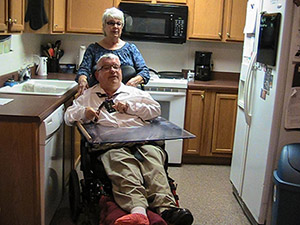
Kyle Hulet, 63, with his sister Ginger Zyskowski at his apartment (Photo by Jenni Bergal).

Hulet, a cheerful 63-year-old quadriplegic with cerebral palsy who loves watching wrestling and singing at church, lives in an apartment. He works next door at the agency’s front desk, earning about $29 a week for four hours’ work, answering phones in tandem with another client. He also uses a computer to type up banners and notices by pushing a button with his head.

“Right now, my brother is in a pretty safe place. I’m not sure what the future’s going to hold,” said Zyskowski, 67. “There is a fear among older caretakers like me that if this thing with KanCare goes wrong, what’s going to happen? He could outlive me, and what’s in place for him?”

Aldona and Pat Carney share similar thoughts about their son, Neil. He lived with them for years, but it no longer was safe for him – or them — in his family home. He didn’t do well in a group home, so, with the help of two of Pat’s brothers, they purchased and renovated the house he now lives in with his caregiver, who teaches him about tasks such as brushing his teeth and dressing himself. Aldona Carney said the state pays a nonprofit agency about $71,000 a year for his residential services – the maximum rate because of his extreme disabilities, which is cheaper than if he were institutionalized.

Carney, 51, said she envisions the house as a place for Neil to live the rest of his life. But she fears that at some point with KanCare, that could change because of the cost.

“There’s a definite lack of trust among parents and families in this state,” she said. “We had a system that worked really well, so why are they trying to fix something that’s not broken?”

Â鶹ŮÓÅ Health News is a national newsroom that produces in-depth journalism about health issues and is one of the core operating programs at Â鶹ŮÓÅ—an independent source of health policy research, polling, and journalism. Learn more about .

This <a target="_blank" href="/insurance/kansas-medicaid-managed-care-developmentally-disabled/">article</a&gt; first appeared on <a target="_blank" href="">Â鶹ŮÓÅ Health News</a> and is republished here under a <a target="_blank" href=" Commons Attribution-NonCommercial-NoDerivatives 4.0 International License</a>.<img src="/wp-content/uploads/sites/8/2023/04/kffhealthnews-icon.png?w=150&quot; style="width:1em;height:1em;margin-left:10px;">

<img id="republication-tracker-tool-source" src="/?republication-pixel=true&post=25634&amp;ga4=G-J74WWTKFM0&quot; style="width:1px;height:1px;">]]>
/insurance/kansas-medicaid-managed-care-developmentally-disabled/feed/ 11 25634
States Balk At Terminating Medicaid Contracts Even When There’s Fraud Or Poor Patient Care /aging/medicaid-managed-care/ /aging/medicaid-managed-care/#comments Sun, 15 Sep 2013 14:58:00 +0000 http://khn.wp.alley.ws/news/medicaid-managed-care/

This KHN story was produced in collaboration withÌý

In Florida, a national managed care company’s former top executives were convicted in a scheme to rip off Medicaid. In Illinois, a state official concluded two Medicaid plans were providing “abysmal” care. In Ohio, a nonprofit paid millions to settle civil fraud allegations that it failed to screen special needs children and faked data.

Despite these problems, state health agencies in these – and other states – continued to contract with the plans to provide services to patients on Medicaid, the federal-state program for the poor and disabled.
Health care experts say that’s because states are reluctant to drop Medicaid plans out of fear of leaving patients in a bind.

“You probably won’t find many examples of states flat out pulling the plug. That’s sort of the nuclear option,” said James Verdier, a senior fellow at Mathematica Policy Research, a nonpartisan think tank. “There are all sorts of sanctions you can impose – financial penalties, limitations on enrolling new beneficiaries. States will almost always use those sanctions to work with a plan and try and get them up to speed, to the extent they can.”

States are increasingly turning to insurance companies to provide coverage for people on Medicaid in hopes of saving money and improving care. About 30 million Americans on Medicaid now belong to a managed care plan, and beginning in January, millions more will become eligible under the federal health law. Many in managed care.

States Balk At Terminating Medicaid Contracts Even When There's Fraud Or Poor Patient Care

Thirty-six states and the District of Columbia have enrolled some or all of their Medicaid population in private health plans, many of them owned by major insurers that operate in multiple states.Ìý

State health officials are responsible not only for monitoring and oversight, but for enforcing contracts and cracking down on plans that violate the rules or perform poorly.

Each state decides how to do that, and it varies substantially. Some fine plans or reduce payments for failing to meet quality standards. Others offer more of a carrot than a stick – they pay bonuses or financial incentives for excellent performance. Some use both financial penalties and incentives.

The ‘Hands-Off’ Approach

Advocates say that states need to do a better job of policing problem plans and not wait until a contract is up for renewal to pull the plug.

“You have a situation where too many states take a hands-off approach. I think there’s a significant risk of substantial harm to consumers,” said Alice Dembner, project director for Community Catalyst, a national health care consumer advocacy group.

Dembner’s group is surveying states to find out if – and how – they sanction managed care plans, focusing on companies that operate in multiple states.

“So far, we found that only a small number of states impose fines and many of them are for paperwork violations – the plans didn’t file this form or that form on time,” Dembner said, noting that just a handful of states have levied sizeable penalties.

One of them is Texas, where officials have suspended enrollment and imposed hefty fines on some plans – in one case for more than $2.8 million. They also revoked one of their plan’s contracts – a rare move for a state.

Linda Edwards Gockel, spokeswoman for the Texas Health and Human Services Commission, said that in 2009, officials were concerned about a pilot program in the Dallas-Fort Worth area run by Evercare, a subsidiary of . The program, which coordinated care and long-term services for elderly and disabled people, had been fined more than $600,000 for not providing proper access to care and failing to coordinate services.

Gockel said Texas decided to cancel the contract 15 months early, but continued to do business with Evercare because the problems in Dallas-Fort Worth weren’t affecting services it was providing elsewhere.

“We have contracts with them in a variety of programs and they are currently a good partner with the state,” she said.

UnitedHealth spokeswoman Alice Ferreira said that although there had been “some challenges in the past, we really believe today we enjoy a very positive relationship” with Texas.

States don’t want to dump plans because that could cause major disruption for patients, who might have to switch doctors and prescription drug plans, said Matt Salo, executive director of the National Association of Medicaid Directors.

“Are the other plans capable of dealing with that influx? Maybe they are and maybe they’re not,” he added. “Maybe they’d have to revamp their networks [of doctors and hospitals] and payment structure. That might not be something they can do at the drop of a hat.”

Anne Swerlick, deputy advocacy director for Florida Legal Services, doesn’t buy that argument.

“If we’re going to have managed care, and we’re going to have standards that get enforced,” she said, “the state needs to have some capacity to transition people to other plans.”

Reluctance To Get Into The Business

In Illinois, Medicaid Deputy Administrator Jim Parker said his office was unable to cut ties with Harmony Health Plan, a subsidiary of WellCare Health Plans, and Family Health Network, a nonprofit community plan, even though they had serious quality problems over a decade.

“Their performance was abysmal,” Parker said, noting that their quality rankings were in the low percentiles.

Parker said one reason the state kept awarding them contracts was that they agreed to participate in a program in several counties in which members enrolled voluntarily and weren’t required to join. Most companies weren’t interested in that business because there wasn’t a guaranteed number of patients.

The other reason was more complex.

“Managed care can be a big political issue at the state level,” Parker said. “You had a divide in Illinois. Republicans in the legislature were pushing the state to go to more managed care. In light of that, it was not politically feasible to get rid of the existing plans. They were around for political reasons.”

The two plans have made some improvements, Parker said, and in 2014, when Illinois begins moving large numbers of Medicaid patients to mandatory managed care, “we will not keep plans that are not doing well.”

WellCare spokesman Jack Maurer wrote in an email that over the past several years, the company has “worked hard to improve its quality scores and has made significant investments to this end.”Ìý

Family Health Network CEO Keith Kudla said that the company has “always been the leader” among plans in its Chicago-area market when it comes to quality scores.Ìý

“We recognize, however, in comparison to national benchmarks that we can do better,” Kudla wrote in an email. He said his company embarked in 2010 on a multimillion dollar strategy to expand access, improve care coordination and upgrade information systems.

Another nonprofit Medicaid plan got into trouble with government officials, but the issue wasn’t about quality.

CareSource, a Dayton, Ohio-based nonprofit Medicaid plan, agreed in 2011 to pay the federal government and the state $26 million that it failed to provide screenings and other services for adults and special needs children and submitted false data to the state. The company denied the allegations, but said it settled to bring the matter to a close.Ìý

CareSource spokeswoman Jenny Michael said the company had no comment.

Ohio Medicaid spokesman Sam Rossi wrote in an email that the settlement “did not include any actual finding of wrongdoing, and there was never an allegation of consumer harm.” He said CareSource has taken steps in recent years “to better document the services it provides.”

CareSource remains Ohio’s largest Medicaid managed care plan.

Not Walking The Walk

Another plan that faced fraud allegations was Amerigroup Corp. of Virginia Beach, a national managed care company that currently operates in 12 states. It agreed in 2008 to pay $225 million to the federal government and Illinois to settle a civil case that alleged it had defrauded the state’s Medicaid program because it avoided enrolling pregnant women and unhealthy patients and submitted thousands of false claims to the government. The company did not admit any wrongdoing.Ìý

Amerigroup, which was purchased by WellPoint in late 2012, had already left Illinois when its contract expired two years before the settlement. The other states did not rescind their contracts.

WellPoint spokeswoman Maureen C. McDonnell said the company had no comment.

Health care fraud experts said they couldn’t think of a single case in recent years in which a plan had been dropped because it was the subject of a Medicaid fraud probe.

“If you’re going to talk the talk about enforcement, you better be prepared to walk the walk,” said Bill Mahon, former executive director of the National Health Care Anti-Fraud Association. “There’s a lot of talk, but a lot less walk by the states.”

Florida health officials continued to contract with WellCare after FBI agents raided the national managed care company’s Tampa headquarters in 2007. That eventually led to criminal charges, and earlier this year, several former WellCare top executives were by falsely inflating the amount it spent on care.Ìý

In 2009, WellCare signed a “deferred prosecution agreement” with the U.S. Attorney’s Office, agreeing to pay $80 million potential criminal charges in the fraud case. Last year, the company finalized a $137 million settlement civil fraud allegations. ÌýIt did not admit wrongdoing in the civil case.

In February, Florida officials allowed the company to expand its Medicaid services to all 67 counties. Today, WellCare, which has 1.8 million Medicaid members in eight states, is the largest Medicaid managed care plan in Florida.

WellCare spokesman Maurer said in a statement that it is “a transformed company.” He said a new leadership team appointed in 2008 “has set an exemplary ‘tone at the top’ by emphasizing integrity, personal accountability, ethical business practices, regularly compliance and transparency.”

Maurer said WellCare cooperated fully with state and federal authorities in their investigation and resolved all the issues that directly involved the company.Ìý

Florida Medicaid Director Justin Senior said the state consulted with federal health officials and decided not to drop WellCare’s contract mostly out of concern that it would have caused chaos for patients.Ìý

Senior said the WellCare situation was “the closest our state has come to terminating” a plan’s contract and noted that no other state canceled its contract with WellCare because of the fraud case. He said the company’s new leadership has made a difference.Ìý

“There’s no reason not to continue to do business with them,” Senior said. “They were making up for the past wrongs of the past management team. A leopard can change its spots.”

This article was produced by Kaiser Health News with support from .

Â鶹ŮÓÅ Health News is a national newsroom that produces in-depth journalism about health issues and is one of the core operating programs at Â鶹ŮÓÅ—an independent source of health policy research, polling, and journalism. Learn more about .

This <a target="_blank" href="/aging/medicaid-managed-care/">article</a&gt; first appeared on <a target="_blank" href="">Â鶹ŮÓÅ Health News</a> and is republished here under a <a target="_blank" href=" Commons Attribution-NonCommercial-NoDerivatives 4.0 International License</a>.<img src="/wp-content/uploads/sites/8/2023/04/kffhealthnews-icon.png?w=150&quot; style="width:1em;height:1em;margin-left:10px;">

<img id="republication-tracker-tool-source" src="/?republication-pixel=true&post=26230&amp;ga4=G-J74WWTKFM0&quot; style="width:1px;height:1px;">]]>
/aging/medicaid-managed-care/feed/ 2 26230
Kentucky’s Rush Into Medicaid Managed Care: A Cautionary Tale For Other States /health-industry/kentucky-medicad-managed-care/ /health-industry/kentucky-medicad-managed-care/#comments Mon, 15 Jul 2013 06:02:00 +0000 http://khn.wp.alley.ws/news/kentucky-medicad-managed-care/

This story was produced in collaboration withÌý

GREENSBURG, Ky. — Kaden Stone loves playing baseball, riding his bike and watching Duck Dynasty on TV at his red-brick ranch-style house in rural south central Kentucky.Ìý

Despite his energy, the tiny boy of eight with a crewcut and missing front tooth can’t eat much, the result of congenital bowel problems that have required dozens of surgeries and procedures. He needs PediaSure, says his mother, who was shocked when Kaden’s Medicaid managed care plan stopped paying last fall for the expensive nutritional drink, saying it was not “medically necessary.”

Kentucky's Rush Into Medicaid Managed Care: A Cautionary Tale For Other States

Kaden Stone and his mother, Angelina Alcott (Photo by Jenni Bergal/For KHN)

“We couldn’t believe it, because he had only gained four pounds in a year and the doctor said he had to have it because he wasn’t flourishing,” said Angelina Alcott. “He’s only 3 ½ feet tall and 48 pounds.”

Ever since Kentucky rapidly shifted patients from traditional Medicaid to private health plans that manage their care for a set price, problems have been widespread.

Patients complain of being denied treatment or forced to travel long distances to find a doctor or hospital in their plan’s network. Advocates for the mentally ill argue the care system for them has deteriorated. And hospitals and doctors say health plans have denied or delayed payments.

Experts warn that what happened in Kentucky should be a cautionary tale for other states that rush to switch large numbers of people in Medicaid, the state-federal program for the poor and disabled, to managed care in hopes of cutting costs and improving quality. Nearly 30 million Americans on Medicaid to a private health plan, as states move away from the traditional program that paid doctors and hospitals for each service they provided.

Beginning in January, millions more people will become eligible for Medicaid under the federal health law, and many will be placed in managed care. Thirty-six states and the District of Columbia some or all of their Medicaid population in private health plans, which last year cost the states and federal government about $108 billion.Ìý

“The Kentucky case is a harbinger of what can happen when states don’t allow enough time and devote sufficient resources to strengthen the Medicaid agency’s oversight capacity and systems — or develop strong contracts and care monitoring systems from scratch if they haven’t contracted with managed care plans before,” said Debra Lipson, a senior researcher for Mathematica Policy Research, a nonpartisan think tank

Kentucky health officials admit there have been some rough spots because of the speed of the changeover that started in late 2011. But they insist that claims now are being paid promptly and the quality of care has improved.

“We’re changing the delivery of health care in Kentucky for the good,” Kentucky Medicaid Commissioner Lawrence Kissner said.

Kissner, a former CEO of two managed care companies, said that in one year, child immunization and diabetes testing rates have jumped, emergency room use has dropped and prescriptions for controlled substances such as Oxycontin are down.

In May, Democratic Gov. Steve Beshear announced that the state would expand Medicaid under Obamacare to about 308,000 more Kentuckians, who will be placed in managed care plans.

But many say that problems persist, especially in rural areas where access to services can be spotty. And mental health advocates say the plans have denied prescriptions that patients have taken successfully for years and many community mental health centers have limited or canceled programs because the plans won’t authorize enough treatment.

“The whole thing has been a mess,” said Sheila Schuster, executive director of the Kentucky Mental Health Coalition, an advocacy group. “It’s extremely difficult to get any resolution on issues people are facing. If you bring up problems, state officials say you’re just being resistant to managed care.”

Advocates say they’re also worried about managed care’s impact on patients with developmental disorders.

Sheila Schuster, executive director of the Kentucky Mental Health Coalition

Darlene VanHoeve, who lives in the hills of southeastern Kentucky, was shocked to learn that health plan WellCare of Kentucky wouldn’t pay for services at an autism center for her son Reuben, whose doctor thought he had Asperger’s Syndrome. The lanky 17-year-old with curly brown hair and thick glasses is depressed, she says, often hyper-focuses on one thing and gets agitated if he has to do multiple tasks.Ìý

The doctor recommended that he get testing and counseling at the center, an hour away, because no local child psychologists were in his plan’s network. But WellCare denied the request, saying the center wasn’t in its network.Ìý

“I’ve got a child who’s almost non-functioning,” said VanHoeve, who home schools her children and whose husband, Frank, is a missionary. “He’s going to have to take at least another year to finish high school.”

The VanHoeve family, which lives on about $22,000 a year, is paying $1,650 out of pocket to have Reuben tested at the autism center, which has given him an Asperger’s diagnosis. Their ministry has stepped in to help by temporarily offering the family insurance.

Kentucky's Rush Into Medicaid Managed Care: A Cautionary Tale For Other States

Reuben VanHoeve and his mother, Darlene VanHoeve (Photo by Jenni Bergal/For KHN)

WellCare of Kentucky president Mike Minor couldn’t comment on the case because of privacy laws, but he wrote in an email that the plan believes that its provider network is capable of covering members’ behavioral health needs.

Kentucky is largely rural, with a population that has serious health care needs. Last year, its national overall health ranking was 44th and it ranked 50th in smoking and cancer deaths and 40th in obesity, according to a .Ìý

Medicaid pays a lot of the medical bills. When the state faced a $100 million shortfall in its $6 billion Medicaid program, Beshear announced a plan to move members to managed care in 2011. Officials signed contracts with three national managed care companies and transferred about 550,000 people within four months.

The companies had to scramble to recruit and train employees and contract with a network of doctors and hospitals.Ìý

“It was a significant challenge,” said Michael Murphy, CEO of CoventryCares, which is part of the Bethesda, Md.-based Coventry Health Care chain that recently was purchased by Aetna. “Obviously we learned a few lessons in Kentucky,” he adds. “We have the scars to prove it.”

Payment disputes soon erupted between the plans and hospitals and doctors, who complained that claims were being denied or delayed improperly and that the cumbersome pre-authorization process hindered treatment.

“It’s just been a litany of issues – slow payment, network adequacy, denials, pre-admission problems,” said Michael Rust, president of the Kentucky Hospital Association. “States usually phase this in. Here, it was the whole enchilada. It was almost a change overnight.”

A 2012 by the Urban Institute called the transition in Kentucky “extremely rapid.”Ìý

It found that patients faced delays in getting care, mental health gaps were exacerbated and an “adversarial relationship” plagued the state, the plans and the medical community.

Medicaid chief Kissner said most problems have been resolved. But some state legislators say they continue to be flooded with complaints from disgruntled doctors, dentists and hospitals.

“The state is tone deaf to the providers,” said state Sen. Julie Denton, a Louisville Republican who chairs the Health and Welfare Committee and has held hearings on the issue. “They have let these health plans run amok because they want the savings and they don’t want to do anything to jeopardize that. It’s all about the money. It’s not about patient care and access to care.”

Earlier this year, the legislature unanimously passed a bill that would have set up an appeals process at the Department of Insurance to mediate disputes between the medical community and the health plans. The governor vetoed it, saying it would have resulted in excessive costs and could have interfered with contractual agreements. Instead, he announced an “action plan” that included insurance department audits and a requirement that plans meet with every hospital to review past-due bills.Ìý

Kissner said those meetings have taken place, and the plans aren’t finding anywhere near as many unpaid claims as the hospitals allege. New claims are being paid promptly, he added.

For the three national health plans, Medicaid managed care in Kentucky has been a loser financially.

Kentucky Spirit, a subsidiary of the St. Louis, Mo.-based Centene Corp., pulled out of Kentucky this month, saying it had lost $120 million. It has sued the state for damages, arguing that the data it received when it initially bid was flawed and underestimated the actual costs and poor health of members. The state, which has started transferring about 125,000 members into the two other plans, announced it would sue Kentucky Spirit for breach of contract.

CoventryCares CEO Murphy said his plan has lost about $156 million since the contract started. But he said the payment disputes with doctors and hospitals are now being resolved and the situation has “improved and stabilized.”

In January, the state amended its contracts with CoventryCares and WellCare, agreeing to increase their rates by 7 percent. That’s an additional $18 million in state funds and $22.5 million from the federal government, according to Kissner.

While payment issues have gotten most of the attention in the halls of Frankfort’s capitol, there’s also concern about whether the plans’ network of doctors and hospitals is adequate, especially in underserved areas.

In rural Eastern Kentucky, Appalachian Regional Healthcare, the predominant hospital chain, is suing Coventry, which severed its contract after the health care system refused to agree to reduced rates. Appalachian also did not contract with Kentucky Spirit because of a disagreement over rates. Only WellCare remains in the Appalachian system.

Hospital officials say that means many poor Eastern Kentuckians are left without ready access to certain services, such as maternity care and radiation therapy.

Medicaid’s Kissner disputes the criticism about the network’s adequacy. He said his office performs a monthly review to insure services are available in rural areas within 60 miles or 60 minutes of members, as required by state law.Ìý

Advocates are also distressed about the safety net for vulnerable mentally ill Kentuckians. They say that not only have programs been cut and access been limited under managed care, but psychiatrists and therapists have reduced the amount of time they spend with patients.

“The result is decompensation, poor illness management and more hospitalizations,” said Kelly Gunning, advocacy and public affairs director for the National Association for the Mentally Ill in Lexington. “The people are powerless. They have no say.”

Kissner disagreed with the advocates’ assessment about the decline in mental health care. He said the community mental health centers have been rattled because the plans are demanding information about discharges and the expected outcome for patients.

“I think they’re struggling with oversight of managed care. They’ve operated in a different environment and now the (plans) are requiring more oversight,” Kissner said. “The goal is not to be in a facility the rest of your life.”

While Kissner and other Medicaid officials view the move to managed care in Kentucky as a monumental step toward improving patients’ health, that view isn’t shared by Alcott, the mother of the boy who was born without a rectum or bowel control.

Alcott said that for years she was grateful that Kaden was on Medicaid, which paid for all his health care expenses. Even though she teaches adult education and Kaden’s father is an electrician, they relied on the state program for their son’s treatment because it would have been too costly if he was on her private health plan.

Alcott said she was hopeful about managed care until CoventryCares stopped paying for the PediaSure last year. She has had to take on extra jobs to pay the $180 to $200 a month it costs.

Coventry spokesperson Kristine Grow said that the plan generally covers “medically necessary” nutritional supplements, but she couldn’t discuss the case because of privacy laws.

What’s been even more disturbing for Alcott was that the Louisville children’s hospital where Kaden’s long-time surgeon is on staff decided to stop accepting CoventryCares patients in June. She switched plans in July.

“At first, managed care was great. Now it’s really stressful,” Alcott said. “It’s been so hard. I feel like I’m a strong person, but I’ve cried. You feel powerless.”

This article was produced by Kaiser Health News with support from .

Â鶹ŮÓÅ Health News is a national newsroom that produces in-depth journalism about health issues and is one of the core operating programs at Â鶹ŮÓÅ—an independent source of health policy research, polling, and journalism. Learn more about .

This <a target="_blank" href="/health-industry/kentucky-medicad-managed-care/">article</a&gt; first appeared on <a target="_blank" href="">Â鶹ŮÓÅ Health News</a> and is republished here under a <a target="_blank" href=" Commons Attribution-NonCommercial-NoDerivatives 4.0 International License</a>.<img src="/wp-content/uploads/sites/8/2023/04/kffhealthnews-icon.png?w=150&quot; style="width:1em;height:1em;margin-left:10px;">

<img id="republication-tracker-tool-source" src="/?republication-pixel=true&post=26621&amp;ga4=G-J74WWTKFM0&quot; style="width:1px;height:1px;">]]>
/health-industry/kentucky-medicad-managed-care/feed/ 5 26621
Advocates Urge More Government Oversight Of Medicaid Managed Care /aging/medicaid-managed-care-states-quality/ /aging/medicaid-managed-care-states-quality/#respond Fri, 05 Jul 2013 07:41:00 +0000 http://khn.wp.alley.ws/news/medicaid-managed-care-states-quality/

This KHN story was produced in collaboration with

When the federal government recently gave Florida the green light to vastly expand its experiment with privatizing Medicaid, patient advocates quickly raised an alarm.

They cited serious problems with the state’s five-county pilot managed care program and urged close monitoring of the companies that run private Medicaid plans to ensure that they don’t scrimp on care.

Advocates and experts say that the need for oversight is growing nationally as states have increasingly contracted out the huge state-federal program for the poor to insurance companies, aiming to control costs and improve quality through close management of patient care. About .ÌýUnder the federal health law that launches Jan. 1, eligibility will be expanded and about 7 million more will be covered by Medicaid. Many will be placed in managed care.Ìý

Advocates Urge More Government Oversight Of Medicaid Managed Care

Florida’s Agency for Health Care Administration held a June 2011 public hearing focused on the state’s Medicaid managed care plans in Miami Gardens, Fla. (Photo by Joe Raedle/Getty Images).

States are required by the federal government to establish quality standards for Medicaid plans and monitor their compliance, but there’s no uniformity. This has resulted in a patchwork of contract requirements and data collection that experts say makes it difficult to compare states and assess whether patients’ health has actually improved.Ìý

“The quality of the monitoring and the quality of the managed care really varies from state to state,” said Joan Alker, a co-executive director of the Center on Children and Families at Georgetown University who studies health policy. “This is important because we want to have accountability for our taxpayer dollars. These are very vulnerable populations and sometimes not getting the services they need is a matter of huge import.”

Advocates are particularly worriedÌýthat more than 20 states are moving frail elderly, mentally ill and people with disabilities into managed care for long-term services.Ìý They have especially complex needs.

Some states have also cut back staffing of their Medicaid offices, raising concerns about their ability to hold plans accountable.ÌýThe federal government, in turn, has been criticized for failing to fulfill its duty: ensuring that states do what’s needed to oversee the plans.

Thirty-six states and the District of Columbia have enrolled some or all of their Medicaid population in private health plans. The states give the plans a fixed amount per member each month. Last year, the states and about $108 billion out of the $435 billion spent on Medicaid.

State Number of Medicaid managed care enrollees
Alabama 0
Alaska 0
Arizona 1,198,818
Arkansas 0
California 4,523,838
Colorado 46,962
Connecticut 396,425
Delaware 154,904
District of Columbia 137,424
Florida 1,249,264
Georgia 951,408
Hawaii 266,819
Idaho 0
Illinois 213,417
Indiana 705,708
Iowa 0
Kansas 181,540
Kentucky 171,142
Louisiana 0
Maine 0
Maryland 735,856
Massachusetts 510,355
Michigan 1,211,393
Minnesota 556,665
Mississippi 51,626
Missouri 406,796
Montana 0
Nebraska 100,972
Nevada 168,851
New Hampshire 0
New Jersey 853,645
New Mexico 401,318
New York 3,725,644
North Carolina 0
North Dakota 0
Ohio 1,605,042
Oklahoma 0
Oregon 496,987
Pennsylvania 1,152,069
Puerto Rico 1,040,493
Rhode Island 135,049
South Carolina 428,765
South Dakota 0
Tennessee 1,174,007
Texas 1,872,383
Utah 51,486
Vermont 103,529
Virgin Islands 0
Virginia 532,292
Washington 730,592
West Virginia 166,555
Wisconsin 711,043
Wyoming 0
TOTAL 29,121,082
Source: Centers for Medicare & Medicaid Services, July 2011

States are supposed to set rates, monitor contracts and enrollment practices, make sure that plans have sufficient networks of doctors, oversee quality and performance and ensure consumer protections for members. But how they each go about doing it is up to them.

For example, federal rules don’t say how many doctors a plan must contract with or how often state officials need to review the adequacy of the plan’s network of doctors.

Seventeen states require Medicaid health plans to be accredited by a national organization, which sets specific quality standards. Other states use some of those standards, but don’t require accreditation. Each state chooses its own approach.

States also must arrange for an external group to independently monitor the plans’ quality of care every year. But the federal requirement doesn’t specify how that monitoring should be done either.

“If you want to collect data about screening people for obesity, Minnesota may collect it, but Louisiana may not,” said Sarah Somers, a managing attorney for the National Health Law Program, a nonprofit legal services group for low-income people. “If you want to do a systematic comparison across the states, it’s not really doable.”

A July 2012 in 20 states found “tremendous variation” in the kind of quality monitoring conducted by states and health plans and in how they ensure the plans’ networks of doctors are adequate.ÌýThe maximum number of patients per doctor, for example, varied from 750 in Michigan to 2,500 in Tennessee. In rural areas, primary care doctors had to be located within 10 miles of patients in California, but within 45 miles in Ohio.

Embry Howell, a senior fellow who co-authored the study, said that while states don’t necessarily need to use all of the same quality measurements, there should be a way to compare them state-to-state and plan-to-plan. “Otherwise the data is going to be apples and oranges,” Howell said. “This is important. It’s the accountability side of it.”

Even the health plans themselves are frustrated with the hodgepodge of state quality measures. “It adds an additional level of complexity for plans that operate in a dozen or more states,” said Joe Moser, executive director of Medicaid Health Plans of America, an industry trade group. “We do support more federal standardization.”

Matt Salo, executive director of the National Association of Medicaid Directors, said states may oversee quality and access differently, but that he’s “not aware of anyone doing it badly.”

Salo pointed out that in traditional Medicaid, with states focused on paying doctors and hospitals for each service they provide, there is little monitoring and oversight, other than for financial fraud and abuse.

“The irony about quality is that consumer advocates say we’re not sure there’s a proper focus on quality. But where are the quality measures for fee-for-service Medicaid?” he said.

Some state Medicaid offices have taken a hit in recent years because of budget cuts – Washington state’s program lost more than 200 positions since 2009. And oversight isn’t always a priority, says Carolyn Ingram, a former New Mexico Medicaid director who is senior vice president of the Center for Health Care Strategies, a nonprofit health policy center.

Ingram said Medicaid directors who are getting pressured by governors and legislatures to expand managed care often end up focusing on “bright and shiny” new initiatives. “Oversight of our managed care plans is less bright and shiny,” she said. “The day-to-day monitoring of managed care plans goes kind of on the back burner. That’s where you put your newer staff, your green staff.”

Florida’s experience with managed care underscores the importance of close monitoring. After the state launched a pilot program in 2006, doctors were unhappy about delayed payments and administrative obstacles, patients complained about being denied access to services and data on the quality of care was lacking. Several insurers dropped out because they couldn’t make enough money.

State officials say those problems have been fixed. In 2011, the federal government approved an extension of the pilot and in June agreed to allow Florida to expand it statewide.

But Georgetown University’s Health Policy Institute has been critical of Florida’s pilot program.Ìý “Little data is available to assess whether access to care has improved or worsened,” it reported in 2011, noting there is no “clear evidence” the program is saving money and if it is, “whether the savings came at the expense of needed care.”

Advocates say access problems remain and Florida’s oversight is inadequate. “The state is supposed to be overseeing all of this. They haven’t done a good job of that,” said Laura Goodhue, executive director of Florida CHAIN, a statewide health care advocacy group.

Experts caution that even in states that devote lots of resources to oversight, many of the quality standards they use are aimed at figuring out whether services were provided, not the effect on patients’ health – what they call “outcome.”

Earlier from KHN:ÌýIn Conservative Arizona, Government-Run Health Care That Works

“Even if there’s an intent to aggressively monitor, you have to figure out whether and how they’re doing it. And measuring quality is really, really tough,” said Michael Sparer, a Columbia University professor of health policy. “We can say immunization rates have gone up or waiting times are down…But measuring whether outcomes have changed substantively is very elusive and difficult to get at.”

In a few states, legislators have tried to beef up oversight.

In Kansas, which in January moved nearly all of its 380,000 Medicaid members into plans run by three commercial plans, the legislature decided to do its own oversight. It unanimously passed a bill in March that would establish a joint legislative committee to monitor the state’s Medicaid managed care program. The governor signed it in April.

“We need to make sure they’re adhering to contractual arrangements, that they’re providing the services they committed to provide, that our Medicaid clients have access to services and are actually getting them,” said Kansas State Sen. Laura Kelly, a Topeka Democrat.

In Kansas and several other states, consumer advocates worry that officials are rushing too quickly to move vulnerable elderly, mentally ill and physically disabled people into Medicaid managed care for long-term services, such as home health and personal care. They say states don’t have systems in place to properly monitor quality of care or the plans’ performance. A estimated that the number of states with these programs will grow from 16 to 26 by 2014.

“It’s a Medicaid managed care stampede of states. That’s what it feels like,” said Mitzi McFatrich, executive director of Kansas Advocates for Better Care. “It’s too quick.”

In the District of Columbia, in Medicaid managed care, including mentally ill adults.ÌýA federally-mandated group that makes recommendations about Medicaid policy in Washington created a subcommittee to track the impact of managed care on mental health. Its report, issued last year, concluded that the program was poorly administered, with minimal oversight and insufficient data available.

“I think we were shocked to find out how little oversight that there was,” said subcommittee chairman Shannon Hall, executive director of the D.C. Behavioral Health Association. “They had great contracts with the plans, but as far as we could tell, none of them were being actively monitored or enforced.”

Advocates across the country say they’re worried that a number of companies vying for state contracts have little or no experience dealing with people who need long-term care, and they fear that plans might try to restrict access to save money because many new members will require expensive services.

Moser, of the industry trade group, dismisses those concerns, saying that the plans support rigorous oversight and want to make sure members get the care they need. He said several companies have a decade or more experience with long-term services and other plans will learn from them.

While states are responsible for keeping an eye on Medicaid managed care plans, the federal Centers for Medicare & Medicaid Services is required to monitor how well the states are doing that. But CMS, too, has had its problems with oversight, according to reports by the Department of Health and Human Services Inspector General’s office and the U.S. Government Accountability Office.

In 2009, the that CMS hadn’t enforced a requirement that states collect and report data that gives detailed information about services provided to individual Medicaid managed care patients.

The following year, the GAO criticized CMS for lax oversight and inconsistency in tracking how states set managed care plans’ rates. The auditors wrote that this was essential because it could “help avoid significant overpayments and reduce incentives to underserve or deny enrollees’ access to needed care.”

And earlier this year, the , saying that CMS needed to “continue taking steps to improve oversight” of Medicaid managed care rate-setting.

Howell, the Urban Institute researcher, said their study also found gaps in federal monitoring. Ìý

We saw unevenness in both how the rates are set and in the federal oversight of the state’s oversight,” she said. “The requirements are there,” she said, “but they’re not evenly enforced in (CMS’) regional offices.”Ìý

CMS would not make an official available to comment for this story, instead issuing a statement saying it is committed to working with states to give them flexibility in administering their programs.Ìý

This article was produced by Kaiser Health News with support from .

Â鶹ŮÓÅ Health News is a national newsroom that produces in-depth journalism about health issues and is one of the core operating programs at Â鶹ŮÓÅ—an independent source of health policy research, polling, and journalism. Learn more about .

This <a target="_blank" href="/aging/medicaid-managed-care-states-quality/">article</a&gt; first appeared on <a target="_blank" href="">Â鶹ŮÓÅ Health News</a> and is republished here under a <a target="_blank" href=" Commons Attribution-NonCommercial-NoDerivatives 4.0 International License</a>.<img src="/wp-content/uploads/sites/8/2023/04/kffhealthnews-icon.png?w=150&quot; style="width:1em;height:1em;margin-left:10px;">

<img id="republication-tracker-tool-source" src="/?republication-pixel=true&post=26545&amp;ga4=G-J74WWTKFM0&quot; style="width:1px;height:1px;">]]>
/aging/medicaid-managed-care-states-quality/feed/ 0 26545
Long-Term Care Ombudsmen Face Challenges To Independence /aging/long-term-care-ombudsmen/ /aging/long-term-care-ombudsmen/#respond Sun, 27 Jan 2013 19:31:00 +0000 http://khn.wp.alley.ws/news/long-term-care-ombudsmen/

This story was produced in collaboration with

The 2.3 million elderly or disabled people living in nursing homes or assisted living centers might not know it, but they’ve got an advocate – someone who’s supposed to be looking out for their health, safety and rights.

In 2011, state long-term care ombudsmen — assisted by hundreds of local ombudsmen programs and thousands of volunteers – responded to 204,000 complaints nationwide. They ranged from roommate conflicts to lack of privacy to allegations of abuse or neglect.

State ombudsmen also are expected to testify before the legislature, talk to the media and take a public stance on long-term care issues, without interference by government officials.

But that’s not always the case. While ombudsmen in some states maintain their autonomy, in other states conflicts have erupted and government officials have been accused of trying to muzzle ombudsmen, especially when they publicly disagree with state policies or battle industry officials.

Among the controversies in recent years:

  • In Florida, the state ombudsman – for years considered a thorn in the long-term care industry’s side — under orders from newly-elected Gov. Rick Scott. This prompted a state Senate hearing and a federal Administration on Aging investigation, which found that the action “raised troubling concerns” and that Florida had violated the spirit of the Older Americans Act, which created the ombudsman program.

  • In Iowa, the state Department on Aging’s director resigned in 2010 amid allegations that the administration had tried to thwart the state’s ombudsman.

  • In California, local ombudsmen campaigned for three years to strengthen the state ombudsman’s independence, arguing that he wasn’t able to take positions on long-term care issues that clashed with the governor or state officials. In 2012, that beefs up the ombudsman’s independence.

“Ombudsman independence has been a longstanding hot-button issue in a number of areas, both at the state and local level,” says Lori Smetanka, director of theÌý in Washington, D.C., which provides support and training to ombudsmen. She and her staff regularly hear from ombudsmen who say their ability to speak out is being challenged or limited.

“Sometimes it’s an issue of personalities,” she says. “Sometimes, it’s state policies that get in the way. Oftentimes, it means that there is no one speaking out for nursing home residents or that their voice is not being carried to that higher level.”

The $87 million-a-year ombudsman program dates to 1972 and today operates in every state, the District of Columbia, Puerto Rico and Guam, along with 576 local ombudsmen programs, serving all long-term care residents. The program, funded mostly by the federal government and states, has 1,185 paid staffers and 9,065 trained volunteers nationwide.

Ombudsmen can’t impose sanctions or levy fines, but the law requires them to investigate complaints and advocate for improvements to the long-term-care system. They usually refer serious violations to state licensing officials.

Ombudsmen are also required to report whether they have visited long-term care facilities at least quarterly to find out how residents are doing. In 2011, ombudsmen visited 70 percent of all nursing homes and about 33 percent of all board and care and assisted living centers at least once every three months.

Among the most frequent complaints they investigate: improper discharge or eviction, lack of respect from staff, poor quality food and medication problems.

Other examples: In Maryland an ombudsman assisted a 68-year-old nursing home resident with Parkinson’s disease in getting her wheelchair repaired after it had been broken for months. In Oregon, an ombudsman helped a 95-year-old veteran who lived in a nursing home get a refund after he was scammed by a telemarketer. In Michigan, an ombudsman helped a 49-year-old woman with multiple sclerosis transition out of a nursing home to her own apartment after a legal battle to remove her guardian.

“So many of the people who live in nursing homes don’t have family members,” says Mitzi McFatrich, executive director of Kansas Advocates for Better Care. “They are truly vulnerable. If you’re being overcharged, if you’re not properly cared for, if you’re being given antipsychotic medications to keep you in line, without the ombudsman program, those residents don’t have any place to turn.”

For Bob Jones, having an ombudsman was “a great relief.”

The 84-year-old former chef badly wanted to leave his Walla Walla, Wash., nursing home. Jones, a stroke victim who suffers from mild dementia and pulmonary disease, had become withdrawn and had lost 47 pounds.

That’s when volunteer ombudsman Carolyn Mosebar came into his life. The 78-year-old retired nurse helped Jones move out of the nursing home in October and into a family care home owned by a couple he knew.

“Carolyn was an advocate and she was a darn good one. She got my confidence back. By being there, she gave me hope,” says Jones, who also worked as a stuntman in Hollywood and used to go fishing with Roy Rogers.

While local ombudsmen across the country have the freedom to help individuals such as Jones, it’s a more slippery slope when it comes to state ombudsmen advocating publicly on long-term care issues.

Part of the controversy revolves around how the states have structured their ombudsmen programs. Most are part of state government. Others are located in nonprofit or legal assistance organizations. And in seven states, including Washington, Maine and Colorado, the ombudsman program is located within a nonprofit or legal assistance organization. In five states, including Kansas, New Jersey and Oregon, the governor appoints the ombudsman.

Some experts say it’s a bad idea for the program to be within state government.

“I think the ombudsman programs outside of state government have more independence and are less subject to political pressure,” says Eric Carlson, an attorney at the National Senior Citizens Law Center in Los Angeles.

A 2007 survey by theÌý found that more than a third of state ombudsmen said they needed prior approval before testifying about long-term care issues and that one in five said they were not allowed to initiate contact with legislators.

Some ombudsmen argue that there are advantages to being located within a state agency, such as having access to decision-makers and clerical and IT support. Many say that the state’s culture is more important than the program’s location.

“For some states, it has been an awkward fit. We’re actively working with a number of them so they don’t have the situation in which ombudsmen would be muzzled,” says Becky Kurtz, director of the federal Office of Long-Term Care Ombudsman Programs, which administers the program.

Kurtz and other experts believe that shackling an ombudsman can directly affect long-term care residents. For example, if a state is considering reducing the number of staffers required in nursing homes or cutting a Medicaid benefit, the ombudsman must have the freedom to come to the table and represent residents’ interests, they say.

Even state units on aging agree that the ombudsman program needs to remain an independent voice.

“Sometimes, state officials don’t understand that the ombudsman’s role is unlike any other state employee and that federal law requires autonomy,” says Deborah Merrill, senior policy director for National Association of States United for Aging and Disabilities. “Over the course of time, some states have struggled with it. Florida is the most obvious.”

Brian Lee was Florida’s state ombudsman for almost eight years until he was forced to resign.

“The nursing home industry and the adult care industry hated me. I was very outspoken,” says Lee, who is now executive director of Families for Better Care, a Tallahassee-based advocacy group.

In January 2011, everything came to a head when Lee asked Florida’s nursing homes to provide his office with detailed corporate ownership information, citing a provision in the new Affordable Care Act. Less than two weeks later, the governor’s office told state officials that it was time for Lee to go.

Florida officials maintained that Lee’s departure was part of the normal turnover that occurs with a change of administration. They said the governor’s office wanted the ombudsman program to “go in a new direction,” according to an investigative report by the federal Administration on Aging.

Four days after Lee was ousted, the state retracted the request for nursing home corporate ownership information.

This article was produced by Kaiser Health News with support from .

Â鶹ŮÓÅ Health News is a national newsroom that produces in-depth journalism about health issues and is one of the core operating programs at Â鶹ŮÓÅ—an independent source of health policy research, polling, and journalism. Learn more about .

This <a target="_blank" href="/aging/long-term-care-ombudsmen/">article</a&gt; first appeared on <a target="_blank" href="">Â鶹ŮÓÅ Health News</a> and is republished here under a <a target="_blank" href=" Commons Attribution-NonCommercial-NoDerivatives 4.0 International License</a>.<img src="/wp-content/uploads/sites/8/2023/04/kffhealthnews-icon.png?w=150&quot; style="width:1em;height:1em;margin-left:10px;">

<img id="republication-tracker-tool-source" src="/?republication-pixel=true&post=26836&amp;ga4=G-J74WWTKFM0&quot; style="width:1px;height:1px;">]]>
/aging/long-term-care-ombudsmen/feed/ 0 26836
Feds Say Nursing Homes Overbilled Medicare By $1.5 Billion /aging/nursing-homes-inspector-general-medicare/ /aging/nursing-homes-inspector-general-medicare/#respond Thu, 15 Nov 2012 16:22:00 +0000 http://khn.wp.alley.ws/news/nursing-homes-inspector-general-medicare/ At a time when the nursing home industry is lobbying Congress to avoid cuts in Medicare payments, a federal watchdog agency is reporting that taxpayers overpaid nursing homes $1.5 billion.

TheÌý by the inspector general’s office of the Department of Health and Human Services concluded that nursing homes billed about a quarter of claims incorrectly in 2009 – the year it studied. Most of those claims were “upcoded,” which means Medicare was billed for services that were more extensive than what was provided or needed. Many of the claims were for intensive physical, speech or occupational therapy.

The overpayments represented more than 5 percent of the $26.9 billion paid to nursing homes in 2009.

“We found that they are billing for high amounts of therapy, and they don’t provide that. Or they’re billing for it and the patient doesn’t need that amount,” Jodi Nudelman, the New York regional inspector general in charge of the study, said in an interview.

Nursing home industry officials lashed out at the report, saying that it didn’t take into account individual patients’ needs.

“Bureaucrats questioning these services after three years and saying they know what’s in the best interests of patients is not good medicine and doesn’t make sense,” Mark Parkinson, president and CEO of the American Health Care Association and the National Center for Assisted Living, said in a press release.

Feds Say Nursing Homes Overbilled Medicare By $1.5 Billion

Parkinson said that nursing homes provide life-changing therapies to hundreds of thousands of patients who have suffered strokes, falls, fractures and other ailments. He said those patients work with their doctors and therapists to map out a care plan.

“Now, three years later, the government steps in and second guesses those decisions, without the benefit of the patient’s views or even acknowledging what a doctor prescribes,” Parkinson said. “It’s easier to say ‘no’ to a file than a person, but to do so discounts the necessary care we deliver.”

The nation’s 15,000 nursing homes are facing possible Medicare cutbacks as Congress and President Barack Obama try to negotiate ways to avoid automatic cuts in defense and entitlement spending. This week, the association launched a series of TV, print and radio ads aimed at defeating those cuts. In fiscal 2012, Medicare paid nursing homes $32.2 billion.

Greg Crist, the association’s vice president of public affairs, said his industry already had an uphill fight on its hands and that “it’s too early to tell” whether the federal report will hurt its efforts.

Medicare, the federal program for seniors and the disabled, pays for nursing home care for limited periods after patients leave hospitals. The homes assess patients for therapy and put them into a payment category. Medicare pays different rates depending on that category – anywhere from $256 to $623 a patient per day in 2009.

Nudelman, of the inspector general’s office, said it’s not just a question of overcharging but of patient care, especially when it comes to intensive therapy and treating wounds or skin conditions.

“We’re concerned that when they’re not reporting information accurately, that affects the quality of care,” Nudelman said. She noted that the inspector general’s office plans to look into these quality issues in a future study.

The report makes a number of recommendations to the Centers for Medicare & Medicaid Services, including increasing the number of claims reviews, using its fraud prevention system to identify nursing homes that are overbilling and changing the method for determining how much therapy is needed for patients.

Nudelman said that although Medicare has made some revisions since 2009 in how it pays nursing homes for therapy, there needs to be a more “fundamental change.”

Parkinson, of the health care association, said that the changes Medicare has made since 2009 have improved the way it allocates payments. He said his group has supported actions to stop fraud and will continue to do so.

“But to imply that clinical decisions made in consultation with doctors and therapists at the time of treatment somehow constitutes wrongdoing goes too far,” he said.

This article was produced by Kaiser Health News with support from .

Â鶹ŮÓÅ Health News is a national newsroom that produces in-depth journalism about health issues and is one of the core operating programs at Â鶹ŮÓÅ—an independent source of health policy research, polling, and journalism. Learn more about .

This <a target="_blank" href="/aging/nursing-homes-inspector-general-medicare/">article</a&gt; first appeared on <a target="_blank" href="">Â鶹ŮÓÅ Health News</a> and is republished here under a <a target="_blank" href=" Commons Attribution-NonCommercial-NoDerivatives 4.0 International License</a>.<img src="/wp-content/uploads/sites/8/2023/04/kffhealthnews-icon.png?w=150&quot; style="width:1em;height:1em;margin-left:10px;">

<img id="republication-tracker-tool-source" src="/?republication-pixel=true&post=22937&amp;ga4=G-J74WWTKFM0&quot; style="width:1px;height:1px;">]]>
/aging/nursing-homes-inspector-general-medicare/feed/ 0 22937
Nursing Home Patients Returning To The Community /medicaid/money-follows-the-person/ /medicaid/money-follows-the-person/#respond Mon, 22 Oct 2012 18:00:00 +0000 http://khn.wp.alley.ws/news/money-follows-the-person/

This story was produced in collaboration with

After nearly two years in a Baltimore nursing home, Sonia Savage was eager to leave. She was in her late 20s, surrounded by older people and feeling “it wasn’t a place for me.”

Savage had suffered a traumatic brain injury, a stroke and broken bones after being struck by a car in 2009 while crossing the street with her 7-year-old daughter, who died after the crash. Now 30 years old, she still uses a wheelchair and walker but is in her own house, outfitted for the handicapped. “It was a new beginning,” said Savage.

Nursing Home Patients Returning To The Community

Sonia Savage, 30, spent nearly two years in a Baltimore nursing home after being struck by a car in 2009. She was crossing the street with her 7-year-old daughter, who died in the crash. Savage suffered a traumatic brain injury, a stroke and broken bones (Photo by Sarah L. Voisin/The Washington Post).

Savage is one of 1,336 disabled or elderly low-income Marylanders who as of early July had moved out of nursing homes and other institutional settings as part of a national program called Money Follows the Person. The goal is to return them to the community.

Maryland’s program is doing well compared with efforts in most of the 43 participating states and the District, having already moved 55 percent of its original target of 2,413. But the same is not true for the District and Virginia, where there are fewer stories like Sonia Savage’s. As of July 2, only 126 people had moved in the District, just 11 percent of its original five-year goal of 1,110. In Virginia, where the latest figures are from May, 362 people had moved, 35 percent of the original goal of 1,041.

Many states have fallen far short of early, optimistic projections. Five years into the program, about 22,500 people nationwide have left institutional settings and transitioned back into community settings. The states’ goal had been 35,380, a target that federal officials now say was unrealistic.

Officials at the Centers for Medicare & Medicaid Services, which administers the program, concede that it got off to a slow start. They say that many states had to create community- and home-based care systems from scratch. Some ran up against a shortage of home health workers, which many participants need. Some did not anticipate the bureaucratic challenges, such as negotiating contracts with local nonprofits to help with transitions.

Congress has authorized $4 billion for the program through September 2016. To date, the federal government has paid or committed to pay $1 billion to the states, most of which set up their programs by the end of 2008. Maryland was awarded up to $67.1 million for the first five years; Virginia, $28.6 million; and the District, $26.3 million. None has received all the allotted money, as there have been fewer participants than expected.

Money Follows the Person covers the elderly, adults with physical disabilities, the developmentally disabled and the mentally ill. Participants must choose to return to the community and be enrolled in Medicaid, the state-federal program for the poor and disabled. Transition coordinators assist them with moving into apartments, houses, small group homes or, in some cases, assisted living facilities.

Nursing Home Patients Returning To The Community

Savage still uses a wheelchair and walker but lives in her own house with her two children Essence Jones, 5, center, and Ezekiel Jones, 3, right. The family is sitting in front of their home (Photo by Sarah L. Voisin/The Washington Post).

The federal government gives states additional Medicaid money to help with each person’s transition over the first 12 months.

This includes paying for home- and community-based services, security deposits and renovations to make housing handicap-accessible.

In subsequent years, states are expected to use Medicaid money to keep paying for the person’s home health, personal care and other services, although there is no formal requirement that the states do so.

The program also requires states to spend some of the Medicaid money they’ve gotten for the program on long-term-care services that will help people live in their own homes. The goal is to avoid institutionalizing people in the first place.

Each state has flexibility in deciding whether to focus on a particular group.

In the District, 101 participants are developmentally disabled people who had been living in institutions. As of July, only 25 nursing home residents had transitioned out since the program started in 2008.

In December 2010, disability rights advocates filed a class-action lawsuit against the District, claiming that it had deprived 2,900 Medicaid-covered nursing home residents of their right to return to the community. In February, a judge rejected the District’s request to throw out the case.

“We’re in Year 5 of a five-year Money Follows the Person grant, and they’ve barely transitioned anyone from a nursing home,” said Marjorie Rifkin, managing attorney for University Legal Services, a nonprofit advocacy group that co-filed the lawsuit. “The District made no effort to market the program. People in nursing homes don’t know the services exist, and to a large degree the staff don’t know, either.”

Leyla Sarigol, Money Follows the Person project director at the District’s Department of Health Care Finance, defended the program, saying officials initially chose to focus on the developmentally disabled because the infrastructure was already there for them in the community.

Sarigol said her office began its “pilot work” in nursing homes only in 2010 and acknowledged that it has faced barriers finding subsidized housing and primary-care doctors for Medicaid patients with complex medical needs. Sarigol said that 40 nursing home residents were supposed to be chosen in a lottery in July for Money Follows the Person slots and that those who are relocated would continue to receive home health and community services after the first year is over. But as of mid-September, the lottery still had not been held.

Curtis Wilkerson, now 49, tried for years to get into the District’s program. He suffered a spinal cord injury from a surgery that left him a paraplegic and for more than a decade he lived in nursing homes.

The former sous-chef wanted to live in his own home, though, and thought if he could get help with everyday activities he would be able to manage. In 2009, he contacted the District’s Money Follows the Person program and was told it was closed. Two years later, he said, a program outreach worker visited him and he applied. In August, Wilkerson was notified he had been accepted. Since then, he said, he has received little help.

On his own, he signed up with the District’s housing authority and got one of its handicap-accessible apartments, a one-bedroom unit in a brand-new complex in Southeast. He left the nursing home and moved in earlier this month.

Wilkerson remains frustrated with the program. Other than buying him furniture, “they’ve hardly done anything,” said Wilkerson, who is a plaintiff in the lawsuit against the District. “They didn’t pay for my first month’s rent or security, which I ended up paying myself. They haven’t paid the rent for October; I’m paying for that. They didn’t find a home health care agency to take care of me.

“It’s ridiculous.”

In Virginia, which likewise launched its program in 2008, officials also have run up against obstacles.

“Housing is the top challenge we face,” said Nichole Martin, long-term-care program manager at Virginia’s Department of Medical Assistance Services. “When we started out, we didn’t know how much of a challenge it would be.”

As in the District, the bulk of Virginia’s participants have been developmentally disabled people in institutions. As of the end of May, only 135 elderly people or adults with physical disabilities had left nursing homes.

Terry Smith, the department’s director of long-term care, said more developmentally disabled people have transitioned out because their need is greater. At least 7,000 are on waiting lists for home- and community-based services.

But advocates say there’s also a need for nursing home residents to move back to the community and that Virginia has not done a good enough job signing up people for the program.

“We’re not sure if it’s not being followed through on, if folks aren’t being encouraged enough or whether there’s some disconnect,” said Joani Latimer, Virginia’s ombudsman for long-term care. (In addition to Latimer, Virginia has local ombudsmen in offices around the state.) “The ombudsmen have their antennae up when they work with residents who have an interest, but it’s hard to know why there aren’t more folks surfacing.”

In Maryland, 87 percent of Money Follows the Person participants have come from nursing homes. Devon Snider, the program’s director at the Maryland Department of Health and Mental Hygiene, said “finding affordable, accessible housing is definitely an issue.”

While Maryland’s number of transitions is among the highest in the country, advocates say not enough people have been helped.

“It’s completely insufficient,” said Gayle Hafner, senior attorney for the Maryland Disability Law Center. “It’s been five years. There’s been all this money coming in and yet the transition rate has stagnated.”

Sonia Savage, the Baltimore woman who finally left her nursing home, said the program turned around her life.

Savage is living with her two children in a three-bedroom rowhouse in East Baltimore that the landlord made handicap-accessible to accommodate her. She has signed up for job training and hopes to return to secretarial work.

“Now that I have a home, everything has changed,” she said. “The program has made me feel like I have a life again.”

Â鶹ŮÓÅ Health News is a national newsroom that produces in-depth journalism about health issues and is one of the core operating programs at Â鶹ŮÓÅ—an independent source of health policy research, polling, and journalism. Learn more about .

This <a target="_blank" href="/medicaid/money-follows-the-person/">article</a&gt; first appeared on <a target="_blank" href="">Â鶹ŮÓÅ Health News</a> and is republished here under a <a target="_blank" href=" Commons Attribution-NonCommercial-NoDerivatives 4.0 International License</a>.<img src="/wp-content/uploads/sites/8/2023/04/kffhealthnews-icon.png?w=150&quot; style="width:1em;height:1em;margin-left:10px;">

<img id="republication-tracker-tool-source" src="/?republication-pixel=true&post=24379&amp;ga4=G-J74WWTKFM0&quot; style="width:1px;height:1px;">]]>
/medicaid/money-follows-the-person/feed/ 0 24379
States Encounter Obstacles Moving Elderly And Disabled Into Community /aging/states-obstacles-moving-elderly-disabled/ /aging/states-obstacles-moving-elderly-disabled/#respond Thu, 24 May 2012 15:59:00 +0000 http://khn.wp.alley.ws/news/states-obstacles-moving-elderly-disabled/ A multi-billion dollar federal initiative to move low-income elderly and disabled people from long-term care facilities into the community has fallen far short of its goals, as many states have struggled to cobble together housing and other services.

Launched in 2007 during the Bush administration, the states initially projected placing 35,380 Medicaid recipients in the first five years. As of March 31 at least 22,500 had made the transition, about 36 percent below the states’ target.

The numbers vary sharply by state. Some, such as Texas and Ohio, have helped thousands find homes in their communities. Others, including North Carolina, Missouri and Kentucky, have moved fewer than 500 each.

In California, onlyÌý827 people have made the jump since 2008, although the state was awarded $41 million during that time. “We’re not doing a good job of it here,” said Deborah Doctor, legislative advocate for Disability Rights California. “It’s pathetic.”

Some states have found it especially difficult to move the elderly. While the vast majority of eligible people are seniors, only about one-third of the program’s participants are age 65 or over, according to Mathematica Policy Research, a Princeton, N.J.-based firm hired by the government to . Most of the other participants are adults under 65 with physical disabilities living in nursing homes and developmentally disabled people living in institutions.

State Efforts To Move People Out Of Nursing Homes Languish

States Encounter Obstacles Moving Elderly And Disabled Into Community
  • Watch an earlier KHN video on the “Money Follows the Person” program

While advocates strongly support the program and its goals, many say they are disappointed with what they see as its glacial pace, given the $4 billion Congress has authorized and the fact that about 900,000 people living in institutions meet the eligibility requirements.

“It’s very frustrating to us,” said Kate Ricks, who heads Voices for Quality Care, a multi-state long-term care advocacy group based in Maryland. “At the rate they’re getting people out, everyone who is eligible will be dead.”

Officials from the federal Centers for Medicare & Medicaid Services, which administers ,Ìýacknowledge that it was tough for many states to get rolling; some states didn’t start until 2008. But they say the pace has picked up – placements have doubled in the last few years.

“We’ve transitioned individuals from nursing homes who have been over 90 years old and have been able to serve them extremely well in the community,” said Ron Hendler, CMS’ technical director for the program. “They have been very complicated transitions, but we’ve been able to do them – and very successfully.”

States Receive Extra Funds

To participate in the program, a person must express interest and be enrolled in Medicaid, the state-federal program for the poor and disabled. Transition counselors help coordinate their move into houses, apartments or group homes of four or fewer residents – or, in some cases, assisted living facilities.

The program, called Money Follows the Person, offers states extra Medicaid funding to pay for the participant’s home and community-based services over 12 months, as well as furniture, security deposits and renovations to make housing accessible to the handicapped.

The program was slow to get off the ground for a number of reasons. Some states had a shortage of direct care workers. Some faced bureaucratic obstacles — for example, problems meeting federal reporting requirements or setting up quality monitoring systems. Some ran into delays in negotiating contracts with transition specialists or case management contractors, according to a July 2011 report by the .

Mathematica found that some of the barriers to moving the elderly included dealing with their intensive medical needs, lack of community-based services and difficulty arranging support from family members.

Another challenge in many states is finding affordable, accessible housing for participants. Elderly nursing home residents may not have a house or apartment to return to. Long waiting lists for subsidized housing vouchers may delay transitions for physically disabled adults.

Wayne Cook, of San Leandro, Calif., struggled to find a place to live.

Cook, 56, suffers from polymyositis, an inflammatory disease that attacks the muscles. He was living in a nursing home when he signed up for the program.

His transition counselor gave him a list of apartments, but many had been rented months earlier. “I just started getting on the bus and looking for places on my own,” said Cook, who uses a wheelchair.

Cook said it took him more than six months to find a landlord who would accept his Section 8 housing voucher. He finally moved into a one-bedroom apartment that wasn’t handicap-accessible but was on the first floor.

“Man, it’s kind of hard to describe what it was like to go back to an apartment,” he said. “I had come a long way from people telling me I was going to be bedridden for the rest of my life. I can’t put it in words what it felt like to get my own door key again.”

Cook said the hardest part for him has been dealing with tasks such as paying bills and grocery shopping.

Transitions Present Challenges

That’s a common concern for people transitioning out, said Robyn Grant, outreach director for the National Consumer Voice for Quality Long-Term Care, an advocacy group.

Grant has interviewed more than a dozen Money Follows the Person participants who’ve left nursing homes. While they praised the program, they’ve stressed the need for more life-skills training in areas such as personal hygiene, menu planning and hiring caretakers.

“Nursing home life is very regimented,” Grant said. “You go from everything being decided for you to it being wide open. A number of people said getting used to that was a big adjustment.”

Some participants end up returning to nursing homes and institutions. The states routinely send CMS data about how many people died or have been reinstitutionalized during their time in the program. CMS officials would not release those numbers to Kaiser Health News.

A 2011 MathematicaÌý found that out of 4,746 participants studied, about 14 percent of seniors and about 10 percent of people with physical disabilities returned to an institution within the year. Eleven percent of seniors died during that time, as did six percent of people with physical disabilities.

For participants who remain in the program, once the year ends, the states are expected to use their Medicaid dollars to continue paying for the participant’s day-to-day services, such as home health, case management and personal care.

States are also required to take some of the Medicaid funds they’ve gotten for Money Follows the Person and reinvest them in long-term care services, shifting spending from institutional to home and community-based care. The idea is to help keep people out of nursing homes and institutions from the start.

Congress Repeatedly Invested In The Program

In 2005, Congress authorized $1.75 billion to fund the original five-year project in 30 states and the District of Columbia. States started receiving their awards in 2007, and by the end of 2008, most had launched their programs. In 2010, Congress authorized another $2.25 billion for the program under the Affordable Care Act and extended it through September 2016. Thirteen more states won grants last year, bringing the total to 44.

So far, the federal government has paid or committed to pay $1.1 billion to the states, according to CMS officials.

Each state decides which target population it wants to transition: the elderly, adults with physical disabilities, the developmentally disabled or the mentally ill. Some states choose one or two groups, others include all of them. Some have comprehensive community care networks already in place. Others don’t, and must spend a big chunk of grant money getting their programs running.

“The states that started from almost zero have had to really struggle,” said Barbara Edwards, director of CMS’ Disabled and Elderly Health Programs. “The states need the dollars to make the investment in the infrastructure, but you don’t get the dollars till you move people. But you can’t move people without the infrastructure. There was a chicken and egg problem.”

Even now, a handful of states are responsible for the bulk of placements. The biggest by far is Texas, which was awarded $123 million for the first five years of the program and by the end of 2011 had moved out 5,298 people.

Texas officials say their state had already been operating its own version of Money Follows the Person starting in 2001. “We had earlier experience and looked for the barriers and how to address them,” said Marc Gold, manager of Texas’ Promoting Independence program. “I think other states having problems probably didn’t have an infrastructure at all.”

Some states are struggling. Joel Weeden, who runs the program at the California Department of Health Care Services, blames much of the problem there on the logistical headache his agency faces because it contracts with a network of two dozen local agencies responsible for transitioning people.

“We did not have an existing statewide system in place for coordinating home and community based services,” Weeden said. “California has a fragmented system.”

In a few states, Money Follows the Person never even got off the ground – or ended abruptly.

In Florida, lawmakers last year failed to give state officials the authority to use their $35.7 million grant award because the funding was authorized under the Affordable Care Act, which the state is challenging in federal court.

And in Oregon, officials suspended their program last October after a state investigation cited irregularities and money spent improperly. While the probe found no evidence of fraud or collusion, it concluded that the director had agreed to use grant funds to pay providers for construction and remodeling of housing that wasn’t allowed. The director resigned and two other state officials left their jobs.

“The issue here was a lack of oversight and lack of adequate controls,” said Jim Scherzinger, the Oregon Department of Human Services’ chief operating officer.

In the four years the program operated, the state spent $16 million in federal funds on client services and $5 million on administrative costs, according to Scherzinger. Only 306 people transitioned out. Scherzinger said the program was “of marginal benefit” because his state already was a leader in diverting people from nursing homes into community settings.

Oregon State Sen. Jackie Winters, who serves on the Ways and Means committee, said the program was “wracked with problems.”

“They grabbed the money without real planning,” said Winters, a Republican from Salem. “The federal government holds out the carrot for states to receive revenues. States have been very, very strapped. They’re anxious for the dollars that come down…It’s just like a kid going into a candy store.”

One area that Congress didn’t address when it authorized Money Follows the Person was whether it would save money.

In a February review, CMS contractor Mathematica found that the cost of community-based long-term care services is 34 percent lower than what Medicaid programs typically pay for nursing home care. But the study wasÌý about whether Money Follows the Person is saving taxpayer money because it did not assess the cost of medical care for people living in the community.

“We have not made that determination. We feel it’s a little too early,” said Mathematica project director Carol Irvin. “Don’t construe that it saves money to have someone in the community.”

Other than the Mathematica reports, no federal agency has evaluated the program. The Government Accountability Office is expected to release a report in June that examines the states’ plans for providing home and community services and how they are implementing different types of options, said Katherine Iritani, a GAO director for health issues. The review will include Money Follows the Person, but won’t be assessing its cost effectiveness or quality.

Whether the program saves money or not, both advocates and government officials agree that it’s the right policy direction because it gives people choice in how and where they live their lives.

But even boosters say there need to be improvements.

Federal officials want states to continue modernizing their data and tracking systems. Advocates want improved monitoring and oversight.

“One of the things we’re most concerned about is that people are actually getting the quality services and follow-up,” said Lori Smetanka, a director at The Consumer Voice. “The states have to submit assurances about how they’re going to monitor the quality, but we aren’t yet satisfied about how they’re doing that.”

This article was produced by Kaiser Health News with support from .

Â鶹ŮÓÅ Health News is a national newsroom that produces in-depth journalism about health issues and is one of the core operating programs at Â鶹ŮÓÅ—an independent source of health policy research, polling, and journalism. Learn more about .

This <a target="_blank" href="/aging/states-obstacles-moving-elderly-disabled/">article</a&gt; first appeared on <a target="_blank" href="">Â鶹ŮÓÅ Health News</a> and is republished here under a <a target="_blank" href=" Commons Attribution-NonCommercial-NoDerivatives 4.0 International License</a>.<img src="/wp-content/uploads/sites/8/2023/04/kffhealthnews-icon.png?w=150&quot; style="width:1em;height:1em;margin-left:10px;">

<img id="republication-tracker-tool-source" src="/?republication-pixel=true&post=24255&amp;ga4=G-J74WWTKFM0&quot; style="width:1px;height:1px;">]]>
/aging/states-obstacles-moving-elderly-disabled/feed/ 0 24255
Jenni Bergal, Author at Â鶹ŮÓÅ Health News Â鶹ŮÓÅ Health News produces in-depth journalism on health issues and is a core operating program of Â鶹ŮÓÅ. Thu, 16 Apr 2026 05:27:20 +0000 en-US hourly 1 https://wordpress.org/?v=6.8.5 /wp-content/uploads/sites/8/2023/04/kffhealthnews-icon.png?w=32 Jenni Bergal, Author at Â鶹ŮÓÅ Health News 32 32 161476233 Millions Of Lower-Income People Expected To Shift Between Exchanges And Medicaid /insurance/low-income-health-insurance-churn-medicaid-exchange/ /insurance/low-income-health-insurance-churn-medicaid-exchange/#respond Mon, 06 Jan 2014 09:06:53 +0000 http://khn.wp.alley.ws/news/low-income-health-insurance-churn-medicaid-exchange/

This KHN story was produced in collaboration with

While government officials have spent months scrambling to fix the federal health law’s botched rollout, another issue is looming that could create new headaches for states, health plans – and patients.

In 2014, millions of people are expected to shift between the health exchanges and Medicaid, as their income fluctuates over the year. That could be costly for states and insurance companies, and patients could wind up having gaps in coverage or having to switch health plans or doctors.

The process — called “churning” – is common in Medicaid, the state-federal program for the poor and disabled. Typically, people lose Medicaid eligibility after their income spikes temporarily, such as when they get a seasonal job or pick up extra hours at certain times of the year. They re-enroll when their income drops.

Until now, people who churn out of Medicaid because of an income bump often wound up uninsured because they can’t afford private insurance. Starting this month under the Affordable Care Act, many will become eligible for insurance and subsidies through the exchanges.

Millions Of Lower-Income People Expected To Shift Between Exchanges And Medicaid

But experts warn that churning will continue to be a problem, as patients bounce between Medicaid and the exchanges. Patients in an exchange plan may end up in a Medicaid managed care plan run by another company, with different doctors – or vice versa.

“This is a critical issue for the states and the providers. They are worried about patients experiencing gaps in coverage,” said Jenna Stento, a senior manager who tracks the federal health law at Avalere Health, a consulting firm. “It could be a very significant population that is moving back and forth.”

Matthew Buettgens, a senior research analyst at the Urban Institute who studies churning, estimates nine million people will shift between Medicaid and the exchanges over the course of a year.

Nearly 30 million Americans on Medicaid ,Ìýwhich are designed to help reduce costs by providing administrative control over health-care services and are becoming the coverage of choice for state Medicaid operations.Ìý Millions more will become eligible for Medicaid this year under the federal health law. Many will be put in managed care. States pay managed care plans a fixed amount per member each month to set up networks of doctors and hospitals to provide services.

Buettgens said most states are only now beginning to think about ways to deal with the upcoming dilemma.

“It took a backseat to Medicaid expansion decisions and launching the marketplaces. Now it’s starting to get more practical attention,” he said. “The churning issue is going to become much more visible this year.”

Jeff Myers, president of Medicaid Health Plans of America, a trade group representing about 120 members, called the problem “serious” both for patients’ continuity of care and for the plans’ stability. Companies not only face administrative cost burdens, but they won’t be able to predict what their financial risk will be, he said.

“The challenge is how the states want to address the churning issue,” Myers added. “As far as we know, we haven’t gotten any guidance about how they intend to do that yet. They haven’t really given us any guidelines. We are on the front line.”

Matt Salo, executive director of the National Association of Medicaid Directors, said states are anxious to seek solutions.

“You want people to have consistent insurance coverage, whether you’re dealing with someone who’s got mental health and substance abuse issues or a variety of undertreated chronic conditions,” Salo said. “If you get them into Medicaid at one point and get them stable and on a plan of care, you don’t want a transition into a different plan to set them back, and then have those people rebound back into Medicaid.”

Some states have tried to tackle the problem.

Nevada will require Medicaid managed care companies to offer a comparable plan on the exchanges starting this year.

Washington has created a program to help health care companies in the exchange also become Medicaid plans if they provide an identical network for patients.

In Delaware, companies in the exchange must continue to cover approved medical treatment and medications for new members coming from Medicaid during a transition period.

In Congress, a bill sponsored by Democratic Rep. Gene Green and Republican Rep. Joe Barton, both of Texas, to people on Medicaid, to help reduce churning. About two dozen states already require that for children on Medicaid and in the Children’s Health Insurance Program.Ìý

While the bill is enthusiastically supported by groups including the Children’s Hospital Association, many states are skeptical because they believe it will be costly.

All sides agree, however, that churning affects quality and interrupts care for Medicaid patients.

An April 2013 study by George Washington University researchers noted that interruptions in Medicaid coverage or pay for prescription drugs. They wind up delaying or avoiding treatment, such as vaccinations and blood pressure screenings.

While churning isn’t unique to Medicaid, in workplace insurance, health benefits generally remain unchanged over the course of a year. Employees stay enrolled until the next open enrollment or they change jobs.

With Medicaid, people generally must reapply for or renew coverage every six or 12 months, depending on the state. They also must report changes in income or family composition, such as a marriage or divorce, which could affect eligibility. They could be dumped from the rolls any given month.

Some experts suggest that the best strategy to avoid churning between Medicaid and the exchanges will be for health plans to sign up for both markets.

But that’s easier said than done.

Margaret Murray, CEO of the Association for Community Affiliated Plans, a trade group of nonprofit Medicaid health plans, said that 16 of its 60 members have joined the exchanges. The process isn’t easy, she noted, because of the differences between Medicaid contract requirements and state insurance department rules for commercial health plans.

“It’s definitely a challenge for our members,” Murray said. “They don’t collect premiums, they don’t market, they don’t set rates.” Commercial plans do all three.

A recent analysis by Murray’s group found that while 41 percent of health-care plans that have signed up for the exchanges also operate Medicaid plans, the rest don’t.Ìý

Even if a health-care company runs both a Medicaid plan and an exchange plan in a state, that doesn’t mean that patients will be able to stay in the same network.

“There’s no guarantee that your plan in one market is also participating in another market,” said Sara Rosenbaum, a health policy professor at George Washington University. “The potential is great that you not only will have to switch plans, but you’ll have to switch providers if they don’t share networks.”

Experts say that whatever changes states make, they won’t be able to eliminate churning. But they can create programs that make the changeover smooth and reach out through consumer assistance and education.

In Oregon, where an advisory committee is spending six months reviewing options and data from other states before coming up with a plan, health officials are optimistic.

“The bottom line is we want to make sure people and their families are getting the care they need and that it’s a smooth transition,” said Jeanene Smith, chief medical officer for the Oregon Health Authority.

Â鶹ŮÓÅ Health News is a national newsroom that produces in-depth journalism about health issues and is one of the core operating programs at Â鶹ŮÓÅ—an independent source of health policy research, polling, and journalism. Learn more about .

This <a target="_blank" href="/insurance/low-income-health-insurance-churn-medicaid-exchange/">article</a&gt; first appeared on <a target="_blank" href="">Â鶹ŮÓÅ Health News</a> and is republished here under a <a target="_blank" href=" Commons Attribution-NonCommercial-NoDerivatives 4.0 International License</a>.<img src="/wp-content/uploads/sites/8/2023/04/kffhealthnews-icon.png?w=150&quot; style="width:1em;height:1em;margin-left:10px;">

<img id="republication-tracker-tool-source" src="/?republication-pixel=true&post=33901&amp;ga4=G-J74WWTKFM0&quot; style="width:1px;height:1px;">]]>
/insurance/low-income-health-insurance-churn-medicaid-exchange/feed/ 0 33901
In Kansas, A Fight Over Developmentally Disabled Shifting To Medicaid Managed Care /insurance/kansas-medicaid-managed-care-developmentally-disabled/ /insurance/kansas-medicaid-managed-care-developmentally-disabled/#comments Thu, 05 Dec 2013 05:48:00 +0000 http://khn.wp.alley.ws/news/kansas-medicaid-managed-care-developmentally-disabled/

This KHN story was produced in collaboration with

WICHITA, Kan. — Aldona and Pat Carney call their son, Neil, “a 24-7 kid.” He’s profoundly autistic, severely mentally disabled and attends a special school. He has tried to eat light bulbs and charcoal briquettes and can be aggressive, sometimes scratching people near him.

Neil, 18, who walks with a limp and carries around a grey sock that calms him, lives in a beige single-family home with a professional caregiver who’s known him for years. The house is equipped with cameras to track his movements and a backyard swing he loves to ride.

In Kansas, A Fight Over Developmentally Disabled Shifting To Medicaid Managed Care

Neil Carney, 18, who is autistic and mentally disabled, enjoys a swing in the backyard of a house where he lives with a professional caregiver (Photo by Jenni Bergal).

Come January, the Carneys – and thousands of parents and relatives of Kansans with developmental disabilities – fear that the world their loved ones have become accustomed to may turn topsy-turvy.

That’s when Kansas’ Medicaid managed care system – called KanCare — will take charge of all home and community-based services for about 8,500 developmentally disabled people, most of them adults. What concerns families and advocates the most is that the three for-profit national insurance companies that run KanCare will be responsible for a statewide program that they’ve never managed in Kansas or elsewhere. They’re also worried that the need to make a profit ultimately will destroy a system families and advocates think works well.

While Kansas will become the first state to make such a leap, it is being watched closely elsewhere, as at least two other states – Louisiana and New Hampshire – are considering moving in the same direction.

“This is an unprecedented model. No state has ever taken a developmental disability population and placed it in an arrangement like this, with an out-of-state managed care system, all at once,” said Rocky Nichols, executive director of the Disability Rights Center of Kansas, a legal advocacy group. “It’s almost like throwing everyone into the deep end of the pool.”

Aldona Carney said her family and others are “extremely concerned” because these services, such as in-home care and daytime activities, affect people’s day-to-day lives.

“This type of model has not been done in any other state,” Carney said. “We’re worried that the managed care companies don’t have a clue about what it takes to keep developmentally disabled people healthy and safe in their home.”

Kansas officials have assured parents and advocates that services will remain unchanged and that payment rates to agencies that provide care won’t be cut. But many are skeptical. They fear that the managed care companies will seek to boost profits by reducing services or driving some small providers out of business because of payment delays or denials. The companies say these concerns are unfounded and insist that services will be maintained and providers paid promptly.

Many states are scrambling to place large numbers of people on Medicaid – the state-federal program for the poor and disabled – into managed care in hopes of cutting costs and improving quality. Nearly 30 million Americans on Medicaid are in .

and millions more will become eligible for Medicaid in January under the federal health law. Many will be placed in managed care.

Disabled often need extensive care

By next year, more than two dozen states are expected to have set up programs to transfer frail elderly, mentally ill or physically disabled people into managed care for home and community-based services. But in most states, the developmentally disabled – people with impairments such as cerebral palsy, Down syndrome and autism – have been excluded from managed care for these services because their needs are so specialized.

They live with their families or in apartments, single-family homes or group homes. Some need round-the-clock supervision and many require assistance with dressing, bathing and preparing meals, as well as transportation. Some need help finding a job or volunteer work, and many attend daytime activity centers.

In Kansas, where a network of community-based nonprofit organizations and county agencies oversee these services, individuals can choose a case manager, who visits them at home and coordinates their care. In some cases, those relationships go back decades. While these organizations will continue to determine what services clients are eligible for and case managers will work with families to arrange that care, ultimately the health plans will be responsible.

“There is a great deal of fear in the community that these big private health plans don’t know much about this population,” said Maureen Fitzgerald, disability rights director for The Arc, a national advocacy organization for the developmentally disabled. “These are such vulnerable people. Mistakes that are just inconvenient to some can be devastating to them. If the home care person doesn’t show up, you could be lying in your bed all day. It’s kind of scary.”

Only a handful of states, including Michigan and Vermont, have moved the developmentally disabled into managed care for long-term services. They’ve mostly relied on existing networks of community-based nonprofits or county agencies or have made themselves the managed care organization. None has turned exclusively to national managed care companies.

But that’s exactly what Kansas Gov. Sam Brownback had in mind when his administration decided to transfer virtually all of the nearly 380,000 people on Medicaid into KanCare, starting in January 2013.

Kansas contracts with three companies — Amerigroup, UnitedHealthcare Community Plan and Sunflower State Health Plan, a subsidiary of Centene. It gives them a fixed amount per member each month. As of Sept. 30, it had paid them a total of $1.3 billion for this year.

The companies provide medical, pharmaceutical and mental health care to KanCare members, including the developmentally disabled.

Brownback, a Republican, has said that KanCare will improve care coordination and reduce growth in Medicaid spending for the state and federal government by $1 billion over five years.

Although the frail elderly, physically disabled and mentally ill are now getting long-term services through KanCare, inclusion of the developmentally disabled was delayed until 2014 by the legislature following bitter protests from parents, advocates and providers. Lawmakers wouldn’t yield again, even as more than 1,000 people rallied outside the Capitol in Topeka in May, many wearing red T-shirts that read: “Not Worth the Gamble.”

Kansas State Rep. Nancy Lusk, a Democrat from Overland Park, said she received so many “passionate e-mails” opposing the state’s plan that she put together a  highlighting the stories of families who would be affected, posted it online and sent a message to her colleagues.

Shawn Sullivan, Secretary of the Kansas Department for Aging and Disability Services, said in an interview that providers who are fearful of change had gotten families riled up unnecessarily. He said families and advocates need not be worried because clients will be able to keep their case managers and agencies that provide services won’t have reimbursements slashed. The major difference, Sullivan said, is that the insurance companies will hire care coordinators who will work in conjunction with case managers and providers.

Sullivan, a former nursing home administrator, conceded that state officials should have done a better job interacting with families and providers from the start.

“I think there are a lot of lessons learned,” he said. “I would have gone and worked with families and guardians and all the providers to address their concerns and do a better job of communicating the protections we have in the system.”

Sullivan said the upcoming changes, which still have to be approved by federal health officials, won’t produce cost savings initially. But they will improve outcomes for clients who will receive more employment opportunities and better coordination of their medical and mental health care, he said. Ultimately, that will save money because of fewer hospitalizations and medical costs.

Companies say they won’t cut services

Kansas currently spends about $349 million a year on home and community-based care for the developmentally disabled— about 10 percent of its Medicaid budget. A study by the University of Minnesota’s Institute on Community Integration found that Kansas paid on average $40,464 a person in fiscal 2011, which was mid-range .

Jean Rumbaugh, president of Sunflower State Health Plan, said money can be saved by reducing inefficient care and better coordinating services. We want to provide solutions to states and have a holistic approach to this population,” she said. “It is a new opportunity and one that I think Centene is very interested in.”

Rumbaugh said Sunflower’s goals – which are similar to the other two plans’ — are to support families, meet individuals’ needs, focus on competitive employment and make sure clients have access to medical and mental health care.

Amerigroup Kansas President Laura Hopkins said her plan wants to protect the array of services for clients. “There’s no incentive for us to cut services, from a contract perspective or from a human perspective,” she said. 

Debra Lipson, a senior researcher for Mathematica Policy Research, a nonpartisan think tank, cautioned that Kansas’ blueprint presents “huge challenges.”

“They’re entering into virgin territory,” she said. “They don’t have a lot of models to follow, and it’s a highly vulnerable population, and therefore you can’t skimp on oversight. And there’s a risk when you’ve got national companies that don’t bring a tremendous amount of experience in this area.”

The health plans say that while they may not have much experience with this particular type of program, they have been handling similar services for physically disabled and elderly members. They also have been hiring workers and managers with expertise in developmental disabilities in Kansas.

Kansas official Sullivan dismissed criticism about the companies’ lack of experience, noting that the state will maintain a high level of oversight and stringent contractual requirements, such as withholding 3 to 5 percent of payments to the plans to ensure performance requirements are met.

But some family members say they’re not optimistic because they’ve already experienced problems with KanCare on the medical side.

Kay Soltz, of Wichita, said her 32-year-old son, Zachary, was initially assigned to a pediatrician as his primary care doctor when KanCare launched. After she complained, the health plan assigned him to a doctor located 20 miles away, and Soltz said she jumped through more hoops to get it changed.

Zachary, who is in constant motion, is also autistic and mentally disabled. He spends much of his time watching 30-second snippets of old TV game shows from his childhood and listening to TV theme songs on his Walkman over and over. He attends a day program and, like Neil Carney, lives in a single-family home with a caregiver.

Soltz, 63, said she has “no confidence” in the health plans taking over management of long-term care for Zachary.

“At my age, I’d like to think my son has something stable, something that will protect him if I’m not here,” she said. “Boy, I don’t feel that way at all.”

In recent months, KanCare has also come under attack from hospitals and some providers, who have charged that the health plans have improperly denied or delayed reimbursements and created serious financial and bureaucratic obstacles for them. The companies say they have been meeting with providers to work out the bugs and have been trying to resolve any systemic problems on their end. But they note that providers also need to become more familiar with the billing and claims process.

Many long-term services agencies for the developmentally disabled fear the same thing will happen to them in 2014 – and that some smaller providers and mom-and-pop operations won’t be able to stay in business if they can’t pay their bills. They say this would leave clients with fewer choices and could result in them losing their case managers and caregivers.

“It’s very personal and intimate direct care – and home care workers are not paid very much. For small providers, if they don’t get paid, they don’t stay,” said Tom Laing, executive director of InterHab, an association of Kansas providers. “The system was running very well, and now it will be operating on flat tires and worn-out spark plugs.”

In Hutchinson, Ginger Zyskowski worries that the nonprofit agency that cares for her brother, Kyle Hulet, could suffer financial instability under KanCare if the health plans don’t pay on time and in full.

In Kansas, A Fight Over Developmentally Disabled Shifting To Medicaid Managed Care

Kyle Hulet, 63, with his sister Ginger Zyskowski at his apartment (Photo by Jenni Bergal).

Hulet, a cheerful 63-year-old quadriplegic with cerebral palsy who loves watching wrestling and singing at church, lives in an apartment. He works next door at the agency’s front desk, earning about $29 a week for four hours’ work, answering phones in tandem with another client. He also uses a computer to type up banners and notices by pushing a button with his head.

“Right now, my brother is in a pretty safe place. I’m not sure what the future’s going to hold,” said Zyskowski, 67. “There is a fear among older caretakers like me that if this thing with KanCare goes wrong, what’s going to happen? He could outlive me, and what’s in place for him?”

Aldona and Pat Carney share similar thoughts about their son, Neil. He lived with them for years, but it no longer was safe for him – or them — in his family home. He didn’t do well in a group home, so, with the help of two of Pat’s brothers, they purchased and renovated the house he now lives in with his caregiver, who teaches him about tasks such as brushing his teeth and dressing himself. Aldona Carney said the state pays a nonprofit agency about $71,000 a year for his residential services – the maximum rate because of his extreme disabilities, which is cheaper than if he were institutionalized.

Carney, 51, said she envisions the house as a place for Neil to live the rest of his life. But she fears that at some point with KanCare, that could change because of the cost.

“There’s a definite lack of trust among parents and families in this state,” she said. “We had a system that worked really well, so why are they trying to fix something that’s not broken?”

Â鶹ŮÓÅ Health News is a national newsroom that produces in-depth journalism about health issues and is one of the core operating programs at Â鶹ŮÓÅ—an independent source of health policy research, polling, and journalism. Learn more about .

This <a target="_blank" href="/insurance/kansas-medicaid-managed-care-developmentally-disabled/">article</a&gt; first appeared on <a target="_blank" href="">Â鶹ŮÓÅ Health News</a> and is republished here under a <a target="_blank" href=" Commons Attribution-NonCommercial-NoDerivatives 4.0 International License</a>.<img src="/wp-content/uploads/sites/8/2023/04/kffhealthnews-icon.png?w=150&quot; style="width:1em;height:1em;margin-left:10px;">

<img id="republication-tracker-tool-source" src="/?republication-pixel=true&post=25634&amp;ga4=G-J74WWTKFM0&quot; style="width:1px;height:1px;">]]>
/insurance/kansas-medicaid-managed-care-developmentally-disabled/feed/ 11 25634
States Balk At Terminating Medicaid Contracts Even When There’s Fraud Or Poor Patient Care /aging/medicaid-managed-care/ /aging/medicaid-managed-care/#comments Sun, 15 Sep 2013 14:58:00 +0000 http://khn.wp.alley.ws/news/medicaid-managed-care/

This KHN story was produced in collaboration withÌý

In Florida, a national managed care company’s former top executives were convicted in a scheme to rip off Medicaid. In Illinois, a state official concluded two Medicaid plans were providing “abysmal” care. In Ohio, a nonprofit paid millions to settle civil fraud allegations that it failed to screen special needs children and faked data.

Despite these problems, state health agencies in these – and other states – continued to contract with the plans to provide services to patients on Medicaid, the federal-state program for the poor and disabled.
Health care experts say that’s because states are reluctant to drop Medicaid plans out of fear of leaving patients in a bind.

“You probably won’t find many examples of states flat out pulling the plug. That’s sort of the nuclear option,” said James Verdier, a senior fellow at Mathematica Policy Research, a nonpartisan think tank. “There are all sorts of sanctions you can impose – financial penalties, limitations on enrolling new beneficiaries. States will almost always use those sanctions to work with a plan and try and get them up to speed, to the extent they can.”

States are increasingly turning to insurance companies to provide coverage for people on Medicaid in hopes of saving money and improving care. About 30 million Americans on Medicaid now belong to a managed care plan, and beginning in January, millions more will become eligible under the federal health law. Many in managed care.

States Balk At Terminating Medicaid Contracts Even When There's Fraud Or Poor Patient Care

Thirty-six states and the District of Columbia have enrolled some or all of their Medicaid population in private health plans, many of them owned by major insurers that operate in multiple states.Ìý

State health officials are responsible not only for monitoring and oversight, but for enforcing contracts and cracking down on plans that violate the rules or perform poorly.

Each state decides how to do that, and it varies substantially. Some fine plans or reduce payments for failing to meet quality standards. Others offer more of a carrot than a stick – they pay bonuses or financial incentives for excellent performance. Some use both financial penalties and incentives.

The ‘Hands-Off’ Approach

Advocates say that states need to do a better job of policing problem plans and not wait until a contract is up for renewal to pull the plug.

“You have a situation where too many states take a hands-off approach. I think there’s a significant risk of substantial harm to consumers,” said Alice Dembner, project director for Community Catalyst, a national health care consumer advocacy group.

Dembner’s group is surveying states to find out if – and how – they sanction managed care plans, focusing on companies that operate in multiple states.

“So far, we found that only a small number of states impose fines and many of them are for paperwork violations – the plans didn’t file this form or that form on time,” Dembner said, noting that just a handful of states have levied sizeable penalties.

One of them is Texas, where officials have suspended enrollment and imposed hefty fines on some plans – in one case for more than $2.8 million. They also revoked one of their plan’s contracts – a rare move for a state.

Linda Edwards Gockel, spokeswoman for the Texas Health and Human Services Commission, said that in 2009, officials were concerned about a pilot program in the Dallas-Fort Worth area run by Evercare, a subsidiary of . The program, which coordinated care and long-term services for elderly and disabled people, had been fined more than $600,000 for not providing proper access to care and failing to coordinate services.

Gockel said Texas decided to cancel the contract 15 months early, but continued to do business with Evercare because the problems in Dallas-Fort Worth weren’t affecting services it was providing elsewhere.

“We have contracts with them in a variety of programs and they are currently a good partner with the state,” she said.

UnitedHealth spokeswoman Alice Ferreira said that although there had been “some challenges in the past, we really believe today we enjoy a very positive relationship” with Texas.

States don’t want to dump plans because that could cause major disruption for patients, who might have to switch doctors and prescription drug plans, said Matt Salo, executive director of the National Association of Medicaid Directors.

“Are the other plans capable of dealing with that influx? Maybe they are and maybe they’re not,” he added. “Maybe they’d have to revamp their networks [of doctors and hospitals] and payment structure. That might not be something they can do at the drop of a hat.”

Anne Swerlick, deputy advocacy director for Florida Legal Services, doesn’t buy that argument.

“If we’re going to have managed care, and we’re going to have standards that get enforced,” she said, “the state needs to have some capacity to transition people to other plans.”

Reluctance To Get Into The Business

In Illinois, Medicaid Deputy Administrator Jim Parker said his office was unable to cut ties with Harmony Health Plan, a subsidiary of WellCare Health Plans, and Family Health Network, a nonprofit community plan, even though they had serious quality problems over a decade.

“Their performance was abysmal,” Parker said, noting that their quality rankings were in the low percentiles.

Parker said one reason the state kept awarding them contracts was that they agreed to participate in a program in several counties in which members enrolled voluntarily and weren’t required to join. Most companies weren’t interested in that business because there wasn’t a guaranteed number of patients.

The other reason was more complex.

“Managed care can be a big political issue at the state level,” Parker said. “You had a divide in Illinois. Republicans in the legislature were pushing the state to go to more managed care. In light of that, it was not politically feasible to get rid of the existing plans. They were around for political reasons.”

The two plans have made some improvements, Parker said, and in 2014, when Illinois begins moving large numbers of Medicaid patients to mandatory managed care, “we will not keep plans that are not doing well.”

WellCare spokesman Jack Maurer wrote in an email that over the past several years, the company has “worked hard to improve its quality scores and has made significant investments to this end.”Ìý

Family Health Network CEO Keith Kudla said that the company has “always been the leader” among plans in its Chicago-area market when it comes to quality scores.Ìý

“We recognize, however, in comparison to national benchmarks that we can do better,” Kudla wrote in an email. He said his company embarked in 2010 on a multimillion dollar strategy to expand access, improve care coordination and upgrade information systems.

Another nonprofit Medicaid plan got into trouble with government officials, but the issue wasn’t about quality.

CareSource, a Dayton, Ohio-based nonprofit Medicaid plan, agreed in 2011 to pay the federal government and the state $26 million that it failed to provide screenings and other services for adults and special needs children and submitted false data to the state. The company denied the allegations, but said it settled to bring the matter to a close.Ìý

CareSource spokeswoman Jenny Michael said the company had no comment.

Ohio Medicaid spokesman Sam Rossi wrote in an email that the settlement “did not include any actual finding of wrongdoing, and there was never an allegation of consumer harm.” He said CareSource has taken steps in recent years “to better document the services it provides.”

CareSource remains Ohio’s largest Medicaid managed care plan.

Not Walking The Walk

Another plan that faced fraud allegations was Amerigroup Corp. of Virginia Beach, a national managed care company that currently operates in 12 states. It agreed in 2008 to pay $225 million to the federal government and Illinois to settle a civil case that alleged it had defrauded the state’s Medicaid program because it avoided enrolling pregnant women and unhealthy patients and submitted thousands of false claims to the government. The company did not admit any wrongdoing.Ìý

Amerigroup, which was purchased by WellPoint in late 2012, had already left Illinois when its contract expired two years before the settlement. The other states did not rescind their contracts.

WellPoint spokeswoman Maureen C. McDonnell said the company had no comment.

Health care fraud experts said they couldn’t think of a single case in recent years in which a plan had been dropped because it was the subject of a Medicaid fraud probe.

“If you’re going to talk the talk about enforcement, you better be prepared to walk the walk,” said Bill Mahon, former executive director of the National Health Care Anti-Fraud Association. “There’s a lot of talk, but a lot less walk by the states.”

Florida health officials continued to contract with WellCare after FBI agents raided the national managed care company’s Tampa headquarters in 2007. That eventually led to criminal charges, and earlier this year, several former WellCare top executives were by falsely inflating the amount it spent on care.Ìý

In 2009, WellCare signed a “deferred prosecution agreement” with the U.S. Attorney’s Office, agreeing to pay $80 million potential criminal charges in the fraud case. Last year, the company finalized a $137 million settlement civil fraud allegations. ÌýIt did not admit wrongdoing in the civil case.

In February, Florida officials allowed the company to expand its Medicaid services to all 67 counties. Today, WellCare, which has 1.8 million Medicaid members in eight states, is the largest Medicaid managed care plan in Florida.

WellCare spokesman Maurer said in a statement that it is “a transformed company.” He said a new leadership team appointed in 2008 “has set an exemplary ‘tone at the top’ by emphasizing integrity, personal accountability, ethical business practices, regularly compliance and transparency.”

Maurer said WellCare cooperated fully with state and federal authorities in their investigation and resolved all the issues that directly involved the company.Ìý

Florida Medicaid Director Justin Senior said the state consulted with federal health officials and decided not to drop WellCare’s contract mostly out of concern that it would have caused chaos for patients.Ìý

Senior said the WellCare situation was “the closest our state has come to terminating” a plan’s contract and noted that no other state canceled its contract with WellCare because of the fraud case. He said the company’s new leadership has made a difference.Ìý

“There’s no reason not to continue to do business with them,” Senior said. “They were making up for the past wrongs of the past management team. A leopard can change its spots.”

This article was produced by Kaiser Health News with support from .

Â鶹ŮÓÅ Health News is a national newsroom that produces in-depth journalism about health issues and is one of the core operating programs at Â鶹ŮÓÅ—an independent source of health policy research, polling, and journalism. Learn more about .

This <a target="_blank" href="/aging/medicaid-managed-care/">article</a&gt; first appeared on <a target="_blank" href="">Â鶹ŮÓÅ Health News</a> and is republished here under a <a target="_blank" href=" Commons Attribution-NonCommercial-NoDerivatives 4.0 International License</a>.<img src="/wp-content/uploads/sites/8/2023/04/kffhealthnews-icon.png?w=150&quot; style="width:1em;height:1em;margin-left:10px;">

<img id="republication-tracker-tool-source" src="/?republication-pixel=true&post=26230&amp;ga4=G-J74WWTKFM0&quot; style="width:1px;height:1px;">]]>
/aging/medicaid-managed-care/feed/ 2 26230
Kentucky’s Rush Into Medicaid Managed Care: A Cautionary Tale For Other States /health-industry/kentucky-medicad-managed-care/ /health-industry/kentucky-medicad-managed-care/#comments Mon, 15 Jul 2013 06:02:00 +0000 http://khn.wp.alley.ws/news/kentucky-medicad-managed-care/

This story was produced in collaboration withÌý

GREENSBURG, Ky. — Kaden Stone loves playing baseball, riding his bike and watching Duck Dynasty on TV at his red-brick ranch-style house in rural south central Kentucky.Ìý

Despite his energy, the tiny boy of eight with a crewcut and missing front tooth can’t eat much, the result of congenital bowel problems that have required dozens of surgeries and procedures. He needs PediaSure, says his mother, who was shocked when Kaden’s Medicaid managed care plan stopped paying last fall for the expensive nutritional drink, saying it was not “medically necessary.”

Kentucky's Rush Into Medicaid Managed Care: A Cautionary Tale For Other States

Kaden Stone and his mother, Angelina Alcott (Photo by Jenni Bergal/For KHN)

“We couldn’t believe it, because he had only gained four pounds in a year and the doctor said he had to have it because he wasn’t flourishing,” said Angelina Alcott. “He’s only 3 ½ feet tall and 48 pounds.”

Ever since Kentucky rapidly shifted patients from traditional Medicaid to private health plans that manage their care for a set price, problems have been widespread.

Patients complain of being denied treatment or forced to travel long distances to find a doctor or hospital in their plan’s network. Advocates for the mentally ill argue the care system for them has deteriorated. And hospitals and doctors say health plans have denied or delayed payments.

Experts warn that what happened in Kentucky should be a cautionary tale for other states that rush to switch large numbers of people in Medicaid, the state-federal program for the poor and disabled, to managed care in hopes of cutting costs and improving quality. Nearly 30 million Americans on Medicaid to a private health plan, as states move away from the traditional program that paid doctors and hospitals for each service they provided.

Beginning in January, millions more people will become eligible for Medicaid under the federal health law, and many will be placed in managed care. Thirty-six states and the District of Columbia some or all of their Medicaid population in private health plans, which last year cost the states and federal government about $108 billion.Ìý

“The Kentucky case is a harbinger of what can happen when states don’t allow enough time and devote sufficient resources to strengthen the Medicaid agency’s oversight capacity and systems — or develop strong contracts and care monitoring systems from scratch if they haven’t contracted with managed care plans before,” said Debra Lipson, a senior researcher for Mathematica Policy Research, a nonpartisan think tank

Kentucky health officials admit there have been some rough spots because of the speed of the changeover that started in late 2011. But they insist that claims now are being paid promptly and the quality of care has improved.

“We’re changing the delivery of health care in Kentucky for the good,” Kentucky Medicaid Commissioner Lawrence Kissner said.

Kissner, a former CEO of two managed care companies, said that in one year, child immunization and diabetes testing rates have jumped, emergency room use has dropped and prescriptions for controlled substances such as Oxycontin are down.

In May, Democratic Gov. Steve Beshear announced that the state would expand Medicaid under Obamacare to about 308,000 more Kentuckians, who will be placed in managed care plans.

But many say that problems persist, especially in rural areas where access to services can be spotty. And mental health advocates say the plans have denied prescriptions that patients have taken successfully for years and many community mental health centers have limited or canceled programs because the plans won’t authorize enough treatment.

“The whole thing has been a mess,” said Sheila Schuster, executive director of the Kentucky Mental Health Coalition, an advocacy group. “It’s extremely difficult to get any resolution on issues people are facing. If you bring up problems, state officials say you’re just being resistant to managed care.”

Advocates say they’re also worried about managed care’s impact on patients with developmental disorders.

Sheila Schuster, executive director of the Kentucky Mental Health Coalition

Darlene VanHoeve, who lives in the hills of southeastern Kentucky, was shocked to learn that health plan WellCare of Kentucky wouldn’t pay for services at an autism center for her son Reuben, whose doctor thought he had Asperger’s Syndrome. The lanky 17-year-old with curly brown hair and thick glasses is depressed, she says, often hyper-focuses on one thing and gets agitated if he has to do multiple tasks.Ìý

The doctor recommended that he get testing and counseling at the center, an hour away, because no local child psychologists were in his plan’s network. But WellCare denied the request, saying the center wasn’t in its network.Ìý

“I’ve got a child who’s almost non-functioning,” said VanHoeve, who home schools her children and whose husband, Frank, is a missionary. “He’s going to have to take at least another year to finish high school.”

The VanHoeve family, which lives on about $22,000 a year, is paying $1,650 out of pocket to have Reuben tested at the autism center, which has given him an Asperger’s diagnosis. Their ministry has stepped in to help by temporarily offering the family insurance.

Kentucky's Rush Into Medicaid Managed Care: A Cautionary Tale For Other States

Reuben VanHoeve and his mother, Darlene VanHoeve (Photo by Jenni Bergal/For KHN)

WellCare of Kentucky president Mike Minor couldn’t comment on the case because of privacy laws, but he wrote in an email that the plan believes that its provider network is capable of covering members’ behavioral health needs.

Kentucky is largely rural, with a population that has serious health care needs. Last year, its national overall health ranking was 44th and it ranked 50th in smoking and cancer deaths and 40th in obesity, according to a .Ìý

Medicaid pays a lot of the medical bills. When the state faced a $100 million shortfall in its $6 billion Medicaid program, Beshear announced a plan to move members to managed care in 2011. Officials signed contracts with three national managed care companies and transferred about 550,000 people within four months.

The companies had to scramble to recruit and train employees and contract with a network of doctors and hospitals.Ìý

“It was a significant challenge,” said Michael Murphy, CEO of CoventryCares, which is part of the Bethesda, Md.-based Coventry Health Care chain that recently was purchased by Aetna. “Obviously we learned a few lessons in Kentucky,” he adds. “We have the scars to prove it.”

Payment disputes soon erupted between the plans and hospitals and doctors, who complained that claims were being denied or delayed improperly and that the cumbersome pre-authorization process hindered treatment.

“It’s just been a litany of issues – slow payment, network adequacy, denials, pre-admission problems,” said Michael Rust, president of the Kentucky Hospital Association. “States usually phase this in. Here, it was the whole enchilada. It was almost a change overnight.”

A 2012 by the Urban Institute called the transition in Kentucky “extremely rapid.”Ìý

It found that patients faced delays in getting care, mental health gaps were exacerbated and an “adversarial relationship” plagued the state, the plans and the medical community.

Medicaid chief Kissner said most problems have been resolved. But some state legislators say they continue to be flooded with complaints from disgruntled doctors, dentists and hospitals.

“The state is tone deaf to the providers,” said state Sen. Julie Denton, a Louisville Republican who chairs the Health and Welfare Committee and has held hearings on the issue. “They have let these health plans run amok because they want the savings and they don’t want to do anything to jeopardize that. It’s all about the money. It’s not about patient care and access to care.”

Earlier this year, the legislature unanimously passed a bill that would have set up an appeals process at the Department of Insurance to mediate disputes between the medical community and the health plans. The governor vetoed it, saying it would have resulted in excessive costs and could have interfered with contractual agreements. Instead, he announced an “action plan” that included insurance department audits and a requirement that plans meet with every hospital to review past-due bills.Ìý

Kissner said those meetings have taken place, and the plans aren’t finding anywhere near as many unpaid claims as the hospitals allege. New claims are being paid promptly, he added.

For the three national health plans, Medicaid managed care in Kentucky has been a loser financially.

Kentucky Spirit, a subsidiary of the St. Louis, Mo.-based Centene Corp., pulled out of Kentucky this month, saying it had lost $120 million. It has sued the state for damages, arguing that the data it received when it initially bid was flawed and underestimated the actual costs and poor health of members. The state, which has started transferring about 125,000 members into the two other plans, announced it would sue Kentucky Spirit for breach of contract.

CoventryCares CEO Murphy said his plan has lost about $156 million since the contract started. But he said the payment disputes with doctors and hospitals are now being resolved and the situation has “improved and stabilized.”

In January, the state amended its contracts with CoventryCares and WellCare, agreeing to increase their rates by 7 percent. That’s an additional $18 million in state funds and $22.5 million from the federal government, according to Kissner.

While payment issues have gotten most of the attention in the halls of Frankfort’s capitol, there’s also concern about whether the plans’ network of doctors and hospitals is adequate, especially in underserved areas.

In rural Eastern Kentucky, Appalachian Regional Healthcare, the predominant hospital chain, is suing Coventry, which severed its contract after the health care system refused to agree to reduced rates. Appalachian also did not contract with Kentucky Spirit because of a disagreement over rates. Only WellCare remains in the Appalachian system.

Hospital officials say that means many poor Eastern Kentuckians are left without ready access to certain services, such as maternity care and radiation therapy.

Medicaid’s Kissner disputes the criticism about the network’s adequacy. He said his office performs a monthly review to insure services are available in rural areas within 60 miles or 60 minutes of members, as required by state law.Ìý

Advocates are also distressed about the safety net for vulnerable mentally ill Kentuckians. They say that not only have programs been cut and access been limited under managed care, but psychiatrists and therapists have reduced the amount of time they spend with patients.

“The result is decompensation, poor illness management and more hospitalizations,” said Kelly Gunning, advocacy and public affairs director for the National Association for the Mentally Ill in Lexington. “The people are powerless. They have no say.”

Kissner disagreed with the advocates’ assessment about the decline in mental health care. He said the community mental health centers have been rattled because the plans are demanding information about discharges and the expected outcome for patients.

“I think they’re struggling with oversight of managed care. They’ve operated in a different environment and now the (plans) are requiring more oversight,” Kissner said. “The goal is not to be in a facility the rest of your life.”

While Kissner and other Medicaid officials view the move to managed care in Kentucky as a monumental step toward improving patients’ health, that view isn’t shared by Alcott, the mother of the boy who was born without a rectum or bowel control.

Alcott said that for years she was grateful that Kaden was on Medicaid, which paid for all his health care expenses. Even though she teaches adult education and Kaden’s father is an electrician, they relied on the state program for their son’s treatment because it would have been too costly if he was on her private health plan.

Alcott said she was hopeful about managed care until CoventryCares stopped paying for the PediaSure last year. She has had to take on extra jobs to pay the $180 to $200 a month it costs.

Coventry spokesperson Kristine Grow said that the plan generally covers “medically necessary” nutritional supplements, but she couldn’t discuss the case because of privacy laws.

What’s been even more disturbing for Alcott was that the Louisville children’s hospital where Kaden’s long-time surgeon is on staff decided to stop accepting CoventryCares patients in June. She switched plans in July.

“At first, managed care was great. Now it’s really stressful,” Alcott said. “It’s been so hard. I feel like I’m a strong person, but I’ve cried. You feel powerless.”

This article was produced by Kaiser Health News with support from .

Â鶹ŮÓÅ Health News is a national newsroom that produces in-depth journalism about health issues and is one of the core operating programs at Â鶹ŮÓÅ—an independent source of health policy research, polling, and journalism. Learn more about .

This <a target="_blank" href="/health-industry/kentucky-medicad-managed-care/">article</a&gt; first appeared on <a target="_blank" href="">Â鶹ŮÓÅ Health News</a> and is republished here under a <a target="_blank" href=" Commons Attribution-NonCommercial-NoDerivatives 4.0 International License</a>.<img src="/wp-content/uploads/sites/8/2023/04/kffhealthnews-icon.png?w=150&quot; style="width:1em;height:1em;margin-left:10px;">

<img id="republication-tracker-tool-source" src="/?republication-pixel=true&post=26621&amp;ga4=G-J74WWTKFM0&quot; style="width:1px;height:1px;">]]>
/health-industry/kentucky-medicad-managed-care/feed/ 5 26621
Advocates Urge More Government Oversight Of Medicaid Managed Care /aging/medicaid-managed-care-states-quality/ /aging/medicaid-managed-care-states-quality/#respond Fri, 05 Jul 2013 07:41:00 +0000 http://khn.wp.alley.ws/news/medicaid-managed-care-states-quality/

This KHN story was produced in collaboration with

When the federal government recently gave Florida the green light to vastly expand its experiment with privatizing Medicaid, patient advocates quickly raised an alarm.

They cited serious problems with the state’s five-county pilot managed care program and urged close monitoring of the companies that run private Medicaid plans to ensure that they don’t scrimp on care.

Advocates and experts say that the need for oversight is growing nationally as states have increasingly contracted out the huge state-federal program for the poor to insurance companies, aiming to control costs and improve quality through close management of patient care. About .ÌýUnder the federal health law that launches Jan. 1, eligibility will be expanded and about 7 million more will be covered by Medicaid. Many will be placed in managed care.Ìý

Advocates Urge More Government Oversight Of Medicaid Managed Care

Florida’s Agency for Health Care Administration held a June 2011 public hearing focused on the state’s Medicaid managed care plans in Miami Gardens, Fla. (Photo by Joe Raedle/Getty Images).

States are required by the federal government to establish quality standards for Medicaid plans and monitor their compliance, but there’s no uniformity. This has resulted in a patchwork of contract requirements and data collection that experts say makes it difficult to compare states and assess whether patients’ health has actually improved.Ìý

“The quality of the monitoring and the quality of the managed care really varies from state to state,” said Joan Alker, a co-executive director of the Center on Children and Families at Georgetown University who studies health policy. “This is important because we want to have accountability for our taxpayer dollars. These are very vulnerable populations and sometimes not getting the services they need is a matter of huge import.”

Advocates are particularly worriedÌýthat more than 20 states are moving frail elderly, mentally ill and people with disabilities into managed care for long-term services.Ìý They have especially complex needs.

Some states have also cut back staffing of their Medicaid offices, raising concerns about their ability to hold plans accountable.ÌýThe federal government, in turn, has been criticized for failing to fulfill its duty: ensuring that states do what’s needed to oversee the plans.

Thirty-six states and the District of Columbia have enrolled some or all of their Medicaid population in private health plans. The states give the plans a fixed amount per member each month. Last year, the states and about $108 billion out of the $435 billion spent on Medicaid.

State Number of Medicaid managed care enrollees
Alabama 0
Alaska 0
Arizona 1,198,818
Arkansas 0
California 4,523,838
Colorado 46,962
Connecticut 396,425
Delaware 154,904
District of Columbia 137,424
Florida 1,249,264
Georgia 951,408
Hawaii 266,819
Idaho 0
Illinois 213,417
Indiana 705,708
Iowa 0
Kansas 181,540
Kentucky 171,142
Louisiana 0
Maine 0
Maryland 735,856
Massachusetts 510,355
Michigan 1,211,393
Minnesota 556,665
Mississippi 51,626
Missouri 406,796
Montana 0
Nebraska 100,972
Nevada 168,851
New Hampshire 0
New Jersey 853,645
New Mexico 401,318
New York 3,725,644
North Carolina 0
North Dakota 0
Ohio 1,605,042
Oklahoma 0
Oregon 496,987
Pennsylvania 1,152,069
Puerto Rico 1,040,493
Rhode Island 135,049
South Carolina 428,765
South Dakota 0
Tennessee 1,174,007
Texas 1,872,383
Utah 51,486
Vermont 103,529
Virgin Islands 0
Virginia 532,292
Washington 730,592
West Virginia 166,555
Wisconsin 711,043
Wyoming 0
TOTAL 29,121,082
Source: Centers for Medicare & Medicaid Services, July 2011

States are supposed to set rates, monitor contracts and enrollment practices, make sure that plans have sufficient networks of doctors, oversee quality and performance and ensure consumer protections for members. But how they each go about doing it is up to them.

For example, federal rules don’t say how many doctors a plan must contract with or how often state officials need to review the adequacy of the plan’s network of doctors.

Seventeen states require Medicaid health plans to be accredited by a national organization, which sets specific quality standards. Other states use some of those standards, but don’t require accreditation. Each state chooses its own approach.

States also must arrange for an external group to independently monitor the plans’ quality of care every year. But the federal requirement doesn’t specify how that monitoring should be done either.

“If you want to collect data about screening people for obesity, Minnesota may collect it, but Louisiana may not,” said Sarah Somers, a managing attorney for the National Health Law Program, a nonprofit legal services group for low-income people. “If you want to do a systematic comparison across the states, it’s not really doable.”

A July 2012 in 20 states found “tremendous variation” in the kind of quality monitoring conducted by states and health plans and in how they ensure the plans’ networks of doctors are adequate.ÌýThe maximum number of patients per doctor, for example, varied from 750 in Michigan to 2,500 in Tennessee. In rural areas, primary care doctors had to be located within 10 miles of patients in California, but within 45 miles in Ohio.

Embry Howell, a senior fellow who co-authored the study, said that while states don’t necessarily need to use all of the same quality measurements, there should be a way to compare them state-to-state and plan-to-plan. “Otherwise the data is going to be apples and oranges,” Howell said. “This is important. It’s the accountability side of it.”

Even the health plans themselves are frustrated with the hodgepodge of state quality measures. “It adds an additional level of complexity for plans that operate in a dozen or more states,” said Joe Moser, executive director of Medicaid Health Plans of America, an industry trade group. “We do support more federal standardization.”

Matt Salo, executive director of the National Association of Medicaid Directors, said states may oversee quality and access differently, but that he’s “not aware of anyone doing it badly.”

Salo pointed out that in traditional Medicaid, with states focused on paying doctors and hospitals for each service they provide, there is little monitoring and oversight, other than for financial fraud and abuse.

“The irony about quality is that consumer advocates say we’re not sure there’s a proper focus on quality. But where are the quality measures for fee-for-service Medicaid?” he said.

Some state Medicaid offices have taken a hit in recent years because of budget cuts – Washington state’s program lost more than 200 positions since 2009. And oversight isn’t always a priority, says Carolyn Ingram, a former New Mexico Medicaid director who is senior vice president of the Center for Health Care Strategies, a nonprofit health policy center.

Ingram said Medicaid directors who are getting pressured by governors and legislatures to expand managed care often end up focusing on “bright and shiny” new initiatives. “Oversight of our managed care plans is less bright and shiny,” she said. “The day-to-day monitoring of managed care plans goes kind of on the back burner. That’s where you put your newer staff, your green staff.”

Florida’s experience with managed care underscores the importance of close monitoring. After the state launched a pilot program in 2006, doctors were unhappy about delayed payments and administrative obstacles, patients complained about being denied access to services and data on the quality of care was lacking. Several insurers dropped out because they couldn’t make enough money.

State officials say those problems have been fixed. In 2011, the federal government approved an extension of the pilot and in June agreed to allow Florida to expand it statewide.

But Georgetown University’s Health Policy Institute has been critical of Florida’s pilot program.Ìý “Little data is available to assess whether access to care has improved or worsened,” it reported in 2011, noting there is no “clear evidence” the program is saving money and if it is, “whether the savings came at the expense of needed care.”

Advocates say access problems remain and Florida’s oversight is inadequate. “The state is supposed to be overseeing all of this. They haven’t done a good job of that,” said Laura Goodhue, executive director of Florida CHAIN, a statewide health care advocacy group.

Experts caution that even in states that devote lots of resources to oversight, many of the quality standards they use are aimed at figuring out whether services were provided, not the effect on patients’ health – what they call “outcome.”

Earlier from KHN:ÌýIn Conservative Arizona, Government-Run Health Care That Works

“Even if there’s an intent to aggressively monitor, you have to figure out whether and how they’re doing it. And measuring quality is really, really tough,” said Michael Sparer, a Columbia University professor of health policy. “We can say immunization rates have gone up or waiting times are down…But measuring whether outcomes have changed substantively is very elusive and difficult to get at.”

In a few states, legislators have tried to beef up oversight.

In Kansas, which in January moved nearly all of its 380,000 Medicaid members into plans run by three commercial plans, the legislature decided to do its own oversight. It unanimously passed a bill in March that would establish a joint legislative committee to monitor the state’s Medicaid managed care program. The governor signed it in April.

“We need to make sure they’re adhering to contractual arrangements, that they’re providing the services they committed to provide, that our Medicaid clients have access to services and are actually getting them,” said Kansas State Sen. Laura Kelly, a Topeka Democrat.

In Kansas and several other states, consumer advocates worry that officials are rushing too quickly to move vulnerable elderly, mentally ill and physically disabled people into Medicaid managed care for long-term services, such as home health and personal care. They say states don’t have systems in place to properly monitor quality of care or the plans’ performance. A estimated that the number of states with these programs will grow from 16 to 26 by 2014.

“It’s a Medicaid managed care stampede of states. That’s what it feels like,” said Mitzi McFatrich, executive director of Kansas Advocates for Better Care. “It’s too quick.”

In the District of Columbia, in Medicaid managed care, including mentally ill adults.ÌýA federally-mandated group that makes recommendations about Medicaid policy in Washington created a subcommittee to track the impact of managed care on mental health. Its report, issued last year, concluded that the program was poorly administered, with minimal oversight and insufficient data available.

“I think we were shocked to find out how little oversight that there was,” said subcommittee chairman Shannon Hall, executive director of the D.C. Behavioral Health Association. “They had great contracts with the plans, but as far as we could tell, none of them were being actively monitored or enforced.”

Advocates across the country say they’re worried that a number of companies vying for state contracts have little or no experience dealing with people who need long-term care, and they fear that plans might try to restrict access to save money because many new members will require expensive services.

Moser, of the industry trade group, dismisses those concerns, saying that the plans support rigorous oversight and want to make sure members get the care they need. He said several companies have a decade or more experience with long-term services and other plans will learn from them.

While states are responsible for keeping an eye on Medicaid managed care plans, the federal Centers for Medicare & Medicaid Services is required to monitor how well the states are doing that. But CMS, too, has had its problems with oversight, according to reports by the Department of Health and Human Services Inspector General’s office and the U.S. Government Accountability Office.

In 2009, the that CMS hadn’t enforced a requirement that states collect and report data that gives detailed information about services provided to individual Medicaid managed care patients.

The following year, the GAO criticized CMS for lax oversight and inconsistency in tracking how states set managed care plans’ rates. The auditors wrote that this was essential because it could “help avoid significant overpayments and reduce incentives to underserve or deny enrollees’ access to needed care.”

And earlier this year, the , saying that CMS needed to “continue taking steps to improve oversight” of Medicaid managed care rate-setting.

Howell, the Urban Institute researcher, said their study also found gaps in federal monitoring. Ìý

We saw unevenness in both how the rates are set and in the federal oversight of the state’s oversight,” she said. “The requirements are there,” she said, “but they’re not evenly enforced in (CMS’) regional offices.”Ìý

CMS would not make an official available to comment for this story, instead issuing a statement saying it is committed to working with states to give them flexibility in administering their programs.Ìý

This article was produced by Kaiser Health News with support from .

Â鶹ŮÓÅ Health News is a national newsroom that produces in-depth journalism about health issues and is one of the core operating programs at Â鶹ŮÓÅ—an independent source of health policy research, polling, and journalism. Learn more about .

This <a target="_blank" href="/aging/medicaid-managed-care-states-quality/">article</a&gt; first appeared on <a target="_blank" href="">Â鶹ŮÓÅ Health News</a> and is republished here under a <a target="_blank" href=" Commons Attribution-NonCommercial-NoDerivatives 4.0 International License</a>.<img src="/wp-content/uploads/sites/8/2023/04/kffhealthnews-icon.png?w=150&quot; style="width:1em;height:1em;margin-left:10px;">

<img id="republication-tracker-tool-source" src="/?republication-pixel=true&post=26545&amp;ga4=G-J74WWTKFM0&quot; style="width:1px;height:1px;">]]>
/aging/medicaid-managed-care-states-quality/feed/ 0 26545
Long-Term Care Ombudsmen Face Challenges To Independence /aging/long-term-care-ombudsmen/ /aging/long-term-care-ombudsmen/#respond Sun, 27 Jan 2013 19:31:00 +0000 http://khn.wp.alley.ws/news/long-term-care-ombudsmen/

This story was produced in collaboration with

The 2.3 million elderly or disabled people living in nursing homes or assisted living centers might not know it, but they’ve got an advocate – someone who’s supposed to be looking out for their health, safety and rights.

In 2011, state long-term care ombudsmen — assisted by hundreds of local ombudsmen programs and thousands of volunteers – responded to 204,000 complaints nationwide. They ranged from roommate conflicts to lack of privacy to allegations of abuse or neglect.

State ombudsmen also are expected to testify before the legislature, talk to the media and take a public stance on long-term care issues, without interference by government officials.

But that’s not always the case. While ombudsmen in some states maintain their autonomy, in other states conflicts have erupted and government officials have been accused of trying to muzzle ombudsmen, especially when they publicly disagree with state policies or battle industry officials.

Among the controversies in recent years:

  • In Florida, the state ombudsman – for years considered a thorn in the long-term care industry’s side — under orders from newly-elected Gov. Rick Scott. This prompted a state Senate hearing and a federal Administration on Aging investigation, which found that the action “raised troubling concerns” and that Florida had violated the spirit of the Older Americans Act, which created the ombudsman program.

  • In Iowa, the state Department on Aging’s director resigned in 2010 amid allegations that the administration had tried to thwart the state’s ombudsman.

  • In California, local ombudsmen campaigned for three years to strengthen the state ombudsman’s independence, arguing that he wasn’t able to take positions on long-term care issues that clashed with the governor or state officials. In 2012, that beefs up the ombudsman’s independence.

“Ombudsman independence has been a longstanding hot-button issue in a number of areas, both at the state and local level,” says Lori Smetanka, director of theÌý in Washington, D.C., which provides support and training to ombudsmen. She and her staff regularly hear from ombudsmen who say their ability to speak out is being challenged or limited.

“Sometimes it’s an issue of personalities,” she says. “Sometimes, it’s state policies that get in the way. Oftentimes, it means that there is no one speaking out for nursing home residents or that their voice is not being carried to that higher level.”

The $87 million-a-year ombudsman program dates to 1972 and today operates in every state, the District of Columbia, Puerto Rico and Guam, along with 576 local ombudsmen programs, serving all long-term care residents. The program, funded mostly by the federal government and states, has 1,185 paid staffers and 9,065 trained volunteers nationwide.

Ombudsmen can’t impose sanctions or levy fines, but the law requires them to investigate complaints and advocate for improvements to the long-term-care system. They usually refer serious violations to state licensing officials.

Ombudsmen are also required to report whether they have visited long-term care facilities at least quarterly to find out how residents are doing. In 2011, ombudsmen visited 70 percent of all nursing homes and about 33 percent of all board and care and assisted living centers at least once every three months.

Among the most frequent complaints they investigate: improper discharge or eviction, lack of respect from staff, poor quality food and medication problems.

Other examples: In Maryland an ombudsman assisted a 68-year-old nursing home resident with Parkinson’s disease in getting her wheelchair repaired after it had been broken for months. In Oregon, an ombudsman helped a 95-year-old veteran who lived in a nursing home get a refund after he was scammed by a telemarketer. In Michigan, an ombudsman helped a 49-year-old woman with multiple sclerosis transition out of a nursing home to her own apartment after a legal battle to remove her guardian.

“So many of the people who live in nursing homes don’t have family members,” says Mitzi McFatrich, executive director of Kansas Advocates for Better Care. “They are truly vulnerable. If you’re being overcharged, if you’re not properly cared for, if you’re being given antipsychotic medications to keep you in line, without the ombudsman program, those residents don’t have any place to turn.”

For Bob Jones, having an ombudsman was “a great relief.”

The 84-year-old former chef badly wanted to leave his Walla Walla, Wash., nursing home. Jones, a stroke victim who suffers from mild dementia and pulmonary disease, had become withdrawn and had lost 47 pounds.

That’s when volunteer ombudsman Carolyn Mosebar came into his life. The 78-year-old retired nurse helped Jones move out of the nursing home in October and into a family care home owned by a couple he knew.

“Carolyn was an advocate and she was a darn good one. She got my confidence back. By being there, she gave me hope,” says Jones, who also worked as a stuntman in Hollywood and used to go fishing with Roy Rogers.

While local ombudsmen across the country have the freedom to help individuals such as Jones, it’s a more slippery slope when it comes to state ombudsmen advocating publicly on long-term care issues.

Part of the controversy revolves around how the states have structured their ombudsmen programs. Most are part of state government. Others are located in nonprofit or legal assistance organizations. And in seven states, including Washington, Maine and Colorado, the ombudsman program is located within a nonprofit or legal assistance organization. In five states, including Kansas, New Jersey and Oregon, the governor appoints the ombudsman.

Some experts say it’s a bad idea for the program to be within state government.

“I think the ombudsman programs outside of state government have more independence and are less subject to political pressure,” says Eric Carlson, an attorney at the National Senior Citizens Law Center in Los Angeles.

A 2007 survey by theÌý found that more than a third of state ombudsmen said they needed prior approval before testifying about long-term care issues and that one in five said they were not allowed to initiate contact with legislators.

Some ombudsmen argue that there are advantages to being located within a state agency, such as having access to decision-makers and clerical and IT support. Many say that the state’s culture is more important than the program’s location.

“For some states, it has been an awkward fit. We’re actively working with a number of them so they don’t have the situation in which ombudsmen would be muzzled,” says Becky Kurtz, director of the federal Office of Long-Term Care Ombudsman Programs, which administers the program.

Kurtz and other experts believe that shackling an ombudsman can directly affect long-term care residents. For example, if a state is considering reducing the number of staffers required in nursing homes or cutting a Medicaid benefit, the ombudsman must have the freedom to come to the table and represent residents’ interests, they say.

Even state units on aging agree that the ombudsman program needs to remain an independent voice.

“Sometimes, state officials don’t understand that the ombudsman’s role is unlike any other state employee and that federal law requires autonomy,” says Deborah Merrill, senior policy director for National Association of States United for Aging and Disabilities. “Over the course of time, some states have struggled with it. Florida is the most obvious.”

Brian Lee was Florida’s state ombudsman for almost eight years until he was forced to resign.

“The nursing home industry and the adult care industry hated me. I was very outspoken,” says Lee, who is now executive director of Families for Better Care, a Tallahassee-based advocacy group.

In January 2011, everything came to a head when Lee asked Florida’s nursing homes to provide his office with detailed corporate ownership information, citing a provision in the new Affordable Care Act. Less than two weeks later, the governor’s office told state officials that it was time for Lee to go.

Florida officials maintained that Lee’s departure was part of the normal turnover that occurs with a change of administration. They said the governor’s office wanted the ombudsman program to “go in a new direction,” according to an investigative report by the federal Administration on Aging.

Four days after Lee was ousted, the state retracted the request for nursing home corporate ownership information.

This article was produced by Kaiser Health News with support from .

Â鶹ŮÓÅ Health News is a national newsroom that produces in-depth journalism about health issues and is one of the core operating programs at Â鶹ŮÓÅ—an independent source of health policy research, polling, and journalism. Learn more about .

This <a target="_blank" href="/aging/long-term-care-ombudsmen/">article</a&gt; first appeared on <a target="_blank" href="">Â鶹ŮÓÅ Health News</a> and is republished here under a <a target="_blank" href=" Commons Attribution-NonCommercial-NoDerivatives 4.0 International License</a>.<img src="/wp-content/uploads/sites/8/2023/04/kffhealthnews-icon.png?w=150&quot; style="width:1em;height:1em;margin-left:10px;">

<img id="republication-tracker-tool-source" src="/?republication-pixel=true&post=26836&amp;ga4=G-J74WWTKFM0&quot; style="width:1px;height:1px;">]]>
/aging/long-term-care-ombudsmen/feed/ 0 26836
Feds Say Nursing Homes Overbilled Medicare By $1.5 Billion /aging/nursing-homes-inspector-general-medicare/ /aging/nursing-homes-inspector-general-medicare/#respond Thu, 15 Nov 2012 16:22:00 +0000 http://khn.wp.alley.ws/news/nursing-homes-inspector-general-medicare/ At a time when the nursing home industry is lobbying Congress to avoid cuts in Medicare payments, a federal watchdog agency is reporting that taxpayers overpaid nursing homes $1.5 billion.

TheÌý by the inspector general’s office of the Department of Health and Human Services concluded that nursing homes billed about a quarter of claims incorrectly in 2009 – the year it studied. Most of those claims were “upcoded,” which means Medicare was billed for services that were more extensive than what was provided or needed. Many of the claims were for intensive physical, speech or occupational therapy.

The overpayments represented more than 5 percent of the $26.9 billion paid to nursing homes in 2009.

“We found that they are billing for high amounts of therapy, and they don’t provide that. Or they’re billing for it and the patient doesn’t need that amount,” Jodi Nudelman, the New York regional inspector general in charge of the study, said in an interview.

Nursing home industry officials lashed out at the report, saying that it didn’t take into account individual patients’ needs.

“Bureaucrats questioning these services after three years and saying they know what’s in the best interests of patients is not good medicine and doesn’t make sense,” Mark Parkinson, president and CEO of the American Health Care Association and the National Center for Assisted Living, said in a press release.

Feds Say Nursing Homes Overbilled Medicare By $1.5 Billion

Parkinson said that nursing homes provide life-changing therapies to hundreds of thousands of patients who have suffered strokes, falls, fractures and other ailments. He said those patients work with their doctors and therapists to map out a care plan.

“Now, three years later, the government steps in and second guesses those decisions, without the benefit of the patient’s views or even acknowledging what a doctor prescribes,” Parkinson said. “It’s easier to say ‘no’ to a file than a person, but to do so discounts the necessary care we deliver.”

The nation’s 15,000 nursing homes are facing possible Medicare cutbacks as Congress and President Barack Obama try to negotiate ways to avoid automatic cuts in defense and entitlement spending. This week, the association launched a series of TV, print and radio ads aimed at defeating those cuts. In fiscal 2012, Medicare paid nursing homes $32.2 billion.

Greg Crist, the association’s vice president of public affairs, said his industry already had an uphill fight on its hands and that “it’s too early to tell” whether the federal report will hurt its efforts.

Medicare, the federal program for seniors and the disabled, pays for nursing home care for limited periods after patients leave hospitals. The homes assess patients for therapy and put them into a payment category. Medicare pays different rates depending on that category – anywhere from $256 to $623 a patient per day in 2009.

Nudelman, of the inspector general’s office, said it’s not just a question of overcharging but of patient care, especially when it comes to intensive therapy and treating wounds or skin conditions.

“We’re concerned that when they’re not reporting information accurately, that affects the quality of care,” Nudelman said. She noted that the inspector general’s office plans to look into these quality issues in a future study.

The report makes a number of recommendations to the Centers for Medicare & Medicaid Services, including increasing the number of claims reviews, using its fraud prevention system to identify nursing homes that are overbilling and changing the method for determining how much therapy is needed for patients.

Nudelman said that although Medicare has made some revisions since 2009 in how it pays nursing homes for therapy, there needs to be a more “fundamental change.”

Parkinson, of the health care association, said that the changes Medicare has made since 2009 have improved the way it allocates payments. He said his group has supported actions to stop fraud and will continue to do so.

“But to imply that clinical decisions made in consultation with doctors and therapists at the time of treatment somehow constitutes wrongdoing goes too far,” he said.

This article was produced by Kaiser Health News with support from .

Â鶹ŮÓÅ Health News is a national newsroom that produces in-depth journalism about health issues and is one of the core operating programs at Â鶹ŮÓÅ—an independent source of health policy research, polling, and journalism. Learn more about .

This <a target="_blank" href="/aging/nursing-homes-inspector-general-medicare/">article</a&gt; first appeared on <a target="_blank" href="">Â鶹ŮÓÅ Health News</a> and is republished here under a <a target="_blank" href=" Commons Attribution-NonCommercial-NoDerivatives 4.0 International License</a>.<img src="/wp-content/uploads/sites/8/2023/04/kffhealthnews-icon.png?w=150&quot; style="width:1em;height:1em;margin-left:10px;">

<img id="republication-tracker-tool-source" src="/?republication-pixel=true&post=22937&amp;ga4=G-J74WWTKFM0&quot; style="width:1px;height:1px;">]]>
/aging/nursing-homes-inspector-general-medicare/feed/ 0 22937
Nursing Home Patients Returning To The Community /medicaid/money-follows-the-person/ /medicaid/money-follows-the-person/#respond Mon, 22 Oct 2012 18:00:00 +0000 http://khn.wp.alley.ws/news/money-follows-the-person/

This story was produced in collaboration with

After nearly two years in a Baltimore nursing home, Sonia Savage was eager to leave. She was in her late 20s, surrounded by older people and feeling “it wasn’t a place for me.”

Savage had suffered a traumatic brain injury, a stroke and broken bones after being struck by a car in 2009 while crossing the street with her 7-year-old daughter, who died after the crash. Now 30 years old, she still uses a wheelchair and walker but is in her own house, outfitted for the handicapped. “It was a new beginning,” said Savage.

Nursing Home Patients Returning To The Community

Sonia Savage, 30, spent nearly two years in a Baltimore nursing home after being struck by a car in 2009. She was crossing the street with her 7-year-old daughter, who died in the crash. Savage suffered a traumatic brain injury, a stroke and broken bones (Photo by Sarah L. Voisin/The Washington Post).

Savage is one of 1,336 disabled or elderly low-income Marylanders who as of early July had moved out of nursing homes and other institutional settings as part of a national program called Money Follows the Person. The goal is to return them to the community.

Maryland’s program is doing well compared with efforts in most of the 43 participating states and the District, having already moved 55 percent of its original target of 2,413. But the same is not true for the District and Virginia, where there are fewer stories like Sonia Savage’s. As of July 2, only 126 people had moved in the District, just 11 percent of its original five-year goal of 1,110. In Virginia, where the latest figures are from May, 362 people had moved, 35 percent of the original goal of 1,041.

Many states have fallen far short of early, optimistic projections. Five years into the program, about 22,500 people nationwide have left institutional settings and transitioned back into community settings. The states’ goal had been 35,380, a target that federal officials now say was unrealistic.

Officials at the Centers for Medicare & Medicaid Services, which administers the program, concede that it got off to a slow start. They say that many states had to create community- and home-based care systems from scratch. Some ran up against a shortage of home health workers, which many participants need. Some did not anticipate the bureaucratic challenges, such as negotiating contracts with local nonprofits to help with transitions.

Congress has authorized $4 billion for the program through September 2016. To date, the federal government has paid or committed to pay $1 billion to the states, most of which set up their programs by the end of 2008. Maryland was awarded up to $67.1 million for the first five years; Virginia, $28.6 million; and the District, $26.3 million. None has received all the allotted money, as there have been fewer participants than expected.

Money Follows the Person covers the elderly, adults with physical disabilities, the developmentally disabled and the mentally ill. Participants must choose to return to the community and be enrolled in Medicaid, the state-federal program for the poor and disabled. Transition coordinators assist them with moving into apartments, houses, small group homes or, in some cases, assisted living facilities.

Nursing Home Patients Returning To The Community

Savage still uses a wheelchair and walker but lives in her own house with her two children Essence Jones, 5, center, and Ezekiel Jones, 3, right. The family is sitting in front of their home (Photo by Sarah L. Voisin/The Washington Post).

The federal government gives states additional Medicaid money to help with each person’s transition over the first 12 months.

This includes paying for home- and community-based services, security deposits and renovations to make housing handicap-accessible.

In subsequent years, states are expected to use Medicaid money to keep paying for the person’s home health, personal care and other services, although there is no formal requirement that the states do so.

The program also requires states to spend some of the Medicaid money they’ve gotten for the program on long-term-care services that will help people live in their own homes. The goal is to avoid institutionalizing people in the first place.

Each state has flexibility in deciding whether to focus on a particular group.

In the District, 101 participants are developmentally disabled people who had been living in institutions. As of July, only 25 nursing home residents had transitioned out since the program started in 2008.

In December 2010, disability rights advocates filed a class-action lawsuit against the District, claiming that it had deprived 2,900 Medicaid-covered nursing home residents of their right to return to the community. In February, a judge rejected the District’s request to throw out the case.

“We’re in Year 5 of a five-year Money Follows the Person grant, and they’ve barely transitioned anyone from a nursing home,” said Marjorie Rifkin, managing attorney for University Legal Services, a nonprofit advocacy group that co-filed the lawsuit. “The District made no effort to market the program. People in nursing homes don’t know the services exist, and to a large degree the staff don’t know, either.”

Leyla Sarigol, Money Follows the Person project director at the District’s Department of Health Care Finance, defended the program, saying officials initially chose to focus on the developmentally disabled because the infrastructure was already there for them in the community.

Sarigol said her office began its “pilot work” in nursing homes only in 2010 and acknowledged that it has faced barriers finding subsidized housing and primary-care doctors for Medicaid patients with complex medical needs. Sarigol said that 40 nursing home residents were supposed to be chosen in a lottery in July for Money Follows the Person slots and that those who are relocated would continue to receive home health and community services after the first year is over. But as of mid-September, the lottery still had not been held.

Curtis Wilkerson, now 49, tried for years to get into the District’s program. He suffered a spinal cord injury from a surgery that left him a paraplegic and for more than a decade he lived in nursing homes.

The former sous-chef wanted to live in his own home, though, and thought if he could get help with everyday activities he would be able to manage. In 2009, he contacted the District’s Money Follows the Person program and was told it was closed. Two years later, he said, a program outreach worker visited him and he applied. In August, Wilkerson was notified he had been accepted. Since then, he said, he has received little help.

On his own, he signed up with the District’s housing authority and got one of its handicap-accessible apartments, a one-bedroom unit in a brand-new complex in Southeast. He left the nursing home and moved in earlier this month.

Wilkerson remains frustrated with the program. Other than buying him furniture, “they’ve hardly done anything,” said Wilkerson, who is a plaintiff in the lawsuit against the District. “They didn’t pay for my first month’s rent or security, which I ended up paying myself. They haven’t paid the rent for October; I’m paying for that. They didn’t find a home health care agency to take care of me.

“It’s ridiculous.”

In Virginia, which likewise launched its program in 2008, officials also have run up against obstacles.

“Housing is the top challenge we face,” said Nichole Martin, long-term-care program manager at Virginia’s Department of Medical Assistance Services. “When we started out, we didn’t know how much of a challenge it would be.”

As in the District, the bulk of Virginia’s participants have been developmentally disabled people in institutions. As of the end of May, only 135 elderly people or adults with physical disabilities had left nursing homes.

Terry Smith, the department’s director of long-term care, said more developmentally disabled people have transitioned out because their need is greater. At least 7,000 are on waiting lists for home- and community-based services.

But advocates say there’s also a need for nursing home residents to move back to the community and that Virginia has not done a good enough job signing up people for the program.

“We’re not sure if it’s not being followed through on, if folks aren’t being encouraged enough or whether there’s some disconnect,” said Joani Latimer, Virginia’s ombudsman for long-term care. (In addition to Latimer, Virginia has local ombudsmen in offices around the state.) “The ombudsmen have their antennae up when they work with residents who have an interest, but it’s hard to know why there aren’t more folks surfacing.”

In Maryland, 87 percent of Money Follows the Person participants have come from nursing homes. Devon Snider, the program’s director at the Maryland Department of Health and Mental Hygiene, said “finding affordable, accessible housing is definitely an issue.”

While Maryland’s number of transitions is among the highest in the country, advocates say not enough people have been helped.

“It’s completely insufficient,” said Gayle Hafner, senior attorney for the Maryland Disability Law Center. “It’s been five years. There’s been all this money coming in and yet the transition rate has stagnated.”

Sonia Savage, the Baltimore woman who finally left her nursing home, said the program turned around her life.

Savage is living with her two children in a three-bedroom rowhouse in East Baltimore that the landlord made handicap-accessible to accommodate her. She has signed up for job training and hopes to return to secretarial work.

“Now that I have a home, everything has changed,” she said. “The program has made me feel like I have a life again.”

Â鶹ŮÓÅ Health News is a national newsroom that produces in-depth journalism about health issues and is one of the core operating programs at Â鶹ŮÓÅ—an independent source of health policy research, polling, and journalism. Learn more about .

This <a target="_blank" href="/medicaid/money-follows-the-person/">article</a&gt; first appeared on <a target="_blank" href="">Â鶹ŮÓÅ Health News</a> and is republished here under a <a target="_blank" href=" Commons Attribution-NonCommercial-NoDerivatives 4.0 International License</a>.<img src="/wp-content/uploads/sites/8/2023/04/kffhealthnews-icon.png?w=150&quot; style="width:1em;height:1em;margin-left:10px;">

<img id="republication-tracker-tool-source" src="/?republication-pixel=true&post=24379&amp;ga4=G-J74WWTKFM0&quot; style="width:1px;height:1px;">]]>
/medicaid/money-follows-the-person/feed/ 0 24379
States Encounter Obstacles Moving Elderly And Disabled Into Community /aging/states-obstacles-moving-elderly-disabled/ /aging/states-obstacles-moving-elderly-disabled/#respond Thu, 24 May 2012 15:59:00 +0000 http://khn.wp.alley.ws/news/states-obstacles-moving-elderly-disabled/ A multi-billion dollar federal initiative to move low-income elderly and disabled people from long-term care facilities into the community has fallen far short of its goals, as many states have struggled to cobble together housing and other services.

Launched in 2007 during the Bush administration, the states initially projected placing 35,380 Medicaid recipients in the first five years. As of March 31 at least 22,500 had made the transition, about 36 percent below the states’ target.

The numbers vary sharply by state. Some, such as Texas and Ohio, have helped thousands find homes in their communities. Others, including North Carolina, Missouri and Kentucky, have moved fewer than 500 each.

In California, onlyÌý827 people have made the jump since 2008, although the state was awarded $41 million during that time. “We’re not doing a good job of it here,” said Deborah Doctor, legislative advocate for Disability Rights California. “It’s pathetic.”

Some states have found it especially difficult to move the elderly. While the vast majority of eligible people are seniors, only about one-third of the program’s participants are age 65 or over, according to Mathematica Policy Research, a Princeton, N.J.-based firm hired by the government to . Most of the other participants are adults under 65 with physical disabilities living in nursing homes and developmentally disabled people living in institutions.

State Efforts To Move People Out Of Nursing Homes Languish

States Encounter Obstacles Moving Elderly And Disabled Into Community
  • Watch an earlier KHN video on the “Money Follows the Person” program

While advocates strongly support the program and its goals, many say they are disappointed with what they see as its glacial pace, given the $4 billion Congress has authorized and the fact that about 900,000 people living in institutions meet the eligibility requirements.

“It’s very frustrating to us,” said Kate Ricks, who heads Voices for Quality Care, a multi-state long-term care advocacy group based in Maryland. “At the rate they’re getting people out, everyone who is eligible will be dead.”

Officials from the federal Centers for Medicare & Medicaid Services, which administers ,Ìýacknowledge that it was tough for many states to get rolling; some states didn’t start until 2008. But they say the pace has picked up – placements have doubled in the last few years.

“We’ve transitioned individuals from nursing homes who have been over 90 years old and have been able to serve them extremely well in the community,” said Ron Hendler, CMS’ technical director for the program. “They have been very complicated transitions, but we’ve been able to do them – and very successfully.”

States Receive Extra Funds

To participate in the program, a person must express interest and be enrolled in Medicaid, the state-federal program for the poor and disabled. Transition counselors help coordinate their move into houses, apartments or group homes of four or fewer residents – or, in some cases, assisted living facilities.

The program, called Money Follows the Person, offers states extra Medicaid funding to pay for the participant’s home and community-based services over 12 months, as well as furniture, security deposits and renovations to make housing accessible to the handicapped.

The program was slow to get off the ground for a number of reasons. Some states had a shortage of direct care workers. Some faced bureaucratic obstacles — for example, problems meeting federal reporting requirements or setting up quality monitoring systems. Some ran into delays in negotiating contracts with transition specialists or case management contractors, according to a July 2011 report by the .

Mathematica found that some of the barriers to moving the elderly included dealing with their intensive medical needs, lack of community-based services and difficulty arranging support from family members.

Another challenge in many states is finding affordable, accessible housing for participants. Elderly nursing home residents may not have a house or apartment to return to. Long waiting lists for subsidized housing vouchers may delay transitions for physically disabled adults.

Wayne Cook, of San Leandro, Calif., struggled to find a place to live.

Cook, 56, suffers from polymyositis, an inflammatory disease that attacks the muscles. He was living in a nursing home when he signed up for the program.

His transition counselor gave him a list of apartments, but many had been rented months earlier. “I just started getting on the bus and looking for places on my own,” said Cook, who uses a wheelchair.

Cook said it took him more than six months to find a landlord who would accept his Section 8 housing voucher. He finally moved into a one-bedroom apartment that wasn’t handicap-accessible but was on the first floor.

“Man, it’s kind of hard to describe what it was like to go back to an apartment,” he said. “I had come a long way from people telling me I was going to be bedridden for the rest of my life. I can’t put it in words what it felt like to get my own door key again.”

Cook said the hardest part for him has been dealing with tasks such as paying bills and grocery shopping.

Transitions Present Challenges

That’s a common concern for people transitioning out, said Robyn Grant, outreach director for the National Consumer Voice for Quality Long-Term Care, an advocacy group.

Grant has interviewed more than a dozen Money Follows the Person participants who’ve left nursing homes. While they praised the program, they’ve stressed the need for more life-skills training in areas such as personal hygiene, menu planning and hiring caretakers.

“Nursing home life is very regimented,” Grant said. “You go from everything being decided for you to it being wide open. A number of people said getting used to that was a big adjustment.”

Some participants end up returning to nursing homes and institutions. The states routinely send CMS data about how many people died or have been reinstitutionalized during their time in the program. CMS officials would not release those numbers to Kaiser Health News.

A 2011 MathematicaÌý found that out of 4,746 participants studied, about 14 percent of seniors and about 10 percent of people with physical disabilities returned to an institution within the year. Eleven percent of seniors died during that time, as did six percent of people with physical disabilities.

For participants who remain in the program, once the year ends, the states are expected to use their Medicaid dollars to continue paying for the participant’s day-to-day services, such as home health, case management and personal care.

States are also required to take some of the Medicaid funds they’ve gotten for Money Follows the Person and reinvest them in long-term care services, shifting spending from institutional to home and community-based care. The idea is to help keep people out of nursing homes and institutions from the start.

Congress Repeatedly Invested In The Program

In 2005, Congress authorized $1.75 billion to fund the original five-year project in 30 states and the District of Columbia. States started receiving their awards in 2007, and by the end of 2008, most had launched their programs. In 2010, Congress authorized another $2.25 billion for the program under the Affordable Care Act and extended it through September 2016. Thirteen more states won grants last year, bringing the total to 44.

So far, the federal government has paid or committed to pay $1.1 billion to the states, according to CMS officials.

Each state decides which target population it wants to transition: the elderly, adults with physical disabilities, the developmentally disabled or the mentally ill. Some states choose one or two groups, others include all of them. Some have comprehensive community care networks already in place. Others don’t, and must spend a big chunk of grant money getting their programs running.

“The states that started from almost zero have had to really struggle,” said Barbara Edwards, director of CMS’ Disabled and Elderly Health Programs. “The states need the dollars to make the investment in the infrastructure, but you don’t get the dollars till you move people. But you can’t move people without the infrastructure. There was a chicken and egg problem.”

Even now, a handful of states are responsible for the bulk of placements. The biggest by far is Texas, which was awarded $123 million for the first five years of the program and by the end of 2011 had moved out 5,298 people.

Texas officials say their state had already been operating its own version of Money Follows the Person starting in 2001. “We had earlier experience and looked for the barriers and how to address them,” said Marc Gold, manager of Texas’ Promoting Independence program. “I think other states having problems probably didn’t have an infrastructure at all.”

Some states are struggling. Joel Weeden, who runs the program at the California Department of Health Care Services, blames much of the problem there on the logistical headache his agency faces because it contracts with a network of two dozen local agencies responsible for transitioning people.

“We did not have an existing statewide system in place for coordinating home and community based services,” Weeden said. “California has a fragmented system.”

In a few states, Money Follows the Person never even got off the ground – or ended abruptly.

In Florida, lawmakers last year failed to give state officials the authority to use their $35.7 million grant award because the funding was authorized under the Affordable Care Act, which the state is challenging in federal court.

And in Oregon, officials suspended their program last October after a state investigation cited irregularities and money spent improperly. While the probe found no evidence of fraud or collusion, it concluded that the director had agreed to use grant funds to pay providers for construction and remodeling of housing that wasn’t allowed. The director resigned and two other state officials left their jobs.

“The issue here was a lack of oversight and lack of adequate controls,” said Jim Scherzinger, the Oregon Department of Human Services’ chief operating officer.

In the four years the program operated, the state spent $16 million in federal funds on client services and $5 million on administrative costs, according to Scherzinger. Only 306 people transitioned out. Scherzinger said the program was “of marginal benefit” because his state already was a leader in diverting people from nursing homes into community settings.

Oregon State Sen. Jackie Winters, who serves on the Ways and Means committee, said the program was “wracked with problems.”

“They grabbed the money without real planning,” said Winters, a Republican from Salem. “The federal government holds out the carrot for states to receive revenues. States have been very, very strapped. They’re anxious for the dollars that come down…It’s just like a kid going into a candy store.”

One area that Congress didn’t address when it authorized Money Follows the Person was whether it would save money.

In a February review, CMS contractor Mathematica found that the cost of community-based long-term care services is 34 percent lower than what Medicaid programs typically pay for nursing home care. But the study wasÌý about whether Money Follows the Person is saving taxpayer money because it did not assess the cost of medical care for people living in the community.

“We have not made that determination. We feel it’s a little too early,” said Mathematica project director Carol Irvin. “Don’t construe that it saves money to have someone in the community.”

Other than the Mathematica reports, no federal agency has evaluated the program. The Government Accountability Office is expected to release a report in June that examines the states’ plans for providing home and community services and how they are implementing different types of options, said Katherine Iritani, a GAO director for health issues. The review will include Money Follows the Person, but won’t be assessing its cost effectiveness or quality.

Whether the program saves money or not, both advocates and government officials agree that it’s the right policy direction because it gives people choice in how and where they live their lives.

But even boosters say there need to be improvements.

Federal officials want states to continue modernizing their data and tracking systems. Advocates want improved monitoring and oversight.

“One of the things we’re most concerned about is that people are actually getting the quality services and follow-up,” said Lori Smetanka, a director at The Consumer Voice. “The states have to submit assurances about how they’re going to monitor the quality, but we aren’t yet satisfied about how they’re doing that.”

This article was produced by Kaiser Health News with support from .

Â鶹ŮÓÅ Health News is a national newsroom that produces in-depth journalism about health issues and is one of the core operating programs at Â鶹ŮÓÅ—an independent source of health policy research, polling, and journalism. Learn more about .

This <a target="_blank" href="/aging/states-obstacles-moving-elderly-disabled/">article</a&gt; first appeared on <a target="_blank" href="">Â鶹ŮÓÅ Health News</a> and is republished here under a <a target="_blank" href=" Commons Attribution-NonCommercial-NoDerivatives 4.0 International License</a>.<img src="/wp-content/uploads/sites/8/2023/04/kffhealthnews-icon.png?w=150&quot; style="width:1em;height:1em;margin-left:10px;">

<img id="republication-tracker-tool-source" src="/?republication-pixel=true&post=24255&amp;ga4=G-J74WWTKFM0&quot; style="width:1px;height:1px;">]]>
/aging/states-obstacles-moving-elderly-disabled/feed/ 0 24255