Jennifer Ludden, NPR News, Author at 麻豆女优 Health News 麻豆女优 Health News produces in-depth journalism on health issues and is a core operating program of 麻豆女优. Thu, 16 Apr 2026 06:05:19 +0000 en-US hourly 1 https://wordpress.org/?v=6.8.5 /wp-content/uploads/sites/8/2023/04/kffhealthnews-icon.png?w=32 Jennifer Ludden, NPR News, Author at 麻豆女优 Health News 32 32 161476233 AARP Finds Toll On Family Caregivers Is ‘Huge’ /health-industry/npr-caregivers/ /health-industry/npr-caregivers/#respond Mon, 18 Jul 2011 10:50:05 +0000 http://khn.wp.alley.ws/news/npr-caregivers/ A estimates that for the more than 40 million Americans caring for an elderly or disabled loved one, the value of their work is $450 billion a year.

That’s a good deal for society. But for the family members doing the work, the study finds they need a lot more help.

Take Cymando Henley, 36, whose mother was diagnosed with multiple sclerosis when he was starting college. She’s now wheelchair bound, and Henley has been taking care of her for nearly two decades.

Henley does have help. Montgomery County, Md., where they live, and the MS Society, pay for a combined 35 hours of home health aides each week – though that’s threatened by budget cuts.

But every day, Henley must help his mom in and out of bed and onto the toilet. He even rolls her over in the middle of the night if she becomes uncomfortable. Care like this from a professional can cost tens of thousands of dollars a year. But Henley does it for free, and it’s on top of his full-time job. The AARP study finds family members spend an average 20 hours a week providing care. Henley refuses to count, but his mom, Vicki, keeps tab.

“Cymando’s care for me was about 40 hours a week,” she says.

‘The Burden On Families Is Huge’

Modern medicine now allows people to manage chronic conditions for decades. But the AARP study finds increasingly complicated procedures are routinely expected of family caregivers. Henley remembers one time his mom was being discharged from the hospital. She had a catheter in, and the nurse said, ‘Oh, we’ll call and tell you how to take it out over the phone.’

“And I said, ‘Oh, no you will not.’ Cause I’m like really? This is my mother,” he says.

Lynn Feinberg, who co-authored the AARP study, says modern family caregiving is incredibly stressful.

“The burden on families is huge,” Feinberg says. “While families are stepping up to the plate and make this contribution to society, the costs to their own health and financial security is huge.”

The study finds those who cut back work lose hundreds of thousands of dollars in income over a lifetime. Feinberg says caregivers are also more prone to depression, physical ailments and social isolation.

“They will burn out, they will get sick and there will be no other option but to place someone in a nursing home, which is what nobody wants,” Feinberg says.

New Solutions

And if the burden for caregivers seems big now, according to Suzanne Mintz of the National Family Caregivers Associations, it’s only going to get worse as the baby boom generation enters old age.

“Boomers have fewer kids than their parents did, and they’re working, and they don’t necessarily live around the corner anymore,” Mintz says.

On top of this, there’s a shortage of paid home health aides. Last week, the Obama administration joined labor groups calling for the creation of two million more jobs in home health care, plus a new visa for immigrants willing to enter the field.

Mintz has grappled with the problem in caring for her husband, who has multiple sclerosis. Earlier this year she had trouble finding someone to change his catheter twice a week while she was at work. So she says she resorted to something a little crazy.

“With Steven’s permission, I actually put a note on the neighborhood Listserv,” she says.

Sure enough, a man who works from home said he’d be willing to try it. He’s been doing it ever since – for free.

Mintz says we need to expand our definition of “family.” Next year, she plans to launch a recruitment drive to match those in need with volunteers.

“It might be, ‘I can drive her to PT for the next five Thursdays,’ or ‘I can bring meals for the next six months,'” Mintz says.

In other words, create a community of caregivers – an old idea for a new age.

麻豆女优 Health News is a national newsroom that produces in-depth journalism about health issues and is one of the core operating programs at 麻豆女优鈥攁n independent source of health policy research, polling, and journalism. Learn more about .

This <a target="_blank" href="/health-industry/npr-caregivers/">article</a&gt; first appeared on <a target="_blank" href="">麻豆女优 Health News</a> and is republished here under a <a target="_blank" href=" Commons Attribution-NonCommercial-NoDerivatives 4.0 International License</a>.<img src="/wp-content/uploads/sites/8/2023/04/kffhealthnews-icon.png?w=150&quot; style="width:1em;height:1em;margin-left:10px;">

<img id="republication-tracker-tool-source" src="/?republication-pixel=true&post=27683&amp;ga4=G-J74WWTKFM0&quot; style="width:1px;height:1px;">]]>
/health-industry/npr-caregivers/feed/ 0 27683
Wired Homes Keep Tabs On Aging Parents /aging/wired-homes-aging-npr/ /aging/wired-homes-aging-npr/#respond Tue, 24 Aug 2010 11:49:00 +0000 http://khn.wp.alley.ws/news/wired-homes-aging-npr/

This story comes from our partner

Wired Homes Keep Tabs On Aging Parents

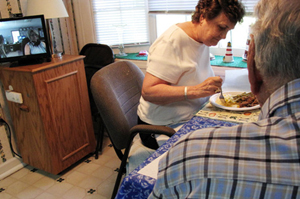
Edward and Lavinia Fitzgerald in Savannah, Ga., have dinner while telecaregiver Denise Cady of ResCare, a camera monitoring service, looks on. (Jennifer Ludden/NPR)

Part聽three in a four-part series

The boomer generation that has grown up with e-mail, cell phones and video cameras is now using all of these things to help care for their aging parents. That’s leading to some odd dinnertime scenes, like the one that plays out every evening in the ranch house of Edward and Lavinia Fitzgerald in Savannah, Ga.

They settle at their small kitchen table as their daughter Colleen Henry dishes out the homemade meat loaf, mashed potatoes and green beans that she has brought over. Edward’s health is failing now that he’s 83, and his wife suffered brain damage from a stroke.

“Here’s your ketchup,” Colleen says, as she puts the bottle on the table along with the salt shaker.

It could be dinnertime anywhere, but for one thing: There’s an extra guest at this meal.

“How’s the weather down there?”

That voice comes from a woman who appears on a computer monitor next to the kitchen table.

“Oh, that’s Denise,” Edward explains. “That’s our good friend!”

Actually, Denise Cady is what’s called a “telecaregiver,” and for two years she has been checking on the Fitzgeralds every evening from Lafayette, Ind. She joins in the mealtime chatter just like a friend who dropped by. Cady asks about the Fitzgeralds’ family and neighbors, swaps jokes about the hot weather and chats with Colleen about the meal.

“Oooh, looks good,” Cady says. “Are those fresh green beans?”

The scene may not seem so strange in the era of Skype, when many people use the computer to keep in touch with far-flung relatives. But Cady can see almost every move the Fitzgeralds make. Their house is wired with video cameras, like something out of a sci-fi movie, though, at first, you don’t notice it.

Seeing Everything

Edward points out a camera in the kitchen ceiling. It’s enclosed in a dark-tinted bubble, but you can hear it swivel when it turns to scan the adjoining living room and dining room.

Another camera monitors who enters the front door. It can pan down a hall to show who goes into the bedroom and bathroom, though it can’t see into those rooms. Colleen admits that the idea of video monitoring made her wary at first.

In addition to camera monitoring, companies offer other kinds of services to help keep track of an elderly person’s daily activities.

Some use motion sensors to monitor someone’s movement around the house, and daily tasks like preparing coffee. If a sensor detects that, say, Grandpa has been in the bathroom too long, a relative can be notified by cell phone or text. Companies that specialize in this kind of monitoring — such as , and — provide detailed activity information for loved ones to see on a private website.

Medical alert services like and offer emergency help at the push of a button. A similar service offered by can also detect falls, instead of relying on the user to push the button.

Still other services like and Philips Lifeline’s offer reminders to take medication or, in the case of , provide automated daily check-in calls and will alert others when there’s no answer.

“I was thinking all sorts of things,” she says with a laugh. “My dad sitting around in his underwear. My mother – I just thought these people are going to see everything, you know. And it bothered me.”

But after her mom broke her ankle two years ago, Colleen became overwhelmed with the duties of caring for her aging parents. And she worried constantly when she wasn’t with them. What if her dad had a heart attack? What if her mom had another stroke?

“The burden’s on me if something happened,” she says.

Desperate for help, Colleen discovered a new video monitoring service and signed them up. It has turned out to be a huge relief for her dad, as well.

As with many elderly spouses, his wife’s condition had thrown Edward into the exhausting role of full-time caregiver. Now, with the cameras on, he gets out of the house for daily mass and a gab session with his buddies at McDonald’s.

“We go down there and sit around and talk,” he says. “That telephone will ring, and I’m home in five minutes.”

Cady or another telecaregiver calls Edward’s cell phone if they worry that Lavinia is staying in the bathroom a bit too long. They’ve called a couple of times when she had fallen and couldn’t get back up. They also alert Colleen and even call in the middle of the night if something seems wrong.

“They’re diligent,” Edward says. “They’re on the ball. And I like it.”

Zooming In

But what about this hi-tech invasion of Edward’s privacy? He says he has no problem with it. He worries more about strangers coming into the house. A home health aide does come to get his wife bathed and dressed every day, and Colleen is grateful the cameras can monitor the quality of that care.

The company that’s monitoring the Fitzgerald house is called ResCare. At its offices in Lafayette, Ind., telecaregiver Cady sits before two large computer screens. On one, you can see the Fitzgeralds in Savannah, eating their dinner as Cady chats with them.

There are also thumbnail video images of two-dozen other homes, which Cady will check in with over the course of her shift. If one client signals for help, that image pops up larger. Children of her clients can log into the same video Cady watches and monitor their parents themselves.

This long-distance care isn’t cheap. ResCare’s services start at $600 a month and can run well over $1,000 depending on how much active monitoring is needed. But that’s still a lot less than the average nursing home.

“Primarily the people using this at this time are in the beginning stages of Alzheimer’s or dementia,” says Nel Taylor of ResCare.

She says a telecaregiver can remind people to take their medication at a certain time. They can alert a relative if someone appears confused or in distress. They can help with the simple tasks of daily life, like the time a client was about to sit down to breakfast.

“The telecaregiver zoomed in on the frying pan and said, ‘Maybe you ought to cook the sausage and the eggs a little longer. The eggs look kind of runny and the sausage is pink,’ ” Taylor says.

A New Paradigm

No doubt, starring in your own daily reality show won’t appeal to everyone. But there are all kinds of remote monitoring systems popping up to keep tabs on a fast-aging population. Most use sensors placed around the house and alert children to every mundane detail of their parents’ day: when they get in and out of bed, sit on the sofa, open the refrigerator door or turn on the air conditioning. ResCare’s Taylor says all of the research and startup companies are driven by this simple equation.

“At the same time that we have this huge population of aging folks, we have a shrinking population of caregivers, of younger people able to provide the care that these older people are going to need,” she says. “If we don’t find other ways [to do that], then we are really going to be in big trouble in the future.”

Back in Savannah, Colleen scoops out some extra banana pudding for her parents as she chats with Cady on the monitor.

“I was going to leave the whole dish, but I thought better of it,” Colleen says.

Cady laughs. “It would be gone by tomorrow morning, I’m telling ya!”

Colleen says she assumed video monitoring would help keep her parents healthy and at home. But she had no idea it would also provide her parents with a new friend.

“You see how old people are just lonely,” she says. “This makes Momma and Daddy happy.”

And Colleen admits that it relieves her own guilt at not being around even more.

As her parents keep talking with Cady, Colleen packs up the dishes, shouts out a goodbye and heads for the door. She leaves her parents for the night, reassured that they’re not really alone.

麻豆女优 Health News is a national newsroom that produces in-depth journalism about health issues and is one of the core operating programs at 麻豆女优鈥攁n independent source of health policy research, polling, and journalism. Learn more about .

This <a target="_blank" href="/aging/wired-homes-aging-npr/">article</a&gt; first appeared on <a target="_blank" href="">麻豆女优 Health News</a> and is republished here under a <a target="_blank" href=" Commons Attribution-NonCommercial-NoDerivatives 4.0 International License</a>.<img src="/wp-content/uploads/sites/8/2023/04/kffhealthnews-icon.png?w=150&quot; style="width:1em;height:1em;margin-left:10px;">

<img id="republication-tracker-tool-source" src="/?republication-pixel=true&post=30370&amp;ga4=G-J74WWTKFM0&quot; style="width:1px;height:1px;">]]>
/aging/wired-homes-aging-npr/feed/ 0 30370
High-Tech Aging: Tracking Seniors’ Every Move /aging/high-tech-aging-npr/ /aging/high-tech-aging-npr/#respond Tue, 24 Aug 2010 11:48:00 +0000 http://khn.wp.alley.ws/news/high-tech-aging-npr/

This story comes from our partner

Part two in a four-part series

When Lida Lee Bridgers’ mother had a stroke a few years back, Bridgers and her husband moved in with her in Austin, Texas. But that left them house-bound.

“She was not very steady on her feet,” Bridgers says, “and doing the surfing-the-furniture type thing. And so we were real reluctant to leave her alone.”

Bridgers’ husband, Chris, was in IT, so he set up some motion sensors around their home and linked them to a computer. They were worried about a fall, especially in the bathroom.

“If she was in the bathroom more than 30 minutes, it would send a text message on our cell phone,” Lida Bridgers says.

From that, a business grew. This year, the couple launched , one of a growing number of startups that use monitoring technology to revolutionize elder care. These companies are also betting on a big market as the baby boomers enter old age.

Chris Bridgers says a basic package includes about a dozen motion sensors placed strategically around a house. They can provide adult children with a stunningly detailed rundown of a parent’s day.

“They may know that their mother got up in the morning, that she’s been to the kitchen, she’s opened the refrigerator, she’s taken her medicine,” he says.

The sensors can even note when Mom makes her coffee and sits in her favorite chair. The idea is to alert children with a phone call or text message when anything unusual happens.

Lida Bridgers warns that every mundane habit will come to light with this kind of monitoring. Some clients, for example, insist that they’re sound asleep all night.

“Come to find out, they’re out of bed for two hours at night,” she says with a laugh. “They’re in the kitchen, the bathroom – the refrigerator was open three times. The kids don’t need alerts because Grandpa wants a glass of milk!”

Sharing Information

“Well, it’s frightening to me. It’s like Orwell,” says Nancy Schlossberg, a counseling psychologist who focuses on . She wonders if all of this monitoring really means it’s time to consider assisted living. But, if a family goes the high-tech route, Schlossberg hopes they ask Mom and Dad first.

“It is really important not to feel marginalized, not to feel degraded because you are old,” Schlossberg says. “So, if the technology can make you feel good about yourself, that’s fine. If it is a way of looking at you, inspecting you, then it isn’t so good.”

The AgeLab at MIT uses radio frequency tags like this one to monitor, say, when people pick up a pill bottle or where they left their eyeglasses. The AgeLab at MIT uses radio frequency tags like this one to monitor, say, when people pick up a pill bottle or where they left their eyeglasses.

Researchers insist that technology can improve quality of life, and they’re coming up with all kinds of new things to monitor.

At the AgeLab at MIT, Joe Coughlin is deploying the same technology NASA uses to track supplies in the space station.

“You can go on to a Web browser and find out exactly what is in Mom’s kitchen, or what medication has been taken or not taken,” he says.

The key is tiny radio frequency tags, which Earth-bound retailers already use for inventory. These would signal when a parent picked up, say, a particular bottle of medicine.

Of course that doesn’t mean Dad actually took those pills, so Coughlin is developing a Smart Trash Can to track the pill bottles as they’re thrown out. He says this technology could also monitor whether Mom is eating enough good meals, since nutrition is a common problem for elderly people living alone.

Moving on to the bathroom, MIT professor Oli de Weck envisions sensors on toothbrushes.

“There are even electric sensors that can measure how much pressure did you apply to the toothbrush when you brushed your teeth,” de Weck says.

Does this sound like way too much information-sharing? For some, no doubt. But Coughlin says it can help get beyond simply reacting to a crisis.

“Where we’re moving is predictive,” he says. “A change in your walk, a change in the time you’ve made coffee or tea, may indicate that you’re not feeling well. So the idea is to be able to intervene before you fall, before you have an issue.”

And that, Coughlin says, can help keep a loved one on their own even longer.

麻豆女优 Health News is a national newsroom that produces in-depth journalism about health issues and is one of the core operating programs at 麻豆女优鈥攁n independent source of health policy research, polling, and journalism. Learn more about .

This <a target="_blank" href="/aging/high-tech-aging-npr/">article</a&gt; first appeared on <a target="_blank" href="">麻豆女优 Health News</a> and is republished here under a <a target="_blank" href=" Commons Attribution-NonCommercial-NoDerivatives 4.0 International License</a>.<img src="/wp-content/uploads/sites/8/2023/04/kffhealthnews-icon.png?w=150&quot; style="width:1em;height:1em;margin-left:10px;">

<img id="republication-tracker-tool-source" src="/?republication-pixel=true&post=30366&amp;ga4=G-J74WWTKFM0&quot; style="width:1px;height:1px;">]]>
/aging/high-tech-aging-npr/feed/ 0 30366
Seniors Finding Long-Term Care Close To Home /aging/village-long-term-care-npr/ /aging/village-long-term-care-npr/#respond Mon, 23 Aug 2010 17:29:00 +0000 http://khn.wp.alley.ws/news/village-long-term-care-npr/

This story comes from our partner

Seniors Finding Long-Term Care Close To Home

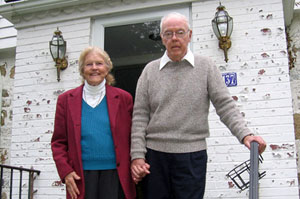
Betty and Jack O’Connor want to stay in their Chevy Chase, Md., home as they age and are trying to create a network of volunteers in their neighborhood, called a “village,” to help them with tasks they can no longer handle. (Jennifer Ludden/NPR)

Part one in a four-part series

In Chevy Chase, Md., Betty and Jack O’Connor are part of a growing number of people banding together to help each other grow old at home.

Betty is 80, Jack, 85, and it’s something of a triumph that they’re still living independently in their suburban house, with its backyard garden and pool.

Jack suffered a brain injury in a fall five years ago. Since then, a hip replacement has left him frail, and an allergic reaction to the anesthesia in that operation stole even more of his memory.

“This is my miracle man,” Betty says. “And Jack and I do not want to leave the house.”

“Oh, no,” Jack agrees. “I don’t know what the alternatives are, but I can’t think of a good one.”

Actually, Betty knows exactly what the alternatives are. She has visited friends in assisted living and nursing homes, and she says she finds such places depressing.

“We like to be around young people,” she says. “There’s so many walkers over there, and I feel sorry for them because they’re in these long corridors.”

So the O’Connors have a plan: If and when Jack can no longer climb the stairs, they’ll convert their first-floor family room to a bedroom. But they’ll still need help, so Betty has begun recruiting friends and neighbors to help create what’s called a “village,” an organized network of volunteers dedicated to doing what’s needed for seniors to stay in their own homes. For an annual fee, these communities help seniors manage household tasks they can no longer handle and arrange transportation when they can no longer drive.

Creating A Village

There are already 50 of these nonprofit groups around the country, with 100 more in the works – and it’s a trend that’s expected to gain steam as baby boomers hit their golden years. Village organizers say the key is training seniors to reach out and request help, something that doesn’t come easily.

“We spend our lives from childhood being told, ‘Be independent, do this for yourselves,’ ” says Gail Kohn, executive director of Capitol Hill Village in Washington, D.C. “Then we get to a certain point when we say, ‘We want you to ask.’ That’s alien to all of us, and it feels like dependence.”

In three years, Capitol Hill Village has signed up 350 members. The $500 to $800 annual fee pays for a small staff, which helps coordinate a long list of volunteers.

The village office is a borrowed row-house basement, where Julie Maggioncalda manned the 24-hour telephone help line one recent morning. She connected one member with a carpet cleaner, one of an array of vendors the village vets for reasonable rates and reliability. On another call, she lined up a volunteer to water someone’s garden. Organizers stress that no need is too small.

A lot of villages are in better-off neighborhoods, but Capitol Hill and others use private grants or public money so they can offer a steeply discounted annual fee to those who need it.

And frequent callers may well get their money’s worth.

Kohn says tech help is a big need: ” ‘Fix my computer,’ [or,] ‘Program my watch,’ or, ‘Why is it that I can’t download that?’ “

Transportation is also popular. The village coordinates rides to doctors’ appointments, the grocery store and the airport. It has sent volunteers to ride along in the ambulance when members have had to go to the emergency room. There are also regular social outings, plus activities geared to keep members in shape.

“We have a third of our volunteers who are 30 and younger,” Kohn says, “and they very much like playing Wii with our members, which helps the members with balance.”

The village even sponsors a monthly balance class in the basement of the local library. The aim is to help prevent a dangerous spill in the shower or a tumble down the stairs.

Exercise, tech help and car rides may sound like small stuff, but added together, such support can have a huge impact. Members say it can make the difference between feeling the need to move into assisted living and having the confidence to stick it out on one’s own for a few more months – or even years.

A Support Group

On a leafy Washington side street, Patricia Witt, 75, slowly climbs out of a car in front of her white brick townhouse. She wears those boxy, black sunglasses that seniors like, and she’s leaning on a walking cane. A village volunteer has just brought her home from yet another doctor’s appointment and escorts her to the door.
Seniors Finding Long-Term Care Close To Home

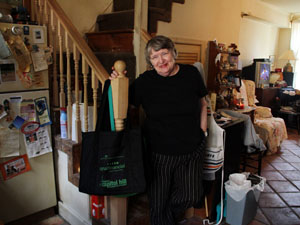
Patricia Witt credits the Capitol Hill Village for helping her stay in her home. Volunteers drive her to doctors’ appointments and help with household repairs. (Becky Lettenberger/NPR)

“Well, thank you very much,” she tells him as she fumbles for her keys. Witt has nearly lost sight in one eye and is recovering from surgery in the other. She has also had a heart valve replaced. She can’t bear the thought of leaving her home but admits that she has begun to feel vulnerable.

“I’m so afraid I’m going to fall,” she says. “So then, of course, I’ve got stairs here.” They’re steep and narrow. But in her desire for independence, Witt even rationalizes that.

“I could go up on my knees, actually. I can crawl upstairs,” she says.

But her open front stoop had become a menace. Capitol Hill Village found a handyman to put up a railing. The village rides save her cab money. Mostly, though, knowing that she has a support group to call on means her children – who live in the Midwest – don’t have to worry so much.

“I love my children, and they’re very supportive of me,” she says. “But you can’t live together. It’s very difficult.”

For as long as possible, Witt hopes the village can help maintain her privacy and independence in the home she loves.

Related, earlier KHN story:

For Senior Care, Sometimes It Does Take A Village

(Gleckman, 2/9)

麻豆女优 Health News is a national newsroom that produces in-depth journalism about health issues and is one of the core operating programs at 麻豆女优鈥攁n independent source of health policy research, polling, and journalism. Learn more about .

This <a target="_blank" href="/aging/village-long-term-care-npr/">article</a&gt; first appeared on <a target="_blank" href="">麻豆女优 Health News</a> and is republished here under a <a target="_blank" href=" Commons Attribution-NonCommercial-NoDerivatives 4.0 International License</a>.<img src="/wp-content/uploads/sites/8/2023/04/kffhealthnews-icon.png?w=150&quot; style="width:1em;height:1em;margin-left:10px;">

<img id="republication-tracker-tool-source" src="/?republication-pixel=true&post=30493&amp;ga4=G-J74WWTKFM0&quot; style="width:1px;height:1px;">]]>
/aging/village-long-term-care-npr/feed/ 0 30493
Jennifer Ludden, NPR News, Author at 麻豆女优 Health News 麻豆女优 Health News produces in-depth journalism on health issues and is a core operating program of 麻豆女优. Thu, 16 Apr 2026 06:05:19 +0000 en-US hourly 1 https://wordpress.org/?v=6.8.5 /wp-content/uploads/sites/8/2023/04/kffhealthnews-icon.png?w=32 Jennifer Ludden, NPR News, Author at 麻豆女优 Health News 32 32 161476233 AARP Finds Toll On Family Caregivers Is ‘Huge’ /health-industry/npr-caregivers/ /health-industry/npr-caregivers/#respond Mon, 18 Jul 2011 10:50:05 +0000 http://khn.wp.alley.ws/news/npr-caregivers/ A estimates that for the more than 40 million Americans caring for an elderly or disabled loved one, the value of their work is $450 billion a year.

That’s a good deal for society. But for the family members doing the work, the study finds they need a lot more help.

Take Cymando Henley, 36, whose mother was diagnosed with multiple sclerosis when he was starting college. She’s now wheelchair bound, and Henley has been taking care of her for nearly two decades.

Henley does have help. Montgomery County, Md., where they live, and the MS Society, pay for a combined 35 hours of home health aides each week – though that’s threatened by budget cuts.

But every day, Henley must help his mom in and out of bed and onto the toilet. He even rolls her over in the middle of the night if she becomes uncomfortable. Care like this from a professional can cost tens of thousands of dollars a year. But Henley does it for free, and it’s on top of his full-time job. The AARP study finds family members spend an average 20 hours a week providing care. Henley refuses to count, but his mom, Vicki, keeps tab.

“Cymando’s care for me was about 40 hours a week,” she says.

‘The Burden On Families Is Huge’

Modern medicine now allows people to manage chronic conditions for decades. But the AARP study finds increasingly complicated procedures are routinely expected of family caregivers. Henley remembers one time his mom was being discharged from the hospital. She had a catheter in, and the nurse said, ‘Oh, we’ll call and tell you how to take it out over the phone.’

“And I said, ‘Oh, no you will not.’ Cause I’m like really? This is my mother,” he says.

Lynn Feinberg, who co-authored the AARP study, says modern family caregiving is incredibly stressful.

“The burden on families is huge,” Feinberg says. “While families are stepping up to the plate and make this contribution to society, the costs to their own health and financial security is huge.”

The study finds those who cut back work lose hundreds of thousands of dollars in income over a lifetime. Feinberg says caregivers are also more prone to depression, physical ailments and social isolation.

“They will burn out, they will get sick and there will be no other option but to place someone in a nursing home, which is what nobody wants,” Feinberg says.

New Solutions

And if the burden for caregivers seems big now, according to Suzanne Mintz of the National Family Caregivers Associations, it’s only going to get worse as the baby boom generation enters old age.

“Boomers have fewer kids than their parents did, and they’re working, and they don’t necessarily live around the corner anymore,” Mintz says.

On top of this, there’s a shortage of paid home health aides. Last week, the Obama administration joined labor groups calling for the creation of two million more jobs in home health care, plus a new visa for immigrants willing to enter the field.

Mintz has grappled with the problem in caring for her husband, who has multiple sclerosis. Earlier this year she had trouble finding someone to change his catheter twice a week while she was at work. So she says she resorted to something a little crazy.

“With Steven’s permission, I actually put a note on the neighborhood Listserv,” she says.

Sure enough, a man who works from home said he’d be willing to try it. He’s been doing it ever since – for free.

Mintz says we need to expand our definition of “family.” Next year, she plans to launch a recruitment drive to match those in need with volunteers.

“It might be, ‘I can drive her to PT for the next five Thursdays,’ or ‘I can bring meals for the next six months,'” Mintz says.

In other words, create a community of caregivers – an old idea for a new age.

麻豆女优 Health News is a national newsroom that produces in-depth journalism about health issues and is one of the core operating programs at 麻豆女优鈥攁n independent source of health policy research, polling, and journalism. Learn more about .

This <a target="_blank" href="/health-industry/npr-caregivers/">article</a&gt; first appeared on <a target="_blank" href="">麻豆女优 Health News</a> and is republished here under a <a target="_blank" href=" Commons Attribution-NonCommercial-NoDerivatives 4.0 International License</a>.<img src="/wp-content/uploads/sites/8/2023/04/kffhealthnews-icon.png?w=150&quot; style="width:1em;height:1em;margin-left:10px;">

<img id="republication-tracker-tool-source" src="/?republication-pixel=true&post=27683&amp;ga4=G-J74WWTKFM0&quot; style="width:1px;height:1px;">]]>
/health-industry/npr-caregivers/feed/ 0 27683
Wired Homes Keep Tabs On Aging Parents /aging/wired-homes-aging-npr/ /aging/wired-homes-aging-npr/#respond Tue, 24 Aug 2010 11:49:00 +0000 http://khn.wp.alley.ws/news/wired-homes-aging-npr/

This story comes from our partner

Wired Homes Keep Tabs On Aging Parents

Edward and Lavinia Fitzgerald in Savannah, Ga., have dinner while telecaregiver Denise Cady of ResCare, a camera monitoring service, looks on. (Jennifer Ludden/NPR)

Part聽three in a four-part series

The boomer generation that has grown up with e-mail, cell phones and video cameras is now using all of these things to help care for their aging parents. That’s leading to some odd dinnertime scenes, like the one that plays out every evening in the ranch house of Edward and Lavinia Fitzgerald in Savannah, Ga.

They settle at their small kitchen table as their daughter Colleen Henry dishes out the homemade meat loaf, mashed potatoes and green beans that she has brought over. Edward’s health is failing now that he’s 83, and his wife suffered brain damage from a stroke.

“Here’s your ketchup,” Colleen says, as she puts the bottle on the table along with the salt shaker.

It could be dinnertime anywhere, but for one thing: There’s an extra guest at this meal.

“How’s the weather down there?”

That voice comes from a woman who appears on a computer monitor next to the kitchen table.

“Oh, that’s Denise,” Edward explains. “That’s our good friend!”

Actually, Denise Cady is what’s called a “telecaregiver,” and for two years she has been checking on the Fitzgeralds every evening from Lafayette, Ind. She joins in the mealtime chatter just like a friend who dropped by. Cady asks about the Fitzgeralds’ family and neighbors, swaps jokes about the hot weather and chats with Colleen about the meal.

“Oooh, looks good,” Cady says. “Are those fresh green beans?”

The scene may not seem so strange in the era of Skype, when many people use the computer to keep in touch with far-flung relatives. But Cady can see almost every move the Fitzgeralds make. Their house is wired with video cameras, like something out of a sci-fi movie, though, at first, you don’t notice it.

Seeing Everything

Edward points out a camera in the kitchen ceiling. It’s enclosed in a dark-tinted bubble, but you can hear it swivel when it turns to scan the adjoining living room and dining room.

Another camera monitors who enters the front door. It can pan down a hall to show who goes into the bedroom and bathroom, though it can’t see into those rooms. Colleen admits that the idea of video monitoring made her wary at first.

In addition to camera monitoring, companies offer other kinds of services to help keep track of an elderly person’s daily activities.

Some use motion sensors to monitor someone’s movement around the house, and daily tasks like preparing coffee. If a sensor detects that, say, Grandpa has been in the bathroom too long, a relative can be notified by cell phone or text. Companies that specialize in this kind of monitoring — such as , and — provide detailed activity information for loved ones to see on a private website.

Medical alert services like and offer emergency help at the push of a button. A similar service offered by can also detect falls, instead of relying on the user to push the button.

Still other services like and Philips Lifeline’s offer reminders to take medication or, in the case of , provide automated daily check-in calls and will alert others when there’s no answer.

“I was thinking all sorts of things,” she says with a laugh. “My dad sitting around in his underwear. My mother – I just thought these people are going to see everything, you know. And it bothered me.”

But after her mom broke her ankle two years ago, Colleen became overwhelmed with the duties of caring for her aging parents. And she worried constantly when she wasn’t with them. What if her dad had a heart attack? What if her mom had another stroke?

“The burden’s on me if something happened,” she says.

Desperate for help, Colleen discovered a new video monitoring service and signed them up. It has turned out to be a huge relief for her dad, as well.

As with many elderly spouses, his wife’s condition had thrown Edward into the exhausting role of full-time caregiver. Now, with the cameras on, he gets out of the house for daily mass and a gab session with his buddies at McDonald’s.

“We go down there and sit around and talk,” he says. “That telephone will ring, and I’m home in five minutes.”

Cady or another telecaregiver calls Edward’s cell phone if they worry that Lavinia is staying in the bathroom a bit too long. They’ve called a couple of times when she had fallen and couldn’t get back up. They also alert Colleen and even call in the middle of the night if something seems wrong.

“They’re diligent,” Edward says. “They’re on the ball. And I like it.”

Zooming In

But what about this hi-tech invasion of Edward’s privacy? He says he has no problem with it. He worries more about strangers coming into the house. A home health aide does come to get his wife bathed and dressed every day, and Colleen is grateful the cameras can monitor the quality of that care.

The company that’s monitoring the Fitzgerald house is called ResCare. At its offices in Lafayette, Ind., telecaregiver Cady sits before two large computer screens. On one, you can see the Fitzgeralds in Savannah, eating their dinner as Cady chats with them.

There are also thumbnail video images of two-dozen other homes, which Cady will check in with over the course of her shift. If one client signals for help, that image pops up larger. Children of her clients can log into the same video Cady watches and monitor their parents themselves.

This long-distance care isn’t cheap. ResCare’s services start at $600 a month and can run well over $1,000 depending on how much active monitoring is needed. But that’s still a lot less than the average nursing home.

“Primarily the people using this at this time are in the beginning stages of Alzheimer’s or dementia,” says Nel Taylor of ResCare.

She says a telecaregiver can remind people to take their medication at a certain time. They can alert a relative if someone appears confused or in distress. They can help with the simple tasks of daily life, like the time a client was about to sit down to breakfast.

“The telecaregiver zoomed in on the frying pan and said, ‘Maybe you ought to cook the sausage and the eggs a little longer. The eggs look kind of runny and the sausage is pink,’ ” Taylor says.

A New Paradigm

No doubt, starring in your own daily reality show won’t appeal to everyone. But there are all kinds of remote monitoring systems popping up to keep tabs on a fast-aging population. Most use sensors placed around the house and alert children to every mundane detail of their parents’ day: when they get in and out of bed, sit on the sofa, open the refrigerator door or turn on the air conditioning. ResCare’s Taylor says all of the research and startup companies are driven by this simple equation.

“At the same time that we have this huge population of aging folks, we have a shrinking population of caregivers, of younger people able to provide the care that these older people are going to need,” she says. “If we don’t find other ways [to do that], then we are really going to be in big trouble in the future.”

Back in Savannah, Colleen scoops out some extra banana pudding for her parents as she chats with Cady on the monitor.

“I was going to leave the whole dish, but I thought better of it,” Colleen says.

Cady laughs. “It would be gone by tomorrow morning, I’m telling ya!”

Colleen says she assumed video monitoring would help keep her parents healthy and at home. But she had no idea it would also provide her parents with a new friend.

“You see how old people are just lonely,” she says. “This makes Momma and Daddy happy.”

And Colleen admits that it relieves her own guilt at not being around even more.

As her parents keep talking with Cady, Colleen packs up the dishes, shouts out a goodbye and heads for the door. She leaves her parents for the night, reassured that they’re not really alone.

麻豆女优 Health News is a national newsroom that produces in-depth journalism about health issues and is one of the core operating programs at 麻豆女优鈥攁n independent source of health policy research, polling, and journalism. Learn more about .

This <a target="_blank" href="/aging/wired-homes-aging-npr/">article</a&gt; first appeared on <a target="_blank" href="">麻豆女优 Health News</a> and is republished here under a <a target="_blank" href=" Commons Attribution-NonCommercial-NoDerivatives 4.0 International License</a>.<img src="/wp-content/uploads/sites/8/2023/04/kffhealthnews-icon.png?w=150&quot; style="width:1em;height:1em;margin-left:10px;">

<img id="republication-tracker-tool-source" src="/?republication-pixel=true&post=30370&amp;ga4=G-J74WWTKFM0&quot; style="width:1px;height:1px;">]]>
/aging/wired-homes-aging-npr/feed/ 0 30370
High-Tech Aging: Tracking Seniors’ Every Move /aging/high-tech-aging-npr/ /aging/high-tech-aging-npr/#respond Tue, 24 Aug 2010 11:48:00 +0000 http://khn.wp.alley.ws/news/high-tech-aging-npr/

This story comes from our partner

Part two in a four-part series

When Lida Lee Bridgers’ mother had a stroke a few years back, Bridgers and her husband moved in with her in Austin, Texas. But that left them house-bound.

“She was not very steady on her feet,” Bridgers says, “and doing the surfing-the-furniture type thing. And so we were real reluctant to leave her alone.”

Bridgers’ husband, Chris, was in IT, so he set up some motion sensors around their home and linked them to a computer. They were worried about a fall, especially in the bathroom.

“If she was in the bathroom more than 30 minutes, it would send a text message on our cell phone,” Lida Bridgers says.

From that, a business grew. This year, the couple launched , one of a growing number of startups that use monitoring technology to revolutionize elder care. These companies are also betting on a big market as the baby boomers enter old age.

Chris Bridgers says a basic package includes about a dozen motion sensors placed strategically around a house. They can provide adult children with a stunningly detailed rundown of a parent’s day.

“They may know that their mother got up in the morning, that she’s been to the kitchen, she’s opened the refrigerator, she’s taken her medicine,” he says.

The sensors can even note when Mom makes her coffee and sits in her favorite chair. The idea is to alert children with a phone call or text message when anything unusual happens.

Lida Bridgers warns that every mundane habit will come to light with this kind of monitoring. Some clients, for example, insist that they’re sound asleep all night.

“Come to find out, they’re out of bed for two hours at night,” she says with a laugh. “They’re in the kitchen, the bathroom – the refrigerator was open three times. The kids don’t need alerts because Grandpa wants a glass of milk!”

Sharing Information

“Well, it’s frightening to me. It’s like Orwell,” says Nancy Schlossberg, a counseling psychologist who focuses on . She wonders if all of this monitoring really means it’s time to consider assisted living. But, if a family goes the high-tech route, Schlossberg hopes they ask Mom and Dad first.

“It is really important not to feel marginalized, not to feel degraded because you are old,” Schlossberg says. “So, if the technology can make you feel good about yourself, that’s fine. If it is a way of looking at you, inspecting you, then it isn’t so good.”

The AgeLab at MIT uses radio frequency tags like this one to monitor, say, when people pick up a pill bottle or where they left their eyeglasses. The AgeLab at MIT uses radio frequency tags like this one to monitor, say, when people pick up a pill bottle or where they left their eyeglasses.

Researchers insist that technology can improve quality of life, and they’re coming up with all kinds of new things to monitor.

At the AgeLab at MIT, Joe Coughlin is deploying the same technology NASA uses to track supplies in the space station.

“You can go on to a Web browser and find out exactly what is in Mom’s kitchen, or what medication has been taken or not taken,” he says.

The key is tiny radio frequency tags, which Earth-bound retailers already use for inventory. These would signal when a parent picked up, say, a particular bottle of medicine.

Of course that doesn’t mean Dad actually took those pills, so Coughlin is developing a Smart Trash Can to track the pill bottles as they’re thrown out. He says this technology could also monitor whether Mom is eating enough good meals, since nutrition is a common problem for elderly people living alone.

Moving on to the bathroom, MIT professor Oli de Weck envisions sensors on toothbrushes.

“There are even electric sensors that can measure how much pressure did you apply to the toothbrush when you brushed your teeth,” de Weck says.

Does this sound like way too much information-sharing? For some, no doubt. But Coughlin says it can help get beyond simply reacting to a crisis.

“Where we’re moving is predictive,” he says. “A change in your walk, a change in the time you’ve made coffee or tea, may indicate that you’re not feeling well. So the idea is to be able to intervene before you fall, before you have an issue.”

And that, Coughlin says, can help keep a loved one on their own even longer.

麻豆女优 Health News is a national newsroom that produces in-depth journalism about health issues and is one of the core operating programs at 麻豆女优鈥攁n independent source of health policy research, polling, and journalism. Learn more about .

This <a target="_blank" href="/aging/high-tech-aging-npr/">article</a&gt; first appeared on <a target="_blank" href="">麻豆女优 Health News</a> and is republished here under a <a target="_blank" href=" Commons Attribution-NonCommercial-NoDerivatives 4.0 International License</a>.<img src="/wp-content/uploads/sites/8/2023/04/kffhealthnews-icon.png?w=150&quot; style="width:1em;height:1em;margin-left:10px;">

<img id="republication-tracker-tool-source" src="/?republication-pixel=true&post=30366&amp;ga4=G-J74WWTKFM0&quot; style="width:1px;height:1px;">]]>
/aging/high-tech-aging-npr/feed/ 0 30366
Seniors Finding Long-Term Care Close To Home /aging/village-long-term-care-npr/ /aging/village-long-term-care-npr/#respond Mon, 23 Aug 2010 17:29:00 +0000 http://khn.wp.alley.ws/news/village-long-term-care-npr/

This story comes from our partner

Seniors Finding Long-Term Care Close To Home

Betty and Jack O’Connor want to stay in their Chevy Chase, Md., home as they age and are trying to create a network of volunteers in their neighborhood, called a “village,” to help them with tasks they can no longer handle. (Jennifer Ludden/NPR)

Part one in a four-part series

In Chevy Chase, Md., Betty and Jack O’Connor are part of a growing number of people banding together to help each other grow old at home.

Betty is 80, Jack, 85, and it’s something of a triumph that they’re still living independently in their suburban house, with its backyard garden and pool.

Jack suffered a brain injury in a fall five years ago. Since then, a hip replacement has left him frail, and an allergic reaction to the anesthesia in that operation stole even more of his memory.

“This is my miracle man,” Betty says. “And Jack and I do not want to leave the house.”

“Oh, no,” Jack agrees. “I don’t know what the alternatives are, but I can’t think of a good one.”

Actually, Betty knows exactly what the alternatives are. She has visited friends in assisted living and nursing homes, and she says she finds such places depressing.

“We like to be around young people,” she says. “There’s so many walkers over there, and I feel sorry for them because they’re in these long corridors.”

So the O’Connors have a plan: If and when Jack can no longer climb the stairs, they’ll convert their first-floor family room to a bedroom. But they’ll still need help, so Betty has begun recruiting friends and neighbors to help create what’s called a “village,” an organized network of volunteers dedicated to doing what’s needed for seniors to stay in their own homes. For an annual fee, these communities help seniors manage household tasks they can no longer handle and arrange transportation when they can no longer drive.

Creating A Village

There are already 50 of these nonprofit groups around the country, with 100 more in the works – and it’s a trend that’s expected to gain steam as baby boomers hit their golden years. Village organizers say the key is training seniors to reach out and request help, something that doesn’t come easily.

“We spend our lives from childhood being told, ‘Be independent, do this for yourselves,’ ” says Gail Kohn, executive director of Capitol Hill Village in Washington, D.C. “Then we get to a certain point when we say, ‘We want you to ask.’ That’s alien to all of us, and it feels like dependence.”

In three years, Capitol Hill Village has signed up 350 members. The $500 to $800 annual fee pays for a small staff, which helps coordinate a long list of volunteers.

The village office is a borrowed row-house basement, where Julie Maggioncalda manned the 24-hour telephone help line one recent morning. She connected one member with a carpet cleaner, one of an array of vendors the village vets for reasonable rates and reliability. On another call, she lined up a volunteer to water someone’s garden. Organizers stress that no need is too small.

A lot of villages are in better-off neighborhoods, but Capitol Hill and others use private grants or public money so they can offer a steeply discounted annual fee to those who need it.

And frequent callers may well get their money’s worth.

Kohn says tech help is a big need: ” ‘Fix my computer,’ [or,] ‘Program my watch,’ or, ‘Why is it that I can’t download that?’ “

Transportation is also popular. The village coordinates rides to doctors’ appointments, the grocery store and the airport. It has sent volunteers to ride along in the ambulance when members have had to go to the emergency room. There are also regular social outings, plus activities geared to keep members in shape.

“We have a third of our volunteers who are 30 and younger,” Kohn says, “and they very much like playing Wii with our members, which helps the members with balance.”

The village even sponsors a monthly balance class in the basement of the local library. The aim is to help prevent a dangerous spill in the shower or a tumble down the stairs.

Exercise, tech help and car rides may sound like small stuff, but added together, such support can have a huge impact. Members say it can make the difference between feeling the need to move into assisted living and having the confidence to stick it out on one’s own for a few more months – or even years.

A Support Group

On a leafy Washington side street, Patricia Witt, 75, slowly climbs out of a car in front of her white brick townhouse. She wears those boxy, black sunglasses that seniors like, and she’s leaning on a walking cane. A village volunteer has just brought her home from yet another doctor’s appointment and escorts her to the door.

Seniors Finding Long-Term Care Close To Home

Patricia Witt credits the Capitol Hill Village for helping her stay in her home. Volunteers drive her to doctors’ appointments and help with household repairs. (Becky Lettenberger/NPR)

“Well, thank you very much,” she tells him as she fumbles for her keys. Witt has nearly lost sight in one eye and is recovering from surgery in the other. She has also had a heart valve replaced. She can’t bear the thought of leaving her home but admits that she has begun to feel vulnerable.

“I’m so afraid I’m going to fall,” she says. “So then, of course, I’ve got stairs here.” They’re steep and narrow. But in her desire for independence, Witt even rationalizes that.

“I could go up on my knees, actually. I can crawl upstairs,” she says.

But her open front stoop had become a menace. Capitol Hill Village found a handyman to put up a railing. The village rides save her cab money. Mostly, though, knowing that she has a support group to call on means her children – who live in the Midwest – don’t have to worry so much.

“I love my children, and they’re very supportive of me,” she says. “But you can’t live together. It’s very difficult.”

For as long as possible, Witt hopes the village can help maintain her privacy and independence in the home she loves.

Related, earlier KHN story:

For Senior Care, Sometimes It Does Take A Village

(Gleckman, 2/9)

麻豆女优 Health News is a national newsroom that produces in-depth journalism about health issues and is one of the core operating programs at 麻豆女优鈥攁n independent source of health policy research, polling, and journalism. Learn more about .

This <a target="_blank" href="/aging/village-long-term-care-npr/">article</a&gt; first appeared on <a target="_blank" href="">麻豆女优 Health News</a> and is republished here under a <a target="_blank" href=" Commons Attribution-NonCommercial-NoDerivatives 4.0 International License</a>.<img src="/wp-content/uploads/sites/8/2023/04/kffhealthnews-icon.png?w=150&quot; style="width:1em;height:1em;margin-left:10px;">

<img id="republication-tracker-tool-source" src="/?republication-pixel=true&post=30493&amp;ga4=G-J74WWTKFM0&quot; style="width:1px;height:1px;">]]>
/aging/village-long-term-care-npr/feed/ 0 30493