
After Kaiser Health News and NPR his plight in a story that aired Monday, federal Medicare officials said they would look into the case. Bianco’s appeal of an earlier denial had been rejected by WellCare, a private insurer that contracts with the federal program to provide drug coverage. The insurer rejected coverage saying the combined use of the costly new drugs has not yet been approved by the Food and Drug Administration — even though two doctors’ groups had recommended the protocol in cases like Bianco’s.
Late Tuesday, Bianco’s doctor got word that the earlier denials had been reversed – an unusually fast turnaround for the agency.
“I am very pleased that Mr. Bianco received approval for the treatment he needs,” said Dr. of Mayo Clinic in Scottsdale, Ariz. “I hope all patients in similar (or more urgent) circumstances can be given a fair hearing.”
Bianco, whose liver has been severely damaged by the hepatitis C virus, said Medicare’s reversal “is great news for me, and hopefully for many others, since a precedent has been set now.”
In a statement, Medicare officials indicate that the new policy will apply broadly to hepatitis C patients whose doctors prescribe the combined use of the two drugs because they meet certain criteria laid out in January by the Infectious Diseases Society of America and the American Association for the Study of Liver Diseases. Those guidelines recommend the combined use of the two drugs in patients with advanced liver disease who have failed to be cured by earlier drug regimens – even though the FDA has not yet approved the combination.
Medicare officials say that beneficiaries “are required to have access to needed therapies” if they have demonstrated “medical necessity” and have “medically accepted indications” for the treatment.
The agency is reportedly conferring with medical specialty groups on refining the guidelines about when patients should be treated with which regimens.
For now, Medicare’s Part DÂ plans may decide on a case-by-case basis whether to approve payment for the costly drugs. But if the plans deny payment, consumer advocates say patients will now have a good chance of prevailing because of the new stance by federal officials.
There is little doubt that coverage of the drugs will be a substantial financial burden for the program.
, deputy Medicare administrator, Â summit that the agency hopes to have a handle on potential costs later this year after it receives bids from Part D drug plans which will take the cost of the new treatments into account.
One of them, called , costs $84,000 for a typical 12-week course of treatment, although some patients will need to take the drugs for 24 weeks. The other, , costs about $66,000, but is approved for fewer types of patients. Other drugs must often be used with the two new products, adding to the cost.
The issue of paying for the expensive new drugs – which may cure upwards of 90 percent of patients — is being closely watched by patient advocates, federal health and budget officials, state , the Department of Veterans Affairs, and corrections officials across the country. All face billions of dollars in potential obligations to treat the three to five million Americans infected by the deadly virus.
The publication Inside CMS has reported that Gilead Sciences, maker of Sovaldi, gained 90 percent of the $2.1 billion first-quarter sales of the drug – a record for any new drug – from Medicare and private health insurers. Another 7 percent of sales came from Medicaid.
Medicare officials’ fast response in the Bianco case is an indication of the political sensitivity of rejecting potentially life-saving coverage based at least in part on the drugs’ costs. “We want to try to be as helpful as we can to get beneficiaries the drugs that they need,” a Medicare spokesman said earlier this week.
Or to put it the other way around, no one wants to be the first to say that patients who need the drugs can’t get them– in other words, that hepatitis C has pushed the nation into explicit rationing of life-saving care.
This article was produced by Kaiser Health News with support from .
Â鶹ŮÓÅ Health News is a national newsroom that produces in-depth journalism about health issues and is one of the core operating programs at Â鶹ŮÓÅ—an independent source of health policy research, polling, and journalism. Learn more about .This <a target="_blank" href="/aging/medicare-reverses-denial-of-costly-treatment-for-hepatitis-c-patient/">article</a> first appeared on <a target="_blank" href="">Â鶹ŮÓÅ Health News</a> and is republished here under a <a target="_blank" href=" Commons Attribution-NonCommercial-NoDerivatives 4.0 International License</a>.<img src="/wp-content/uploads/sites/8/2023/04/kffhealthnews-icon.png?w=150" style="width:1em;height:1em;margin-left:10px;">
<img id="republication-tracker-tool-source" src="/?republication-pixel=true&post=7369&ga4=G-J74WWTKFM0" style="width:1px;height:1px;">]]>This KHN story was produced in collaboration with
UPDATE, 5/15/14:
Walter Bianco has had hepatitis-C for 40 years, and his time is running out.
“The liver is at the stage next to becoming cirrhotic,” the 65-year-old Arizona contractor says. Cirrhosis is severe scarring, whether from alcoholism or a chronic viral infection. It’s a fateful step closer to liver failure or liver cancer.

Walter Bianco, 65, at his Arizona home, has had hepatitis-C for more than 40 years. (Photo by Alexandra Olgin/KHN)
If he develops one of these complications, the only possible solution would be a hard-to-get liver transplant. “The alternative,” Bianco says, “is death.”
Previous drug treatments didn’t clear the virus from Bianco’s system. But it’s almost certain that potent new drugs for hep-C could cure him.
However, the private insurer that handles his medication coverage for the federal Medicare program has twice refused to pay for the drugs his doctor has prescribed.
Doctors are seeing more and more patients approaching the end-stage of hep-C infection. “There isn’t a day that goes by when I don’t have a story very similar to Mr. Bianco’s,” says Dr. Hugo Vargas of Mayo Clinic in Scottsdale, AZ, his liver specialist.
Researchers estimate that 3 to 5 million Americans carry the insidious hep-C virus. The biggest concentration is among those born between 1945 and 1965.
Many, like Bianco, got hep-C from injecting street drugs in their youth. He says he’s been drug- and alcohol-free for 32 years, but the infection was permanent.
Other baby boomers got the virus from transfusions before 1992, a period when blood wasn’t screened. Some got it from sharing razors or toothbrushes, or from contaminated tattoo needles or hospital equipment. For some, transmission was sexual, although fortunately this isn’t the highest-risk route.
The timing of these infections spells trouble for Medicare, which insures Americans over 65.
Hepatitis-C is a slow-acting virus. Over a period of 20 to 40 years, it causes liver damage in about 70 percent of people it infects.
A growing number of people who got infected in the 1960s through the 1990s have now “used up” the infection’s latency period, notes Dr. Camilla Graham of Beth Israel Deaconess Hospital in Boston, “which is why we’re now seeing this dramatic increase in the number of people developing complications and dying of hepatitis. And we expect this to continue to increase for the next 10 years.”
Is A Cure Worth $84,000?Â
Another part of Medicare’s problem is that new hep-C medications are among the priciest of any drugs. One called Sovaldi, federally approved last December, costs $1,000 a pill – or $84,000 for a typical 12-week treatment course. The other recently approved drug, Olysio, costs around $66,000. Others in the pipeline are expected to be similarly expensive.
“People were very shocked about the price because it hit a psychological barrier in terms of  ‘this is too expensive,'” Graham says.
She has a patient like Walter Bianco – a 65-year-old woman whose severe liver damage puts her on the edge of liver failure.
Graham believes her patient’s best chance at cure lies in the use of both Sovaldi and Olysio. “We have about 160 people who were studied in a clinical trial called COSMOS that showed a very high cure rate – 90 to 100 percent – for even the most difficult-to-treat patients with this combination,” she says.

Walter Bianco, 65, playing with one of his tropical birds, has had hepatitis-C for more than 40 years. (Photo by Alexandra Olgin/KHN)
But, as in Bianco’s case, the Medicare’s drug-benefit contractor that covers this patient has refused to approve payment.
The apparent reason is that the Food and Drug Administration has not yet approved use of the two drugs in combination. (On May 7, Olysio’s maker, Janssen Therapeutics, asked the agency for such approval.)
But Graham notes that in the early days of successful antiviral drug treatment for HIV, payers allowed doctors to “mix and match” medications in “off-label” or unapproved combinations as they thought best.
“Medicare has been slower to adopt off-label combinations than most of the other insurance plans,” Graham says.
Accelerating Demand
Medicare officials wouldn’t comment on coverage of new hep-C drugs. A spokesman wrote in an email that the federal program turns such decisions over to private insurers that administer its drug plan, called Medicare Part D.
However, advocates say Medicare officials are well aware of the program’s looming exposure to the enormous costs of treating hep-C. Some say it could run in the tens or hundreds of billions of dollars, though it’s not clear over what period of time.
One thing likely to accelerate demand for treatment: Medicare is expected to approve payment for routine blood tests for hep-C infection soon. That will reveal many people who don’t yet know they’re infected – and spark difficult conversations between patients and doctors on when to use the expensive new medications to clear the virus from their blood.
Many hepatitis specialists and patient advocates are worried that the cost of the drugs will lead payers to limit access to patients who already have advanced liver disease, or even more narrowly, those who are on transplant waiting lists.
“We’re very scared that these programs to limit access to treatment could interfere with our goals of trying to find people with hepatitis C,” Graham says.
Ryan Clary of the National Viral Hepatitis Roundtable, a patient advocacy group, says public health may be on a collision course with treatment and reimbursement policy.
“On the one hand, we’re saying ‘Now is the time to be tested for hep-C. There are these promising treatments,'” Clary says. “But on the other hand, we’re saying ‘You can’t have access to these cures. It’ll bankrupt the country.’ So where’s the incentive to test?”
Apart from expensive drug treatment aimed at cure, doctors say there are other good reasons for identifying infected patients. They can be counseled to stay away from alcohol, which accelerates hep-C related liver damage. They can also be told about steps to take to avoid infecting others.
There are other implications of delaying treatment until liver damage is advanced. Once a patient has developed cirrhosis, he’ll need to be monitored every six months for the rest of his life for signs of liver cancer.
And if a patient tips into liver failure or cancer before getting cured, treatment will cost an estimated $50,000 a year – possibly over several years.
“Hepatitis-C is a ticking time bomb,” Graham says. “We have a very limited amount of time to get in here and alter the course of the disease for a good number of people. And we either do that, and we do it well now, or we face a whole lot more people suffering severe complications of this disease.”
While the cost and treatment implications get sorted out, patients like Walter Bianco are in an agonizing limbo. He says he can’t possibly afford the $150,000 it would cost to buy Sovaldi and Olysio on his own.
“It is a lot of money and there are a lot of hep-C sufferers out there,” he says. “I think Medicare’s probably thinking ‘If we can hold off for a year or two, some of these following drugs will be cheaper.'”
But Hugo Vargas, Bianco’s doctor, says it’s urgent to cure his infection now. “If he were my father,” the Mayo specialist says, “I would want Mr. Bianco to be treated now – not in a year, not in a year-and-a-half.”
This article was produced by Kaiser Health News with support from .
Â鶹ŮÓÅ Health News is a national newsroom that produces in-depth journalism about health issues and is one of the core operating programs at Â鶹ŮÓÅ—an independent source of health policy research, polling, and journalism. Learn more about .This <a target="_blank" href="/aging/medicare-struggling-with-hepatitis-c-cure-costs/">article</a> first appeared on <a target="_blank" href="">Â鶹ŮÓÅ Health News</a> and is republished here under a <a target="_blank" href=" Commons Attribution-NonCommercial-NoDerivatives 4.0 International License</a>.<img src="/wp-content/uploads/sites/8/2023/04/kffhealthnews-icon.png?w=150" style="width:1em;height:1em;margin-left:10px;">
<img id="republication-tracker-tool-source" src="/?republication-pixel=true&post=33624&ga4=G-J74WWTKFM0" style="width:1px;height:1px;">]]>The , from the World Health Organization, give strong endorsement to the two newest medicines. Gilead Science’s Sovaldi costs $1,000 per pill/$84,000 for a 12-week course of treatment and Olysio, Janssen Pharmaceuticals, $66,360 for its three-month course.
The high prices have ignited a of . In the United States, doctors and insurers argue that the cost of the drugs will make their widespread use impossible. And critics say even if the prices are heavily discounted in other countries, the drugs will still be unaffordable in most of the world.
The WHO Â of treatment with Sovaldi and Olysio was made without taking the cost of the two drugs into consideration. That’s because the price of the drugs outside the U.S. was unknown in December, when the WHO panel wrapped up its work.
But the price of the drugs isn’t the only issue. The WHO recommends that all 150 million or so people around the globe with chronic hepatitis C infection be assessed for treatment — a gargantuan task in itself. Authors of the report are quick to acknowledge that neither the assessment of people’s health status nor actual treatment will happen anytime soon.
“A lot has to happen for this to really take off in a big way,” says the guidelines’ chief architect, . “Even if prices came down dramatically tomorrow, that doesn’t mean there would be an immediate rush to treatment.”
Screening programs for hepatitis C need to be ramped up. Labs to determine the genetic type of the virus (crucial in choosing treatment regimens) have to be built and staffed. Medical personnel need to be able to assess when viral liver damage has progressed to the point when treatment is urgent. And drugs have to be chosen wisely and administered carefully.
Fewer of Americans with chronic hepatitis C currently have had or are getting any treatment. In Europe, treatment has reached only 3.5 percent. And in most countries, Wiktor says, “hardly anyone is getting treatment.”
Hoping For HIV-Like Success
The WHO guidelines are setting a deliberately high standard in the hope, Wiktor says, of replicating the remarkable dissemination of antiviral therapy for HIV.
Starting from a similar point of little distribution 15 years ago, antiviral treatment for HIV around 10 million people, most of them in the poorest countries of sub-Saharan Africa. HIV infects more than 35 million people globally (and almost a third of those also have hepatitis C). That makes chronic hepatitis C infection at least four times more prevalent.
But HIV requires lifelong antiviral treatment. The big difference with hepatitis C is that suddenly there are drugs that can actually cure more than 90 percent of patients with a three-month regimen. “Treatments are getting better, shorter and safer,” Wiktor says.
The controversy over the cost is apparently beginning to have an effect on pricing. Egypt, which has the world’s highest infection rates – somewhere around 20 percent of the population – has negotiated a 99 percent discount on Sovaldi, to $900 for a 12-week course.
Gilead, Sovaldi’s maker, is tiering prices for the drug in other countries too — , and reportedly around that may be licensed to several Indian companies.
But those discounts don’t impress , such as Rohit Malpani of . “When you’re starting from such an exorbitant price in the U.S., the price Gilead will offer middle-income countries like Thailand and Indonesia may seem like a good discount,” Malpani says. “But it will still be too expensive for many of these countries to scale up treatment.”
Other forces may drive prices lower. “A number of other medicines are coming down the pike — at least 20,” WHO’s Wiktor says. “That in itself will provide competition as companies try to assure market share.”
A flood of new data on the effectiveness of new medicines is expected this week at an in London, where the new WHO guidelines were unveiled.
“The dynamism around hep C is really remarkable,” Wiktor says. “Once you know you can cure somebody, that really changes the tone of the conversation.”
But until the prices fall, and until (or unless) pressure develops to shake loose massive new amounts of funding to pay for access to the new drugs, hard choices loom.
For instance, the WHO guidelines say that treatments will have to be rationed, starting with patients whose livers are heavily scarred or cirrhotic – putting them at high risk for liver cancer or the need for liver transplants.
“We don’t have reliable figures, but about 20 percent of people with chronic hep C are in that stage,” he says. “That would be 26 to 30 million people globally.”
Or around three times the number receiving HIV treatment.
This report is produced as part of a partnership with KHN and .
Â鶹ŮÓÅ Health News is a national newsroom that produces in-depth journalism about health issues and is one of the core operating programs at Â鶹ŮÓÅ—an independent source of health policy research, polling, and journalism. Learn more about .This <a target="_blank" href="/news/a-call-for-pricey-treatment-for-millions-with-hepatitis-c/">article</a> first appeared on <a target="_blank" href="">Â鶹ŮÓÅ Health News</a> and is republished here under a <a target="_blank" href=" Commons Attribution-NonCommercial-NoDerivatives 4.0 International License</a>.<img src="/wp-content/uploads/sites/8/2023/04/kffhealthnews-icon.png?w=150" style="width:1em;height:1em;margin-left:10px;">
<img id="republication-tracker-tool-source" src="/?republication-pixel=true&post=7218&ga4=G-J74WWTKFM0" style="width:1px;height:1px;">]]>When sweeping new advice on preventing heart attacks and strokes came out last November, it wasn’t clear how many more Americans should be taking daily statin pills to lower their risk.
AÂ provides an answer: a whole lot. Nearly 13 million more, to be precise.
If the were followed to the letter, about half of all Americans over 40 would be on cholesterol-lowering statins — more than double the current level.
Even more striking, the new recommendations would make prescription of the drugs almost universal among older men. “What was personally most surprising to me, is that it turns out the difference between the old and new guidelines is very small in younger adults — 40 to 59,” says Duke University biostatistician, lead author of the study.
“The vast majority of those affected by the new guidelines are between 60 and 75,” he says. “So much so that 87 percent of men 60 to 75 and 54 percent of women [in that age range] should be on statins.”
The great majority of Americans newly recommended for statin treatment have no known heart disease, Pencina and his colleagues say.
The analysis was published online Wednesday by the New England Journal of Medicine.
Statin drugs are pretty cheap these days. Most are generics. Common doses of atorvastatin, the generic form of Lipitor, can be had for 50 cents a day. Older statins cost even less. Still, the number of potential patients is so huge that the recommended expansion in treatment has major cost implications.
If all those newly recommended for treatment got the drugs, the expansion would cost from $2 billion to $6.6 billion a year more than the price tag under the old guidelines, which is $7.8 billion to $22.4 billion depending on cost assumptions for a year’s worth of the drugs .
In fact, far from everybody eligible for treatment under the previous guidelines is taking statins. Pencina and his colleagues calculate that 22 percent of adults between 40 and 75 are on statins now — about 60 percent of the recommended number. About 25.2 million people take statins now, at an annual cost of about $6 billion to $13 billion.
The new guidelines more than double the potential number of statin-takers to 56 million people.
Pencina says over 10 years, the change in statin use could potentially prevent nearly a half-million heart attacks, strokes and cardiovascular deaths. He thinks the benefit could be worth the lifetime cost of statin treatment, which he thinks could be well below the cost of treating the victims of heart attacks and strokes over their remaining lifetimes.
“We’re going to identify more people at truly high risk and give them more statins, so we’ll potentially prevent more cardiovascular deaths,” Pencina says.
But the price will be a good deal of overtreatment. “We will treat a fair amount of people who will not have developed the disease,” he says. And the drugs, including an increased risk for developing diabetes.
The new guidelines, formulated by the American Heart Association and the American College of Cardiology, are a major departure from those in place for decades. They throw out the notion that doctors should prescribe cholesterol-lowering drugs when a patient’s LDL, or, reaches a certain threshold — in recent years, above 130.
Instead, the new guidelines say everybody with known heart disease should be taking statins.
And for adults over 40 without known cardiovascular disease, the new trigger for statin use is a 10-year risk of heart attack or stroke of 7.5 percent or more, according to a new. The old guidelines, using a different calculator, prescribed statin use at a 10-year risk above 20 percent, along with an LDL-cholesterol reading above 130.
Under the new guidelines, statin therapy is urged for everybody over 40 who has diabetes. The drugs are also recommended for younger adults if their LDL cholesterol is over 190.
It’s not yet clear what the impact of the new recommendations has been. They’re complicated for doctors and patients to understand, and they’re controversial in the medical community.
“I’ve hear very varied responses,” Pencina says. “Some say the guidelines over-treat in the older age group. And I have colleagues who say the guidelines don’t go far enough in the younger age group.”
The new analysis used data from the National Health and Nutrition Examination surveys to estimate the effect of the current cholesterol guidelines.
Â鶹ŮÓÅ Health News is a national newsroom that produces in-depth journalism about health issues and is one of the core operating programs at Â鶹ŮÓÅ—an independent source of health policy research, polling, and journalism. Learn more about .This <a target="_blank" href="/aging/cholesterol-guidelines-could-mean-statins-for-half-of-adults-over-40/">article</a> first appeared on <a target="_blank" href="">Â鶹ŮÓÅ Health News</a> and is republished here under a <a target="_blank" href=" Commons Attribution-NonCommercial-NoDerivatives 4.0 International License</a>.<img src="/wp-content/uploads/sites/8/2023/04/kffhealthnews-icon.png?w=150" style="width:1em;height:1em;margin-left:10px;">
<img id="republication-tracker-tool-source" src="/?republication-pixel=true&post=7148&ga4=G-J74WWTKFM0" style="width:1px;height:1px;">]]>‘s Shots blog.
In the lull between the Supreme Court arguments over the federal health overhaul law and the decision expected in June, we thought we’d ask Americans who actually use the health system quite a bit how they view the quality of care and its cost.
Most surveys don’t break it down this way.
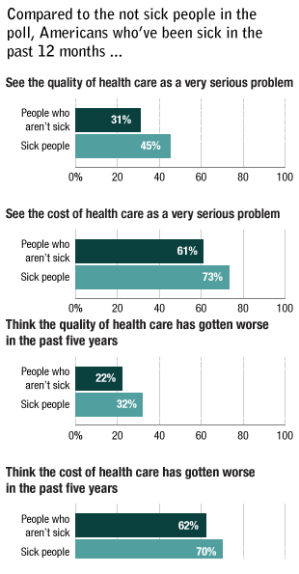
When the results came back, we found that people who have a serious medical condition or who’ve been in the hospital in the past year tended to have more concerns about costs and quality than people who aren’t sick. No big surprise there.
But what was notable: 3 of 4 people who were sick said cost is a very serious problem, and half said quality is a veryserious problem.
Nearly half of those with recent serious illness say they felt burdened by what they had to pay out of their own pocket for care.
The recently ill are more likely to say the cost and quality of care have worsened over the past five years, compared to people who weren’t sick.
Among people who’ve recently required a lot of care, significant proportions say their treatment was poorly managed, with nearly a third complaining of poor communication among their caregivers. One in eight believe they got the wrong diagnosis, treatment or test.
Those findings led us to investigate the problems people are having, both in our poll and in a series of stories on the radio and the Web we’re calling “Sick in America.”
The poll, a joint venture of NPR, the Robert Wood Johnson Foundation and the Harvard School of Public Health, is one of very few focusing on people who’ve actually been seriously ill, injured or hospitalized in the past year.
“This poll listens to the voices of the sick,” says Robert Blendon of Harvard. “That provides a good barometer of what’s happening in health care in America.”
The poll randomly surveyed 1,508 adults across the nation. A little more than a quarter of them had a serious illness, injury or disability requiring “a lot of medical care,” or overnight hospitalization within the past 12 months.
If you want to dive deeper, here’s a , plus the and
Â鶹ŮÓÅ Health News is a national newsroom that produces in-depth journalism about health issues and is one of the core operating programs at Â鶹ŮÓÅ—an independent source of health policy research, polling, and journalism. Learn more about .This <a target="_blank" href="/news/poll-what-its-like-to-be-sick-in-america/">article</a> first appeared on <a target="_blank" href="">Â鶹ŮÓÅ Health News</a> and is republished here under a <a target="_blank" href=" Commons Attribution-NonCommercial-NoDerivatives 4.0 International License</a>.<img src="/wp-content/uploads/sites/8/2023/04/kffhealthnews-icon.png?w=150" style="width:1em;height:1em;margin-left:10px;">
<img id="republication-tracker-tool-source" src="/?republication-pixel=true&post=3108&ga4=G-J74WWTKFM0" style="width:1px;height:1px;">]]>This story comes from our partner, NPR’s health blog .
Patients at risk of a heart attack who are having surgery can cut their death risk 35 percent by simply taking a drug called a .
The cost: A dollar per patient. That’s the bottom line of a large Veterans Affairs in the October issue of the journal Anesthesiology.
And here’s why your doctor might take notice: The new study may allay earlier doubts that beta blockers for surgery patients may pose more harm than good.
The new study looked at the effect of beta blockers taken around the time of surgery in nearly 39,000 VA patients undergoing operations of any kind.
Beta blockers are widely used pills that blunt the effect of the stress hormone adrenaline on the heart, slowing the heartbeat. The idea is that in somebody at risk of a heart attack, the drug shields the heart from the stress of surgery, which can jack up the heart rate.
This isn’t the first study to show a protective effect of beta blockers in surgery patients with known heart disease or cardiovascular risk factors such as high blood pressure, high cholesterol and smoking. Since 1996, a series of studies that randomly assigned such patients to beta blockers or placebo pills suggested the drug could lower death risk by up to 90 percent.
The new study is not a randomized trial. It looked back at how many people died within a year of surgery if they took beta blockers or not. Its authors say this provides a more realistic picture than carefully controlled look-ahead studies.
“This is what happens in real life,” says study leader Arthur Wallace of the San Francisco Veterans Affairs Medical Center. “And still it reduces mortality by 35 percent. That’s pretty good.”
Wallace says about half of hospitals have adopted the routine use of beta blockers in at-risk surgery patients. If it were universally used, he says, it would save about 7,000 lives a year.
He hopes the new study will address doubts raised by a 2007 study called the Perioperative Ischemic Evaluation trial, or . It concluded that beta blockers prevent heart attacks among surgical patients, but raised the risk of deaths and severe strokes.
In the wake of POISE, an expert committee of the American College of Cardiology and the last year backed away from its earlier recommendation to use beta blockers routinely in surgical patients with known or suspected heart disease. The new guidelines urge more care in the timing and dose of beta blockers for surgery patients.
“When POISE came out, we thought, oh my goodness, maybe we’ve done something wrong,” Wallace says. “We’ve been telling people for 10 years to use this drug. Maybe we’ve made a mistake.”
So the San Francisco group decided to use the VA’s computerized record system to see how beta blockers affected the death rate among its surgical patients from 1996 to 2008.
The new study found no evidence that patients who got beta blockers around the time of surgery had more strokes. “We just didn’t see any strokes,” Wallace says. “We didn’t have enough to say anything about it.”
He says the POISE study came up with different results because it used an unusually high dose of beta blockers – 16 to 32 times higher than the usual dose.
One other apparent lesson from the new San Francisco study: It’s a very bad idea to take beta blockers away from patients already on the drug when they enter the hospital for surgery. The VA study finds that quadruples patients’ risk of death.
Wallace says hospitals routinely stop patients’ routine medications when they come into the hospital to prevent bad drug interactions. “We have to change the way pharmacies think,” he says.
Â鶹ŮÓÅ Health News is a national newsroom that produces in-depth journalism about health issues and is one of the core operating programs at Â鶹ŮÓÅ—an independent source of health policy research, polling, and journalism. Learn more about .This <a target="_blank" href="/health-industry/npr-cheap-pills-may-save-lives-shorttake/">article</a> first appeared on <a target="_blank" href="">Â鶹ŮÓÅ Health News</a> and is republished here under a <a target="_blank" href=" Commons Attribution-NonCommercial-NoDerivatives 4.0 International License</a>.<img src="/wp-content/uploads/sites/8/2023/04/kffhealthnews-icon.png?w=150" style="width:1em;height:1em;margin-left:10px;">
<img id="republication-tracker-tool-source" src="/?republication-pixel=true&post=30770&ga4=G-J74WWTKFM0" style="width:1px;height:1px;">]]>
After Kaiser Health News and NPR his plight in a story that aired Monday, federal Medicare officials said they would look into the case. Bianco’s appeal of an earlier denial had been rejected by WellCare, a private insurer that contracts with the federal program to provide drug coverage. The insurer rejected coverage saying the combined use of the costly new drugs has not yet been approved by the Food and Drug Administration — even though two doctors’ groups had recommended the protocol in cases like Bianco’s.
Late Tuesday, Bianco’s doctor got word that the earlier denials had been reversed – an unusually fast turnaround for the agency.
“I am very pleased that Mr. Bianco received approval for the treatment he needs,” said Dr. of Mayo Clinic in Scottsdale, Ariz. “I hope all patients in similar (or more urgent) circumstances can be given a fair hearing.”
Bianco, whose liver has been severely damaged by the hepatitis C virus, said Medicare’s reversal “is great news for me, and hopefully for many others, since a precedent has been set now.”
In a statement, Medicare officials indicate that the new policy will apply broadly to hepatitis C patients whose doctors prescribe the combined use of the two drugs because they meet certain criteria laid out in January by the Infectious Diseases Society of America and the American Association for the Study of Liver Diseases. Those guidelines recommend the combined use of the two drugs in patients with advanced liver disease who have failed to be cured by earlier drug regimens – even though the FDA has not yet approved the combination.
Medicare officials say that beneficiaries “are required to have access to needed therapies” if they have demonstrated “medical necessity” and have “medically accepted indications” for the treatment.
The agency is reportedly conferring with medical specialty groups on refining the guidelines about when patients should be treated with which regimens.
For now, Medicare’s Part DÂ plans may decide on a case-by-case basis whether to approve payment for the costly drugs. But if the plans deny payment, consumer advocates say patients will now have a good chance of prevailing because of the new stance by federal officials.
There is little doubt that coverage of the drugs will be a substantial financial burden for the program.
, deputy Medicare administrator, Â summit that the agency hopes to have a handle on potential costs later this year after it receives bids from Part D drug plans which will take the cost of the new treatments into account.
One of them, called , costs $84,000 for a typical 12-week course of treatment, although some patients will need to take the drugs for 24 weeks. The other, , costs about $66,000, but is approved for fewer types of patients. Other drugs must often be used with the two new products, adding to the cost.
The issue of paying for the expensive new drugs – which may cure upwards of 90 percent of patients — is being closely watched by patient advocates, federal health and budget officials, state , the Department of Veterans Affairs, and corrections officials across the country. All face billions of dollars in potential obligations to treat the three to five million Americans infected by the deadly virus.
The publication Inside CMS has reported that Gilead Sciences, maker of Sovaldi, gained 90 percent of the $2.1 billion first-quarter sales of the drug – a record for any new drug – from Medicare and private health insurers. Another 7 percent of sales came from Medicaid.
Medicare officials’ fast response in the Bianco case is an indication of the political sensitivity of rejecting potentially life-saving coverage based at least in part on the drugs’ costs. “We want to try to be as helpful as we can to get beneficiaries the drugs that they need,” a Medicare spokesman said earlier this week.
Or to put it the other way around, no one wants to be the first to say that patients who need the drugs can’t get them– in other words, that hepatitis C has pushed the nation into explicit rationing of life-saving care.
This article was produced by Kaiser Health News with support from .
Â鶹ŮÓÅ Health News is a national newsroom that produces in-depth journalism about health issues and is one of the core operating programs at Â鶹ŮÓÅ—an independent source of health policy research, polling, and journalism. Learn more about .This <a target="_blank" href="/aging/medicare-reverses-denial-of-costly-treatment-for-hepatitis-c-patient/">article</a> first appeared on <a target="_blank" href="">Â鶹ŮÓÅ Health News</a> and is republished here under a <a target="_blank" href=" Commons Attribution-NonCommercial-NoDerivatives 4.0 International License</a>.<img src="/wp-content/uploads/sites/8/2023/04/kffhealthnews-icon.png?w=150" style="width:1em;height:1em;margin-left:10px;">
<img id="republication-tracker-tool-source" src="/?republication-pixel=true&post=7369&ga4=G-J74WWTKFM0" style="width:1px;height:1px;">]]>This KHN story was produced in collaboration with
UPDATE, 5/15/14:
Walter Bianco has had hepatitis-C for 40 years, and his time is running out.
“The liver is at the stage next to becoming cirrhotic,” the 65-year-old Arizona contractor says. Cirrhosis is severe scarring, whether from alcoholism or a chronic viral infection. It’s a fateful step closer to liver failure or liver cancer.

Walter Bianco, 65, at his Arizona home, has had hepatitis-C for more than 40 years. (Photo by Alexandra Olgin/KHN)
If he develops one of these complications, the only possible solution would be a hard-to-get liver transplant. “The alternative,” Bianco says, “is death.”
Previous drug treatments didn’t clear the virus from Bianco’s system. But it’s almost certain that potent new drugs for hep-C could cure him.
However, the private insurer that handles his medication coverage for the federal Medicare program has twice refused to pay for the drugs his doctor has prescribed.
Doctors are seeing more and more patients approaching the end-stage of hep-C infection. “There isn’t a day that goes by when I don’t have a story very similar to Mr. Bianco’s,” says Dr. Hugo Vargas of Mayo Clinic in Scottsdale, AZ, his liver specialist.
Researchers estimate that 3 to 5 million Americans carry the insidious hep-C virus. The biggest concentration is among those born between 1945 and 1965.
Many, like Bianco, got hep-C from injecting street drugs in their youth. He says he’s been drug- and alcohol-free for 32 years, but the infection was permanent.
Other baby boomers got the virus from transfusions before 1992, a period when blood wasn’t screened. Some got it from sharing razors or toothbrushes, or from contaminated tattoo needles or hospital equipment. For some, transmission was sexual, although fortunately this isn’t the highest-risk route.
The timing of these infections spells trouble for Medicare, which insures Americans over 65.
Hepatitis-C is a slow-acting virus. Over a period of 20 to 40 years, it causes liver damage in about 70 percent of people it infects.
A growing number of people who got infected in the 1960s through the 1990s have now “used up” the infection’s latency period, notes Dr. Camilla Graham of Beth Israel Deaconess Hospital in Boston, “which is why we’re now seeing this dramatic increase in the number of people developing complications and dying of hepatitis. And we expect this to continue to increase for the next 10 years.”
Is A Cure Worth $84,000?Â
Another part of Medicare’s problem is that new hep-C medications are among the priciest of any drugs. One called Sovaldi, federally approved last December, costs $1,000 a pill – or $84,000 for a typical 12-week treatment course. The other recently approved drug, Olysio, costs around $66,000. Others in the pipeline are expected to be similarly expensive.
“People were very shocked about the price because it hit a psychological barrier in terms of  ‘this is too expensive,'” Graham says.
She has a patient like Walter Bianco – a 65-year-old woman whose severe liver damage puts her on the edge of liver failure.
Graham believes her patient’s best chance at cure lies in the use of both Sovaldi and Olysio. “We have about 160 people who were studied in a clinical trial called COSMOS that showed a very high cure rate – 90 to 100 percent – for even the most difficult-to-treat patients with this combination,” she says.

Walter Bianco, 65, playing with one of his tropical birds, has had hepatitis-C for more than 40 years. (Photo by Alexandra Olgin/KHN)
But, as in Bianco’s case, the Medicare’s drug-benefit contractor that covers this patient has refused to approve payment.
The apparent reason is that the Food and Drug Administration has not yet approved use of the two drugs in combination. (On May 7, Olysio’s maker, Janssen Therapeutics, asked the agency for such approval.)
But Graham notes that in the early days of successful antiviral drug treatment for HIV, payers allowed doctors to “mix and match” medications in “off-label” or unapproved combinations as they thought best.
“Medicare has been slower to adopt off-label combinations than most of the other insurance plans,” Graham says.
Accelerating Demand
Medicare officials wouldn’t comment on coverage of new hep-C drugs. A spokesman wrote in an email that the federal program turns such decisions over to private insurers that administer its drug plan, called Medicare Part D.
However, advocates say Medicare officials are well aware of the program’s looming exposure to the enormous costs of treating hep-C. Some say it could run in the tens or hundreds of billions of dollars, though it’s not clear over what period of time.
One thing likely to accelerate demand for treatment: Medicare is expected to approve payment for routine blood tests for hep-C infection soon. That will reveal many people who don’t yet know they’re infected – and spark difficult conversations between patients and doctors on when to use the expensive new medications to clear the virus from their blood.
Many hepatitis specialists and patient advocates are worried that the cost of the drugs will lead payers to limit access to patients who already have advanced liver disease, or even more narrowly, those who are on transplant waiting lists.
“We’re very scared that these programs to limit access to treatment could interfere with our goals of trying to find people with hepatitis C,” Graham says.
Ryan Clary of the National Viral Hepatitis Roundtable, a patient advocacy group, says public health may be on a collision course with treatment and reimbursement policy.
“On the one hand, we’re saying ‘Now is the time to be tested for hep-C. There are these promising treatments,'” Clary says. “But on the other hand, we’re saying ‘You can’t have access to these cures. It’ll bankrupt the country.’ So where’s the incentive to test?”
Apart from expensive drug treatment aimed at cure, doctors say there are other good reasons for identifying infected patients. They can be counseled to stay away from alcohol, which accelerates hep-C related liver damage. They can also be told about steps to take to avoid infecting others.
There are other implications of delaying treatment until liver damage is advanced. Once a patient has developed cirrhosis, he’ll need to be monitored every six months for the rest of his life for signs of liver cancer.
And if a patient tips into liver failure or cancer before getting cured, treatment will cost an estimated $50,000 a year – possibly over several years.
“Hepatitis-C is a ticking time bomb,” Graham says. “We have a very limited amount of time to get in here and alter the course of the disease for a good number of people. And we either do that, and we do it well now, or we face a whole lot more people suffering severe complications of this disease.”
While the cost and treatment implications get sorted out, patients like Walter Bianco are in an agonizing limbo. He says he can’t possibly afford the $150,000 it would cost to buy Sovaldi and Olysio on his own.
“It is a lot of money and there are a lot of hep-C sufferers out there,” he says. “I think Medicare’s probably thinking ‘If we can hold off for a year or two, some of these following drugs will be cheaper.'”
But Hugo Vargas, Bianco’s doctor, says it’s urgent to cure his infection now. “If he were my father,” the Mayo specialist says, “I would want Mr. Bianco to be treated now – not in a year, not in a year-and-a-half.”
This article was produced by Kaiser Health News with support from .
Â鶹ŮÓÅ Health News is a national newsroom that produces in-depth journalism about health issues and is one of the core operating programs at Â鶹ŮÓÅ—an independent source of health policy research, polling, and journalism. Learn more about .This <a target="_blank" href="/aging/medicare-struggling-with-hepatitis-c-cure-costs/">article</a> first appeared on <a target="_blank" href="">Â鶹ŮÓÅ Health News</a> and is republished here under a <a target="_blank" href=" Commons Attribution-NonCommercial-NoDerivatives 4.0 International License</a>.<img src="/wp-content/uploads/sites/8/2023/04/kffhealthnews-icon.png?w=150" style="width:1em;height:1em;margin-left:10px;">
<img id="republication-tracker-tool-source" src="/?republication-pixel=true&post=33624&ga4=G-J74WWTKFM0" style="width:1px;height:1px;">]]>The , from the World Health Organization, give strong endorsement to the two newest medicines. Gilead Science’s Sovaldi costs $1,000 per pill/$84,000 for a 12-week course of treatment and Olysio, Janssen Pharmaceuticals, $66,360 for its three-month course.
The high prices have ignited a of . In the United States, doctors and insurers argue that the cost of the drugs will make their widespread use impossible. And critics say even if the prices are heavily discounted in other countries, the drugs will still be unaffordable in most of the world.
The WHO Â of treatment with Sovaldi and Olysio was made without taking the cost of the two drugs into consideration. That’s because the price of the drugs outside the U.S. was unknown in December, when the WHO panel wrapped up its work.
But the price of the drugs isn’t the only issue. The WHO recommends that all 150 million or so people around the globe with chronic hepatitis C infection be assessed for treatment — a gargantuan task in itself. Authors of the report are quick to acknowledge that neither the assessment of people’s health status nor actual treatment will happen anytime soon.
“A lot has to happen for this to really take off in a big way,” says the guidelines’ chief architect, . “Even if prices came down dramatically tomorrow, that doesn’t mean there would be an immediate rush to treatment.”
Screening programs for hepatitis C need to be ramped up. Labs to determine the genetic type of the virus (crucial in choosing treatment regimens) have to be built and staffed. Medical personnel need to be able to assess when viral liver damage has progressed to the point when treatment is urgent. And drugs have to be chosen wisely and administered carefully.
Fewer of Americans with chronic hepatitis C currently have had or are getting any treatment. In Europe, treatment has reached only 3.5 percent. And in most countries, Wiktor says, “hardly anyone is getting treatment.”
Hoping For HIV-Like Success
The WHO guidelines are setting a deliberately high standard in the hope, Wiktor says, of replicating the remarkable dissemination of antiviral therapy for HIV.
Starting from a similar point of little distribution 15 years ago, antiviral treatment for HIV around 10 million people, most of them in the poorest countries of sub-Saharan Africa. HIV infects more than 35 million people globally (and almost a third of those also have hepatitis C). That makes chronic hepatitis C infection at least four times more prevalent.
But HIV requires lifelong antiviral treatment. The big difference with hepatitis C is that suddenly there are drugs that can actually cure more than 90 percent of patients with a three-month regimen. “Treatments are getting better, shorter and safer,” Wiktor says.
The controversy over the cost is apparently beginning to have an effect on pricing. Egypt, which has the world’s highest infection rates – somewhere around 20 percent of the population – has negotiated a 99 percent discount on Sovaldi, to $900 for a 12-week course.
Gilead, Sovaldi’s maker, is tiering prices for the drug in other countries too — , and reportedly around that may be licensed to several Indian companies.
But those discounts don’t impress , such as Rohit Malpani of . “When you’re starting from such an exorbitant price in the U.S., the price Gilead will offer middle-income countries like Thailand and Indonesia may seem like a good discount,” Malpani says. “But it will still be too expensive for many of these countries to scale up treatment.”
Other forces may drive prices lower. “A number of other medicines are coming down the pike — at least 20,” WHO’s Wiktor says. “That in itself will provide competition as companies try to assure market share.”
A flood of new data on the effectiveness of new medicines is expected this week at an in London, where the new WHO guidelines were unveiled.
“The dynamism around hep C is really remarkable,” Wiktor says. “Once you know you can cure somebody, that really changes the tone of the conversation.”
But until the prices fall, and until (or unless) pressure develops to shake loose massive new amounts of funding to pay for access to the new drugs, hard choices loom.
For instance, the WHO guidelines say that treatments will have to be rationed, starting with patients whose livers are heavily scarred or cirrhotic – putting them at high risk for liver cancer or the need for liver transplants.
“We don’t have reliable figures, but about 20 percent of people with chronic hep C are in that stage,” he says. “That would be 26 to 30 million people globally.”
Or around three times the number receiving HIV treatment.
This report is produced as part of a partnership with KHN and .
Â鶹ŮÓÅ Health News is a national newsroom that produces in-depth journalism about health issues and is one of the core operating programs at Â鶹ŮÓÅ—an independent source of health policy research, polling, and journalism. Learn more about .This <a target="_blank" href="/news/a-call-for-pricey-treatment-for-millions-with-hepatitis-c/">article</a> first appeared on <a target="_blank" href="">Â鶹ŮÓÅ Health News</a> and is republished here under a <a target="_blank" href=" Commons Attribution-NonCommercial-NoDerivatives 4.0 International License</a>.<img src="/wp-content/uploads/sites/8/2023/04/kffhealthnews-icon.png?w=150" style="width:1em;height:1em;margin-left:10px;">
<img id="republication-tracker-tool-source" src="/?republication-pixel=true&post=7218&ga4=G-J74WWTKFM0" style="width:1px;height:1px;">]]>When sweeping new advice on preventing heart attacks and strokes came out last November, it wasn’t clear how many more Americans should be taking daily statin pills to lower their risk.
AÂ provides an answer: a whole lot. Nearly 13 million more, to be precise.
If the were followed to the letter, about half of all Americans over 40 would be on cholesterol-lowering statins — more than double the current level.
Even more striking, the new recommendations would make prescription of the drugs almost universal among older men. “What was personally most surprising to me, is that it turns out the difference between the old and new guidelines is very small in younger adults — 40 to 59,” says Duke University biostatistician, lead author of the study.
“The vast majority of those affected by the new guidelines are between 60 and 75,” he says. “So much so that 87 percent of men 60 to 75 and 54 percent of women [in that age range] should be on statins.”
The great majority of Americans newly recommended for statin treatment have no known heart disease, Pencina and his colleagues say.
The analysis was published online Wednesday by the New England Journal of Medicine.
Statin drugs are pretty cheap these days. Most are generics. Common doses of atorvastatin, the generic form of Lipitor, can be had for 50 cents a day. Older statins cost even less. Still, the number of potential patients is so huge that the recommended expansion in treatment has major cost implications.
If all those newly recommended for treatment got the drugs, the expansion would cost from $2 billion to $6.6 billion a year more than the price tag under the old guidelines, which is $7.8 billion to $22.4 billion depending on cost assumptions for a year’s worth of the drugs .
In fact, far from everybody eligible for treatment under the previous guidelines is taking statins. Pencina and his colleagues calculate that 22 percent of adults between 40 and 75 are on statins now — about 60 percent of the recommended number. About 25.2 million people take statins now, at an annual cost of about $6 billion to $13 billion.
The new guidelines more than double the potential number of statin-takers to 56 million people.
Pencina says over 10 years, the change in statin use could potentially prevent nearly a half-million heart attacks, strokes and cardiovascular deaths. He thinks the benefit could be worth the lifetime cost of statin treatment, which he thinks could be well below the cost of treating the victims of heart attacks and strokes over their remaining lifetimes.
“We’re going to identify more people at truly high risk and give them more statins, so we’ll potentially prevent more cardiovascular deaths,” Pencina says.
But the price will be a good deal of overtreatment. “We will treat a fair amount of people who will not have developed the disease,” he says. And the drugs, including an increased risk for developing diabetes.
The new guidelines, formulated by the American Heart Association and the American College of Cardiology, are a major departure from those in place for decades. They throw out the notion that doctors should prescribe cholesterol-lowering drugs when a patient’s LDL, or, reaches a certain threshold — in recent years, above 130.
Instead, the new guidelines say everybody with known heart disease should be taking statins.
And for adults over 40 without known cardiovascular disease, the new trigger for statin use is a 10-year risk of heart attack or stroke of 7.5 percent or more, according to a new. The old guidelines, using a different calculator, prescribed statin use at a 10-year risk above 20 percent, along with an LDL-cholesterol reading above 130.
Under the new guidelines, statin therapy is urged for everybody over 40 who has diabetes. The drugs are also recommended for younger adults if their LDL cholesterol is over 190.
It’s not yet clear what the impact of the new recommendations has been. They’re complicated for doctors and patients to understand, and they’re controversial in the medical community.
“I’ve hear very varied responses,” Pencina says. “Some say the guidelines over-treat in the older age group. And I have colleagues who say the guidelines don’t go far enough in the younger age group.”
The new analysis used data from the National Health and Nutrition Examination surveys to estimate the effect of the current cholesterol guidelines.
Â鶹ŮÓÅ Health News is a national newsroom that produces in-depth journalism about health issues and is one of the core operating programs at Â鶹ŮÓÅ—an independent source of health policy research, polling, and journalism. Learn more about .This <a target="_blank" href="/aging/cholesterol-guidelines-could-mean-statins-for-half-of-adults-over-40/">article</a> first appeared on <a target="_blank" href="">Â鶹ŮÓÅ Health News</a> and is republished here under a <a target="_blank" href=" Commons Attribution-NonCommercial-NoDerivatives 4.0 International License</a>.<img src="/wp-content/uploads/sites/8/2023/04/kffhealthnews-icon.png?w=150" style="width:1em;height:1em;margin-left:10px;">
<img id="republication-tracker-tool-source" src="/?republication-pixel=true&post=7148&ga4=G-J74WWTKFM0" style="width:1px;height:1px;">]]>‘s Shots blog.
In the lull between the Supreme Court arguments over the federal health overhaul law and the decision expected in June, we thought we’d ask Americans who actually use the health system quite a bit how they view the quality of care and its cost.

Most surveys don’t break it down this way.
When the results came back, we found that people who have a serious medical condition or who’ve been in the hospital in the past year tended to have more concerns about costs and quality than people who aren’t sick. No big surprise there.
But what was notable: 3 of 4 people who were sick said cost is a very serious problem, and half said quality is a veryserious problem.
Nearly half of those with recent serious illness say they felt burdened by what they had to pay out of their own pocket for care.
The recently ill are more likely to say the cost and quality of care have worsened over the past five years, compared to people who weren’t sick.
Among people who’ve recently required a lot of care, significant proportions say their treatment was poorly managed, with nearly a third complaining of poor communication among their caregivers. One in eight believe they got the wrong diagnosis, treatment or test.
Those findings led us to investigate the problems people are having, both in our poll and in a series of stories on the radio and the Web we’re calling “Sick in America.”
The poll, a joint venture of NPR, the Robert Wood Johnson Foundation and the Harvard School of Public Health, is one of very few focusing on people who’ve actually been seriously ill, injured or hospitalized in the past year.
“This poll listens to the voices of the sick,” says Robert Blendon of Harvard. “That provides a good barometer of what’s happening in health care in America.”
The poll randomly surveyed 1,508 adults across the nation. A little more than a quarter of them had a serious illness, injury or disability requiring “a lot of medical care,” or overnight hospitalization within the past 12 months.
If you want to dive deeper, here’s a , plus the and
Â鶹ŮÓÅ Health News is a national newsroom that produces in-depth journalism about health issues and is one of the core operating programs at Â鶹ŮÓÅ—an independent source of health policy research, polling, and journalism. Learn more about .This <a target="_blank" href="/news/poll-what-its-like-to-be-sick-in-america/">article</a> first appeared on <a target="_blank" href="">Â鶹ŮÓÅ Health News</a> and is republished here under a <a target="_blank" href=" Commons Attribution-NonCommercial-NoDerivatives 4.0 International License</a>.<img src="/wp-content/uploads/sites/8/2023/04/kffhealthnews-icon.png?w=150" style="width:1em;height:1em;margin-left:10px;">
<img id="republication-tracker-tool-source" src="/?republication-pixel=true&post=3108&ga4=G-J74WWTKFM0" style="width:1px;height:1px;">]]>This story comes from our partner, NPR’s health blog .
Patients at risk of a heart attack who are having surgery can cut their death risk 35 percent by simply taking a drug called a .
The cost: A dollar per patient. That’s the bottom line of a large Veterans Affairs in the October issue of the journal Anesthesiology.
And here’s why your doctor might take notice: The new study may allay earlier doubts that beta blockers for surgery patients may pose more harm than good.
The new study looked at the effect of beta blockers taken around the time of surgery in nearly 39,000 VA patients undergoing operations of any kind.
Beta blockers are widely used pills that blunt the effect of the stress hormone adrenaline on the heart, slowing the heartbeat. The idea is that in somebody at risk of a heart attack, the drug shields the heart from the stress of surgery, which can jack up the heart rate.
This isn’t the first study to show a protective effect of beta blockers in surgery patients with known heart disease or cardiovascular risk factors such as high blood pressure, high cholesterol and smoking. Since 1996, a series of studies that randomly assigned such patients to beta blockers or placebo pills suggested the drug could lower death risk by up to 90 percent.
The new study is not a randomized trial. It looked back at how many people died within a year of surgery if they took beta blockers or not. Its authors say this provides a more realistic picture than carefully controlled look-ahead studies.
“This is what happens in real life,” says study leader Arthur Wallace of the San Francisco Veterans Affairs Medical Center. “And still it reduces mortality by 35 percent. That’s pretty good.”
Wallace says about half of hospitals have adopted the routine use of beta blockers in at-risk surgery patients. If it were universally used, he says, it would save about 7,000 lives a year.
He hopes the new study will address doubts raised by a 2007 study called the Perioperative Ischemic Evaluation trial, or . It concluded that beta blockers prevent heart attacks among surgical patients, but raised the risk of deaths and severe strokes.
In the wake of POISE, an expert committee of the American College of Cardiology and the last year backed away from its earlier recommendation to use beta blockers routinely in surgical patients with known or suspected heart disease. The new guidelines urge more care in the timing and dose of beta blockers for surgery patients.
“When POISE came out, we thought, oh my goodness, maybe we’ve done something wrong,” Wallace says. “We’ve been telling people for 10 years to use this drug. Maybe we’ve made a mistake.”
So the San Francisco group decided to use the VA’s computerized record system to see how beta blockers affected the death rate among its surgical patients from 1996 to 2008.
The new study found no evidence that patients who got beta blockers around the time of surgery had more strokes. “We just didn’t see any strokes,” Wallace says. “We didn’t have enough to say anything about it.”
He says the POISE study came up with different results because it used an unusually high dose of beta blockers – 16 to 32 times higher than the usual dose.
One other apparent lesson from the new San Francisco study: It’s a very bad idea to take beta blockers away from patients already on the drug when they enter the hospital for surgery. The VA study finds that quadruples patients’ risk of death.
Wallace says hospitals routinely stop patients’ routine medications when they come into the hospital to prevent bad drug interactions. “We have to change the way pharmacies think,” he says.
Â鶹ŮÓÅ Health News is a national newsroom that produces in-depth journalism about health issues and is one of the core operating programs at Â鶹ŮÓÅ—an independent source of health policy research, polling, and journalism. Learn more about .This <a target="_blank" href="/health-industry/npr-cheap-pills-may-save-lives-shorttake/">article</a> first appeared on <a target="_blank" href="">Â鶹ŮÓÅ Health News</a> and is republished here under a <a target="_blank" href=" Commons Attribution-NonCommercial-NoDerivatives 4.0 International License</a>.<img src="/wp-content/uploads/sites/8/2023/04/kffhealthnews-icon.png?w=150" style="width:1em;height:1em;margin-left:10px;">
<img id="republication-tracker-tool-source" src="/?republication-pixel=true&post=30770&ga4=G-J74WWTKFM0" style="width:1px;height:1px;">]]>