
Cancer Rehab Begins To Bridge A Gap For Patients
This story was produced in collaboration with
It was her own experience with debilitating side effects after cancer treatment that led Dr. Julie Silver to realize聽there is a huge gap in care that keeps cancer patients from getting rehabilitation services.
聽was 38 in 2003 when she was diagnosed with breast cancer. Even though she is a physician, she was shocked at the toll chemotherapy and radiation took on her body. Silver was dealing with extreme fatigue, weakness and pain.
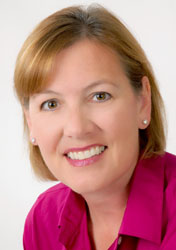
Julie Silver
鈥淚 was really, really sick, sicker than I ever imagined,鈥� says Silver, who is an assistant professor at Harvard Medical School. 鈥淚 did some exercise testing and I tested out as a woman in my 60s. So I had aged three decades in a matter of months through cancer treatment.鈥�
Silver went to her oncology team for help. They told her to go home and heal. 鈥淭he conversation should have been, 鈥榃e鈥檙e going send you to cancer rehab to help you get stronger,鈥欌�� she says. But that鈥檚 not what happened, and after Silver came to realize that her experience was typical, she set out to change the system for other patients.
In 2009 she started聽聽after treatment. It鈥檚 called STAR and is now offered in almost all 50 states.聽The program is growing, as is聽聽and can be helped with rehab.
But even with the awareness of its benefits growing, there is still a disconnect for patients.
鈥淧atients are getting stuck, and they don鈥檛 know where to go,鈥� says Dr. Rebecca Lansky, a rehabilitation specialist at the University of Massachusetts Medical Center. She says the focus on cancer care is on treatment and that cancer patients suffering from major side effects often fall through the cracks. She recalls one patient who struggled with the side effects of tongue cancer treatment.
鈥淗e had radiation to the whole jaw and neck so he couldn鈥檛 open up his mouth for six months,鈥� Lansky said. 鈥淗e had a feeding tube, and he kept going to his oncologist saying, 鈥楬ow can I get better? What I can do? He finally got referred to me and we are now opening up his jaw six months after he has been unable to move.鈥�
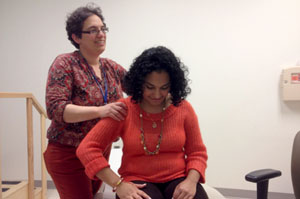
Dr. Rebecca Lansky examines a patient (Photo by Rachel Gotbaum/For KHN)
A in the Journal of Clinical Oncology found that 90 percent of the patients needed rehab but only about one third were getting the therapy.
鈥淚鈥檝e seen cases where someone has had a lot of pain, and they鈥檝e done scans and it鈥檚 not a malignancy and maybe they have done exploratory surgery to see what is happening and not really finding much except a lot of scar tissue,鈥� says physical therapist Jennifer Goyette, a STAR trained therapist who works with cancer patients in Worcester, Massachusetts. 鈥淚 am able to get them a lot of relief and a lot of times patients don鈥檛 need to have further intervention. They don鈥檛 want to be on the narcotics for the pain management. They would rather come here.鈥�
One of Goyette鈥檚 clients is 56-year-old cancer survivor Deborah Leonard. For two years after her treatment for early stage breast cancer, Leonard had swelling, pain and a large mass in her breast –which was not cancer.
鈥淐learly I didn鈥檛 have that before the surgery, because the tumor was so small and this was much bigger, and it just kept getting bigger,鈥� says Leonard.聽鈥淏y nighttime my breast was extremely swollen and very painful.鈥�
At first doctors thought Leonard might have an infection and gave her antibiotics. When that didn鈥檛 work they did another surgery to remove scar tissue. But the problem returned. Her doctors were suggesting a third surgery when Leonard finally found Goyette.
After three sessions with Goyette doing what is called lymphatic drainage, Leonard felt much better.聽Goyette uses manual pressure to clear Leonard鈥檚 lymphatic system, allowing the build up of fluid causing Leonard鈥檚 pain and swelling to subside.
鈥淚 had a 6-inch mass that is now down to half its size,鈥� says Leonard.
鈥淚鈥檓 sleeping at night, I have energy again. More people need to know about this because you don鈥檛 have to be a martyr and grin and bear it. This works.鈥�
The issues are different for every type of cancer 鈥� head and neck cancer patients may need swallowing and speech therapy; blood cancer patients may need therapy similar to cardiac rehab to rebuild their strength and stamina; and patients treated for colon cancer can get help from physical therapists with back pain and abdominal swelling.
Most insurers do cover rehab for cancer patients, but sometimes patients must battle to get more than the standard 9 to 12 sessions covered. Another barrier to care is that too few oncologists and cancer surgeons refer their patients to rehab.
The Commission on Cancer,聽the arm of the American College of Surgeons聽that accredits cancer programs in U.S. hospitals, recently announced聽聽including better access to rehabilitation therapy.


