
Growing Size And Wealth Of Children’s Hospitals Fueling Questions About Spending
This story was produced in collaboration with
Rising from a 60-acre field of old cypress swamp and cattle pasture near the Orlando airport, the 7-story Nemours Children’s Hospital will be a monument to “best-in-class” care, its leaders boast.
That may be the case. But at a cost of about $400 million, the equivalent of $4.2-million for each of its 95 beds, Nemours will also rank among the more expensive children’s hospitals ever built when it is completed next year. Some people believe construction never should have begun.
Florida health planners twice rejected Nemours’ applications for a new hospital, noting that Orlando already had two children’s hospitals; most cities have only one. A third hospital could duplicate existing services, driving up costs for insurers, employers and policyholders.
The regulators reversed themselves in 2008, however, after Nemours, a wealthy Jacksonville-based foundation, mounted an extensive marketing campaign and lined up scores of politicians and civic boosters, .
“It’s a case of excess here in Orlando,” said Becky Cherney, until recently the head of the Florida Health Care Coalition, a statewide business group concerned about the impact of rising health spending. “We don’t have anything against Nemours. But Central Florida doesn’t need another children’s hospital.”
The battle over Nemours reflects the transformation of children’s hospitals from small, struggling charities to huge, often profitable businesses. From their humble origins more than a century ago, many of the nation’s biggest and best known children’s hospitals today are health care juggernauts with sprawling medical centers and suburban satellites, extensive real estate holdings and thousands of well-paid employees and millionaire CEOs.Ìý
The billions of dollars flowing through children’s hospitals every year pay for care for tens of thousands of kids, many of them extremely sick or suffering from chronic conditions requiring a lifetime of treatment. Hospital officials say costs are high because the care is complicated and the technology expensive. In addition, the hospitals help fund research into the causes and treatment of diseases.
But the surge in spending is also helping to fuel a multibillion-dollar building boom as hospitals add towers and beds.Ìý That in turn is spurring more spending on staff and technology, even as Washington, the states and employers grapple with budget-busting increases in health care spending. While children’s hospitals represent a small slice of the nation’s health care bill, they offer a case study of the expansive ambitions of hospital leaders and the faltering efforts of government to control spiraling costs.Ìý
VIDEOÌý
Reporter Gil Gaul Discusses The Series
DATA DIVEÌý
Charity Care At Children’s Hospitals
DATA CHARTÌý
Charity Care
DATA CHARTÌý
The Wealth Of Children’s Hospitals
The government heavily subsidizes the care of children from low-income families with Medicaid and the Children’s Health Insurance Program, and also provides nonprofit children’s hospitals with significant tax breaks that help them fund their growth. Private employers and their workers pay most of the rest of the bill for kids’ care through health insurance. ÌýWhen a new hospital like Nemours is built or another expands, taxpayers and private insurance policyholders pick up the tab down the road.
Over the past year, Kaiser Health News examined the business of children’s hospitals, interviewing experts and hospital officials and inspecting a variety of records, including the hospitals’ publicly available federal tax returns and bond documents filed in the course of borrowing money for expansion.
Some hospitals refused to answer questions, and the documents fell short of providing a complete financial picture. One of the frustrating obstacles confronting independent analysts is the lack of transparency in the hospital industry, including facilities that serve adults. There aren’t reliable comparative measures of quality or finances. And, with few exceptions, the prices hospitals charge insurers for care are closely guarded secrets.
Many of the approximately 220 children’s hospitals nationwide are part of large adult health systems, and details of their finances aren’t public. Some are large and well known, such as the 455-bed Riley Children’s Hospital in Indianapolis, part of Indiana University Health, and the Johns Hopkins Children’s Center, which expects to open a new 205-bed hospital next year.
Elite Hospitals Well Positioned To Make MoneyÌýÌýÌý
KHN’s examination focused on the nation’s 39 largest independent children’s hospitals. They are viewed within the industry as elite providers. All are nonprofit. But the financial performance of some would be the envy of for-profit companies, public tax returns show.
The big, freestanding children’s hospitals generally have a huge advantage in the marketplace: They face little competition and provide an essential service, giving them leverage to negotiate favorable prices with health insurers. At some, charges have risen sharply, increasing two to three times inflation, records and interviews show. That has encouraged aggressive expansion and spending on new facilities, costly technology and executive pay.
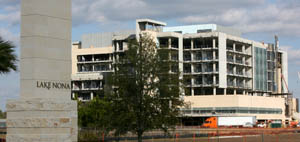
Nemours Children’s Hospital in Orlando will rank among the more expensive children’s hospitals ever built when it is completed next year (Photo by Joe Burbank).
“The elite children’s hospitals don’t compete on price,” said Jerry Katz, a former CEO of St. Christopher’s Hospital for Children in Philadelphia. “They compete for prestige. What that means is they are competing for the top docs and researchers, the top programs.”
To be sure, not all children’s hospitals make big profits; some struggle to break even. In 2009, the elite children’s hospitals reported $1.5 billion in profits – what nonprofits call surpluses. The top 10 alone earned more than $800 million in profits. Children’s Hospital of Philadelphia reported a $197 million surplus and paid its CEO nearly $2.1 million.
In 2009, most CEOs at the nation’s largest children’s hospitals were paid $1 million or more, public tax returns show. Randall L. O’Donnell, CEO of Children’s Mercy Hospital in Kansas City, led the list at almost $6 million, including a special payout of $4.1 million based on his years of service. Five other CEOs collected more than $2 million. Many of the executives received hefty bonuses, country club memberships, cars or other perks.
CEOs say their pay packages are warranted by the responsibilities of running large, complicated businesses – charities or not. Under O’Donnell’s leadership, Children’s Mercy grew from a small, local hospital to a regional and “national destination,” a spokesman said.Ìý Children’s Hospital of Philadelphia doubled in size, to an estimated $1.8 billion in annual revenue, under CEO Steven M. Altschuler.
The pay packages of children’s hospital executives compare favorably to CEO compensation at the nation’s biggest and best known adult hospitals, record show.Ìý The head of the Cleveland Clinic, with more than $5 billion annually in revenue, received $2.1 million in 2009. The head of the Mayo Clinic parent group: nearly $2.2 million.
As nonprofits, children’s hospitals enjoy an array of tax breaks covering real estate, earnings and investment gains. Spokesmen say this allows them to act as safety net providers for the poor. It also helps them boost their reserves and grow the business.
Hospitals Provide Little Free Care
The 39 largest hospitals, KHN found, had accumulated $21 billion in stocks, bonds, real estate and other investments as of 2010 – more than enough to provide an entire year’s worth of medical care for free They had net assets – the equivalent of net worth for nonprofits – of $23 billion.
Children’s Hospital of Boston, arguably the nation’s best known hospital for children,Ìý in bond filings.
Last year, the 400-bed hospital was cited as having some of the highest charges in Massachusetts in a report critical of hospital charges filed by State Attorney General Martha Coakley. ÌýHospital officials declined numerous requests for an interview, but noted on their website that they have lowered the rate of their increases.
Even with their tax breaks and wealth, top children’s hospitals provide relatively little charity care. On average, about 2 percent of what children’s hospitals spend is for free medical care, according to the National Association of Children’s Hospitals and Related Institutions (NACHRI), an industry group. Some of the largest and richest children’s hospitals spend less than one percent.
The American Hospital Association does not break out what its more than 5,000 members, mainly adult hospitals, spend annually on charity care. In 2009 the association said its hospitals provided , which includes bad debt as well as charity care.
In 2009, less than one-half of one percent of Texas Children’s Hospital’s spending went to charity care, according to its tax return. The 639-bed Houston hospital reported $1 billion in revenue and $1.9 billion in cash and investments that year. It spent $4.3 million on free care.
In an e-mail, a spokeswoman noted that Texas Children’s used more than $80 million of its own money to fund research, teaching and other community-based initiatives as part of its charitable mission. Other children’s hospitals point to clinics and public health programs as examples of their community outreach. They say those efforts exceed the value of their tax exemptions.
Taxpayers also are helping to underwrite a race to the top among the nation’s largest children’s hospitals, subsidizing billions in tax-exempt bonds for new hospital towers, outpatient centers, parking garages and research facilities. Nemours is funding $300 million of its new hospital with .ÌýÌý
Billions Spent On Expansion
The Nemours project is part of a nationwide construction boom involving children’s hospitals. In the last decade, children’s hospitals have spent at least $16 billion on expansions, bond filings and other records show, and expect to spend billions more in the next few years. Children’s Hospital of Philadelphia spent $1 billion and says it expects to spend another billion in coming years. At $625 million, the new Children’s Hospital of Pittsburgh cost more than the combined price tag of PNC Park and Heinz Field, home to the Pirates and Steelers. Children’s Memorial Hospital in Chicago is spending $915 million on a new facility – the equivalent of $3.1 million per bed.
In metropolitan Denver, the major children’s hospital has expanded not once but twice in the last five years. In 2007, Denver Children‘s, now known as Children’s Hospital Colorado, opened a $610 million hospital in the suburbs. It is now adding a $222 million, 10-story tower.
“We were probably as surprised as you that we would need space so soon after moving into our new facility,” explained Colorado CEO James Shmerling, but demand has risen by 35 percent. “You always wonder with new construction like we have will it continue? Well, indeed it has.”
Shmerling pointed to several factors spurring the increase in demand, including the lure of a bright new facility and a growing population of children. The hospital has also experienced a bump in referrals from outside the state – about 12 percent of all admissions. At the same time, advances in pediatric medicine have cut mortality rates for some childhood diseases.
“We used to see mortality of 90 percent for some cancers. Now we see survival rates of 90 percent,” Shmerling said. But survivors require lots of care, including tests, chemotherapy and other procedures, which he said “have them coming back to the hospital.”Ìý
While overall pediatric admissions have declined about 15 percent in the last decade, they have climbed at independent children’s hospitals. One reason is that as community hospitals close small pediatric units, those patients are steered elsewhere. Children’s hospitals also are extending their reach into the suburbs, other states and even other countries.Ìý

Larry A. McAndrews (Photo by Olivier Douliery).
Larry A. McAndrews, until last week the head of NACHRI, said many children’s ho spitals are also expanding their research efforts. Others are replacing outdated facilities. Yet even in states with declining children’s populations, including Ohio and California, billions in new spending is taking place.
Like other businesses, children’s hospitals have their own unique brands, missions and ambitions. “Part of it is we are part of a competitive, capitalistic model,” said McAndrews. “In this country we want to build a facility that is bigger and better.”
Some of the spending, hospital officials say, reflects their unique needs. The typical patient’s room is larger than an adult room in order to accommodate more technology and parents who sleep over. Urban construction costs also tend to be higher due to pricey real estate and space constrictions. Children’s Memorial officials pointed out that building their new 23-story hospital on a “relatively small parcel of land” has posed special challenges, including installing two separate banks of elevators between lower and upper floors.
There are other reasons for high costs. Many of the new hospitals are architectural showcases. They feature atriums, rooftop gardens, indoor playgrounds, flat panel televisions, on-demand movies and video games and work stations for parents, among other amenities.
Martin Gaynor, an economist at Carnegie Mellon University who has written extensively about hospital spending, says he was stunned when he toured the new Pittsburgh hospital. “I couldn’t believe it,” he said. “It’s a beautiful, beautiful facility. It’s a very nice facility for the families and kids.
“It’s a very awkward question to ask,” Gaynor added, “but at some point one wonders just how nice does this have to be?”
Consumers don’t ask that question, or another he thinks is important. Ìý“They look at children’s hospitals and think, ‘my goodness, we’re helping poor, sick kids,’” he said. “But who do you think is paying for all this?”
Revenues And Spending Rose Rapidly
Spending by children’s hospitals has soared in the past 10 years, more than doubling in inflation-adjusted dollars at some prominent institutions. For example, it rose 144 percent at Children’s Hospital of Philadelphia; 169 percent at Children’s Medical Center of Dallas, 196 percent at Phoenix Children’s Hospital and 129 percent at Packard Children’s Hospital at Stanford, Calif.
Revenue has more than kept pace. In 2009, the 39 largest children’s hospitals reported $22 billion in revenue from their hospital and outpatient operations, KHN’s analysis found. Hospitals in Boston, Cincinnati, Houston and Philadelphia took in more than $1 billion each.
Most of the money – about 75 percent — came from the fees they charged patients, financial records show. The balance was from research grants, investment income and other sources.
The high cost of children’s care has received little attention, in part because children’s hospitals represent a relatively small piece of the nation’s annual $2.5-trillion-dollar health tab. But there is also a paucity of data on the finances of children’s hospitals and the care they provide.
“Right now, we don’t know very much about how children’s hospitals perform,” said Elliot Fisher, a physician and prominent expert on health care at the Dartmouth Medical School. “There aren’t a lot of data on quality. Are they effective or not effective? Are they investing in the right kinds of treatments? Are they choosing high-margin treatments instead of lower-margin things like primary care that have a much higher impact? We can’t say.”
NACHRI collects financial data on revenues and spending. But the self-reported data are incomplete. Some hospitals report data one year but not another. Ìý“We’re the best there is and that’s not very good,” said Donna Shelton, director of child health policy research and analytics.
Children’s hospitals benefit from their unique mix of revenue sources. Unlike adults, the vast majority of children have some form of insurance. Either they are covered under their parents’ private, employer-sponsored plans, have Medicaid, or are eligible under the Children’s Health Insurance Program.
As a result, the number of uninsured children is relatively small – about one in 10 lacks coverage — reducing the demand for charity care and freeing up tens of millions of dollars for other uses.
Children’s hospitals say, however, they lose large sums treating Medicaid patients, who account for about half of all their patients. According to NACHRI, the state-federal program only pays about 75 percent of the actual cost of providing care. For elite children’s hospitals, the losses add up to about $2 billion annually, NACHRI says.
Some Ìýchildren’s hospitals offset much of their Medicaid losses by charging privately insured patients higher rates – a form of Robin Hood economics in which the well off unknowingly help to pay for the poor. Hospitals for adults also shift costs but not to the same degree.
There’s an enormous impact on the rates paid by private insurers. Seattle Children’s Hospital has raised its prices for commercially insured patients by 7 percent to 9 percent per year to cover ÌýÌýMedicaid shortfalls. Even so, it still loses millions on Medicaid. “Cost shifting is an inevitable result of a large government program paying less than its fair share of costs,” spokeswoman Louise Maxwell said.
Elite children’s hospitals are able to get away with it because they enjoy unique pricing power in communities where insurers have little choice but to include them in their networks.
“It used to be most children’s hospitals made no money or lost a little,” said David W. Johnson, managing director and health care sector head at BMO Capital Markets, a financial company in Chicago. “Maybe a half dozen years ago many figured out…they could pretty much charge whatever they wanted and insurers couldn’t say no.”
Patients and insurers also pay each time a hospital builds a new tower or adds beds. The costs get built into the hospital’s debt service. And the hospitals look to cover those costs by filling their beds and performing more tests and surgeries. Over time, that drives up medical spending in a community.
John Bozard, longtime head of the Arnold Palmer Children’s Hospital in Orlando, says Nemours’ new children’s hospital is a case in point. “They’ve got a very big hospital and they are going to have to fill it,” said Bozard, who opposed Nemours’ plans.


