
Farzad Mostashari: Man On A Digital Mission
This story was produced in partnership with
New York hookers spreading HIV. Killer mosquitos. An anthrax-toting terrorist. An urban-scape rife with the sick and poor. These are just some of the challenges tackled by , a Yale-educated physician, epidemiologist and self-confessed computer nerd. His current mission: moving doctors from the Age of Gutenberg into the 21st century. For starters, he’d like them to use e-mail at the office.
It’s a tough nut. The U.S. leads the world in advanced medical technologies, but when it comes to electronic communication, American medicine remains a backward culture. The percentage of private-practice doctors with “fully functional” electronic health record systems was in the low double digits in 2010, according to . Less than half of solo practitioners keep computer records for anything other than billing. An eBay merchant who sells funny barbecue aprons out of his living room is better equipped for computer communication than many physicians. For real.
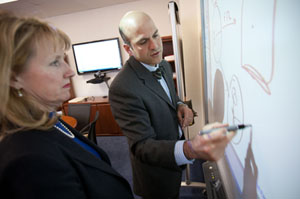
“Data is power,” says Farzad Mostashari, who wants to use data to improve care and cut costs. (Photo by Mark Finkenstaedt for KHN)
American industry learned decades ago that costs could be more efficiently controlled and quality improved with digitized data — information that is gathered electronically, fed into a computer, analyzed, shared and used to offer goods and services at lower cost, better quality and higher margins. Those businesses have joined the Information Age. Not health care, though. Health care costs continue to rise toward the unaffordable, even as quality lags. Meantime, health care’s most essential data — millions of patient health records, trillions of data points — remain isolated on paper stuffed into manila envelopes and stacked on shelves, or locked in proprietary computer systems programmed in incompatible software codes, making them difficult, if not impossible to share.
As head of the federal office charged with leading the digitization effort, Mostashari, 43, aims to change that. “Data is power,” he likes to say. A shaved-head, bow-tied bundle of enthusiasm, he radiates a good-salesman vibe, fist-bumping and high-fiving through conversations. While personality helps, Mostashari’s trump card is money. He is distributing $27 billion in federal stimulus funds as an incentive to doctors and hospitals who install electronic record systems and demonstrate they are meaningfully using them— that could work out to as much as $64,000 per physician over six years. Eligible hospitals will receive payments in the millions.
‘A Social Change Project’
Mostashari believes the benefits will go well beyond improved individual care. Rich stores of population data could be monitored to warn of disease outbreaks, find evidence for which procedures are most effective and help discover innovative approaches to care. Hospitals, managed care clinics, and even small doctor offices could analyze agglomerated data to carve out unnecessary costs and to help keep a lid on health price inflation.
“He’s trying to change a health care system,” says David Blumenthal, a Harvard professor and Mostashari’s predecessor in the HHS job. “It’s not a technology project, it’s a social change project.”
A proud nerd in childhood, Mostashari at age 14 moved from Iran to upstate New York to live with an aunt. He made a mistake thinking his prowess in science, math and computers — a trait revered in his native land — would also be considered cool in the U.S. Classmates mocked him, but he persevered.
He graduated as an epidemiologist from the Harvard School of Public Health, then medical school at Yale. His intent: combine on-the-ground medical experience with epidemiology’s more abstract pursuit of pattern recognition. In an early project, he tallied the prevalence of HIV among intravenous drug users, including prostitutes. Hired by the New York City Department of Health and Mental Hygiene, he rose quickly, getting named lead investigator in the West Nile virus outbreak. In 2001, he applied data patterns to develop early terror warning signals in the wake of the anthrax-by-mail attacks that terrorized the nation.
New York City Trial Run
New York Mayor Michael Bloomberg put him on his current path: bringing information technology to a large group of have-nots — desperately poor patients. In 2005, Mostashari headed a city program to help doctors’ offices, community health centers and hospitals set up digital record systems that now cover more than 2 million patients, three quarters of whom are on Medicaid or uninsured.
Now he is attempting to apply those lessons nationally. Remarkably, in an era of partisan government, Mostashari’s program enjoys bipartisan support — or, at least, bipartisan tolerance. While only three Republicans voted for the stimulus bill in 2009, which provided the program’s funding, few have spoken out against it. The fact that the information technology industry is a big supporter — giants such as IBM, Microsoft, General Electric, Hewlett-Packard and a host of smaller health-care specialty technology companies — doesn’t hurt. The $27 billion will flow their way, and plenty of high-priced lobbyists are working hard to keep it flowing.
As of Feb. 17, the government had disbursed $3.1 billion in to nearly 2,000 hospitals and more than 41,000 doctors, and Mostashari expects that number will balloon in the coming year.
One Doctor’s Transition
Dr. Gustin Ho, whose community clinic in San Francisco’s Chinatown is crammed with elderly men and women, was among the early converts. In an office lined with paper files, the only evidence of Ho’s new electronic health record system is a few Samsung flat-panel monitors in each of three examining rooms. “Before it was ‘copy this,’ ‘fax that,’” Dr. Ho says, stethoscope dangling from a lab coat pocket. “Now, I just hit a button and send the whole thing.”
The adjustment, however, was tough. For starters, Ho says he used to regard patient records as proprietary. “You don’t know how I struggled,” he says. “It’s my chart. It’s my patient. Why let other people look at it?” It came as a revelation, he says, when another doctor persuaded him the records are his patients’, not his.
Then, he had to figure out a way to integrate note-taking in his consultations with patients. “I was an amateur,” Ho admits. “In the beginning I used a laptop. It physically got in the way between me and my patient. I seemed to be paying more attention to the computer than to the patients.” After he switched to flat panel monitors, however, attaching them on wall swivels, patient complaints ceased. Entering an exam room to greet a middle-aged patient with heart problems, Ho pulls out the screen while both wheel their chairs together to go over the results of a recent test.
For such an effort to succeed, “you’ve got to make it simple,” Mostashari says. “Simple enough for the little guy. It has to work not just for the biggest, deep-pocketed organizations, but for the small docs as well.”
Foot-Draggers Face Penalties
Not everyone is on board, and some may pay a price. Physicians who fail to convert to digital records will see their already low Medicare and Medicaid 1 percent a year, beginning in 2015, to a maximum 5 percent reduction.
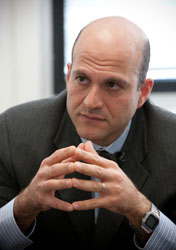
Mostashari (Photo by Mark Finkenstaedt for KHN)
There’s also friction between those who want system standards to be open and some large companies trying to steer standards to benefit their own products. “It’s often in a company’s best interest to make sure you can’t get the data from other sources,” says Aaron E. Carroll, a physician and professor at Indiana University. “They want you to buy their products. Easily compatible systems hurt their bottom line.”
²ѴDzõ³ٲ¹²õ³ù¾±Ìý for foot-dragging late last year. “Push!,” he said. “There is a sense in which not moving on anything is a greater risk than moving forward on something that may be imperfect. We can’t afford to wait another five years before we have (health care data) exchange in this country.”
His biggest challenge may be something over which he has less control: safeguarding patient privacy. Every week, it seems, another hospital reports a , such as last year’s posting of the names and diagnosis codes of 20,000 on a commercial website.
And it’s not just breaches that worry some consumer and privacy advocates. Many companies would love to get their hands on patient data, says Lee Tien, senior staff attorney at the Electronic Frontier Foundation. “Big data is big business,” Tien says.
‘Speed of Trust’
Mostashari counts privacy protection as a top priority and says the program will only move forward “at the speed of trust,” as physicians implement data-sharing systems in increments, with special attention to encryption and rules on access, password protection and audit trails. for the second stage of meaningful use, released in February, put a stronger emphasis on encryption of patient records, for instance.
While the tasks ahead are daunting, Mostashari’s office last year celebrated the first transmission of electronic health records sent securely over the Internet via e-mail using an industry-government standard available to doctors for free. In the annals of communications history, the event won’t rank with “Mr. Watson, come here, I want to see you,” but for doctors, it’s a start.


