
Doctors’ And Nurses’ Licenses Snagged By New Immigration Law In Georgia
This story is part of a reporting partnership that includes聽,听 and Kaiser Health News.
Hundreds of health care workers in Georgia are losing their licenses to practice because of a problem created by a new immigration law in the state.
The law requires everyone 鈥� no matter where they were born 鈥� to prove their citizenship or legal residency as they renew their professional licenses. But with too few staff to process the extra paperwork, licenses for doctors, nurses, pharmacists and other health workers are expiring.
Lisa Durden with the office says renewing a license used to be a straightforward process and until the new proof of citizenship provision took effect this year, most applications whizzed through. Now, they crawl. Enactment of the law coincided with budget cuts that reduced the office staff by 40 percent.
Kelly Farr, Georgia鈥檚 Deputy Secretary of State, says 600 nurses alone have fallen through the cracks.
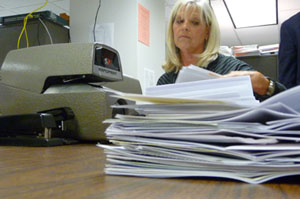
Workers in the Georgia secretary of state’s office have fallen behind on licensing applications for nurses (Photo by Jim Burress/WABE).
鈥淭here鈥檚 nothing more frustrating than getting that call from the desperate nurse, knowing …she鈥檚 being slowed down because we literally don鈥檛 have enough people to click the approve button,” Farr said.
While the Secretary of State handles licensing nurses, pharmacists, and veterinarians, Georgia鈥檚 is in charge of doctors, physician assistants and even acupuncturists. It鈥檚 the same story there. Director LaSharn Hughes says she sent 41,000 letters of notification on a Thursday.
“And by Monday, we鈥檇 burned up a fax machine. We didn鈥檛 have the staff. We didn鈥檛 have the equipment,” Hughes said.
Phones go unanswered. Paperwork piles up. And processing delays, coupled with confusion over the new rules, mean lots of expired licenses. Hughes estimates about 1,300 doctors and other medical practitioners have lost their legal ability to work.Some did not submit the new paperwork required. Others are stuck in the backlog of applications that haven鈥檛 been processed yet.
Donald Palmisano, Jr., Executive Director of the Medical Association of Georgia, believes the law fixes a problem that never existed 鈥� at least not among doctors.
“We鈥檙e not aware of any undocumented immigrants that are physicians,” Palmisano said.
Jorge Simmonds-Diaz, a Colombian-born physician who鈥檚 been practicing in Georgia for decades, is frustrated by the new law. He remembers years ago having to submit a high school transcript in English, to get his license. That makes more sense to him than the new law.
“To have 1,300 doctors not working because of that paper is ridiculous,” Simmonds-Diaz said.
Even , an outspoken activist and critic of illegal immigration who helped write the law, agrees. King says the new law protects Georgia jobs, but even he believes some parts of the legislation need fixing. A bill that addressed some of the law鈥檚 shortcomings died in the last legislative session.
“I am not only outraged, but sincerely disappointed and puzzled that our repair legislation was not allowed a vote,” King said.
Legislative sponsors of the law did not respond to interview requests. Neither did Georgia Gov. Nathan Deal.
For now, state licensing offices will continue opening mail full of copies of passports and birth certificates, then checking them against a list of acceptable documents.
But that鈥檚 where the process ends, confirms Kelly Farr and Lisa Durden of the Secretary of State鈥檚 office. The law says nothing about making sure the documents are genuine. “We really don鈥檛 have a way to do that,鈥� says Durden.
State officials say the new document requirements haven鈥檛 uncovered any undocumented immigrants.
Instead, officials say they hope the process itself is enough to discourage people in the country illegally from trying to get a license in the first place.
This story is part of a reporting partnership that includes聽,听 and Kaiser Health News.


