
Small-Town Clinic Provides Care To A Farming Community’s Poor
This story comes from our partner the
Dr. Angela Patterson often sees her patients when she eats lunch at Mel鈥檚 Diner, an oasis in Puxico, a farming town in Stoddard County in southeast Missouri.
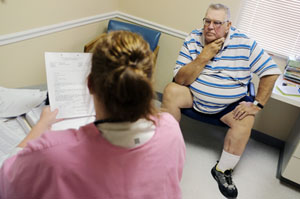
Dr. Angela Patterson talks with patient Jack Miller at Puxico Medical Clinic (Photo by Erik M. Lunsford/St. Louis Post-Dispatch).
Patterson runs a family clinic in Puxico, population 861, where a small staff of physicians and nurses tend to patients who might otherwise not receive care. Their busy offices, located in the rear of a bank building, are cluttered with medical files, a refrigerator for lab tests, an X-ray machine, and supplies.
鈥淚鈥檝e been to patients鈥� homes. I鈥檝e been to their Little League games. I know who鈥檚 getting married and divorced,鈥� said Patterson, a specialist in internal medicine, who grew up in the nearby town of Fisk in Butler County. Her father farmed; her mother taught school.
鈥淲e have people here who financially and physically can鈥檛 get to Poplar Bluff,鈥� she said, adding that a round-trip drive takes an hour out of your day.
Poplar Bluff Regional Medical Center operates seven family clinics in four rural counties to fill the gap for rural patients, many of whom are elderly and afflicted with multiple chronic conditions such as obesity, diabetes and heart failure. Nearly 60 percent of the clinic鈥檚 patients are on Medicare, and some are on Medicaid as well.
鈥淚 struggle with being overweight, so I talk with patients about exercise and making changes,鈥� said Patterson, who sees on average 25 patients a day. The clinic鈥檚 two nurse practitioners, Kimberly Te and Holly Reed, see additional patients; some need urgent care. Reed also makes rounds in a nearby nursing home and residential care facility.
鈥淚 never wanted to be a doctor who just hands a patient a scrip,鈥� Patterson said. 鈥淧eople have to wait. I never operate on time. But when they see me, we may talk for an hour. … I do a lot more mental health care than I thought I would.鈥�
The physician tries to talk with smokers once or twice a year. 鈥淭o be honest, I don鈥檛 badger them every single time,鈥� she said. 鈥淧eople have the right to make poor choices. But I do try to counsel them.鈥�
She nudges her most senior patients toward hospice care, rather than additional diagnostic tests and hospitalization toward the end of life 鈥� encouraging them to value the quality, rather than quantity, of their days.
鈥淲e鈥檙e doing pretty well here, but nothing鈥檚 perfect,鈥� said Patterson, indicating that she鈥檇 like to hire dieticians but Medicare won鈥檛 pay for them.
Story Components
- Hospital In Rural Missouri Faces Tough Challenges
- Small-Town Clinic Provides Care To A Farming Community’s Poor
Patterson also treats kids, from age 2 and up. About 46 percent of the children in Stoddard County are covered by Medicaid.
Dr. Bijan Bastaninejad, a pediatric hospitalist, spends five days a month at the clinic 鈥� handling children鈥檚 appointments and walk-ins. Some of these kids, too, are obese and diabetic. 鈥淚t鈥檚 hard to make lifestyle choices, especially if your (family鈥檚) financials are not in place and it鈥檚 easier to buy fast food,鈥� he said.
Te, the nurse practitioner, summed up the dilemmas of treating the rural poor. 鈥淭hey鈥檙e not ignorant people, but they鈥檙e not educated,鈥� she said. 鈥淵ou need to explain how smoking complicates the disease process.鈥�
Te said that many patients cannot afford to buy medicine . 鈥淥lder people on fixed incomes can鈥檛 afford a $25 a month co-pay for a drug when they鈥檙e taking eight or 10 pills,鈥� she said.
Ginger Holloway, the clinic鈥檚 office manager, said that she often spends 30 or 40 minutes on the phone trying to obtain an insurer鈥檚 鈥減re-authorization鈥� for treatment.
鈥淚nsurance pays less and less all the time,鈥� she said. 鈥淲e have some really sick people who still make too much money to get (government) assistance.鈥�


