
Hobby Lobby Decision May Not Be The Last Word On Birth Control Coverage
This KHN story can be republished for free. (details)
The Supreme Court鈥檚 decision Monday saying that 鈥渃losely held corporations鈥� do not have to abide by the contraceptive coverage mandate in the Affordable Care Act may not give those firms the ability to stop providing that coverage after all.
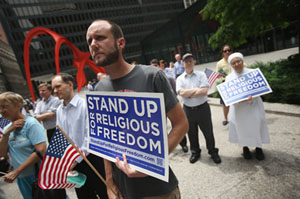
Religious freedom supporters hold a rally in Chicago to celebrate the Supreme Court’s decision in the Hobby Lobby contraception coverage requirement case (Photo by Scott Olson/Getty Images).
More than half the states have 鈥� on the books that require most employers whose health insurance covers prescription drugs to also cover FDA-approved contraceptives as part of that package. Unlike the ACA, those laws do not require that coverage to be available without deductibles or co-pays.
The court鈥檚 decision Monday does not directly affect those state laws, several analysts say.
The Religious Freedom Restoration Act, which the court used to say the closely held companies don鈥檛 have to abide by the federal mandate, 鈥渄oesn鈥檛 supersede state law,鈥� said Marcia Greenberger, co-president of the . 聽鈥淭hey stand as independent protections.鈥�
Many of those state laws have religious exceptions similar to the one the Obama administration has granted to nonprofit religious hospitals and universities, but only two, and , extend those exceptions more broadly. Two other states, Arkansas and North Carolina, do not require coverage of emergency contraception, which is among the in the Supreme Court case. 聽
Firms like , the nationwide arts-and-crafts chain that was the lead plaintiff in Monday鈥檚 case, aren鈥檛 subject to state insurance laws, because they self-insure their workers and don鈥檛 buy state-regulated insurance. Their plans are subject only to federal regulation.
Burwell v. Hobby Lobby Stores
- Supreme Court Limits Contraceptive Mandate For Certain Employers
- What The Hobby Lobby Decision Means For Employers
- FAQ: High Court’s Hobby Lobby Ruling Cuts Into Contraceptive Mandate
- Court Ruling Geared To ‘Closely Held’ Firms, But What Is That?
- Hobby Lobby Decision May Not Be The Last Word On Birth Control Coverage
But they are still likely subject to a ruling issued by the in the year 2000 that employers that fail to cover contraception as part of their health insurance benefit package are in violation of the 1978 Pregnancy Discrimination Act. That law was itself an amendment to the 1964 Civil Rights Act.
So what happens now? 鈥淚t depends,鈥� said Brigitte Amiri, senior staff attorney at the .
Employers that don鈥檛 want to offer some or full contraceptive coverage could sue to block the state contraceptive laws, 鈥渂ut that would be harder given how long some of those laws have been in effect,鈥� she said.
Meanwhile, that female employees of Hobby Lobby or other companies that stop offering contraceptive coverage could turn back to the courts for relief themselves, charging gender discrimination.
鈥淭here will be no shortage of exciting moments in the coming months,鈥� said Amiri.


