
Affordable Care Act Exemptions Mean Millions Don’t Have To Sign Up
This copyrighted story comes from the , produced in partnership with KHN. All rights reserved.
When she was eight weeks old, Ashlyn Whitney suffered a severe respiratory-tract infection that put her in an intensive care unit for 12 days.
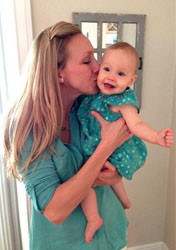
“Because she was so young, she couldn’t handle it,” Ashlyn’s mother, Nicole Whitney, recalled. “They had to give her oxygen.”
The baby, now a year old, recovered from her illness, known as respiratory syncytial virus.The bill for her treatment at the West Boca Medical Center in Palm Beach County came to about $100,000 — a sum that included almost $4,000 in fees for her birth and pre- and post-natal care — but every dime of the tab was picked up by a medical bill-sharing organization set up for its Christian membership.
Such religious groups are exempt from the Affordable Care Act’s mandate that most Americans obtain health insurance or pay a penalty. Although as many as 30 million Americans will remain without health insurance by 2016, despite the best efforts of the ACA’s proponents, all but about seven million of them will be spared having to join the new system because of exemptions created by the act itself, according to an analysis by the Congressional Budget Office and the staff of the Joint Committee on Taxation.
The exempted religious organizations generally pool their members’ money to pay the medical expenses of anyone in the group who gets sick, injured or becomes pregnant. Also exempted from the law are members of federally recognized religious sects who have religious objections to insurance or to such systems as Social Security or Medicare.
Exemptions from the Affordable Care Act
You are exempt from ACA coverage if you:
- Are a member of a recognized healthcare sharing ministry or a religious sect with objections to insurance;
- Are homeless or have suffered recent eviction, foreclosure, bankruptcy or a disaster that caused substantial damage to your property;
- Recently experienced domestic violence or the death of a close relative;
- Had medical expenses in the last year, for yourself or a family member, that you could not pay and which resulted in substantial debt or which were unexpected;
- Received a shut-off notice from a utility company;
- Are incarcerated or in the United States illegally.
SOURCE: Centers for Medicare & Medicaid Services
Most of the other 20 exemptions address circumstantial situations such as homelessness, eviction, foreclosure, bankruptcy, the death of a close family member or an experience with domestic violence. Members of Native American tribes are also free to not sign up for health insurance, as are those whose income is too low or who are serving a prison sentence.
The organization that Nicole Whitney and her husband, Jonathan, joined two years ago was Medi-Share, a program set up in 1993 by the Melbourne-based, not-for-profit Christian Care Ministry, which says on its website that its members “make the rules — and their dollars don’t support unbiblical choices such as abortion, or drug or alcohol abuse.”
The ministry’s medical director, Dr. Andrea Miller, who also holds the title of Vice President of Sharing, said its members were “believers who just wanted to share each other’s burdens and didn’t want to deal with health insurance.” If a member of the group got sick, she said, “they could all help out.”
Of Medi-Share’s 100,000 members nationwide — a number that reflects an increase of about 30,000 since the ACA’s open enrollment began last fall — 7,700 are in Florida, according to the group’s public-relations representative. She said an additional 200,000 people are members of two other national organizations with similar programs.
Joining such plans, Miller said, is often as much a philosophical decision as it is a financial one.
“People are looking to take care of themselves and each other,” said Miller, who was the medical director of a hospice before she was hired by the Christian Care Ministry two years ago. “They want to be connected, and they don’t want to pay for things that are immoral.”
By immoral she meant abortion, Miller said, but not necessarily contraception, which she said some of Medi-Share’s members probably support.
“The other piece of this is living a biblical lifestyle and a healthy lifestyle,” Miller noted, referring to the fact that the ministry provides “health coaches” who contact members suffering from health problems such as obesity — and attendant issues with high blood pressure and excessive cholesterol levels — and “advise them on how to get healthier.”
In practical terms, Medi-Share members contribute to each other’s care by depositing an agreed-upon amount — the Whitneys pay $1,250 a year, although some families pay more than twice that — into an account at America’s Christian Credit Union. The deposits act as deductions, meaning that once a family has used that money for its healthcare bills, any new family medical expenses are covered by Medi-Share’s fellow members.
Medi-Share negotiates with providers to obtain an average of 30 percent in discounts on medical bills incurred by its members. In the past 21 years, Miller said, the organization has “shared” about $750 million, including the discounts.
The system is not open to just anyone. “You have to be a Christian,” Nicole Whitney said. “You have to show regular church attendance, that you lead a religious life.”
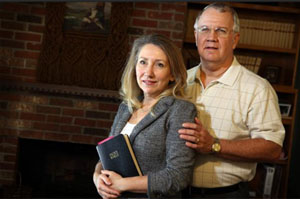
Carol and Paul White, in the living room of their Miami home, are exempt from enrolling in the Affordable Care Act on religious grounds. (Photo by Emily Michot/Miami Herald)
Before giving birth to her son, Sebastian, in 2011, Whitney had worked for six years as a fifth-grade teacher at a Christian school in Deerfield Beach, and had been covered by that institution’s insurance plan. When she left the school and bought a plan for herself and her newborn, she was suddenly paying a premium of about $900 a month.
“I couldn’t afford it,” Whitney said. But a friend told her “good things” about the Medi-Share program, and she was able to join. Whitney said she “didn’t really consider” signing up for a plan under the ACA’s insurance marketplace.
“I felt like I didn’t know enough about Obamacare,” said Whitney, who is 33 and lives in Boca Raton. “I’m glad I had an alternative.”
A fellow Medi-Share member, Paul White, who signed up in 2005, said he will never drop the religious group’s plan in favor of one established by the ACA.
“I didn’t want all the hassles,” said White, 63, a father of three who lives with his wife, Carol, in Miami’s Sunset Pines neighborhood. He had been covered by a corporate insurance plan for 28 years as an employee of a commercial real estate company before retiring in 2001.
A few years ago, after joining Medi-Share, White broke his left leg in what he called “a silly household accident.” He wore a cast for three months, but his medical expenses were covered.
When he was first asked to pay $1,250 as an annual deductible for his family, White recalled being taken aback. “At that point, it sounded like a lot,” he said. “But now it seems cheap. I have no worries.”


