
Missouri, Kansas Reject State-Run Health Insurance Exchanges
This story is part of a partnership with , , and Kaiser Health News.
Immediately after the presidential election, and more than a week ahead of the Nov. 16 deadline, Missouri Gov.聽Jay Nixon, a Democrat, announced he had made up his mind. The state would not be setting up its own health insurance exchange.聽
Next door in Kansas, Gov. Sam Brownback, a Republican, made a similar announcement.聽These聽governors’ moves open the door for increased federal involvement in health care in both states.
President Barack Obama’s health law has never had any easy time in this part of the country. “Kansans feel Obamacare is an overreach by Washington and have rejected the state鈥檚 participation in this federal program,” Brownback said in a statement.
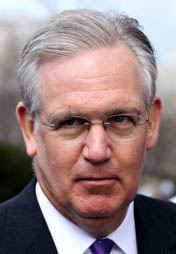
Missouri Gov. Jay Nixon (Photo by Alex Wong/Getty Images)
In Missouri, the law is facing an even steeper uphill battle. Last week, voters overwhelmingly approved a measure prohibiting the governor or any state agency from making any moves toward setting up an exchange without legislative approval. The also allows taxpayers to sue a state worker or agency over being involved with any part of the exchange process that鈥檚 not required by federal law, whether that be assisting a federal agency or providing resources.
A bill that would have authorized a state exchange stalled last year, and state lawmakers haven鈥檛 taken any action on one since then. They don’t convene again until January, well past some of the federal government’s key deadlines, even with the recent deadline extension.
“Based on current state law, and the federal deadline, the state-based option isn鈥檛 on the table for Missouri at this time,” said Nixon. So a federal exchange seems to be the only possibility.聽聽
Some health policy experts find the situation in Missouri ironic. “We have a state that is very much committed to state rights and state control,” notes Thomas McAuliffe, with the Missouri Foundation for Health.聽“Yet we鈥檙e willing to just blindly cede all creation and administration of a health exchange or insurance state marketplace to the federal government.” The foundation聽helped fund efforts to plan an exchange.
McAuliffe doesn鈥檛 want to write everything off just yet. He thinks states like Missouri are likely to become more involved in the process, as the political dust settles. Nixon himself said in his announcement that falling back on a federal exchange isn鈥檛 ideal:聽“Regulating the insurance market is a power best left in the hands of the states, where we perform those duties more efficiently and effectively, and provide better service for our consumers.”
Early on, Missouri聽made some progress toward setting up an exchange, as had Kansas. While that’s聽come to a halt in both states, there聽are still those like Kansas insurance commissioner, Sandy Praeger, who want the state to be involved in a hybrid state-federal partnership.
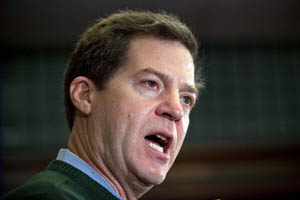
Kansas Gov. Sam Brownback (Photo by Andrew Burton/Getty Images)
Praeger says that will depend on the path Brownback takes with his new legislature in the months ahead: “His concern is that they have all these new conservative Republicans that won鈥檛 want to go along with a partnership exchange,” Praeger said, “but I鈥檓 still hopeful.”
In his statement, Brownback wrote: “My administration will not partner with the federal government to create a state-federal partnership insurance exchange because we will not benefit from it and implementing it could costs Kansas taxpayers millions of dollars.”
McAuliffe believes聽that by聽extending the deadline for states to declare how they will run their own exchange, the HHS聽is signaling a bit of desperation.聽And what that means, he says, is that states like Kansas and Missouri still have an opportunity to get more involved if they choose.聽
No matter who is in charge,聽the health law calls for all of these exchanges to be up and running in a little over a year. That鈥檚 not a lot of time for either federal leaders or the health care industry to work out the details and make sure everything鈥檚 ready.
have said they plan to run their own exchanges. At least eight states have said they won鈥檛. The rest have yet to submit plans.
This story is part of a partnership with NPR, KCUR, and Kaiser Health News.


