
Did The Supreme Court Tip Its Hand On Contraception Cases Yet To Come?
This KHN story can be republished for free. (details)
The Supreme Court鈥檚 opinion Monday holding that some for-profit firms do not have to provide women the contraceptive coverage required under the Affordable Care Act if they have religious objections addressed only half of the ongoing legal battle over the birth control mandate.
But those on both sides of the issue think the court鈥檚 majority may have telegraphed which way it could rule when one of those other cases reaches the justices.
Depending on , there are more than still working their way toward the high court. They were filed by nonprofit groups, mostly religious educational and health organizations like universities and hospitals.
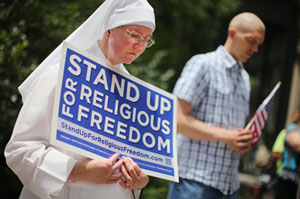
Pro-religious freedom protesters gathered on Monday in Chicago in support of the Supreme Court’s decision in the Hobby Lobby case (Photo by Scott Olson/Getty Images).
Unlike the for-profit companies, which were required to provide the contraceptive coverage directly through their insurance plans, religious nonprofits were given a special accommodation under in 2013. They only have to fill out a form saying they object to providing the benefit on religious grounds, and send it to their insurer, or, in the case of organizations that self-insure, to the company that administers their health benefits.
Once that happens, the insurance company or third-party administrator provides the contraceptive benefits, at no cost to the employer or the employee. For insurers, providing contraceptives is considered less expensive than paying for pregnancy and childbirth. Third-party administrators are indirectly being subsidized by the government in these cases.
But even is too much for many of those organizations. 鈥淪igning the form triggers the provision of services,鈥� said Daniel Blomberg, legal counsel with the Becket Fund for Religious Liberty, which is representing many of the nonprofit plaintiffs in the cases. For many of the organizations, that makes them complicit in providing something they object to on religious grounds, he said.
But that may not be how the Supreme Court鈥檚 majority sees things. The written by Justice Samuel Alito said the administration could extend the offer it makes to nonprofits to for-profit firms with religious objections as well. 鈥淭hat accommodation does not impinge on the plaintiffs鈥� religious beliefs that providing insurance coverage for the contraceptives at issue here violates their religion and it still serves HHS鈥� stated interests,鈥� Alito wrote.
He also noted that 鈥渨e do not decide today whether an approach of this type complies with (the Religious Freedom Restoration Act) for purposes of all religious claims.鈥� But in his concurring opinion, Justice Anthony Kennedy went even further. 鈥淭here is an existing, recognized, workable and already-implemented framework to provide coverage,鈥� he wrote, referring to the HHS regulation for nonprofit organizations.
Advocates for contraceptive coverage say that is a good sign for them; that at the very least Kennedy would likely join the court鈥檚 four liberals to make a majority in upholding challenges to the regulations for the nonprofit groups.
鈥淚f I were litigating one of the nonprofit cases, I wouldn鈥檛 say it bodes well for them,鈥� said Julianna Gonen of the .聽 鈥淭here are some strong signals here that the accommodation the administration created for nonprofits does meet the government鈥檚 burden under RFRA.鈥�
Blomberg of the Becket Fund, however, thinks there are signs the court would go the other way. In particular, he pointed to the court鈥檚 finding Monday that providing the coverage represented a 鈥渟ubstantial burden鈥� to the for-profit companies in the case, Hobby Lobby Stores and Conestoga Wood Specialties. 鈥淲e think that鈥檚 going to be very helpful鈥� in the nonprofit cases as well, he said.
And he noted that in the wake of the ruling in the for-profit case, there have already been several actions in favor of nonprofits. Citing the Hobby Lobby ruling specifically, a U.S. Appeals court in Atlanta Monday afternoon for the nonprofit religious broadcaster Eternal Word Television Network.聽 The Supreme Court itself Monday against Wheaton College in Illinois, with only Justices Sonia Sotomayor and Stephen Breyer dissenting.
Meanwhile, there are suggestions that a compromise could be in the offing.
In the much-publicized case filed by the , which operates a chain of nursing homes, the organization ultimately agreed, , not to fill out the form that went to its insurance provider, but instead to write a letter to the government with essentially the same information. That letter gave them a temporary reprieve from having to provide coverage while the case is heard by a lower court.
鈥淲hen they say to the government, 鈥榳e can鈥檛 do this,鈥� that triggers nothing at all,鈥� said Blomberg.
So could nonprofits that object to sending forms to their insurance companies send them to the government instead?
Sara Rosenbaum, a professor of health law and policy at , said that could be difficult. Particularly in the case of organizations that are self-insured and don鈥檛 use an insurer, she said, 鈥渘obody can direct the administrator but the employer.鈥�
But Rosenbaum said it might not be impossible. It might, however, require yet another round of federal regulations.


