
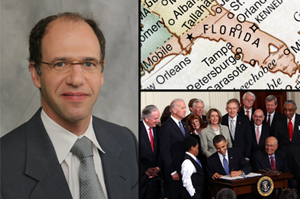
After a Florida district court judge’s recent ruling that the new health law is unconstitutional, Florida Gov. Rick Scott reacted by saying his state could, for now, stop implementing it. Alan Weil, the executive director of the National Academy for State Health Policy, calls that “a risky posture” — considering that the Jan. 31 court decision won’t be the last.
Weil — a social policy researcher and former state cabinet-level health adviser in Colorado — is keeping a close watch as states try to figure out how to implement the law, which calls for the creation of insurance exchanges and a big expansion of Medicaid beginning in 2014.
KHN’s Mary Agnes Carey and Marilyn Werber Serafini recently spoke with Weil. Edited excerpts of the interview follow.
Q: Florida Gov. Rick Scott has said the recent court ruling striking down the health care law means that his state can stop implementing the measure for now. What do you think of that?
A: It’s a risky posture because everybody knows that this isn’t the last word. He may be right from a legal perspective. I think that people who know more about the law than I need to give him guidance on whether it’s factually true that in his state he can treat the world as if the law actually doesn’t exist. But, even if that’s true, knowing that there are going to be other rounds on this, you do stand to lose ground in getting ready. It’s a gamble and there are costs to going along with it if it’s ultimately struck down. There are risks on either side.
Q: On Capitol Hill, the House has voted to repeal the health law and Republicans in both chambers have said if they can’t repeal the entire measure they will try to strip out certain provisions and stop federal funding for the law’s implementation. How are states reacting to that?
A: I don’t think congressional activity affects implementation. States are accustomed to a changing federal legal environment. They’re smart enough to know not to anticipate a change because things don’t always go as planned. There are varying levels of enthusiasm about implementing the law. There’s [also] a lot of uncertainty right now. There are a lot of regulations that haven’t been released.
A key issue for states is building the [health insurance] exchanges and there is no federal plan yet for what the federal fallback would look like. There are many aspects of uncertainty that are causing states to — whether they’re embracing the law or [not] — there is still a lot of tentativeness in their steps because they know they’re going to have to revisit their decisions as the landscape unfolds.
Q: Enrollment in the health law’s for the sickest populations is lower than expected. Does that experience suggest that high-risk pools are not the best way to cover the uninsured?
A: We’ve known from prior to the Affordable Care Act that high-risk pools are not a very effective way to provide coverage because there are strictures on how they function which make them not that appealing. The pools in the Affordable Care Act have different parameters than most of the prior state pools and so they have some things that make them more attractive and some things that make them less attractive. They’re also temporary. But the primary problem with health insurance is affordability. Without significant subsidies a high-risk pool is a great place you can go to buy coverage but it doesn’t mean you can afford it.
Q: What are the biggest challenges for states as they implement the health law?
A: The biggest practical challenge is simply the sheer magnitude of issues that you have to work through. States don’t have a lot of resources right now. You couple that with uncertainty and that makes it hard. It’s not just pure dollars; it’s having the infrastructure, which includes the analytic and the political infrastructure, to work these issues through. It takes time and people and resources that are all really tight right now.
The reality is that the overwhelming majority of states continue to take the steps necessary to implement the law. There is an understanding not only that it is the law but that if the state doesn’t lead the implementation process the federal government will and that’s less palatable. And even if there are many aspects of the law you don’t like, there are aspects of the law worth putting some energy into — even as you work for its demise.
While everyone hangs on the latest political and legal shifts of sands, which are very important, from the perspective of the real world, the law remains on the books and implementation runs apace. The private sector certainly is acting as if this is the law. If you step away from the politics of it, which is hard to do, you do get quickly reminded that everyone else is gearing up on the expectation that this is the world they are going to live in. And I think that’s part of why even when states oppose the law are treating it as the law of the land which it still is.
KHN’s Jessica Marcy contributed to this story.