
Americans Uncomfortable Around Mentally Ill Despite Acknowledging Discrimination
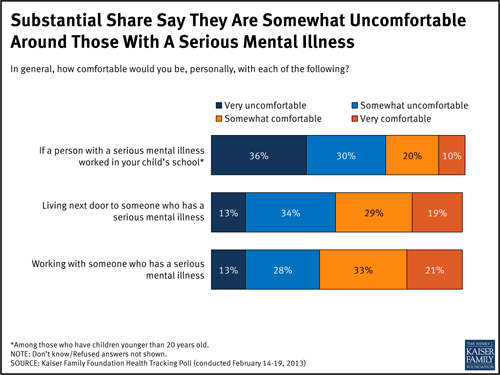
The聽public has a contradictory view of mental illness, according to a new poll. While most Americans believe people with such ailments are the victims of prejudice and discrimination, a substantial portion of the public say they have qualms about working in the same place or having their children attend a school where someone with a 鈥渟erious鈥� mental illness is employed.
Seventy-six percent of Americans believe the mentally ill experience discrimination, according to the . (KHN is an editorially independent program of the foundation.) That was a greater portion of Americans than those who said they thought discrimination burdens people with HIV or AIDS; Hispanics; blacks; people with physical disabilities, or women. Immigrants were the only group to rank higher than those with mental illness.
But the pollsters noted that that the survey 鈥渟uggests that many Americans are themselves uncomfortable with the idea of interacting with people who have a serious mental illness.鈥� Sixty-six percent of parents said they would be 鈥渧ery鈥� or 鈥渟omewhat鈥� uncomfortable if a person with a serious mental illnesses worked in their child鈥檚 school. Forty-seven percent said they would be uncomfortable living next door to someone with a serious mental illness, and 41 percent said they were uncomfortable working with someone who has a serious mental illness. These concerns were less severe among people under 30, and people with their own mental health issues or experiences with family members.
The poll questions were prompted by the Newtown, Conn.,聽 elementary school shooting on Dec. 14 and the subsequent debate about whether stronger gun control laws and better mental health services might prevent similar attacks.
The poll also found a post-election drop in popularity for the 2010 health care law, which had been narrowly more popular than not in November. This month, 42 percent of Americans expressed an unfavorable opinion of the law and 36 percent said had a favorable opinion. Another 23 percent either said they didn鈥檛 know or refused to answer the question鈥攖he most that dodged the issue in the nearly three years that Kaiser has been testing public perceptions about the law. The pollsters attributed the change to a drop in support among Democrats.
The poll was conducted Feb. 14 through Feb 19 among 1,209 adults. The margin of error was +/- 3 percentage points.


