Can for-profit health insurance companies be trusted to take care of the nation’s sickest and most expensive patients? Many states, under an effort supported by the Obama administration, are planning to let the companies manage health care for those elderly and disabled people covered by both Medicare and Medicaid.
Patient advocates have warned that private health insurance companies are ill-equipped to provide the complex medical care and at-home services many of these people need to survive. It turns out that Arizona, a state that has been known to resist federal health programs, has been doing just that for many years.
In Apache Junction, east of Phoenix, a sparsely filled nursing home stands as a stunning achievement for Arizona’s public health insurance program. Only half of the rooms are filled, and the men and women who live here — too disabled in mind or body to return home — seem surely in their last days.
“These are folks that have chronic cognitive and/or physical disabilities that in most cases are not going to improve,” says George Jacobson, the nursing home administrator.
That sets Arizona apart. Of those Arizonans covered by Medicare and Medicaid and deemed sick, frail or disabled enough to live in a nursing home, only 27 percent of them do. The rest, nearly 3 out of 4, live in assisted living facilities or at home.
Joseph Ford sits in his well-worn easy chair in the living room of his suburban Phoenix home. He’s 42 years old and disabled from a car accident. His attendant has just arrived and makes her way into the kitchen to prepare dinner. Later, she’ll change the sheets on Ford’s hospital bed. It’s pushed against the wall in the entry way where he sleeps every night, since Ford can’t make it up the stairs. His house is busy today: the case manager from his health insurance company, Dave Oxford, is here too.

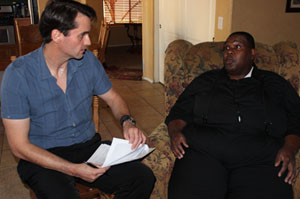
Mercy Care case manager Dave Oxford checks in with his client Joseph Ford (Photo by Sarah Varney/KHN).
“All right, Joseph,” Oxford says. “So you have not had any recent medication changes. I have listed here that you’re on Lyrica at 100 milligrams, is that correct?”
Oxford is a case manager for Mercy Care, a subsidiary of the insurance giant Aetna which is paid with public dollars from Medicare and Medicaid. He visits all of his clients in their homes every three months to monitor their conditions and assess their needs, like: Do they need a new wheelchair? A bar installed in the bathroom? Help with groceries?
“The care doesn’t end at the home visit,” Oxford says. “If there’s a need that arises between the quarterly visits, then we ensure that’s taken care of. And I think that’s a big part of how we maintain people in their home, as opposed to in a nursing home.”
The health plans that compete for Arizona’s combined Medicare-Medicaid patients receive a monthly fee, and with that money they’re expected to cover all of a patient’s needs. Critics have long argued the incentives for companies to keep the cash and withhold care are too great — the potential profits too tempting. And they point to the scandal-filled 1990s when some HMOs kept costs down by denying treatment.
Today in Arizona, though, patients like Joseph Ford, and advocacy groups say the health plan case managers are less like Grim Reapers and more like guardian angels. “Dave is cool,” Joseph tells me. “He’s in my cell phone.”
“I appreciate somebody on the other side looking out for my well-being, and not just looking at me as a number on a paper,” he says.
Ford is a number on a paper, of course. A big number. Nine million people nationwide are eligible for both Medicare and Medicaid, and they cost some $300 billion a year. Arizona though, unlike other states, has long paid private health plans to manage care for public beneficiaries, and that’s saved them money. Arizonans in nursing homes costs the state $5,400 a month for custodial care. If kept in their homes, the cost is $1,400.
But Arizona’s fervent belief in the free market — having those private companies run public benefits — doesn’t mean it’s the Wild West. Insurance executives, hospital and provider groups, and advocates say state regulators are vigilant and quickly rebuke plans that don’t meet their strict standards.
“There are a number of different metrics we look at on a very regular basis, that look at access to care,” says Tom Betlach, who oversees Arizona’s Medicaid agency. “Are the members getting the access to care that they need? Making sure there aren’t any gaps in the system. We’re looking at the quality measures to make sure that they’re meeting the standards within the contract.”
Arizona’s system appears to be working: Arizonans eligible for both Medicaid and Medicare enrolled under one managed care plan were far less likely to be hospitalized or put in nursing homes than those in traditional fee-for-service. They used the emergency department less frequently, and when they did end up in the hospital, they spent far fewer days and were readmitted less often.
There’s widespread consensus that Arizona’s model works because it pays higher Medicaid rates than most other states. Even with a recent rate reduction, nearly every physician and hospital here accepts Medicaid patients and health plans reap about a 2 percent profit.
Still, James Stover, head of the University of Arizona Health Plan in Tucson, cautions other states looking to replicate the Arizona model that the system is fragile, and healthy payment rates are a vital element.
“If the rate drops below a certain amount, it will make our job more difficult. There’s no doubt in that,” Stover says.
For now though, Stover says health plans continue to see a business opportunity in perfecting Arizona’s model: There’s still more wasteful and unnecessary medical care to be stamped out.