

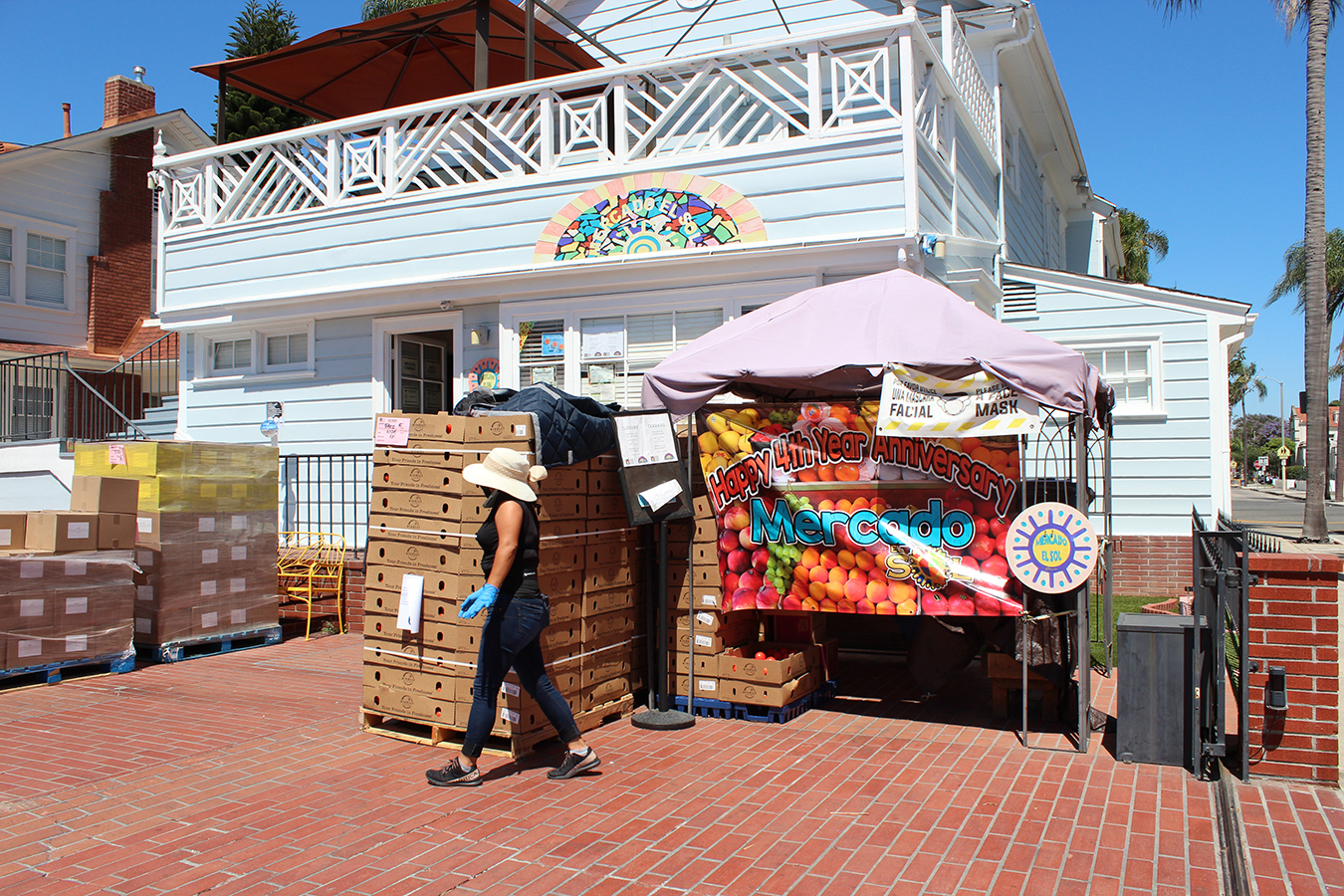
SANTA ANA, Calif. — One week the food pantry had frozen crabmeat; other weeks, deli meat or plant-based “meat.” The week before the Fourth of July, there was no meat at all, and a reminder that the pantry would be closed the next two weeks.
Even though she never knows exactly what she’ll get, Lesli Pastrana is grateful for the Mercado El Sol food pantry. She has frequented it ever since she lost her job in January. On a recent Friday, she walked away with produce, eggs and staples like ramen noodles, pasta and oats.
She and her husband are both in the United States without legal authorization. Before the pandemic, they got by with their wages and the food stamps they received for their two young children — both U.S. citizens.
But now that Pastrana has lost her job at a bowling supplies factory where she worked 10 years, and her husband has been downgraded to part-time work at a warehouse, the couple must save every dollar for their $1,500-a-month, two-bedroom apartment in Tustin. Pastrana is looking for a single room to rent for her family of four. She’s worried about her kids.
“I don’t want them to focus on the fact that I don’t have a job right now,” she said. “They don’t know the magnitude of the situation, but they can sense the worry.”
Additional food stamps could help lighten Pastrana’s load and cut down on trips to the food pantry, but like all undocumented immigrants in the U.S., she and her husband are not eligible for these benefits, despite having worked and paid taxes here.
Democrats in the state legislature this year proposed opening California’s state-funded food stamp program — which serves about 35,000 authorized immigrants who don’t qualify for federal food stamps — to all income-eligible Californians, regardless of immigration status. The cost of the proposed expansion, starting in 2023, was put at about $550 million a year.
But after negotiations with Gov. Gavin Newsom’s administration, the proposal was pared down to a two-year, $30 million project to update the state food aid program so it can accept applications from some of the in California, should the program be extended to them in the future.
A in the legislature would expand the food stamp benefit to the undocumented once the system is updated and the legislature has appropriated funds for the expansion.
For now, the state has not committed to expanding the program. But the legislature’s efforts this year put California at the forefront of extending food aid to unauthorized residents. Advocates say the state has a responsibility to help feed them, especially since toil in California’s fields, feeding the state and the rest of the country.
“They’re working and risking their lives, not just through the pandemic, but right now through a heat wave,” said (D-Sanger), co-author of the bill, whose district is in the Central Valley. “They’re risking their lives to provide food for us. Why wouldn’t we invest in them as well?”
The program would be expensive, and the state would have to foot the whole bill. Right now, California is flush with a $76 billion surplus, but state revenue can swing wildly. For instance, the pandemic’s economic restrictions had the Newsom administration just the year before.
California has already expanded eligibility to undocumented immigrants for its Medicaid health coverage program. Since last year it has allowed people under age 26 to participate , at a cost of roughly $450 million annually. Starting in 2022, unauthorized immigrants age 50 and over will be eligible, and the state’s annual costs are expected to grow to $1.3 billion by fiscal year 2024.
Up to 1 million unauthorized immigrants would meet the income requirements for food stamps, according to advocate Jared Call of Nourish California, which co-sponsored Hurtado’s bill. But the program would likely begin by offering the benefit to subgroups such as children and seniors.
To qualify for food stamps in California, most families would have to earn 200% or less of the federal poverty level for their household size. For a family of four, this would mean grossing no more than .
The governor’s office declined to comment on the “Food for All” proposal and its funding, citing ongoing discussions with the legislature to finalize the budget.
Conservatives have expressed caution. Republican state senators voted as a bloc against Hurtado’s bill. In an email explaining his “no” vote, Sen. Brian Jones (R-Santee) said it asks California taxpayers to “bear the burden of a chaotic border situation that is a federal responsibility.”
In the Assembly, where committees are debating the bill, member Steven Choi (R-Irvine) suggested the program’s generosity would compound problems at the U.S.-Mexico border by encouraging people to try to immigrate to California.
Even Democrats, who hold supermajorities in both houses of the state legislature, are wary of making commitments they can’t keep. Food for All would need to be in case revenues lag or other spending increases, according to an Assembly budget report.
, which Newsom was expected to sign Monday, includes other measures to make food available to poor people, regardless of immigration status, including more investment in food banks and a to all California public school students, regardless of income.
The crushing demand for emergency food assistance during the pandemic put a spotlight on food insecurity. In California, said they went without sufficient food during the first three months of the pandemic lockdown, up 22% from before it began in March 2020, according to a study by researchers at UCLA’s Fielding School of Public Health and Luskin School of Public Affairs.
Food banks in response doubled or tripled their food distribution. Schools, closed for classes, kept cafeterias running so families could drop by every week for free breakfasts and lunches. Nonprofits scrambled to organize emergency grocery deliveries for those sick with covid-19.
But people behind these efforts say charity food giveaways are stopgap solutions that often distribute unhealthy food, result in massive waste and rob people of choice.
“Food banks get — I don’t want to say ‘hand-me-down food’ — but they often get food near its expiration date,” said Claudia Keller, chief mission officer of Second Harvest Food Bank in Orange County. “Food that might be high in sugar, salt and fat. And that, to us, is a disservice to the most vulnerable in our community.”
Advocates say there is a better solution to hunger: Simply give families cash or stamps to buy their own food.
Vanessa Terán of , on California’s Central Coast, said this is why her organization, which primarily serves undocumented immigrant farmworkers, switched from organizing food drives to raising money for prepaid grocery cards.
“People are able to buy what they need, and also there’s a shopper’s dignity,” she said. “They can make choices for their own families that best meet their needs.”
The same approach was taken by the federal benefits program — known nationally as SNAP and in California as CalFresh and often called food stamps — which mails beneficiaries grocery-usable cash cards that automatically reload each month.
Undocumented immigrants make up an estimated 8.1% of California’s workforce, according to a 2019 summary of data from the think tank. A 2019 analysis by the nonpartisan California Budget & Policy Center estimated the state’s undocumented immigrants .
Hurtado praised her colleagues’ decision to expand Medi-Cal to more groups of undocumented immigrants, saying “hunger and health go hand in hand.”
“The foundation for good health is having access to adequate food, and healthy food,” she said. “But I think that something is better than nothing, and I’m happy with the progress that we’re making.”