Thousands of people struggle to access mental health services in Florida. The treatment system is disjointed and complex. Some residents bounce between providers and are prescribed different medications with clinicians unaware of what happened. Jails and prisons have become de facto homes for many who need care.
These problems and more were identified in a scathing report released earlier this year by the Commission on Mental Health and Substance Abuse, a that Florida lawmakers created in 2021 to push for reforms of the state’s patchwork of behavioral health services for uninsured people and low-income families.
What’s most troubling about the group’s findings? They aren’t new.
More than 20 years ago, the Florida Legislature set up a commission to examine the same issues and publish recommendations on how to improve mental health care in the publicly funded system.
The echoes between the two groups — over two decades apart — are unmistakable. And Florida isn’t the only state struggling with the , a between providers, and .
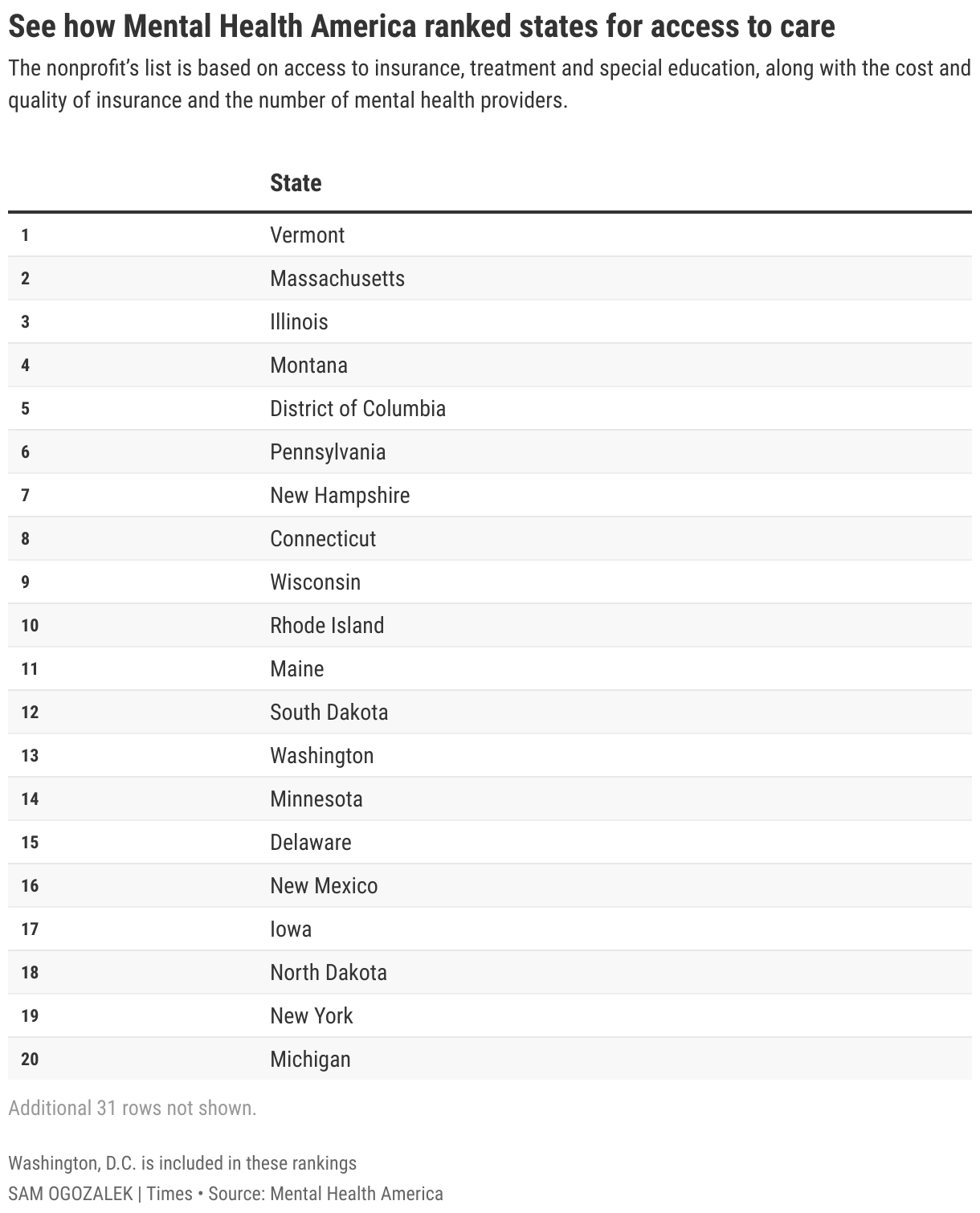
Last year, the national advocacy group Mental Health America said Florida ranked 46th among the 50 states and the District of Columbia for access to such care. Arizona, Kansas, Georgia, Alabama, and Texas were worse off, according to the nonprofit, which based its rankings on access to insurance, treatment, and special education, along with the cost and quality of insurance and the number of mental health providers.
Conversations about mental health are at the forefront nationwide amid the proliferation of mass shootings, pandemic-related stress, rising suicide rates, and shifting viewpoints on the role of police in handling 911 calls.
“It comes down to how much investment, financially, legislators are willing to put into building a system that works,” said Caren Howard, director of policy and advocacy at , a nonprofit just outside Washington, D.C.
In Florida, the 1999 Commission on Mental Health and Substance Abuse was launched when Jeb Bush was governor. In a , the group called the state’s treatment system “complex, fragmented, uncoordinated and often ineffective.”

The commission found that jails and prisons were Florida’s “largest mental hospitals” after began — the 20th-century movement to shutter state psychiatric facilities and treat people instead through community services.
The for not sharing patient data with one another and being unable to track whether those with severe mental illnesses like schizophrenia were truly getting needed help.
“A lot of the things that we’re finding now, they found back then,” said Charlotte County Sheriff Bill Prummell, a member of the latest commission who served as the chairperson for about 18 months.
The similarities raise questions for the group about whether its work will also end up on a shelf, collecting dust, as Florida lawmakers continue to wrestle with the same challenges again and again.
“Are they really going to take us seriously?” Prummell asked.


Dropping the Ball
After hosting public meetings across Florida, the 1999 commission urged a slate of reforms, including expanding jail diversion programs like .
But the group’s key recommendation was to set up a “coordinating council” in the governor’s office to lead the system and develop a strategy for care.
That never happened.
David Shern, chairperson of the 1999 group and former dean of the University of South Florida’s Louis de la Parte Florida Mental Health Institute, said he thinks Bush’s office dropped the ball.
The Republican governor, , didn’t want to add staff to his office, so the coordinating council was never created, said Shern.
That’s “where the plan really fell apart,” he said.
Instead, lawmakers in the Department of Children and Families to review how Florida could improve its behavioral health system and submit a report to Bush, among other leaders.
The work group disbanded in 2003. That same year, the legislature created a to oversee the system, but it was dissolved in 2011, . When the Tampa Bay Times recently asked for the work group’s report, Laura Walthall, a spokesperson for the Department of Children and Families, said it couldn’t be found. Bush didn’t respond to emailed questions.
Former state Rep. Sandra Murman, however, said that what happened is just a reality of bureaucracy.
“It’s the same with all commissions,” said Murman, a Tampa Republican who was part of the 1999 group. “The life cycle of any big report that comes out is probably about five years.”
Lawmakers leave Tallahassee because of term limits. Agency heads step down. New officials get elected. Priorities shift.
“They come in with their agenda, and you won’t see social services ever at the top,” she said of Florida legislative leaders.


But some state lawmakers focused on mental illness in the wake of the 2018 shooting at Marjory Stoneman Douglas High School in Parkland. Amid mounting public demand for more drastic gun control measures, such as an , the Republican-controlled legislature instead approved more limited restrictions, like Florida’s , along with steps unrelated to gun control, allocating about $400 million for .
Before the massacre, received mental health services through several public and private providers, splitting the future gunman’s medical history, according to a from the Marjory Stoneman Douglas High School Public Safety Commission.
“No single health professional or entity had the entire ‘story’ regarding Cruz’s mental health and family issues, due, in part, to an absence of communication between providers and a lack of disclosure by the Cruz family,” the report said.
The vast majority of people with a mental illness , according to the nonprofit in Washington, D.C. And they are to be victims of violent crime than perpetrators.
In 2020, investigating school safety issues related to the shooting called Florida’s mental health care system “a mess.”
“Deficiencies in funding, leadership and services,” , “tend to turn up everywhere like bad pennies.”
The panel said it didn’t have enough time to conduct a full review of the system and urged state lawmakers to set up a commission to do so.
The latest commission reported that the system remains splintered and suffers from “enormous gaps in treatment.” And there’s still no centralized database on patients.
The group, just like its predecessor over two decades ago, has suggested that Florida create more jail diversion programs and that state agencies share patient data. The commission has pitched new ideas, too, like a pilot program in which one agency manages all public behavioral health funding in a geographic area, including state money and local dollars, so providers can focus more on care and less on complicated billing processes.
“This isn’t going away, and if we don’t address it, it’s going to get worse,” Prummell .
Solutions to Florida’s problems are not headline grabbers, which makes it tough to generate political support, said Holly Bullard, chief strategy and development officer at the , an Orlando nonprofit.
“Building good government, it can get technical,” she said, “and sometimes it’s hard to communicate the importance of it.”
Will Anything Change?

There’s been some progress in Florida’s mental health care system since 2001, said Jay Reeve, the new chairperson of the latest commission and CEO of , a behavioral health provider in Tallahassee.
The system is more responsive to regional issues, partly because of state contracts with seven — nonprofits that oversee safety-net services for the uninsured, he said.
There’s also been an increase in initiatives like , which help people in mental health emergencies, and for police officers, in which they get trained on de-escalation techniques and psychiatric diagnoses so they know when to get residents into treatment instead of arresting them, Reeve said.
The Department of Children and Families used to spend about $500 million a year on community-based behavioral health services such as outpatient treatment, case management, and crisis stabilization units, the 1999 commission reported. Now, its budget for such care is $1.1 billion.
Pockets of innovation exist at the local level, too, as in Palm Beach County, where an initiative called aims to boost the area’s mental health care workforce, among other things, said Shern, senior associate in the department of mental health at the .
But challenges remain.
, according to Mental Health America. That’s about 17% of the state’s population of those 18 and up. An estimated 225,000 youths experienced at least one major depressive episode in the past year, the nonprofit reported in October.
In 2020, Florida ranked last among states for per capita mental health care funding, the Parkland grand jury said. In 2021, the Miami-Dade County jail system , according to the 11th Judicial Circuit.

“As long as you keep things siloed, accountability is easier to dodge,” said Ann Berner, a member of the 2021 commission and CEO of , a managing entity.
Political will is needed to enact major reforms, Shern said. So is follow-up on the commission’s work, said Murman, who works at , a lobbying firm.
“In this case, it probably is something that has to be revived every five years to really make an impact,” she said.
, a Parkland Democrat on the 2021 commission, said there’s bipartisan support to improve the system.
But during the current legislative session, the Tampa Bay Times on March 13 could find only one House bill and a matching Senate bill based on the commission’s 35-page interim report: a proposal to study Medicaid expansion for some young adults age 26 and under. (Republican leaders in Florida have refused to expand the under the Affordable Care Act, which became law in 2010.)
Hunschofsky said she thinks the legislature will take more action once the commission releases its final report, .
Republican Gov. Ron DeSantis’ office referred questions to the Department of Children and Families, where officials didn’t answer them.
Senate President Kathleen Passidomo didn’t respond to a voicemail and interview requests made through a spokesperson. Nor could House Speaker Paul Renner be reached for comment.
After more than 20 years, Shern is frustrated.
“It’s time to move on these issues,” he said. “We’ve spent literally decades thinking about them, talking about them.”

This article was produced in partnership with the .