The Congressional Budget Office released a 鈥渃ompendium of budget options鈥� Thursday to 鈥渉elp inform federal lawmakers about the implications of possible policy choices.鈥� According to the , it鈥檚 鈥渙ne of several reports that CBO produces regularly for the House and Senate鈥� and it 鈥減resents more than 100 options for altering federal spending and revenues.鈥� Most are designed to reduce the deficit.
In his about the report,聽CBO director Douglas Elmendorf briefly summarizes the report and lays out the challenges, emphasizing those related to mandatory spending.
Mandatory Spending in 2010

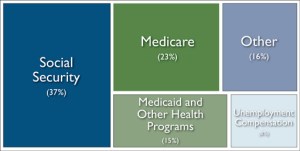
Source: Congressional Budget Office
Elmendorf writes,
鈥淭he choices facing the 112th Congress come at a time when the federal government鈥檚 debt has increased dramatically in the past few years and when large annual budget deficits are projected to continue indefinitely under current laws or policies. Federal budget deficits will total $7 trillion over the next decade if current laws remain unchanged, CBO projects. If certain policies that are scheduled to expire under current law are extended instead, deficits may be much larger.
鈥淭he budget options presented in this volume do not constitute a comprehensive plan (although many of the options could be combined into broader plans) but rather a set of discrete policy actions that illustrate ways in which lawmakers could decrease federal spending or increase revenues. Also known as direct spending, mandatory spending accounts for more than half of federal outlays. The largest mandatory programs are Social Security, Medicare, and Medicaid, which together accounted for nearly three-quarters of mandatory spending in 2010 (see figure below). The Congress generally determines spending for mandatory programs by setting eligibility rules, benefit formulas, and other parameters rather than by appropriating specific amounts each year. Accordingly, to reduce such spending, policymakers might want to modify the automatic indexation of benefits, the populations entitled to benefits, or the federal government鈥檚 share of spending for certain programs.鈥�
Many of the 100 options the report lays out concern health care spending, military and veterans鈥� health care, funding for the National Insitutes of Health and most prominently, Medicare and Medicaid. KHN has excerpted聽the health-care-related options, below.
Download聽this file.