At a critical point in a complex abdominal operation, a surgeon was handed a device that didn’t work because it had been loaded incorrectly by a surgical technician. Furious that she couldn’t use it, the surgeon slammed it down, accidentally breaking the technician’s finger. “I felt pushed beyond my limits,” recalled the surgeon, who was suspended for two weeks and told to attend an anger management course for doctors.
The 2011 incident illuminates a long-festering problem that many hospitals have been reluctant to address: disruptive and often angry behavior by doctors. Experts estimate that engage in such behavior, berating nurses who call them in the middle of the night about a patient, flinging scalpels at trainees who aren’t moving fast enough, demeaning co-workers they consider incompetent or cutting off patients who ask a lot of questions.
“We’re talking about a very small number of physicians, but the ripple effect is profound,” said Charles Samenow, an assistant professor of psychiatry at George Washington University School of Medicine, who evaluates doctors with behavioral problems.
For generations, bad behavior by doctors has been explained away as an inevitable product of stress or tacitly accepted by administrators reluctant to take action and risk alienating the medical staff, particularly if the offending doctors generate a lot of revenue. Recently at one Virginia hospital, according to University of Virginia School of Nursing dean Dorrie Fontaine, a veteran operating-room nurse with 30 years’ experience walked into her supervisor’s office and quit after a surgeon screamed at her — his usual reaction to unwelcome news — when she told him that a routine count revealed that an instrument was missing. Hospital administrators shrugged off the episode, saying, “Well, that’s the way he is.”
But that time-honored tolerance is waning, Samenow and other experts say, as a result of by the Joint Commission, the group that accredits hospitals. These rules require hospitals to institute procedures for dealing with disruptive behavior, which can take passive forms such as refusing to answer pages or attend meetings. The commission has called for a “zero tolerance” approach. Such behavior is not unique to doctors; researchers have found that nurses act out, too, mostly to other nurses, but that their behavior is less likely to affect patients.
Corrosive Effect On Morale
Growing attention to the problem, which appears to be most common among surgeons and other specialists who do procedures, has spawned a cottage industry of therapists who provide anger management counseling, which is sometimes billed as “executive coaching.” Programs are flourishing at Vanderbilt, the University of Virginia, the University of California at San Diego and, most recently, George Washington University.

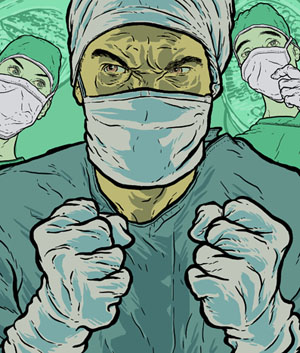
(Illustration by Jan Feindt)
Most doctors who enroll are middle-aged men sent by hospitals or state medical boards that have ordered them to shape up.
Experts say that doctors’ bad behavior is not merely unpleasant; it also has a corrosive effect on morale and poses a significant threat to patient safety. of 842 hospital administrators for the American College of Physician Executives found widespread concern: 71 percent said disruptive behavior occurs at least monthly at their hospital, while 11 percent said it was a daily occurrence. Ninety-nine percent said they believed such conduct negatively affected patient care, while nearly 21 percent linked it to patient harm. Those findings mirror of more than 4,500 doctors and nurses, in which 71 percent tied it to a medical error and 27 percent to the death of a patient.
“Many hospitals and health-care systems are beginning to address it just to keep their accreditation,” said Peter Angood, chief executive of the physician executives group. Angood, formerly chief patient safety officer at the Joint Commission, compares the problem to road rage. Like its automotive counterpart, it can have deadly consequences.
Laura Sweet, deputy chief of enforcement for the Medical Board of California, has said that the licensing body has investigated several maternal or fetal deaths resulting from the failure of nurses to contact doctors about a worrisome reading on a fetal monitor “for fear of being chastised or ridiculed.”
“Hospitals can no longer afford to look the other way,” said California internist Alan Rosenstein, who about the issue, beginning with an influential 2002 study that found that bad behavior by doctors drove nurses from the profession, contributing to the nursing shortage. Bad conduct, notes Rosenstein, former West Coast medical director of the VHA hospital network, can have expensive consequences in the form of lawsuits by employees alleging the existence of a hostile workplace and an exodus of experienced nurses who are expensive to recruit and difficult to replace.
‘The Patient Died’
Sometimes patients are the victims. Rosenstein cites one case of a physician who ridiculed a nurse after she called him at home, worried that a patient in the intensive care unit had developed aspiration pneumonia, a potentially lethal complication that occurs when a substance such as food or vomit is inhaled into the lungs. “He told the nurse to ‘get better training’ and refused to address the issue,” Rosenstein said. “The patient died.”
Changes in the way health care is delivered — along with escalating demands to see more patients, reduced nursing staffs and uncertainty as hospitals buy medical practices — may help foster bad behavior, said J. Kim Penberthy, co-director of the University of Virginia’s . “So much of what we see is the frustration and difficulty of coping with change” by older doctors.
Care is now delivered in teams, making interdependence, not autonomy, paramount, said Fontaine, who has written about disruptive behavior and confronted it as an operating-room nurse. “Forty years ago, medicine was more hierarchical” and teamwork less important, she said.
Most doctors who wind up at Vanderbilt or similar anger management programs have long histories of conflict with colleagues and administrators, sometimes dating back to residency training, said GWU’s Samenow. Those whose outbursts are the result of underlying substance abuse or psychiatric disorders are usually diverted to other kinds of treatment.
Many are technically excellent and some are beloved by patients — even if their colleagues can’t stand to work with them. “Sometimes the guys who are most disruptive are winning teaching awards or Washingtonian top-doctor awards,” Samenow said. Frequently they are narcissistic, compulsive perfectionists who insist that they are the real victims when complaints are lodged and defend their behavior by saying they were doing what was best for their patients.
“Other people experience them as disruptive, but I like the term ‘distressed,’ ” said William Swiggart, who co-directs . Swiggart said he tells participants in the course, which costs $4,500 per person, “This is a course based on how you’re perceived. I’m happy to assume your heart’s good. But your behavior sucks.”
The Vanderbilt team gathers considerable information before a doctor arrives in Nashville, interviewing co-workers and administrators about his or her skills, behavior and other factors.
To one doctor who complained that he didn’t know why he had been sent, Swiggart said he responded, “ ‘They think you’re an arrogant ass is why they sent you.’ “
George Anderson, a social worker in Beverly Hills, Calif., has been offering for 25 years to people in a variety of professions. Doctors, whom he treats individually, not in groups, account for a growing share of his practice.
“You’re working with the smartest group of people on the planet,” said Anderson, whose clients include doctors from UCLA Medical Center. “These are people with high IQs . . . [but] their emotional intelligence scores are really pathetic.” Anderson said he worked with one surgeon who booted an anesthesiologist out of the OR, leaving the patient unmonitored during surgery, after the two physicians had gotten into an argument.
While disruptive behavior is rooted in personality traits and often cemented by dysfunctional childhood experiences, Rosenstein and others say the brutal way in which doctors have been trained plays a role.
Traditionally, “medical students were told, ‘You don’t know anything, so shut up until you do,’” Rosenstein said. Many, he said, emerge from training as “autocratic, independent and dominant,” and they imitate the ways they were taught. “It’s a setup for disaster.”
Swiggart said that the three-day program at Vanderbilt, which is followed by three follow-up sessions over six months, focuses on developing and practicing coping and communication skills. Sessions are held about six times per year and are limited to six physicians, who must role-play the incident that brought them to Nashville.
“You need a group, and [participants] need feedback,” Swiggart said.
Few studies assessing the effectiveness of such programs exist. A preliminary study of 100 doctors who completed the Vanderbilt course showed statistically significant reductions in disruptive behavior as rated by co-workers, administrators and the doctors themselves. But Swiggart added, “Not everybody makes it. There are some individuals who really need to leave.”
One Surgeon’s Story
The surgeon who fractured the tech’s finger described it as an accident fueled by sleep deprivation and a crushing workload. His hand, she said, was “where it shouldn’t have been” — on the patient’s metal leg strap.
“I was completely distraught that I had it in me to do that,” said the surgeon, who spoke on the condition that neither her name nor the Midwestern state where she practices be published. The hospital recommended she go to Vanderbilt at her own expense; about 20 percent of enrollees are women.
Although there had been no other overt incidents, she said that her career had been marked by “difficult interactions,” especially with nurses. “I felt hated,” she said, adding that she thought some were jealous of her. She did not cultivate relationships with co-workers and later learned that others avoided her because of what they regarded as a harsh style and chronic bad mood.
Now in her mid-40s, she said she behaved as she had been taught during residency and fellowship training.
“I was trained by all men who walked into the room and barked, ‘Get the NG [nasogastric] tube working.’ ” One time, she recalled, her mentor threw an instrument at her in the OR. “I never had a female mentor, and what I was told when I went into surgery as a woman was, ‘You’ve got to be tough.’ I think men get away with a lot more than women” when it comes to bad behavior.
She arrived in Nashville feeling as though she was being “sent away and punished” but said that the program helped her better regulate her emotions and soften her brusque demeanor.
“It’s really like group therapy,” she said. “The most powerful part was listening to other people’s stories and telling my story.” Role-playing the incident was particularly hard.
The course has helped her immensely, she said, teaching her relaxation and self-monitoring skills and improving her outlook about her practice. “I was not functioning well, but I did not realize it.”