
Do Different Birth Years Mean Different Insurance Statements For Twins?
By the time newborn Freya Humenny joined her twin brother Beckett this past weekend, the calendar already had turned from 2011 to 2012.
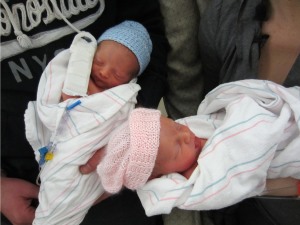
That means the twins always will have their own birthdays鈥攂ut will they share an insurance statement?
The twin鈥檚 mother, Stephanie Peterson, gave birth to Beckett at 6:40 p.m. on Dec. 31, 2011, 聽at the in Minneapolis, but Freya did not follow until 12:26 a.m on Jan. 1.
And so after we ooh-ed and ahh-ed over the adorable pair, we had to ask: What could a case like this mean for a family鈥檚 insurance?
Paul Fronstin, director of the health research and education program at the Employee Benefit Research Institute, said that every case would vary based on the terms of a family鈥檚 policy.
But, as an example, if a family had a high-deductible private insurance plan, a number of factors would be in play, according to Fronstin.
For one, there is the question of the family鈥檚 deductible.聽 Lots of prenatal services are covered as preventive care, but some are not.聽 If the family had not聽yet met聽their 2011 deductible, then the first of the births would be applied to that聽year鈥檚 deductible, while the second could apply to the next year.
There鈥檚 also the question of whether the second birth would even be considered an expense for the new year or whether it would be tied to the mother鈥檚 original admission.
And as for the twins themselves, the second child鈥檚 expenses likely would be billed as new year expenses, but services for the first child, such as nights spent in a nursery, could span the two years鈥攔aising another set of questions about how to bill.
Fronstin said that while a hypothetical case brings up a number of questions, an insurer’s response won鈥檛 necessarily be complicated.
鈥淚t could be as simple as it was so close to midnight that it doesn鈥檛 really matter,鈥� he said.
Recommence the oohs and ahhs.
