The Robinson family of Dallas, Texas started out pretty excited about their new insurance plan under the Affordable Care Act.
Nick Robinson turned to Obamacare after he lost his job last summer. He had been working as a youth pastor, and the job included benefits that covered him, his two young daughters, and his wife Rachel, a wedding photographer.
Nick says he wasn’t too nervous at first, because everyone was healthy. Then, he recalls, they found out Rachel was pregnant.
“It’s one of those times where you hear the news and there’s this immediate sense of joy and excitement like ‘Yay, a new kid. That’s awesome!’ ” he says. Then he continues, after a long pause, “What are we going to do? How are we going to pay for this? This is intense.”

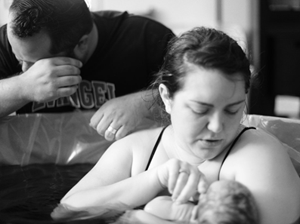
Nick and Rachel Robinson welcome their son Cash, who was born in a midwife’s birthing pool (Photo: Jessica Hooten/Courtesy of Nick Robinson).
Nick, 31, found a new job fairly soon, working as an account manager in retail sourcing. But the small firm did not offer health benefits.
The couple started looking around. They applied for Medicaid but didn’t qualify in Texas. They thought about paying for prenatal care and the delivery out of pocket, but the quotes they got scared them – up to $15,000 for a basic hospital birth.
Summer crept into fall, and Nick started hearing the buzz about the Affordable Care Act.
“I was like, ‘Oh, here’s the answer! This is simple!’ ” he says. ” ‘It’s a cheaper insurance plan, there’s no pre-existing condition stuff.’ “
Rachel was skeptical, but Nick went online and started shopping. He had trouble getting through the glitchy website at first, but eventually he picked a plan just for his wife. It was a gold plan HMO through Blue Cross Blue Shield for about $375 a month.
In January, as soon as the plan began, Nick printed out a list of obstetricians from the plan’s website. “I handed it over to Rachel, fully confident, fully feeling like I had accomplished something for her, I had come through for my wife,” he says. “This whole Obamacare thing was going to work!”
Rachel, who is 30, recalls sitting down over two days in January and calling every doctor on the list of 28. According to her, most of the practices told her they didn’t take the plan, in one way or another.
“Some would just come right out and say, ‘We don’t take Obamacare,’ ” she says. “Or the best one was, the doctor takes it here at the actual practice, but whatever hospital you use, that do all of our deliveries, does not take that insurance.”
She says there were other issues too – some of the doctors said they wouldn’t see her because she was too far along in her pregnancy – about 30 weeks. A few practices did take the HMO, but they operated as a rotating clinic and couldn’t guarantee she would see the same doctor every time. Rachel wanted to establish a relationship with her obstetrician.
“It was mind numbing,” she says, “because I was just sitting there thinking, ‘I’m paying close to $400 a month just for me to have insurance that doesn’t even work. So what am I paying for?’ “
Nick got even more frustrated when he called Blue Cross and was told those doctors should take the plan.
“How could this not be working?” he says. “The United States government has set this up. It’s this whole big deal; there’s commercials everywhere saying we need to use this. And they’re just saying, ‘No, no, no,’ and that just made me so mad!”
Regulators in the Texas Department of Insurance are responsible for monitoring insurance plans to make sure they have adequate networks, what qualifies as adequate, however, is somewhat subjective.
Louis Adams, a spokesman for Blue Cross Blue Shield in Texas, says he went down that same list Rachel had checked. He says most of the 28 obstetricians do take the HMO’s members. Adams was checking the list in May, five months after Rachel made her calls, when Obamacare was brand new.
“We’re committed to helping our new members understand how to get the most from their coverage and also working with doctors and hospitals to inform them of the range of coverage options we have available,” Adams says.
Even if it was a matter of miscommunication, the Robinsons felt lost. It was January and their baby was due in April. They started considering a midwife, an option friends had suggested but that they had previously rejected.
“Our answers to that were absolutely not,” says Nick. “That’s insane. We’re not going to go to some crazy witch doctor lady, and make us get in a giant tub. Those are the crazy people. We’re the normal people. We want to have our birth – in a hospital!”
It was risky, too. Rachel had already had two c-sections but a home birth would mean trying to delivery vaginally. But gradually, the Robinsons changed their minds. Rachel met with a midwife and loved her. Out of pocket, a home birth would cost only $4,000.
And so they dropped their new plan. They just stopped paying the premium.
They signed on to be in the midwife’s care. Nick signed up for a nonprofit, cost-sharing plan. The Robinsons will pay cash to the midwife up front, and then request reimbursement later.
Nick says, “We’re so happy with where we are now, but this is not okay. And I’m extremely confident that that’s not what the architects of this plan had in mind.”
On April 28, Rachel gave birth – at home, in the giant tub, with no pain medication.
It was a healthy baby boy, named Cash. Nick says that’s for Johnny Cash, whom they both love – and not the midwife’s fee.
This story is part of a reporting partnership between , and Kaiser Health News