Washington is full of ideas to overhaul Medicare. Some would , others would for their coverage. Thereā€™s movement to to the quality ā€” rather than the quantity ā€” of care delivered.
Ā decided to ask ordinary Americans how they would change the federal entitlement program.
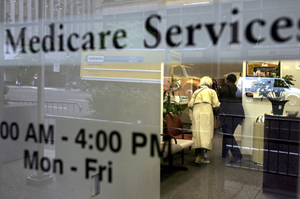
Seventy-seven percent of participants in her Ā group sessions said Medicare should cover at least one year of care in a nursing home, in supportive housing or at a personā€™s home. Eight-five percent wanted ā€œmodest coverageā€ of dental, vision and hearing services. To help Medicare last another half-century ā€” it turns 50 next year ā€” 85 percent were willing to reduce program spending on current and future beneficiaries.
Over the past year, Ginsburgā€™s group, the nonprofit, non-partisan , conducted 82 three-hour ā€œM±š»å°ä±į“”°Õā€ sessions in California with 810 participants to discover what changes they would make to the federal entitlement program. Small groups of eight to 15 people gathered in community centers and churches to use the ā€œM±š»å°ä±į“”°Õā€ tool on computers with guidance from facilitators. The groups included seniors, young adults, health care professionals and community and senior service leaders, and the interactive simulation tool explored Medicare options among 12 categories of coverage. If participants wanted to add benefits, they had to eliminate others or impose new restrictions on current coverage.
While participants did not eliminate benefits, they accepted stricter criteria or new limitations on current coverage. For example, 82 percent supported the use of defined networks of providers, but allowed the use of a provider outside the set network if approved by a primary care provider. Eighty-eight percent supported ā€œvalue-based coverageā€ but also agreed with patients picking up at least half of the tab if research showed the benefits of a treatment ā€œwas small, unlikely or more expensive than an equivalent treatment.ā€ Forty-eight percent backed using both penalties and rewards to encourage compliance with medical advice.
So how will Ginsburgā€™s fare in Washington where entitlement reform is the ā€œthird railā€ of politics ā€” touch it and your career dies?
Health care experts offered their thoughtsĀ at a Sept. 19 sponsored by the American Enterprise Institute and the Engelberg Center for Health Care Reform at the Brookings Institution where Ginsburg presented her findings.
Donā€™t confuse what took place in California with what will happen in Congress,Ā said , a longtime Washington health care policy expert who is now president and chief executive officer of the Ā While many changes could be made to Medicare to make it more efficient, ā€œweā€™ve got to figure this out in a way that minimizes political difficulty,ā€ he said.
People in other parts of the country might not agree with the views of the Ginsburgā€™s groups in California, warned of the Heritage Foundation.of the Brookings Institution said patients facing end-of-life issues first-hand might have different responses than those contemplating end-of-life care while in good health.
“”·”±õā€™s , who moderated the panel discussion, warned that any changes to Medicare would need time. ā€œYou need a sensible transition if you are going to change policy,ā€ he said.
Ginsburg said she would love to take her show on the road and run MedCHAT discussions all over the country, but she needs more funding to make that happen.
ā€œWould I actually expect Congress to change what they do based on 800 Californians? No. But this is a gradual process of enlightenment,ā€ she said in an interview. ā€œEnlightenment of the public, enlightenment of legislators, of community and health care leaders. ā€¦ The future of Medicare is not going to be solved tomorrow.ā€