
In Kansas, No Consensus On How To End ‘Dental Deserts’
This story is part of a reporting partnership that includes , Kaiser Health News and
In an ongoing disagreement over how to solve dental care access problems in Kansas, there is one thing no one disputes: the great need.
That need was on display in February when the Kansas Dental Charitable Foundation held its eleventh free clinic of the past decade. Known as the Kansas Mission of Mercy, the clinic was staffed by volunteer dentists in a vacant Walmart store in Kansas City.
Organizer Greg Hill said that patients began arriving at 8 p.m. the night before the clinic opened. They were able to spend the night inside the store. “By 5:30 a.m., there were 1,200 people in the building,” Hill said.
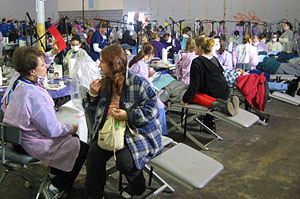
Patients have dental exams at a Kansas Mission of Mercy event in Kansas City, Kansas, in February (Photo by Bryan Thompson/Kansas Public Radio).
At that point, the parking lot had to be closed, because no more patients could be treated in a single day— even with 165 volunteer dentists and many more hygienists and other support staff from all across the state. By the end of the two-day clinic had been treated, adding to the total of approximately 20,000 patients served since Mission of Mercy began in 2002.
Analysts have known for years that Kansas has a severe shortage of dentists, and that shortage is getting worse. The problem is greatest in rural Kansas, especially in the western part of the state.
To deal with the shortage, Fort Hays State University backs the idea of creating a mid-level dental provider — a person whose training and skills fall somewhere between those of a hygienist and a full-fledged dentist.
Hammond is keen to begin training those providers at Fort Hays State, but the proposal faces strong opposition from the Kansas Dental Association and has bogged down in the state legislature.
Hammond points out that it is not just the poor or uninsured who have trouble accessing dental care in western Kansas. Even a college president can have trouble.
“I can’t get dental services where they accept our Delta Dental Blue Cross/Blue Shield plan,” said Hammond. “As a state employee, I get — and pay for — dental insurance, but the dentists in western Kansas don’t accept it.”
Hammond says he’s had to switch dentists three times to find someone who would accept his dental insurance. There are 13 primary care dentists in the Hays area, but Hammond says only a few accept Delta Dental.
“The shortage is impacting not just the indigent, not just the children. It’s impacting all of Kansans in western part of the state,” he said.
A published last fall by the Kansas Department of Health and Environment and the University of Kansas Medical Center counted 1,159 primary care dentists in the 105 counties of Kansas. However, roughly half of them are located in metropolitan Kansas City and Wichita. Add in Topeka and Lawrence, and more than 700 of the state’s dentists are in just four communities.
Most counties in the western half of the state have only one or two dentists, if any. A dozen western counties, plus three more in eastern Kansas, have no dentist at all. Hammond said it’s not hard to understand why dentists are reluctant to set up shop in frontier counties.
“The problem is, the people graduating from dental school are coming out with tremendous debt, and then they have to get a lot of equipment,” Hammond said. “That raises the bar that their practice has to generate a certain amount of resources in order for it to make sense, and so they don’t go to western Kansas and the smaller towns.”
Hammond compared the so-called mid-level dental providers to mid-level medical providers who are already helping meet the need for primary care in rural Kansas.
“We train nurse practitioners that go out to the Hill Citys, the Atwoods, the various different communities throughout the state, and provide medical services. We’re proposing to do the same thing with a mid-level professional in the area of dentistry,” he said.
Hammond said Fort Hays State University is prepared to begin training this new class of dental providers as soon as the legislature approves the proposal. A coalition called the submitted a plan last year. It would create a new type of provider with more training than a dental hygienist, but not as much as a dentist, called a Registered Dental Practitioner, or RDP. The new practitioners would be allowed to fill cavities and do simple extractions of children’s primary teeth.
But the Kansas Dental Association has fought this idea all the way. “The overwhelming majority of dentists are opposed to the registered practitioner model, and it’s not like 99 percent. It’s 99.9 percent,” said Kevin Robertson, who heads the association.
Robertson said the proposal goes too far by allowing RDPs to perform procedures which are, by definition, considered surgery.
“Anything that includes the cutting of the hard surfaces of the tooth is considered surgery,” said Robertson. “The bill is written to allow the extraction of all primary teeth, or meaning baby teeth. Now, a lot of listeners might think, well, baby teeth, I’ve pulled out my son’s or my daughter’s baby teeth. Well, there’s nothing in the proposal that says it has to already be loose.”
And Robertson says what sounds like a simple procedure can suddenly become more than a registered dental practitioner is trained, or licensed, to handle.
“Maybe you’ve snapped off a tooth. You’ve broken it. Maybe the root’s wrapped around the nerve that runs through the jaw, or something like that, and you didn’t know it at the time,” said Robertson. “Those are the types of things that we think could occur and that we’re concerned about.”
Robertson predicted that mid-level providers would actually make it more difficult for dentists to make ends meet in rural areas. He said it would create a two-tiered system of dental care in Kansas: dentists for those in the more-populated areas, and mid-level providers with a lower level of training for rural Kansans.
But others counter that even that scenario would be better than the status quo.
“I would describe no care as second-class care, and that’s the system we have in place now for many Kansans,” said Shannon Cotsoradis, who heads the advocacy group Kansas Action for Children. Cotsoradis is spearheading the Kansas Dental Project, the effort to create licensed, mid-level dental providers.
“Many Kansans, whether they’re low-income, uninsured, or insured through the public health coverage system, can’t access dental care,” Cotsoradis said. “ Our goal is to make sure that all Kansans, regardless of what kind of insurance they may have or whether or not they have insurance at all, can access care, and we believe that adding another member to the Kansas dental team will help ensure that.”
Cotsoradis said the opposition to registered dental practitioners is based on fear and misinformation.
“The research that’s out there says very clearly that mid-level dental providers can provide the same quality and the same level of safety in the care they deliver as a dentist, within their scope of practice, and I would challenge the Kansas Dental Association to produce research that demonstrates something to the contrary,” she said.
Melinda Miner, a dentist in Hays, holds the opposite view of most of her DDS colleagues: She would like to start working with registered dental practitioners.
One of the so-called “dental deserts” identified in the state dental workforce report is just to the south and west of Hays. It’s an area of approximately 500 square miles, where there are no primary care dentists at all. Miner envisions being able to use registered dental practitioners to bring dental care to nearby Trego and Ness counties, which currently have no dentists.
“Our goal would be to open outreach clinics in the surrounding communities for preventive — for cleanings, for check-ups, for small fillings,” Miner said.
Miner said people will drive long distances for major dental problems, but they’re less likely to do so for the kind of routine care that can prevent more serious issues.
“You know, having to take your child out of school, take half a day off work, drive 30 minutes or more to go to the dentist for a routine checkup or preventive care is a lot less likely to happen than if you have a preventive person in your town,” said Miner.
The proposed law would require registered dental practitioners to spend their first 500 hours of practice under the direct supervision of a licensed dentist. That means they’d start out in the Hays clinic, just down the hall from Miner and her husband, who is also a dentist. Once they’re placed in the outreach clinics, they’d be under “general supervision.” Miner said telemedicine would make it possible to supervise a practitioner work without being at the same location.
“All of our x-rays are on the computer. They can call at any time and ask a question. They can send us a photograph or an x-ray, and ask us our opinion. You don’t have to be there in person to watch over somebody,” she said.
Miner sees mid-level providers not as a threat to her practice, but as a way to make it more efficient and to expand her patient base.
“Every dentist can run their practice how they want to, and I don’t want to tell a dentist, ‘Hey, you have to take Medicaid or you have to see people for free, or you have to use a hygienist,’” she said. “There are dentists who don’t want to use hygienists. That’s fine for their practice, but I would prefer if they don’t tell me I can’t do something that would help my practice to be better.”
The Kansas Dental Association does support expanding the role of dental hygienists. They’ve endorsed a bill to create what’s called an Extended Care Permit 3. It would allow specially-trained hygienists, under the sponsorship of a dentist, to provide temporary fillings, adjust dentures, and remove very loose baby teeth. Their services would be aimed at underserved children, senior citizens, and people in various forms of state care or custody. Those favoring creation of Registered Dental Practitioners say this bill would help, but it doesn’t go nearly far enough.
Kansas is among 15 states where advocates are working to expand the dental workforce with mid-level dental providers. So far, Alaska and Minnesota are the only states where these providers have been authorized.


