
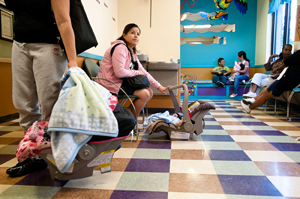
Patients wait to be seen at the People’s Community Clinic in Austin. (Callie Richmond/The Texas Tribune)
A week after newly emboldened Republicans in the Texas Legislature floated a radical cost-saving proposal – opting out of the federal Medicaid program – health care experts, economists and think tanks are trying to determine just how serious they are, and if it would even be possible.
The answer? It is complicated. But that is not stopping some conservative lawmakers in nearly a dozen other states, frantic over budget shortfalls and anticipating new costs from the federal health care overhaul, from exploring it.
“States feel like their backs are against the wall, so this is the nuclear option for them,” said Christie Herrera, director of the health and human services task force for the , an association for conservative state lawmakers. “I’m hearing below-the-radar chatter from legislators around the country from states considering this option.”
In Texas, some Republicans – bolstered by their expanded majority in the State House – say the strings attached to Medicaid and the Children’s Health Insurance Program (CHIP) are bankrupting the state, which is staring down a budget hole that some have estimated as high as $25 billion. They argue that states could provide more efficient and cost-effective care for children, the disabled and the impoverished by either giving up federal matching money altogether or getting federal officials to grant states waivers to provide health care as they see fit.
Jobless parents in Texas only qualify for Medicaid if their income is below 12 percent of poverty ($22,050 for a family of four), and working parents only qualify if their income is below 26 percent of poverty. Gov. Rick Perry “understands the frustrations of legislators as they deal with a program that consumes 20 percent of the state budget,” said Katherine Cesinger, his spokeswoman. “Their options are severely limited by a federal government that continues to tie their hands when it comes to administering Medicaid.”
Opponents argue that dropping Medicaid would have such a devastating effect on the state’s economy – not to mention the health of 3.6 million Texans currently enrolled in the program – that the idea is pure anti-Washington grandstanding.

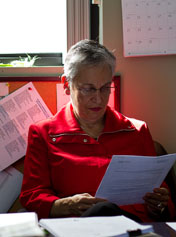
Regina Rogoff, executive director of the safety-net People’s Community Clinic in Austin. (Callie Richmond/The Texas Tribune)
The federal government covers 60 percent of Texas’ $45 billion biennial Medicaid budget. Without that money, critics say, any health care the state could provide would be so limited that undercovered patients would flood emergency rooms, and Texans would end up paying the costs through local property taxes or higher insurance premiums.
“The real benefit of Medicaid is it’s a shared expense, with the feds taking up a larger portion,” said Regina Rogoff, executive director of the safety-net in Austin. Speaking of a withdrawal from the program, Ms. Rogoff said: “This will raise local property taxes, because hospital emergency rooms can’t turn away patients. And it has the implication of us paying, through federal taxes, to subsidize care in other states, leaving people who live in our state without care.”
Such fears notwithstanding, the idea of dropping out of Medicaid is on the table in Texas and roughly a dozen other states, including Alabama, Mississippi, Washington and Wyoming. Options include remaking Medicaid with only state financing to give states broad flexibility in benefit and cost design, and, two, seeking federal waivers to allow states to change parts of their Medicaid programs.
“If people are in superbad poverty, that’s one thing,” said State Representative Warren Chisum, Republican of Pampa, the state’s most vocal supporter of dropping out of Medicaid and a candidate for speaker of the House. “It breaks my heart when there’s someone who smokes, and who stays drunk half the time, and we’re supposed to provide their health care.”
Starting in 2014, the new health law extends Medicaid to those with incomes up to 133 percent of the federal poverty level, which is $29,327 for a family of four in 2010. Some conservatives believe that if states dropped Medicaid, many low-income people could instead receive federal subsidies to buy private insurance coverage through state exchanges, another piece of federal health care overhaul that takes effect in 2014. States would then become totally responsible for Medicaid beneficiaries who require nursing homes and other long-term care, for premiums and other Medicaid costs for Medicare beneficiaries – but everyone else would go into the exchange.
Edmund Haislmaier, senior research fellow at , a conservative research organization, estimates that Texas would save $46.5 billion from 2014 to 2019 under this model. In all, Mr. Haislmaier said, 40 states would come out ahead financially.
Others dispute that and note that switching millions of people from Medicaid to subsidized private insurance would be costly to the federal government, and may not be legal.
“The subsidies are explicitly not available for those with incomes below the poverty level,” said Jennifer Sullivan, senior health policy analyst at the consumer group .
Judith Solomon, co-director of health policy at the nonprofit , said the new health care law explicitly stated that only “applicable taxpayers” were eligible for subsidies, ruling out anyone whose income is less than 100 percent of poverty, except for legal immigrants.
Cindy Mann, director of the federal Center for Medicaid and State Operations, said the Department of Health and Human Services was trying to determine whether Medicaid recipients dropped by their home states would qualify for subsidies.

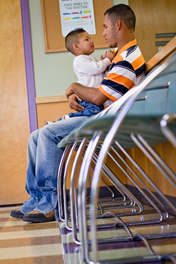
Founded in 1970, the People’s Community Clinic is a primary care center for the medically under served and uninsured. (Callie Richmond/The Texas Tribune)
Critics say dropping out of Medicaid would be a devastating blow to the state’s medically underserved. Seven of 10 Texas nursing home residents rely on Medicaid, which also pays for more than half of all deliveries of babies in the state.
The state’s share of these expenses would not shift to the federal government, said Jose Camacho, executive director of the , but to counties and local taxpayers.
Others fear that cutting off the flow of federal Medicaid dollars could cripple the state’s economy: About a million Texans work in health care, and from 2005 to 2009, a quarter of the new jobs created in the state were in that field.
Tom Banning, chief executive of the , said that without Medicaid, or with a less-extensive replacement program, health care providers would be forced to shift their costs to the private market, driving up insurance premiums and prompting more people to forgo coverage. “From a practical standpoint,” Mr. Banning said, “the downstream economic implications for Texas’ health care infrastructure would be decimating.”
Opponents also say that the theory that a Democratic administration would offer Texas a no- or few-strings-attached Medicaid waiver is a pipe dream. “A state’s choice to get out of Medicaid is to get all the way out, not to pick and choose,” said Anne Dunkelberg, associate director of the , a nonprofit group in Austin.
In the end, said Robert Reischauer,Ìýa former director of the Congressional Budget Office, the debate over Medicaid alternatives may be more about states’ leveraging additional federal financing than dropping the program.
“Some states will toy with it, think about it, and reject it from the state perspective,” Mr. Reischauer said. “To the extent they don’t, I would hope Congress and the president work together to create very strong incentives against it.”
Marilyn Werber Serafini is the Kaiser Family Foundation’s Robin Toner Distinguished Fellow based at Kaiser Health News.Ìý The fellowship honors the late Robin Toner, The New York Times’ long-time health and politics reporter whose workÌý often framed the public debate on health issues. KHN is an editorially independent news service of the foundation.