GOP presidential candidate Mitt Romney鈥檚 choice of House Budget Committee Chairman Paul Ryan, R-Wis., as his running mate has brought renewed focus on Ryan鈥檚 proposal to overhaul Medicare.

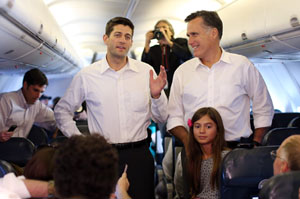
Republican presidential hopeful Mitt Romney and his choice of running mate Rep. Paul Ryan, R-Wis., speak to reporters aboard their campaign plane (Photo by Justin Sullivan/Getty Images).
But how would ,聽which has been approved twice by the GOP-controlled House, change Medicaid? KHN鈥檚 Mary Agnes Carey answers some frequently asked questions about Ryan鈥檚 ideas for Medicaid.
Q: What Is Medicaid?
A: It is the shared federal-state health insurance program for low-income and disabled people. It covers about . States generally administer the program under broad guidelines from the federal government that include minimum eligibility and benefits standards. States and the federal government share in the financing of the program.
Q: How Would Ryan鈥檚 Plan Change Medicaid?
A: The federal government on average pays 57 cents of every dollar spent on Medicaid.听 Some states receive more, some less, with a greater federal share going to the poorest states. Under Ryan鈥檚 plan, the federal share of Medicaid spending would decline about as聽the program becomes a block grant indexed for inflation and population growth. States would have more flexibility over who is covered and what benefits are offered. The block grant would start in 2013. Ryan and his supporters say turning to block grants would both save the federal government money and give states flexibility in who they cover and what benefits are provided. 鈥淪tates will no longer be shackled by federal determined program requirements and enrollment criteria,鈥� his plan says. Opponents of Ryan鈥檚 plan say it would lead states to reduce enrollment, cut benefits or require more cost-sharing from beneficiaries.
Ryan鈥檚 plan would also repeal the Medicaid expansion included in the 2010 health law, which if states opted to do it, would provide Medicaid coverage to people under 133 percent of the federal poverty level, or $14,856 for an individual and $30,656 for a family of four according to current guidelines.听The CBO estimates that would affect .
Q: How Would Federal Spending Change Under Ryan鈥檚 Medicaid Proposal?
础:听础听 of the Ryan plan that the House approved in 2011 found that federal spending for Medicaid would be 35 percent lower in 2022 and 49 percent lower in 2030 than currently projected federal spending.听
While Ryan鈥檚 Medicare proposal changed slightly in the budget plan that the House passed earlier this year, his Medicaid proposal remained largely the same in both versions.
Q: How Would Ryan鈥檚 Plan Impact States鈥� Medicaid Budgets?
A: In March, the Congressional Budget Office said that if, as Ryan proposes, states had additional flexibility to allocate federal funds for Medicaid and the Children鈥檚 Health Insurance program (both programs provide health care for low-income children), states might be able to make their Medicaid programs .听
CBO added that the federal spending reductions called for in budget scenarios that Ryan asked CBO to review meant that 鈥渟tates would need to increase their spending on these programs, make considerable cutbacks in them, or both.鈥澛� States might have to reduce eligibility, cover fewer services, reduce payments to providers or increase beneficiary cost-sharing, CBO said.
If Ryan鈥檚 plan became law, states anticipating large Medicaid expansions under the health law would see some of the largest reductions in federal spending, according to a 2011聽 that predated the Supreme Court鈥檚 June decision making the law鈥檚 Medicaid expansion optional for states. The Urban Institute conducted the study for the Kaiser Commission on Medicaid and the Uninsured, a program of the Kaiser Family Foundation.听 (KHN is an editorially independent program of the Kaiser Family Foundation.)
Q: What Would These Changes Mean To Medicaid Enrollment?
A: Under Ryan鈥檚 block grant proposal, between 14 million and 27 million fewer people would be covered in 2021 than under Medicaid as it currently exists, according to the Urban Institute analysis. Beneficiaries also might see reductions in benefits and greater cost sharing, among other changes. If the health law were repealed, as Ryan鈥檚 plan calls for, an additional 11 million people would not gain coverage under the statute鈥檚 now-optional expansion of Medicaid eligibility.