In most medical schools, students recite the Hippocratic Oath together to mark the start of their professional careers. The soon-to-be physicians swear to uphold the ethical standards of the medical profession and promise to stand for their patients without compromise.
Though the oath has been rewritten over the centuries, the essence of it has remained the same: “In each house I go, I go only for the good of my patients.”
Related Audio
Listen to the story on
But the principles of the oath, says Dr. Gregg Bloche, are under an “unprecedented threat.” In The Hippocratic Myth, Bloche details how doctors are under constant pressure to compromise or ration their care in order to please lawmakers, lawyers and insurance companies.
Bloche says that doctors are increasingly expected to decide which expensive tests and treatments they can and cannot provide for their patients. Their dual role as examiner and cost-cutter can then potentially compromise patients’ care, he says, particularly when insurers and hospital administrators urge physicians to only perform “medically necessary” treatment.

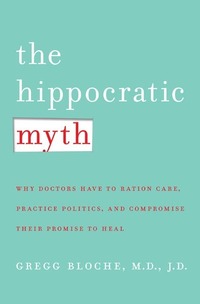
The Hippocratic Myth: Why Doctors Have to Ration Care, Practice Politics, and Compromise their Promise to Heal
By M. Gregg Bloche M.D., Hardcover, 272 pages, Palgrave Macmillan
List Price: $27
“The average person thinks that ‘medically necessary’ care means all care that might potentially be beneficial,” he says. “But the reality is that it’s a wide-open term.”
Care may be denied, says Bloche, for a variety of reasons, including whether patients have consented to cheaper treatment options through their health insurance plans. What that means, he says, is that doctors who ration care on behalf of insurance providers may simply be following their patients’ wishes – even if patients are not aware that they’re receiving subpar treatment.
“In the real world, the choices aren’t made clear in the employee benefits office,” he says. “In the real world, the cheap health plan and the expensive health plan both promise you ‘medically necessary’ care and you don’t really know what that means. So you sign up for this care and you think, ‘Aha! This one’s cheaper than the other. And it’s promising medically necessary care. You don’t really know that one car is a Lexus and one car is a Chevy. These two plans are being presented to you as Lexuses. And so you say, ‘I’ll buy it.’ But in fact, in terms of the care it makes available, it’s cheap because it’s a Chevy, not a Lexus.”
Talking about potential tradeoffs in care is a conversation that doctors and policymakers need to have, says Bloche, because it’s inevitable that our health care system will need to find ways to set limits on care.
“We cannot afford anything like what we’re spending on health care today, and we’re certainly not going to be able to afford what we’re projected to spend in the future,” he says. “We spend almost a fifth of our national income today on medical care. And within 25 years, unless we change dramatically, we’re going to be spending a third of our national income on medical care. And we’re doing that by borrowing from our kids.”
Interview Highlights
On the rationale of withholding care:
“The rationale there is that the doctor who stints on care three years later when you get really sick is acting in accordance with your preferences as you expressed them in the employee benefits office three years before,” says Bloche. “And therefore, the doctor is not violating the Hippocratic Oath. The doctor is merely complying with your preferences when you rolled the dice in the employee benefits office.”
On insurers not being required to reveal their criteria to providers for what claims they’ll pay:
“This is a walk on the wild side. I’ve taken on some of these cases for people that I know, and one thing about it, if you know the system’s hypocrisies, then you can beat the system. One of the hypocrisies is that the companies take the position that their guidelines for what they will and will not pay for are trade secrets – that they’re proprietary. Now imagine a legal system in which the laws were considered trade secrets and their lawyers weren’t allowed to know the laws in advance because that would mean they could game the system. That doesn’t fit with our legal values, our due-process values – but that is what happens for many, not all, health plans. They take the position that they’re not going to reveal in advance the rules for what they’ll pay for and won’t pay for because that would enable doctors and patients to game the system.”
On randomized clinical trials:
“What’s amazing is that probably only 10 to 20 percent of the treatments that doctors use today have been tested [in] randomized clinical trials. Even when a treatment is shown to work really well for the sample that’s studied in the clinical trial, in the real world patients are all different. [They] vary hugely. So we’re never going to be able to have solid science that can tell us for sure whether the treatment is going to work or not. So let’s do the research but let’s be realistic and pragmatic about the limits of that research.”