For patients, the transition from hospital to home is a critical time. Discharged with follow-up instructions and often a fistful of medications, many need medical guidance. But too often a smooth handoff to a primary-care physician doesn’t happen, and small recovery glitches become larger ones. The result: In short order the patient is often back in the hospital.
According to a released this month by the Center for Studying Health System Change, a Washington-based research group, a third of adult patients discharged from a hospital don’t see a physician within 30 days — and experts say this is a key reason so many of them are readmitted.
More From This Series Insuring Your Health


Some hospitals are trying a new strategy to interrupt this predictable and pricey pattern: post-discharge clinics. These hospitals are identifying patients who are more likely to have trouble after discharge, either because of their medical conditions or because they lack health insurance or a primary-care provider, and funneling them to the clinic where they receive one-on-one
assistance.
Deloris Eason, 64, was discharged from Boston’s earlier in December, after having been treated for severe stomach cramps, diarrhea and vomiting. Clinicians weren’t sure whether she had had a bad case of food poisoning or , an inflammation of the colon. Because her primary-care physician couldn’t see her until mid-January, hospital staff referred her to the post-discharge clinic.
By the time she came in four days after leaving the hospital, Eason was feeling better but was concerned because she hadn’t had a bowel movement since returning home. The practitioner at the clinic told her to give it another day and then take a laxative. If that didn’t work, she was instructed to come back.
“I had a chance to ask questions I didn’t get to ask at the hospital,” Eason says, “key questions that came up after I got home.”
More On Readmissions

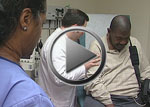
The doctor also checked that she was following the diet she had been given and was taking her antibiotics, and made follow-up appointments for her with a gastroenterologist and her primary-care provider.
°ճó±ðÌý helps streamline the process of getting patients in to see their primary-care physicians, says its medical director, .
A typical patient visits Beth Israel’s post-discharge clinic, located near the hospital, just once or twice. But treatment may last longer at post-discharge clinics affiliated with safety-net hospitals that serve large numbers of low-income, uninsured and other vulnerable patients.
One such hospital is . Clinicians say they see most patients for up to two months and will extend that time frame if necessary.
“We’re a bridge until we are guaranteed they are in . . . primary care,” says Dean Watson, Tallahassee Memorial’s chief medical officer.
The center targets patients at high risk for readmission, including the uninsured, those who don’t have a primary-care physician or who can’t get an appointment with their doctor within a week of discharge, and patients who have been admitted at least three times in the past year.
Patients who are referred to the center work with clinicians to develop a plan for their ongoing care and receive referrals to rehab or other medical services. The center’s staff finds a primary-care provider for them if they need one and connect them with social services for such needs as transportation, food and home care.
Since the center opened in February, more than 600 patients have visited it, says Watson, and emergency room visits and hospital readmissions have decreased by 61 percent for these high-risk patients.
Hospital officials and policy experts agree that the impetus for the post-discharge clinics comes in part from new penalties for certain hospital readmissions that will take effect starting in 2012. Under the 2010 federal health-care overhaul, hospitals that have for three conditions – pneumonia, heart failure and heart attack — may face Medicare payment penalties.
But some analysts question whether the clinics are an efficient solution.
“Creating a whole separate post-discharge follow-up clinic when you’ve got an outpatient network in existence could be duplicative,” says , a senior researcher at the Center for Studying Health System Change, the Washington-based research group that did the study that was released this month. “What we need is better support of the primary-care infrastructure in the community.”
Even with that, some patients are likely to fall through the cracks. , a safety-net hospital in St. Louis, opened a post-discharge clinic about three months ago. Medicare-eligible patients with chronic obstructive pulmonary disease, pneumonia, heart attack and heart failure are referred to the Stay Healthy Clinic for follow-up care.
But there’s a hitch. Even though the hospital schedules the initial post-discharge appointments and offers to arrange a ride for patients to the clinic, about half of them don’t show up.
“We’re trying to understand it,” says , the hospital’s chief medical officer. It’s unclear, he says, whether patients don’t understand the importance of the appointments, for example, or feel better and don’t think they need to come in. With roughly a third of high-risk Medicare patients being readmitted within a week of discharge, it is critical to look for answers. “We’ll continue to try to tweak it,” he says.
Please send comments or ideas for future topics for the Insuring Your Health column to questions@kffhealthnews.org.