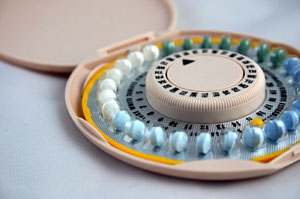
 Debates over the Obama administration’s decision聽to implement the that health plans cover birth control,聽state and federal disputes over public聽and a temporary decision by the popular Susan G. Komen for the Cure foundation to end its support for Planned Parenthood have spurred the activities, the poll reported.
The Kaiser Family Foundation’s , released Thursday, found that 42 percent of women say they took some sort of action in the past six months on the issue. Some say they attempted to influence a friend or family member (23 percent); others聽donated money to a nonprofit organization working on reproductive health issues (15 percent) or contacted an elected official (14 percent), according to the poll. (KHN is an editorially independent program of the foundation).
On the issue of the 2010 health law, the survey also found that the public’s support of the measure dropped five percentage points in May, with unfavorable views outnumbering favorable ones by a margin of 44 percent to 37 percent.
The poll found that 31 percent of women believe there is a “wide-scale effort to limit women’s reproductive health choices and services,” and 45 percent say that while some groups would like to limit women’s reproductive health choices and services, it is not a wide-scale effort.
Seven percent of women say that no coordinated effort to weaken women’s reproductive health choices and services exists, while 17 percent declined to offer an opinion.
Women who say they are liberals (49 percent) are far more likely than women who say they are conservatives (18 percent) to perceive a major effort to limit services.
Like their male counterparts, female voters continue to focus on the economy as their top election concern, with several other issues – including health care – more important than women’s reproductive health. But to the extent that women’s reproductive health becomes a voting issue, more than half of female registered voters say they trust President Barack Obama more to “look out for the best interest of women,” and to make decisions about women’s reproductive health in particular, while about a quarter pick the presumptive GOP candidate, former Massachusetts Gov. Mitt Romney.
The poll was conducted May 8 to May 14. The pollsters surveyed 1,218 adults. The margin of error for the full sample was plus or minus 3 percentage points. For women, it is plus or minus 5 percentage points. For results based on subgroups, the margin of error may be higher.
麻豆女优 Health News is a national newsroom that produces in-depth journalism about health issues and is one of the core operating programs at 麻豆女优鈥攁n independent source of health policy research, polling, and journalism. Learn more about .
USE OUR CONTENT
This story can be republished for free (details).
]]>