
Puzzling Out How To Help States With Hard-Hit Medicaid Budgets
One of the biggest problems governors face during a recession is this: When the economy is going down, Medicaid enrollment is going up. So states have more people in their Medicaid program, but less tax revenue to pay for them. It is what economists call counter-cyclical.
Washington is sensitive to the problem. During the most recent recession, as part of the , Congress voted to increase the federal government鈥檚 share of Medicaid costs, known as the Federal Medical Assistance Percentage (). Under FMAP, states receive a set 鈥渕atch鈥� amount, and depending on the state, that amount is normally 50 to 76 percent of the Medicaid costs. Because of the stimulus funding, that range increased to 62 to 85 percent of costs.
A Kaiser Family Foundation found that while the extra funds 鈥減rovided critical fiscal relief for all states, the funds were not targeted to states with the highest unemployment rates. 鈥� The data used to calculate the FMAP are lagged and therefore may not accurately reflect a state鈥檚 economic distress.鈥� 聽(KHN is an editorially-independent program of the foundation.)
Enter the Government Accountability Office. Congress asked the GAO to figure out the best way to decide how much extra Medicaid money states should get during hard times, and when they would get it.
In March, GAO came up with a formula, and this week it examined how it would have worked during the recession. The new formula would be based on a state鈥檚 particular unemployment and taxable income levels compared against the national average.
鈥淚n the Recovery Act, every state got a 6.2 percent increase in their federal funding across the board,鈥� says Carolyn Yocom, one of the directors for the . She says this new proposal would eliminate generic increases,聽also called bump ups, and instead would look at changes to the state’s unemployment rate and total wages/salaries.
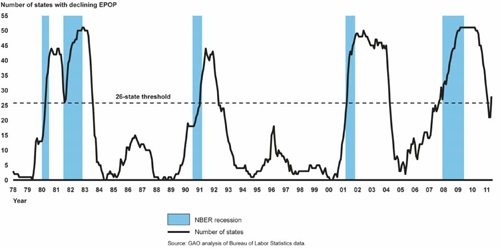
鈥淯nder our proposal the amount of assistance a state got varies based on those two factors and there are no automatic bump ups [from Congress] just because times are hard,鈥� Yocom says. The report says that 鈥渙nce a threshold number of states 鈥� 26 in GAO’s prototype formula 鈥� show a sustained decrease in their employment to-population (EPOP) ratio, temporary increases to states’ FMAPs would be triggered automatically.鈥�
The report details how聽GAO鈥檚 formula would have played out. With the stimulus funds, more federal dollars flowed to the states from October 2008聽 through June 2011 鈥� a total of 13 fiscal quarters. With the new formula, the assistance would have started in Janaury 2008 and gone through September 2011 – more in sync with the states鈥� economic distress 鈥� for a total of 15 quarters, an extra 6 months.
Put another way: the recession ran from December 2007 to June 2009. As the effects rippled down, people lost jobs and health insurance, the聽states were squeezed later and for longer than the actual recession.
Joy Johnson Wilson, the health policy director of the National Conference of State Legislatures (), says with the health law鈥檚 expansion of Medicaid in 2014, it is critical聽to reassess how federal dollars are matched to states. She points out that there are no provisions in the new health care law to protect state Medicaid budgets against recessions. 鈥淯nder the Affordable Care Act [states] are now responsible for a substantial expansion of an entitlement program,鈥� she says. 鈥淸Medicaid] is an entitlement program, so we have to provide that care. While [states] are struggling now to do that, in 2014, it鈥檒l be a whole other set of people coming onto the program, so I think it makes it much more important that there is some protection for state budgets.鈥�


