
Researchers Press For More Action On Health Disparities
As Susan Dentzer, the editor in chief of the journal ,聽was opening a public briefing today on a special issue dedicated to the state of health care disparities in the country, she warned the audience members they 鈥渕ight need a strong dose of Valium鈥� to handle some of the bleak assessments of the racial gap in care.
But panelists, researchers and health care experts say there is light at the end of the tunnel, especially as coverage is expanded under the 2010 health overhaul law. Anne Beal, the president of the Aetna Foundation that helped sponsor the themed issue of the journal, said there is comfort in just knowing how complicated health care disparities can be. “It’s not just race, it’s not just income. … It’s all those things,” she said. “But I think it鈥檚 now time for us to collectively stop talking about health care disparities, but really start doing the hard work of achieving health equity.”
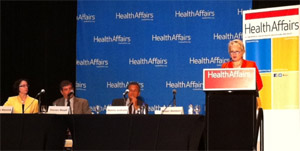
“What we really need, in addition to great research is action,” said Howard K.聽Koh, assistant secretary of the聽Department of Health and Human Services. “Unfortunately we have not made enough progress in this area as a nation.”
The briefing provided a number of presentations by researchers with studies in the October issue, all focused on health care disparities. Among the more intriguing studies, Dr. Renee Yuen-Jan Hsia, a professor of Emergency Medicine at the University of California San Francisco, reported that in 2007, would have needed to travel more than the average patient to reach a trauma facility. Her paper on geographical access to trauma centers revealed that African Americans, people with incomes below the federal poverty level (FPL) and rural residents were deeply affected by emergency center closures.
Stephen Zuckerman presented his work on how changes to Medicare, Medicaid as well as other changes brought on by the health care overhaul 鈥� a group excluded from coverage under the health law. His work suggests that illegal immigrants will continue to use care through safety net operations 鈥� such as hospital emergency rooms and community health centers. He points out that the growing population of illegal immigrants could pinch the safety net providers. But he also noted that safety net providers may be better able to handle this increase, because many more of their other patients will be gaining coverage through the health law.
Dentzer told the audience that beyond health care coverage, other factors play a vital role in closing the racial health care gap. 鈥淚ncomes matter; studies suggest that poverty has a larger effect on health and mortality than tobacco use and obesity,鈥� she said. She pointed to a that looks at how college education can impact health and and others showing that great health risks for both rural white and minority populations compared to urbanites because of education, income and health coverage disparities.
鈥淩ace and ethnicity clearly matter,鈥� Dentzer said. 鈥淥ne in three whites has hypertension, the leading cause of cardiovascular disease, versus three in five blacks. And place聽鈥斅爌robably more than race聽鈥斅爉atters.鈥�
At the meeting, Koh also unveiled the ,聽 a survey that is taken every 10 years to assess the health of Americans.


