
Tight Medicaid Eligibility Leads To More Adults Delaying Care
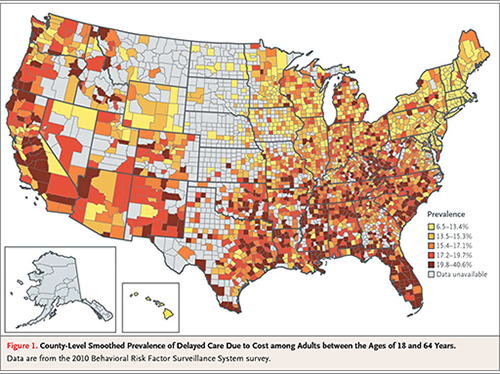
Hidalgo is a聽county in southern Texas just across the Rio Grande from Mexico. It鈥檚 also home to the highest prevalence of U.S. adults 鈥� about 40 percent of the population– delaying necessary medical care because of cost, according to data in the March 28 New England Journal of Medicine.
罢丑别听 of the journal found this number聽varies significantly across the country and is lower in places with less restrictive eligibility criteria for Medicaid, the federal-state insurance program for low-income citizens.
Authors found that people with incomes between 67 percent and 127 percent of the federal poverty line, which is $23,550 for a family of four, had up to a 16 percent chance of delaying care. The odds went up to 42 percent for those with lower incomes.
罢丑别听findings come at a time when states are the Affordable Care Act鈥檚 Medicaid expansion, which would extend eligibility聽to adults聽with incomes at or below 133 percent of the poverty level.
Norfolk, Mass., with 6.5 percent of adults delaying care, was at the opposite end of the spectrum from Hidalgo, researchers said.聽Massachusetts’ adoption of聽state health聽reforms since 1990, including Medicaid expansions, and the state’s聽history of investing in health care were likely reasons, said one of the authors, Dr. Cheryl Clarke from聽Brigham and Women鈥檚 Hospital in Boston.
鈥淲e were surprised by the depth of variation between states,鈥� she said. 鈥淚t鈥檚 important these trends continue to be monitored.鈥�
The study鈥檚 authors looked at of about 289,000 adults to determine the relationship between Medicaid eligibility and adults delaying care. They also took into account the sociodemographic and clinical characteristics at hand.
Researchers聽found that the counties with residents most vulnerable to delaying care were also likely to have more Hispanic residents and high rates of chronic diseases commonly associated with low-income communities. Texas and Florida were among the states with the highest prevalence.
But Clarke said the study shows that it is possible to develop health infrastructure 鈥� through聽Medicaid, community clinics and more primary care doctors 鈥� to combat an issue that might be taking a toll on the country鈥檚 health. And she said federal investments are moving in that direction.
鈥淭his seems to be a strategy that is feasible,鈥� she said. 鈥淲e鈥檒l see how that plays out over time.鈥�


