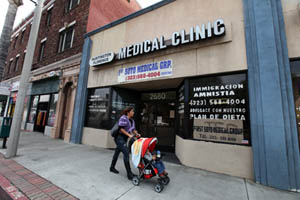
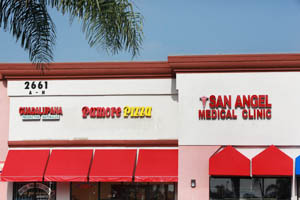
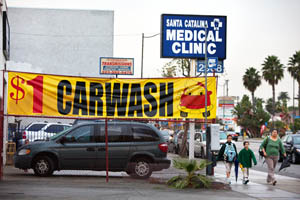
HUNTINGTON PARK, Calif. 鈥� The听so-called听bodega clinicas听that line the听streets of Los Angeles鈥� immigrant neighborhoods听blend into听a dense forest of commerce. Wedged between money order kiosks and pawn shops, these storefront doctors鈥� offices treat ailments for cash: a doctor鈥檚 visit is $20 to $40, a podiatry exam is $120 and at one bustling clinica,听a colonoscopy听is advertised on an erasable white board for $700.
County health officials describe the clinicas as a parallel health care system, servicing a vast number of uninsured Latino residents, yet the officials say they have little understanding of who owns and operates them, how they are regulated听and the quality of the medical care they provide. Staffed with Spanish speaking medical providers, few of these low-rent clinics accept private insurance or participate in Medicaid managed care plans.

Monica Almeida/The New York Times
鈥淪omeone has to figure out if there鈥檚 a basic level of competence,鈥� said Dr. Patrick Dowling, professor and chair of the department of family medicine at the David Geffen School of Medicine at the University of California, Los Angeles.
Not that researchers haven鈥檛 tried. Dr. Dowling, for one, has canvassed the local clinicas听for听years as part of his research for the state to document physician shortages. What he and others have found, however, is that clinca owners were reluctant to answer their questions.
What is certain, though, is that despite their name, many of these clinicas are听actually听private doctor鈥檚 offices, not licensed clinics which are required to report regularly to federal and state oversight bodies.听It is a distinction that deeply concerns Kimberly Wyard, chief executive of Northeast Valley Health Corporation, a non-profit group which runs 13 accredited health clinics for low-income听Southern Californians. 鈥淭hey are off the radar screen,鈥� said Wyard of the clinicas, 鈥渁nd it鈥檚 unclear what they鈥檙e doing.鈥�
But driven by fast-approaching deadlines set by the Affordable Care Act, health officials in Los Angeles are vexed over whether to embrace bodega clinicas and bring them 鈥� selectively and gingerly 鈥� into the network of tightly regulated public and non-profit health centers that are driven more by mission than by profit to serve the uninsured.
Monica Almeida/The New York Times
Health officials see in the clinicas the tantalizing opportunity to fill persistent and profound gaps in the county鈥檚 strained safety net, including a chronic shortage of primary care physicians. By January 2014, up to 2 million currently uninsured Angelenos will need to enroll in Medicaid or buy insurance and find primary care. And the clinicas, public health officials note, are already well established in the county鈥檚 poorest neighborhoods where they are meeting the needs of Spanish-speaking residents. The clinicas also could continue to serve a market that the Affordable Care Act does not touch: undocumented immigrants who are prohibited from getting health insurance under the law.
Dr. Mark Ghaly, deputy director for Community Health at the Los Angeles County Department of Health Services, said bodega clinicas, a term he seems to have coined, that agree to some scrutiny could be a good way of addressing the physician shortage in these neighborhoods.
鈥淲here are we going to find those providers?鈥� he said. 鈥淥ne logical place to consider looking is these clinics.鈥�
Los Angeles is not the only city with a sizable Latino population where clinicas have become a part of the street听scape. Health care providers in Phoenix and Miami say clinicas are听in many Latino neighborhoods.
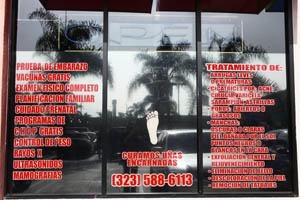
But their presence in parts of Los Angeles can be striking, with dozens of storefront doctors鈥� offices in certain areas. Visits to more than two dozen clinicas in South Los Angeles and the San Fernando Valley found Latino women in brightly colored nurses scrubs handing out cards and coupons that promise everything from pregnancy tests听to听tubal ligations. Others advertise evening and weekend hours, and, some 24-hour a day operations听trumpet that they are 鈥渘unca cerramos鈥� 鈥� never closed. That all-hours access 鈥� and up-front pricing 鈥� is critical, Latino health experts say, to a population that often works low-wage, around-the-clock jobs.
Also important, officials say, is that new immigrants from Mexico and Central America are more accustomed to a corner clinica, which is common in their home countries, than to the sprawling medical complexes or large community health centers found in the United States. And they can get the kind of medical treatments 鈥� including injections of hypertension drugs, vitamin solutions delivered intravenously and liberally dispensed antibiotics 鈥� that are frowned upon in traditional American medicine.听
Monica Almeida/The New York Times
Many Latino immigrants have a 鈥減reference for injectables,鈥� said Dr. Yelba Castellon-Lopez, a family medicine resident at UCLA听raised in South Los Angeles who treats patients at a licensed clinic. And since common antibiotics are available over-the-counter in Mexico and other Latin American countries, patients often demand a prescription for the drugs even when it is not medically prudent. 鈥淚f you try to explain they don鈥檛 need an antibiotic,鈥� Ms. Castellon said, 鈥減eople tend to walk out very dissatisfied.鈥�
The waiting rooms at the bodega clinicas reflect the everyday maladies of peoples鈥� lives: a glassy-eyed child rests listlessly on his mother鈥檚 lap; a fit-looking young woman waits with a bag of ice on her wrist; a pensive middle-aged man in work boots stares straight ahead. For patients with ordinary complaints, the medical care at these bodega clinicas may be suitable, say county health officials and medical experts. But they say problems arise when the illness exceeds the boundaries of a physician鈥檚 skills or the patient鈥檚 ability to pay cash.
Dr. Raul Joaquin Bendana, who has been practicing general medicine since 1987 in听South Los Angeles, said bodega clinicas will refer patients to him when, for example, they have uncontrolled diabetes. 鈥淭hey refer to me because they don鈥檛 know how to handle the situation,鈥� he said. The clinica physicians by and large appear to have current medical licenses, a sample showed, but experts say they are unlikely to be board certified as specialists or have admitting privileges at area hospitals. That can mean some clinicas attempt to continue to treat patients who face serious illness.
Olivia Cardenas, a 40-year-old restaurant worker who lives in Woodland Hills, Calif., got a free pap smear at a clinica that advertises 鈥渆specialistas鈥� including gynecology. The pap smear came back abnormal, and the doctor told Cardenas she had cervical cancer. 鈥淐ome back in a week with $5,000 in cash, and I鈥檒l operate on you,鈥� Cardenas said the doctor told her. 鈥淥therwise you could die.鈥�
Although Ms. Cardenas had gone to the clinica for years, and her husband had received 鈥榮ueros鈥� there (IV therapy) she was shocked by the directive.听She declined to pay the $5,000. Instead, a family friend helped her apply for Medicaid and she went to a licensed hospital听for treatment. The diagnosis, it turned out, was correct.
Monica Almeida/The New York Times
Health care experts say clinicas鈥� medical practices would come under greater scrutiny if they were brought closer into the fold.听Howard Kahn, chief executive of L.A. Care Health Plan, the nation鈥檚 largest public health plan, which contracts with private managed care companies, said: 鈥淚鈥檓 big on the idea that connectedness breeds quality.鈥澨齋ome here hold an uneasy hope that the clinicas could learn from licensed health centers how to follow their patients鈥� diabetes, hypertension and asthma, adopt electronic medical records and employ medical assistants to keep patients on track.
But being connected would mean the clinicas鈥櫶齝ash-only听business model听would need to change. Dowling, the UCLA researcher, said the lure of newly insured patients in 2014 might draw them in: 鈥淭o the extent there are payments available, the legitimate ones might step up to the plate.鈥�
Calls to a half dozen such clinics were met with no comment or were unreturned.There is at least one early indication that the clinicas may sit this one out: Clinica Mi Pueblo, regarded as scrupulous and well-run, recently sold four of its 11 clinics to a health maintenance organization over concerns that when the Affordable Care Act takes hold next year, it will lose a significant portion of its cash business.