
Young Adults Value Health Insurance, Poll Finds
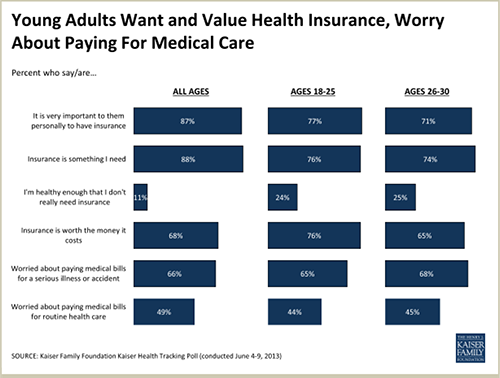
A strong majority of young adults, whose participation in the health law may be key to its success or failure, strongly believe health insurance is important for them and worth the money, according to a new poll.
As some states and the federal government prepare new online marketplaces for people to purchase insurance this fall, the willingness of young people to buy coverage has been a topic of great uncertainty. Their participation in these marketplaces is considered crucial, since the young tend to be healthier than older people and, therefore, will use fewer medical resources, allowing their premiums to help subsidize the care of the old and sick.
Among age groups, the young are considered the , because the coverage mandated under the 2010 health law is more comprehensive 鈥� and therefore more expensive 鈥� than the catastrophic policies that many now obtain. Young adults are considered more likely to believe they won鈥檛 suffer any horrible illnesses or injuries 鈥� a trend that has led to them being labeled 鈥測oung invincibles.鈥�
The poll found some reason to believe that the young may not shun the health law requirement that they hold insurance starting next January. More than 71 percent of adults 30 or younger say having health insurance is 鈥渧ery important to them,鈥� from the Kaiser Family Foundation. (KHN is an independent program of the foundation.) When the pollsters put the question differently by asking whether 鈥渋nsurance is something I need,鈥� more than 74 percent of people under age 30 agreed.
Two-thirds of those 30 or younger agreed with the statement that 鈥渋nsurance is worth the money it costs,鈥� although the pollsters did not offer those polled any dollar figures for an estimated cost. Liz Hamel, an associate director of the foundation鈥檚 polling unit, said the goal of the question was to elicit people鈥檚 general attitude toward insurance cost, not to attempt to predict whether they would ultimately take up coverage. In addition, she said, it would be hard to offer a set figure for premiums, given that they will vary among states and the size of a person鈥檚 family.
Also, two-thirds of these young adults said they worried about paying medical bills in the case of a serious illness or accident, and more than 44 percent said they were concerned about medical bills from routine care.
鈥淭he large majority of Americans want and value health insurance,鈥� the pollsters wrote. 鈥淢ore than seven in ten young adults 鈥� a special focus of outreach and enrollment efforts 鈥� say it is very important to them personally to have insurance. Cost remains the biggest barrier for the uninsured, with four in ten citing the expense of coverage as the main reason they don鈥檛 have it.鈥�
The poll also indicated that the Obama administration, states and health care advocates have much to do to make people aware of the new health insurance exchanges that are being created for people who don鈥檛 get coverage through an employer. Forty-five percent of people polled said they had heard 鈥渘othing at all鈥� about these marketplaces, and 34 percent said they had heard 鈥渙nly a little.鈥� Low-income people and the uninsured knew less about the marketplaces than did their more affluent and covered counterparts, the poll found.
The poll found that once again opposition to the health care law is greater than support by a margin of 43 percent to 35 percent. The poll also found that names matter significantly in this discussion. Calling it 鈥淥bamacare鈥� rather than the 鈥渉ealth reform law鈥� pushes the partisan buttons, causing more Democrats to say they favor it and more Republicans to say they oppose it. Most substantially, the number of Democrats saying they favor Obamacare is 73 percent, while only 58 percent of Democrats favor the 鈥渉ealth reform law.鈥� Republican opposition to the law rises by 10 percentage points if it is called 鈥淥bamacare,鈥� with 86 percent of Republicans taking a dim view of the nicknamed program.
The survey was conducted June 4 through June 9 among 1,505 adults through landlines and cell phones. The margin of error is +/- 3 percentage points, with higher margins for subgroups.

