Eliza Brader worries she soon will need to prove she鈥檚 working to continue receiving Medicaid health coverage. She doesn鈥檛 think she should have to.
The 27-year-old resident of Bloomington, Indiana, has a pacemaker and a painful joint disease. She also has fused vertebrae in her neck from a spinal injury, preventing her from turning her head.
Indiana鈥檚 Medicaid agency currently considers Brader 鈥渕edically frail,鈥� giving her access to an expanded set of benefits, such as physical therapy.
New federal rules will require more than 18 million Medicaid enrollees nationwide to show they鈥檙e working, volunteering, or going to school for 80 hours a month starting in 2027 to keep their coverage. Brader is exempt as long as she鈥檚 deemed medically frail.
But lacking sufficient federal guidance, states are wrestling with how to define medical frailty 鈥� a consequential decision that could cut Medicaid coverage for many people, said state officials, consumer advocates, and health policy researchers.
鈥淚t鈥檚 terrifying,鈥� Brader said. 鈥淚 already have fought so hard to get my health care.鈥�
鈥業ncredibly High鈥� Stakes
President Donald Trump鈥檚 One Big Beautiful Bill Act slashes nearly $1 trillion from Medicaid over the next decade, with much of the savings projected to come from no longer covering those who don鈥檛 qualify under the new work rules. Those spending cuts help offset the costs of GOP priorities, such as extra border security and tax cuts that mainly benefit the wealthy.
Conservative lawmakers have argued that Medicaid, the government health insurance program for people with low incomes or with disabilities, has grown too large and expensive, especially in the wake of its expansion to more low-income adults under the Affordable Care Act. They also say that requiring participants to work is common sense.
The work rules in Trump鈥檚 tax-and-spending law offer exemptions for several groups who might struggle to meet them, including people deemed 鈥渕edically frail.鈥� The law spells out certain 鈥渕edically frail鈥� conditions such as blindness, disability, and substance use disorder. But it does not list many others.
Instead, the law exempts those with a 鈥渟erious or complex medical condition,鈥� a term whose interpretation could vary by state.
State officials say they need more clarity to ensure that people who cannot work for health reasons retain rightful access to Medicaid. They also worry that, even with a clear definition, people will face the onerous task of having to regularly vouch for being medically frail, which is a challenge without reliable access to medical care.
鈥淭he stakes are incredibly high,鈥� said Kinda Serafi, a partner at consulting firm Manatt Health.
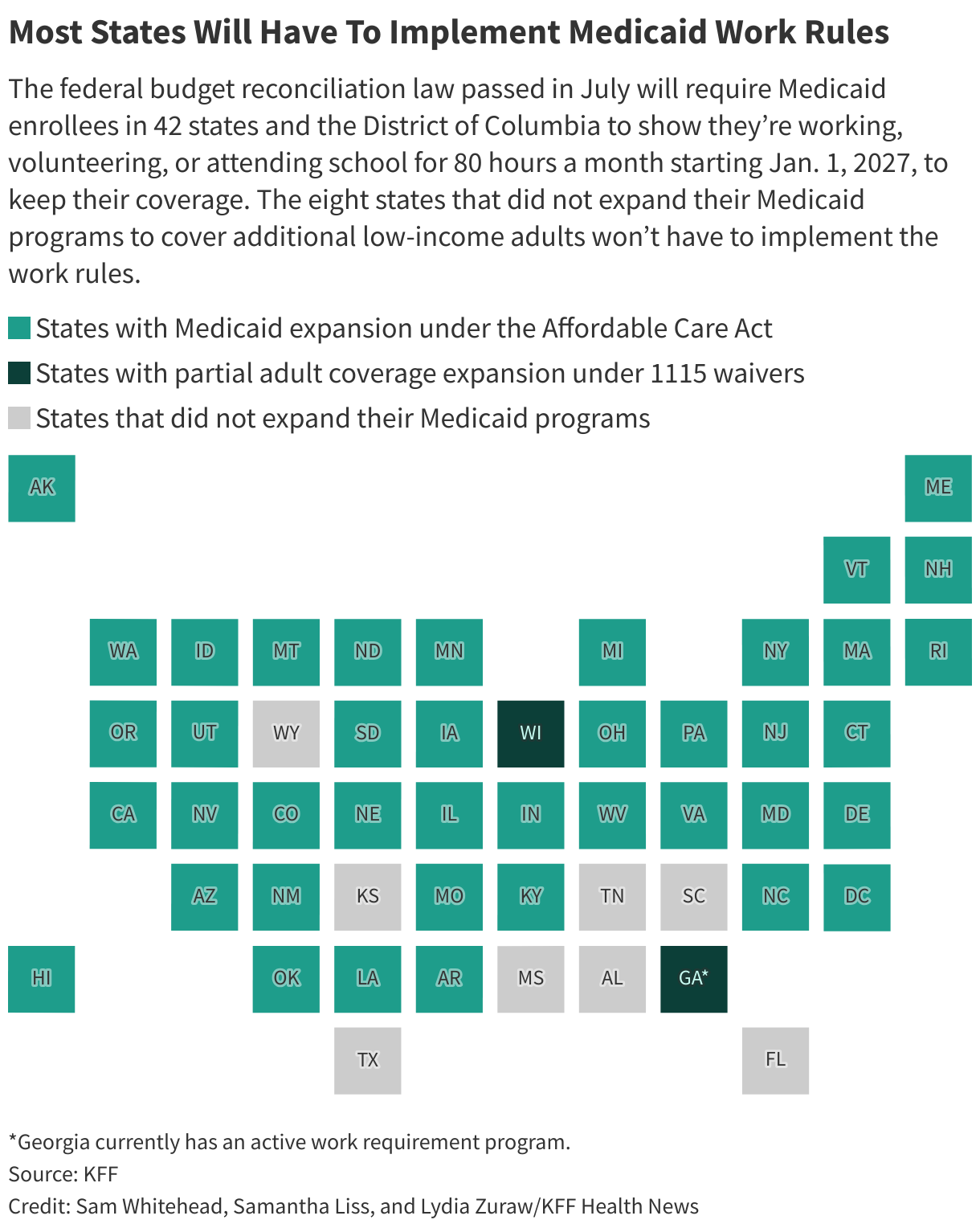
The new work requirements will affect Medicaid recipients in 42 states and Washington, D.C. Eight states 鈥� Alabama, Florida, Kansas, Mississippi, South Carolina, Tennessee, Texas, and Wyoming 鈥� did not expand their Medicaid programs to cover additional low-income adults, so they won鈥檛 have to implement the work rules.
The Medicaid work rules are expected to be the over the next decade, according to the nonpartisan Congressional Budget Office.
Forty-four percent of all adults covered by states鈥� expanded Medicaid programs , according to 麻豆女优.
A Challenge for States
State Medicaid agencies are scrambling to implement the rules with little direction from the U.S. Department of Health and Human Services, which has yet to issue specific guidance. Federal officials will clarify the 鈥渕edically frail鈥� definition next year, said Andrew Nixon, an agency spokesperson.
Ultimately, states will have to decide who is unhealthy enough to be exempt from work rules. And it won鈥檛 be easy for state workers and their computer systems to track.
Every year, state eligibility systems screen millions of applicants to check if they qualify for Medicaid and other government programs. Now, these same systems must screen applicants and existing enrollees to determine whether they meet the new work rules.
Jessica Kahn, a partner at consulting firm McKinsey & Co., has urged states to start planning how to adapt eligibility systems to verify work status. States can do a 鈥渢remendous amount鈥� of work without direction from the federal government, said Kahn, a former federal Medicaid systems official, who spoke during a recent Medicaid advisory panel hearing. 鈥淭ime is a-wasting already.鈥�
State Medicaid directors are pondering the challenge.
鈥淢edical frailty gets so complex,鈥� Emma Sandoe, Oregon鈥檚 Medicaid director, said during a recent panel discussion. Conditions that can keep people from working, such as mental health disorders, can be hard to prove, she said.
A state might try to use data pulled from聽a person鈥檚 health records, for instance, to determine medical frailty. But information from聽a patient鈥檚 chart may not paint a clear picture of someone鈥檚 health, especially if they lack regular access to medical care.
It鈥檚 a tall order for eligibility systems that historically have not had to scrape medical records to screen applicants, said Serafi of Manatt Health.
鈥淭hat is an incredibly new thing that eligibility enrollment systems are just not fluent in at all,鈥� Serafi said.
Lobbying groups for the private health insurance companies that help run Medicaid in many states also have urged federal regulators to clearly define medical frailty so it can be applied uniformly.
In a Nov. 3 letter to federal officials, the Medicaid Health Plans of America and the Association for Community Affiliated Plans advocated for allowing enrollees to qualify for the exemption by saying on their applications that they have conditions that make them medically frail. Successfully implementing exemptions for the medically frail will be 鈥渃rucial鈥� given the 鈥渟evere health risks of coverage loss for these populations,鈥� the groups said.
Some state officials worry about unintended consequences of the work rules for people with chronic conditions.

Jennifer Strohecker, who recently resigned as Utah鈥檚 Medicaid director, reiterated the high stakes, especially for those with diabetes on Medicaid. They may be very healthy and functional with insulin, but if they fail to complete the work requirements, that may change, Strohecker said during a recent Medicaid advisory hearing.
Whether someone is deemed medically frail already depends heavily on where they live.
For example, in Arkansas, people indicate on their Medicaid applications that they鈥檙e disabled, blind, or need help with daily living activities.
Approximately 6% of the roughly 221,000 people enrolled in Arkansas鈥� Medicaid expansion program are deemed medically frail, according to Gavin Lesnick, a spokesperson for the Arkansas Department of Human Services.
In West Virginia, the state accepts a medical frailty designation when an applicant self-reports it.
The burden of proof is higher in North Dakota. Applicants there must answer a questionnaire about their health and submit additional documentation, which may include medical chart notes and treatment plans. More than half of applicants were denied last year, according to Health and Human Services Department spokesperson Mindy Michaels.
Indiana鈥檚 Family and Social Services Administration, which runs its Medicaid program, declined an interview and said it could not comment on individual cases, like Brader鈥檚.
Brader worries the additional red tape will cause her to lose Medicaid again. She said she was temporarily kicked off the program in 2019 for failing to meet the state鈥檚 work rules when Indiana said her work-study job didn鈥檛 count as employment.
鈥淎nytime I have tried to receive help from the state of Indiana, it has been a bureaucratic nightmare,鈥� she said.
As states await federal guidance, Kristi Putnam, a senior fellow at the conservative Cicero Institute and former secretary of the Arkansas Department of Human Services, which oversees the state Medicaid program, said even if a state creates an extensive list of qualifying 鈥渕edically frail鈥� conditions, the line must be drawn somewhere.
鈥淵ou can鈥檛 possibly create a policy for exemptions that will catch everything,鈥� she said.
麻豆女优 Health News is a national newsroom that produces in-depth journalism about health issues and is one of the core operating programs at 麻豆女优鈥攁n independent source of health policy research, polling, and journalism. Learn more about .