Arizona and Florida 鈥� whose rates of uninsured children are among the highest in the nation 鈥� set goals last year to widen the safety net that provides health insurance to people 18 and younger.
But their plans to expand coverage illustrate key ideological differences on the government鈥檚 role in subsidizing health insurance for kids: what to charge low-income families as premiums for public coverage 鈥� and what happens if they miss a payment.
鈥淚t鈥檚 a tale of two states,鈥� said , executive director of Georgetown University鈥檚 Center for Children and Families.
That divergence represents more than just two states taking their own path. It showcases a broader breakthrough moment, Alker said, as the nation rethinks how government works for families following the covid-19 pandemic. 聽The divide also underscores the policies at stake in the 2024 presidential election.
Republican-led legislatures in Florida and Arizona worked across party lines in 2023 to pass bills to expand their states鈥� Children鈥檚 Health Insurance Program 鈥� widely known as CHIP 鈥� which covers anyone younger than 19 in families earning too much to be eligible for Medicaid.
Florida Republican Gov. Ron DeSantis and Arizona Democratic Gov. Katie Hobbs then signed bills into law last year that increased the amount of money a family can make and still be eligible for their states鈥� CHIP programs. That鈥檚 where the similarities end.
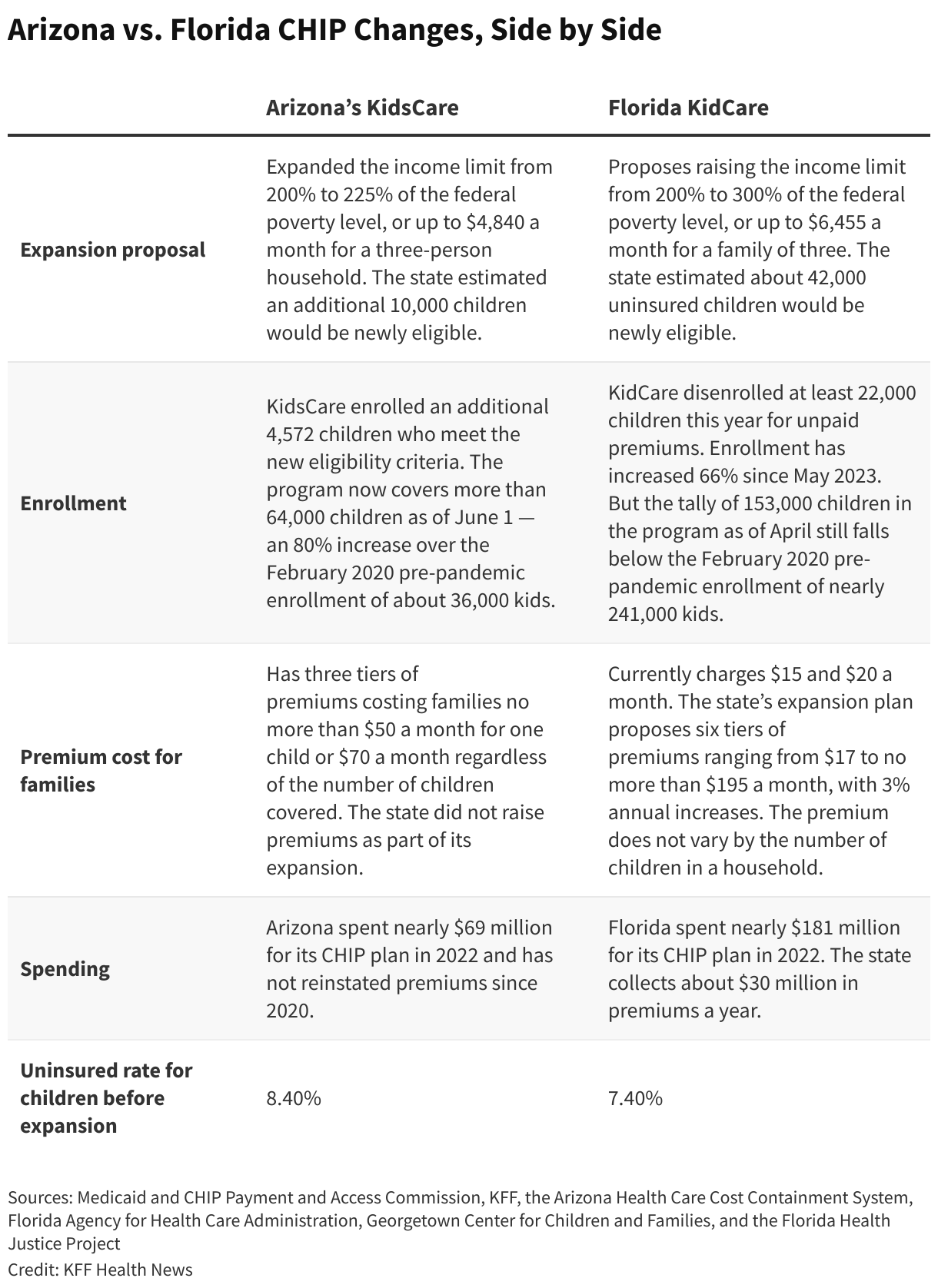
Arizona began to enroll newly eligible children in March. That state has adopted policies that align with the to apply Affordable Care Act-style protections to CHIP, such as eliminating annual and lifetime limits on coverage and lockouts if families don鈥檛 pay premiums.
Arizona鈥檚 CHIP plan, , suspended its monthly premiums in 2020 and has yet to reinstate them. State officials are considering whether it鈥檚 worth the expense to manage and collect the payments given that new federal rules forbid the state from disenrolling children for nonpayment, said , a deputy director for the state鈥檚 Medicaid agency.
鈥淲e鈥檙e trying to understand if the juice is worth the squeeze,鈥� he said.
By contrast, Florida has yet to begin its expanded enrollment and is the only state to file a federal lawsuit challenging a Biden administration rule requiring states to even if their families don鈥檛 pay their premiums.
A judge dismissed Florida鈥檚 lawsuit on May 31, saying the state could appeal to federal regulators. The state鈥檚 CHIP expansion now awaits federal regulatory approval before newly eligible children can be enrolled.
鈥淣o eligible child should face barriers to enrolling in CHIP or be at risk of losing the coverage they rely on,鈥� said Sara Lonardo, a spokesperson for the federal Department of Health and Human Services.
Florida鈥檚 CHIP expansion calls for significantly raising premiums and then boosting them by 3% annually. The state estimates expansion will cost an additional $90 million in its first full year and expects to collect about $23 million in new premiums to help fund the expansion of what it calls .
But Florida officials have said that complying with a provision that bars children from being disenrolled for unpaid premiums would cause the state to lose $1 million a month. The state鈥檚 allocates $46.5 billion to health care and projects .
Florida officials have flouted federal regulations and from CHIP for unpaid premiums since the rule banning such disenrollments took effect on Jan. 1, according to public records obtained by the Florida Health Justice Project, a nonprofit advocacy group.
DeSantis鈥� office and Florida鈥檚 Medicaid administration did not respond to 麻豆女优 Health News鈥� repeated requests for comment about CHIP. But in legal filings, Florida said its CHIP plan is a 鈥減ersonal responsibility program.鈥� It is 鈥渁 bridge from Medicaid to private insurance,鈥� the administration said on , to get families used to premiums, cost sharing, and the risk of losing coverage when missing a payment.
For some Floridians, like Emily Dent in Cape Coral, the higher premiums proposed in the state鈥檚 expansion plan would create a financial burden, not open a path to self-sufficiency.
Dent, 32, said her 8-year-old son, James, was disenrolled from Medicaid in April because the family鈥檚 income was too high. Although James would qualify for CHIP under Florida鈥檚 proposed expansion, Dent said the $195 monthly premium would be a financial struggle for her family.
Leaving James uninsured is not an option, Dent said. He is severely disabled due to a rare genetic disorder, Pallister-Killian syndrome, and requires round-the-clock nursing.

鈥淗e has to have health insurance,鈥� she said. 鈥淏ut it鈥檚 going to drain my savings, which was going to be for a house one day.鈥�
Research shows the cost of from obtaining and maintaining CHIP coverage even when premiums are low.
And premiums don鈥檛 offset much of a state鈥檚 costs to operate the program, said , director of health policy for the Children鈥檚 Action Alliance of Arizona, a nonprofit that promotes health insurance coverage for kids in the Grand Canyon State.
He noted that the federal government pays 70% of Florida鈥檚 program costs and 75% of Arizona鈥檚 鈥� after deducting all premiums collected.
鈥淧remiums are more about an ideological belief that families need to have skin in the game,鈥� he said, 鈥渞ather than any practical means of paying money to support the program.鈥�
Republican-leaning states are not alone in implementing monthly or quarterly premiums for CHIP. , including Democratic-leaning states such as New York and Massachusetts, charge premiums.
States have had wide discretion in how they run CHIP since the program became law in 1997, including the ability to charge such premiums and cut people鈥檚 access if they failed to pay. That鈥檚 been part of its success, said , deputy director of the Program on Medicaid and the Uninsured at 麻豆女优.
鈥淓specially in more conservative states, the ability to create CHIP as a separate program 鈥� independent from Medicaid 鈥� enabled and fostered that bipartisan support,鈥� Tolbert said.
But in the decades since CHIP was enacted, government鈥檚 role in health insurance has evolved, most significantly after President Barack Obama in 2010 signed the Affordable Care Act, which introduced coverage protections and expanded assistance for low-income Americans.
Former President Donald Trump didn鈥檛 prioritize those things while in office, Tolbert said. He has to cutting federal assistance programs if reelected, while the Biden administration has adopted policies to make it easier for low-income Americans to enroll and keep their health coverage.
Just as for Dent, the question of CHIP premiums in this debate isn鈥檛 abstract for Erin Booth, a Florida mom who submitted a about Florida鈥檚 proposed CHIP expansion. She said she would have to pay a high premium, plus copayments for doctor visits, to keep her 8-year-old son covered.
鈥淚 am faced with the impossible decision of whether to pay my mortgage or to pay for health insurance for my son,鈥� she wrote.
麻豆女优 Health News is a national newsroom that produces in-depth journalism about health issues and is one of the core operating programs at 麻豆女优鈥攁n independent source of health policy research, polling, and journalism. Learn more about .