More than two dozen people lined up outside a state public assistance office in Montana before it opened to ensure they didn鈥檛 get cut off from Medicaid.
Callers in Missouri and Florida reported waiting on hold for more than two hours on hotlines to renew their Medicaid coverage.
The parents of a disabled man in Tennessee who had been on Medicaid for three decades fought with the state this summer to keep him enrolled as he lay dying from pneumonia in a hospital.
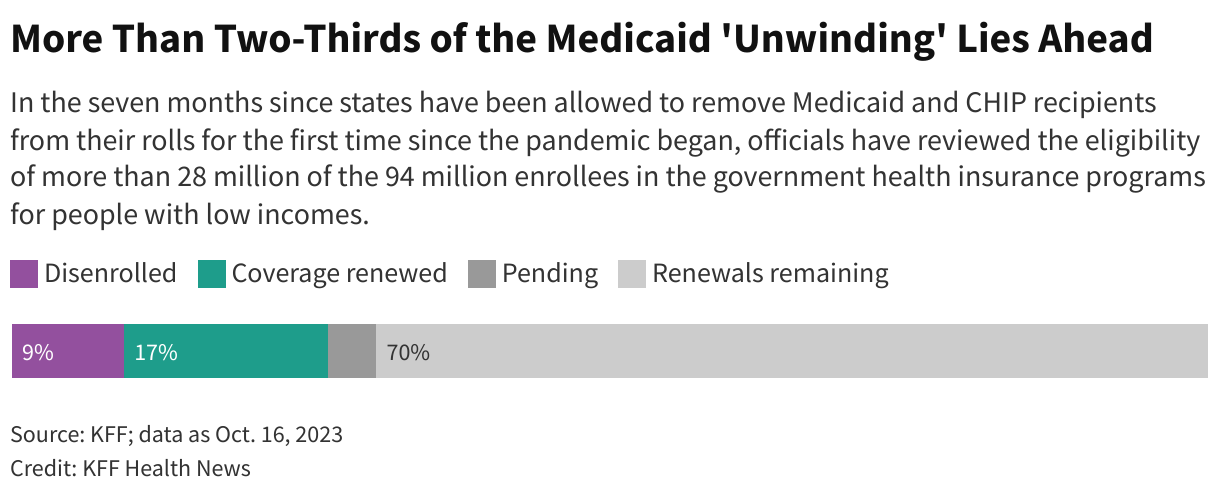
Seven months into what was predicted to be the biggest upheaval in the 58-year history of the government health insurance program for people with low incomes and disabilities, states have reviewed the eligibility of more than 28 million people and for over 10 million of them. Millions more are expected to lose Medicaid in the coming months.
The unprecedented enrollment drop comes after federal protections ended this spring that had prohibited states from removing people from Medicaid during the three pandemic years. Since March 2020, enrollment in Medicaid and the related Children鈥檚 Health Insurance Program had surged by more than 22 million to reach 94 million people.
The process of reviewing all recipients鈥� eligibility has been anything but smooth for many Medicaid enrollees. Some are losing coverage without understanding why. Some are struggling to prove they鈥檙e still eligible. Recipients and patient advocates say Medicaid officials sent mandatory renewal forms to outdated addresses, miscalculated income levels, and offered clumsy translations of the documents. Attempting to process the cases of tens of millions of people at the same time also has exacerbated long-standing weaknesses in the bureaucratic system. Some suspect particular states have used the confusing system to discourage enrollment.
鈥淚t鈥檚 not just bad, but worse than people can imagine,鈥� said , health policy director for the nonprofit Arkansas Advocates for Children and Families. 鈥淭his unwinding has not been about determining who is eligible by all possible means, but how we can kick people off by all possible means.鈥�
To be sure, some of the Medicaid recipients who signed on to the program when the U.S. unemployment rate soared amid covid-19 lockdowns have since gotten health insurance through new jobs as unemployment dropped back to pre-pandemic lows.
And some of the disenrolled are signing up for Affordable Care Act marketplace plans. Centene CEO Sarah London, for example, told investors on Oct. 24 that the health care giant expected as many as 2.4 million of its 15 million Medicaid managed care members to lose coverage from the unwinding, but more than 1 million customers had joined its exchange plans since the same time last year.
Still, it鈥檚 anyone鈥檚 guess how many former Medicaid beneficiaries remain uninsured. States don鈥檛 track what happens to everyone after they鈥檙e disenrolled. And the final tallies likely won鈥檛 be known until 2025, after the unwinding finishes by next summer and federal officials survey Americans鈥� insurance status.
Without Medicaid, Patients Miss Appointments
Trish Chastain, 35, of Springfield, Missouri, said her Medicaid coverage is scheduled to expire at the end of the year. Though her children are still covered, she no longer qualifies because her income is too high at $22 an hour. Chastain鈥檚 employer, a rehab center, offers health insurance but her share of the premium would be $260 a month. 鈥淚 can鈥檛 afford that with my monthly budget,鈥� she said.
She said she did not know she might be eligible for a lower-cost plan on the Affordable Care Act marketplace. That still would mean new costs for her, though.
Gaps in coverage can jeopardize people鈥檚 access to health services or their financial security if they get medical bills for care they cannot postpone.
鈥淎ny type of care that's put off 鈥� whether it's asthma, whether it's autism, whether it's something as simple as an earache 鈥� can just get worse if you wait,鈥� said Pam Shaw, a pediatrician in Kansas City, Kansas, who chairs the American Academy of Pediatrics鈥� state government affairs committee.
Doctors and representatives of community health centers around the country said they have seen an uptick in cancellations and no-shows among patients without coverage 鈥� including children. Nationwide, states have already disenrolled in the 20 states that . Children typically qualify more easily than adults, so child advocates believe many kids are being wrongly terminated based on their parents鈥� being deemed no longer eligible. Meanwhile, enrollment in CHIP, which has higher income eligibility levels than Medicaid, has shown only a tiny increase.
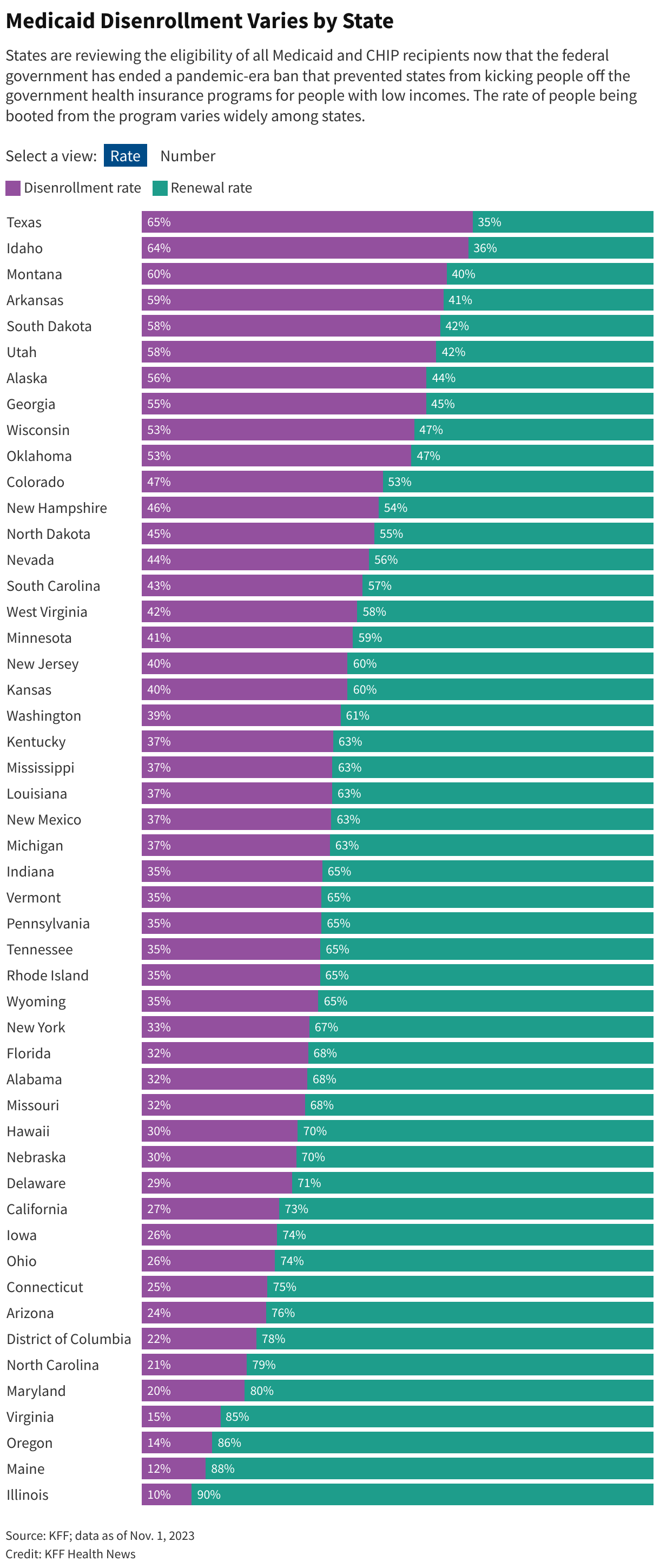
Kids accounted for varying shares of those disenrolled in each state, ranging from 68% in Texas to 16% in Massachusetts, according to 麻豆女优. In September, President Joe Biden鈥檚 administration said most states were conducting eligibility checks incorrectly and inappropriately disenrolling eligible children or household members. It for some 500,000 people.
Varying Timetables, Varying Rates of Disenrollment
Idaho, one of a few states that completed the unwind in six months, said it disenrolled 121,000 people of the 153,000 recipients it reviewed as of September because it suspected they were no longer eligible with the end of the public health emergency. Of those kicked off, about 13,600 signed up for private coverage on the state鈥檚 ACA marketplace, said Pat Kelly, executive director of , the state鈥檚 exchange. What happened to the rest, state officials say they don鈥檛 know.
California, by contrast, started terminating recipients only this summer and is automatically transferring coverage from Medicaid to marketplace plans for those eligible.
The Medicaid disenrollment rates of people reviewed so far vary dramatically by state, largely along a blue-red political divide, from a low of 10% in Illinois to a high of 65% in Texas.
鈥淚 feel like Illinois is doing everything in their power to ensure that as few people lose coverage as possible,鈥� said Paula Campbell of the , which represents dozens of community health centers.
Nationwide, about 71% of Medicaid enrollees terminated during the unwinding have been cut because of procedural issues, such as not responding to requests for information to verify their eligibility. It鈥檚 unclear how many are actually still eligible.
State and local Medicaid officials say they have tried contacting enrollees in multiple ways 鈥� including through letters, phone calls, emails, and texts 鈥� to check their eligibility. Yet some Medicaid recipients lack consistent addresses or internet service, do not speak English, or are juggling more pressing needs.
鈥淭he unwinding effort continues to be very challenging and a significant lift for all states,鈥� said Kate McEvoy, executive director of the .
鈥楶eople Are Not Getting Through鈥�
In many states, that has meant enrollees have faced long waits to get help with renewals. The worst phone waits were in Missouri, according to a 麻豆女优 Health News review of letters the Centers for Medicare & Medicaid Services in August. In the , CMS said it was concerned that the average wait time of 48 minutes and the 44% rate of Missourians abandoning those calls in May was 鈥渋mpeding equitable access鈥� to assistance and patients鈥� ability to maintain coverage.
Some people are waiting on hold more than three hours, said Sunni Johnson, an enrollment worker at Affinia Healthcare, which runs community health centers in the St. Louis area. That鈥檚 a significant hurdle for a population in which many have limited cellphone minutes.
In Florida, which has removed over 730,000 people from the program since April, enrollees earlier this year were waiting almost 2陆 hours on a Spanish-language call center, according to from UnidosUS, a civil rights advocacy group. The Spanish versions of the Medicaid application, renewal website, and other communications are also confusing, said Jared Nordlund, the Florida director for UnidosUS.
鈥淭hey can barely get the Spanish translations right,鈥� he said.
Miguel Nevarez, press secretary for Florida鈥檚 Department of Children and Families, which is managing the state鈥檚 Medicaid redetermination process, criticized complaints about poor translations and long waits for the Spanish-language call center as a 鈥渇alse narrative.鈥� He said, 鈥淭he data clearly shows Florida has executed a fair and effective plan for redeterminations.鈥�
In California, similarly jammed phone lines, crowded and understaffed county offices, and trouble downloading renewal applications electronically are all 鈥渃ompounding people鈥檚 difficulty to renew鈥� their Medicaid, said , a senior attorney in the Los Angeles office of the National Health Law Program. 鈥淲e do know, based on the cases we鈥檙e getting, that people are not getting through.鈥�
Jasmine McClain, a 31-year-old medical assistant, said she tried everything before Montana ended Medicaid coverage for her kids, ages 3 and 5, in early October. She tried submitting paperwork online and over fax to prove they still qualified. She spent hours on hold with the state hotline. After her kids鈥� coverage ended, she went to a state public assistance office in Missoula but couldn鈥檛 get an appointment. One day in mid-October, roughly 30 people lined up outside the office starting as early as 6:40 a.m., before its doors opened.
After three weeks of her pleading for help while her kids were uninsured, the state restored her kids鈥� coverage. She said a supervisor told her the family鈥檚 paperwork submitted online wasn鈥檛 processed initially.
鈥淭he phone call system was a mess. Callbacks were a week out to even talk to somebody,鈥� McClain said. 鈥淚t just was just a lot of hurdles that I had to get through.鈥�
Spokespeople for the Montana, Florida, and Missouri Medicaid programs all said their states had reduced call wait times.
Some Medicaid recipients are seeking help through the courts. In a 2020 class-action lawsuit against Tennessee that seeks to pause the Medicaid eligibility review, parents of recipients describe spending hours on the phone or online with the state Medicaid program, trying to ensure their children鈥檚 insurance coverage is not lost.
One of those parents, Donna Guyton, said in a court filing that Tennessee鈥檚 Medicaid program, called TennCare, sent a June letter revoking the coverage of her 37-year-old son, Patrick, who had been eligible for Medicaid because of disabilities since he was 6. As Guyton made calls and filed appeals to protect her son鈥檚 insurance, he was hospitalized with pneumonia, then spent weeks there before dying in late July.
鈥淲hile Patrick was fighting for his life, TennCare was threatening to take away his health insurance coverage and the services he relied on,鈥� she said in a court filing. 鈥淭hough we should have been able to focus on Patrick鈥檚 care, our family was required to navigate a system that kept denying his eligibility and putting his health coverage at risk.鈥�
TennCare said in a court filing Patrick Guyton鈥檚 Medicaid coverage was never actually revoked 鈥� the termination letter was sent to his family because of an 鈥渆rror.鈥�
Phil Galewitz in Washington, D.C., wrote this article. Daniel Chang in Hollywood, Florida; Katheryn Houghton in Missoula, Montana; Brett Kelman in Nashville, Tennessee; Samantha Liss and Bram Sable-Smith in St. Louis; and Bernard J. Wolfson in Los Angeles contributed to this report.
麻豆女优 Health News is a national newsroom that produces in-depth journalism about health issues and is one of the core operating programs at 麻豆女优鈥攁n independent source of health policy research, polling, and journalism. Learn more about .