Covid Archives - Â鶹ŮÓÅ Health News /tag/covid/ Â鶹ŮÓÅ Health News produces in-depth journalism on health issues and is a core operating program of Â鶹ŮÓÅ. Wed, 15 Apr 2026 23:46:38 +0000 en-US hourly 1 https://wordpress.org/?v=6.8.5 /wp-content/uploads/sites/8/2023/04/kffhealthnews-icon.png?w=32 Covid Archives - Â鶹ŮÓÅ Health News /tag/covid/ 32 32 161476233 Trump’s Covid Views Don’t Track With Reality That Recent Studies Suggest /public-health/the-week-in-brief-covid-19-research-long-term-effects/ Fri, 30 Jan 2026 19:30:00 +0000 More than two years since the official end of the covid pandemic, a growing body of research continues to reveal information about the virus and its ability to cause harm long after initial infections resolve. The findings raise fresh concerns about the Trump administration’s decision to reduce recommendations about who should get covid vaccines and for the development of more-protective shots. 

Covid, for instance, is now linked in studies to in children of mothers who were infected during pregnancy, as well as a decline in mental cognition and greater risk of heart problems. It’s even been shown to trigger the awakening of dormant cancer cells in people who are in remission.  

Policies around covid and vaccination have economic ramifications. The annual average burden of the disease’s long-term health effects is estimated at $9,000 per patient in the U.S., according to a in November in the journal NPJ Primary Care Respiratory Medicine. In this country, the annual lost earnings are estimated to be about $170 billion. 

The virus that causes covid, SARS-CoV-2, leaves damage that can linger for months and sometimes years. In the brain, the virus leads to an immune response that triggers inflammation, can damage brain cells, and can even shrink brain volume, according to published in March 2022 in the journal Nature.  

, a clinical epidemiologist who has studied longer-term health effects from covid, estimated the virus may have increased the number of adults in the U.S. with an IQ less than 70 from 4.7 million to 7.5 million — dealing with “a level of cognitive impairment that requires significant societal support,” he wrote. 

Meanwhile, data from more than a suggests covid vaccines can help reduce risk of severe infection as well as longer-lasting health effects, although researchers say more study is needed. But last May, Health and Human Services Secretary Robert F. Kennedy Jr. said on X that the Centers for Disease Control and Prevention would for , citing a . The FDA has since issued new guidelines limiting the vaccines to people 65 and older and individuals 6 months or older with at least one risk factor, though many states continue to make them more widely available. 

Â鶹ŮÓÅ Health News is a national newsroom that produces in-depth journalism about health issues and is one of the core operating programs at Â鶹ŮÓÅ—an independent source of health policy research, polling, and journalism. Learn more about .

This <a target="_blank" href="/public-health/the-week-in-brief-covid-19-research-long-term-effects/">article</a&gt; first appeared on <a target="_blank" href="">Â鶹ŮÓÅ Health News</a> and is republished here under a <a target="_blank" href=" Commons Attribution-NonCommercial-NoDerivatives 4.0 International License</a>.<img src="/wp-content/uploads/sites/8/2023/04/kffhealthnews-icon.png?w=150&quot; style="width:1em;height:1em;margin-left:10px;">

<img id="republication-tracker-tool-source" src="/?republication-pixel=true&post=2149664&amp;ga4=G-J74WWTKFM0&quot; style="width:1px;height:1px;">]]>
2149664
Trump Policies at Odds With Emerging Understanding of Covid’s Long-Term Harm /public-health/covid-long-term-effects-risks-trump-policies-vaccines-research-hhs-rfk/ Tue, 27 Jan 2026 10:00:00 +0000 /?post_type=article&p=2145436 Possible risk of autism in children. Dormant cancer cells awakening. Accelerating aging of the brain.

Federal officials in May 2023 declared an end to the . But more than two years later, a growing body of research continues to reveal information about the virus and its ability to cause harm long after initial infections resolve, even in some cases when symptoms were mild.

The discoveries raise fresh concerns about the Trump administration’s covid policies, researchers say. While some studies show covid vaccines offer protective benefits against longer-term health effects, the Department of Health and Human Services has drastically limited recommendations about who should get the shot. The administration also aimed at developing more protective covid vaccines.

The federal government is curtailing such efforts just as researchers call for more funding and, in some cases, long-term monitoring of people previously infected.

“People forget, but the legacy of covid is going to be long, and we are going to be learning about the chronic effects of the virus for some time to come,” said , an epidemiologist who directs the University of Minnesota’s Center for Infectious Disease Research and Policy.

The Trump administration said that the covid vaccine remains available and that individuals are encouraged to talk with their health providers about what is best for them. The covid vaccine and others on the schedule of the Centers for Disease Control and Prevention remain covered by insurance so that individuals don’t need to pay out-of-pocket, officials said.

“Updating CDC guidance and expanding shared clinical decision-making restores informed consent, centers parents and clinicians, and discourages ‘one size fits all’ policies,” said HHS spokesperson Emily Hilliard.

Although covid has become less deadly, because of population immunization and mutations making the virus less severe, researchers say the politicization around the infection is obscuring what science is increasingly confirming: covid’s potential to cause unexpected, possibly chronic health issues. That in turn, these scientists say, drives the need for more, rather than less, research, because over the long term, covid could have significant economic and societal implications, such as higher health care costs and more demands on social programs and caregivers.

The annual average burden of the disease’s long-term health effects is estimated at $1 trillion globally and $9,000 per patient in the U.S., according to a in November in the journal NPJ Primary Care Respiratory Medicine. In this country, the annual lost earnings are estimated to be about $170 billion.

One study estimates that the flu resulted in $16 billion in direct health costs and $13 billion in productivity losses in the 2023-2024 season, according to , an online platform that publishes work not yet certified by peer review.

Covid’s Growing Reach

Much has been learned about covid since the virus emerged in 2019, unleashing a pandemic that the World Health Organization reports has killed more than . By the spring of 2020, the term “long covid” had been coined to describe chronic health problems that can persist post-infection.

More recent studies show that infection by the virus that causes covid, SARS-CoV-2, can result in heightened health risks months to more than a year later.

For example, researchers following children born to mothers who contracted the virus while pregnant have discovered they may have an , delayed speech and motor development, or other neurodevelopmental challenges.

found babies exposed to covid in utero experienced accelerated weight gain in their first year, a possible harbinger of metabolic issues that could later carry an increased risk for cardiovascular disease.

These studies suggest avoiding severe covid in pregnancy may reduce risk not just during pregnancy but for future generations. That may be another good reason to get vaccinated when pregnant.

“There are other body symptoms apart from the developing fetal brain that also may be impacted,” said Andrea Edlow, an associate professor of obstetrics, gynecology, and reproductive biology at Harvard Medical School who was involved in both studies. “We definitely need more research.”

Epidemiologists point to some specific, emerging challenges.

A in the New England Journal of Medicine found people who from mild covid infections experienced a cognitive deficit equal to a three-point drop in IQ. Among the more than 100,000 participants, deficits were greater in people who had persistent symptoms and reached the equivalent of a nine-point IQ drop for individuals admitted to intensive care.

, a clinical epidemiologist who has studied longer-term health effects from covid, did the math. He estimated covid may have increased the number of adults in the U.S. with an IQ of less than 70 from 4.7 million to 7.5 million — dealing with “a level of cognitive impairment that requires significant societal support,” he wrote.

“People get covid-19, some people do fine and bounce back, but there are people who start experiencing problems with memory, cognition, and fuzzy brain,” he said. “Even people with mild symptoms. They might not even be aware.”

Diane Yormark, 67, of Boca Raton, Florida, can relate. She got covid in 2022 and 2023. The second infection left her with brain fog and fatigue.

“I felt like if you had a little bit too much wine the night before and you’re out of it,” said Yormark, a retired copywriter, who said the worst of her symptoms lasted for about three months after the infection. “Some of the fog has lifted. But do I feel like myself? Not like I was.”

Data from more than a suggests covid vaccines can help reduce risk of severe infection as well as longer-lasting health effects, although researchers say more study is needed.

But vaccination rates remain low in the U.S., with only about 17% of the adult population reporting that they got the updated 2025-2026 shot as of Jan. 16, based on .

Trump administration officials led by Health and Human Services Secretary Robert F. Kennedy Jr. have reduced access to covid vaccines despite the lack of any new, substantiated evidence of harm. Though the shots were a hallmark achievement of the first Trump administration, which led the effort for their development, Kennedy has said without evidence that they are “.”

In May he said on X that the CDC would for , citing a . The Food and Drug Administration has since issued new guidelines limiting the vaccine to people 65 or older and individuals 6 months or older with at least one risk factor, though many states continue to make them more widely available.

The Trump administration also halted for mRNA-based vaccines. Administration officials and a number of Republicans question the safety of the Nobel Prize-winning technology — heralded for the potential to treat many diseases beyond covid — even though clinical trials with tens of thousands of volunteers were performed before the covid mRNA vaccines were made available to the public.

And numerous studies, including new research in 2025, show covid vaccine benefits include a , although the protective effects wane over time.

Following the Findings

Researchers say more and broader support is important because much remains unknown about covid and its impact on the body.

The growing awareness that, even in mild covid cases, the possibility exists for longer-term, often undetected also warrants more examination, researchers say. A in eBioMedicine found people with neurocognitive issues such as changes in smell or headaches after infection had significant levels of a protein linked to Alzheimer’s in their blood plasma. EBioMedicine is a peer-reviewed, open-access journal published by .

In the brain, the virus leads to an immune response that triggers inflammation, can damage brain cells, and can even shrink brain volume, according to that was published in March 2022 in the journal Nature.

An of advanced brain images found significant alterations even among people who had already recovered from mild infections — a possible explanation for that may persist for years. Lead study author Kiran Thapaliya said the research suggests the virus “may leave a silent, lasting effect on brain health.”

Al-Alay agreed.

“We don’t know what will happen to people 10 years down the road,” he said. “Inflammation of the brain is not a good thing. It’s absolutely not a good thing.”

That inflammatory response has also been linked to blood clots, arrhythmias, and higher risk of cardiovascular issues, even following a mild infection.

A University of Southern California study published in October 2024 in the journal Arteriosclerosis, Thrombosis, and Vascular Biology found the risk for a remains elevated nearly three years after covid infection. The findings held even for people who were not hospitalized.

“We were surprised to see the effects that far out” regardless of individual heart disease history, said James R. Hilser, the study’s lead author and a postdoctoral fellow at the UCLA David Geffen School of Medicine.

Covid can also and trigger a relapse, according to research published in July in the journal Nature. Researchers found that the chance of dying from cancer among cancer survivors was higher among people who’d had covid, especially in the year after being infected. There was nearly a twofold increase in cancer mortality in those who tested positive compared with those who tested negative.

The potential of the covid virus to affect future generations is yielding new findings as well. Australian researchers looked at male mice and found that those who had been from covid experienced changes to their sperm that altered their offspring’s behavior, causing them to exhibit more anxiety.

Meanwhile, many people are now living — and struggling — with the virus’ after-effects.

Dee Farrand, 57, of Marana, Arizona, could once run five miles and was excelling at her job in sales. She recovered from a covid infection in May 2021.

Two months later, her heart began to beat irregularly. Farrand underwent a battery of tests at a hospital. Ultimately, the condition became so severe she had to go on supplemental oxygen for two years.

Her cognitive abilities declined so severely she couldn’t read, because she’d forget the first sentence after reading the second. She also had to leave herself reminders that she is allergic to shrimp or that she likes avocados. She said she lost her job and returned to her previous occupation as a social worker.

“I was the person who is like the Energizer bunny and all of a sudden I’d get so tired getting dressed that I had to go back to bed,” Farrand said.

While she is better, covid has left a mark. She said she’s not yet able to run the five miles she used to do without any problems.

Â鶹ŮÓÅ Health News is a national newsroom that produces in-depth journalism about health issues and is one of the core operating programs at Â鶹ŮÓÅ—an independent source of health policy research, polling, and journalism. Learn more about .

This <a target="_blank" href="/public-health/covid-long-term-effects-risks-trump-policies-vaccines-research-hhs-rfk/">article</a&gt; first appeared on <a target="_blank" href="">Â鶹ŮÓÅ Health News</a> and is republished here under a <a target="_blank" href=" Commons Attribution-NonCommercial-NoDerivatives 4.0 International License</a>.<img src="/wp-content/uploads/sites/8/2023/04/kffhealthnews-icon.png?w=150&quot; style="width:1em;height:1em;margin-left:10px;">

<img id="republication-tracker-tool-source" src="/?republication-pixel=true&post=2145436&amp;ga4=G-J74WWTKFM0&quot; style="width:1px;height:1px;">]]>
2145436
Inside the FDA’s Vaccine Uproar /public-health/vaccine-uproar-fda-former-commissioners-vinay-prasad-memo-worldview/ Fri, 19 Dec 2025 10:00:00 +0000 Six days after a senior FDA official sent a claiming that covid vaccines had caused the deaths of “at least 10 children,” 12 former FDA commissioners released an in the Dec. 3 issue of the New England Journal of Medicine.

They wrote that the claims and policy changes in the memo from Vinay Prasad, the head of the FDA’s Center for Biologics Evaluation and Research, pose “a threat to evidence-based vaccine policy and public health security” and break sharply from long-standing scientific norms.

What is unfolding inside the FDA is not a narrow dispute over covid vaccines. It is an attempt, according to critics and vaccine scientists, to rewrite the rules governing the entire U.S. vaccine system — how risks are weighed, how benefits are proved, and how quickly lifesaving shots reach the public. Former agency leaders warn that if these changes take hold, the consequences could be lasting: fewer vaccines, slower updates, weakened public trust, and more preventable outbreaks.

Prasad made clear he sees the moment as corrective. “Never again will the US FDA commissioner have to himself find deaths in children for staff to identify it,” he wrote, telling employees the agency’s mission, and its “worldview,” would change.

Prasad’s email reopened old arguments about covid vaccines, using what is generally considered weak and misleading science in the peer-reviewed research community. He claimed that FDA staff had found “at least 10” deaths in children that happened “after and because of” covid vaccination, using reports from the .

The VAERS system is notoriously crowdsourced, meaning anyone can contribute, and scientists say it serves only as a clearinghouse for reports. For example, a person could file a report saying that after getting a flu shot, their hair turned purple. Though that report would remain in the database until it was reviewed, it cannot prove the cause of medical events. But Prasad argued that the true number of deaths was likely higher because many cases go unreported.

On Substack, that Prasad used incomplete information and that a Dec. 5 internal FDA memo set the pediatric death toll from covid shots somewhere between zero and seven. Department of Health and Human Services spokesperson Emily Hilliard wrote, “The FDA’s investigation into deaths caused by Covid vaccines is still ongoing and there’s no final count yet of those deaths.”

Prasad also accused the FDA and the Centers for Disease Control and Prevention of downplaying the risk of heart inflammation, called myocarditis, in young men; criticized the agency for approving shots for teenagers; and suggested that school and workplace vaccine mandates may have “harmed more children than we saved,” adding that “we do not know if we saved lives on balance.”

By comparison, died of covid itself since the pandemic began, the CDC reported.

Based on his erroneous and misleading claims about covid vaccines, Prasad proposed a major overhaul of how vaccines are approved. He said the FDA should stop relying on immune markers to establish the efficacy of shots, such as antibody levels, and instead require large placebo-controlled randomized trials that track hospitalizations and deaths before approving most new vaccines.

Many immunologists and vaccine experts say it’s unethical to test vaccines known to be effective against disease with a control group that would receive a placebo, exposing them to infection.

“There is a rock-solid principle in bioethics that it is unethical to test any drug or vaccine against a placebo if it is known to be safe and effective. The reason is that such placebo-controlled trials would effectively deny patients access to a vaccine that could prevent a dangerous infectious disease,” said Lawrence Gostin, a professor of global health law at Georgetown University.

Prasad called the current flu vaccine system an “evidence-based catastrophe,” questioned the approval of vaccines for pregnant women based on immune response alone, and raised concerns about giving multiple vaccines at once. He told staff to rewrite FDA guidelines to match his new “worldview” and said anyone who disagreed with his “core principles” should resign.
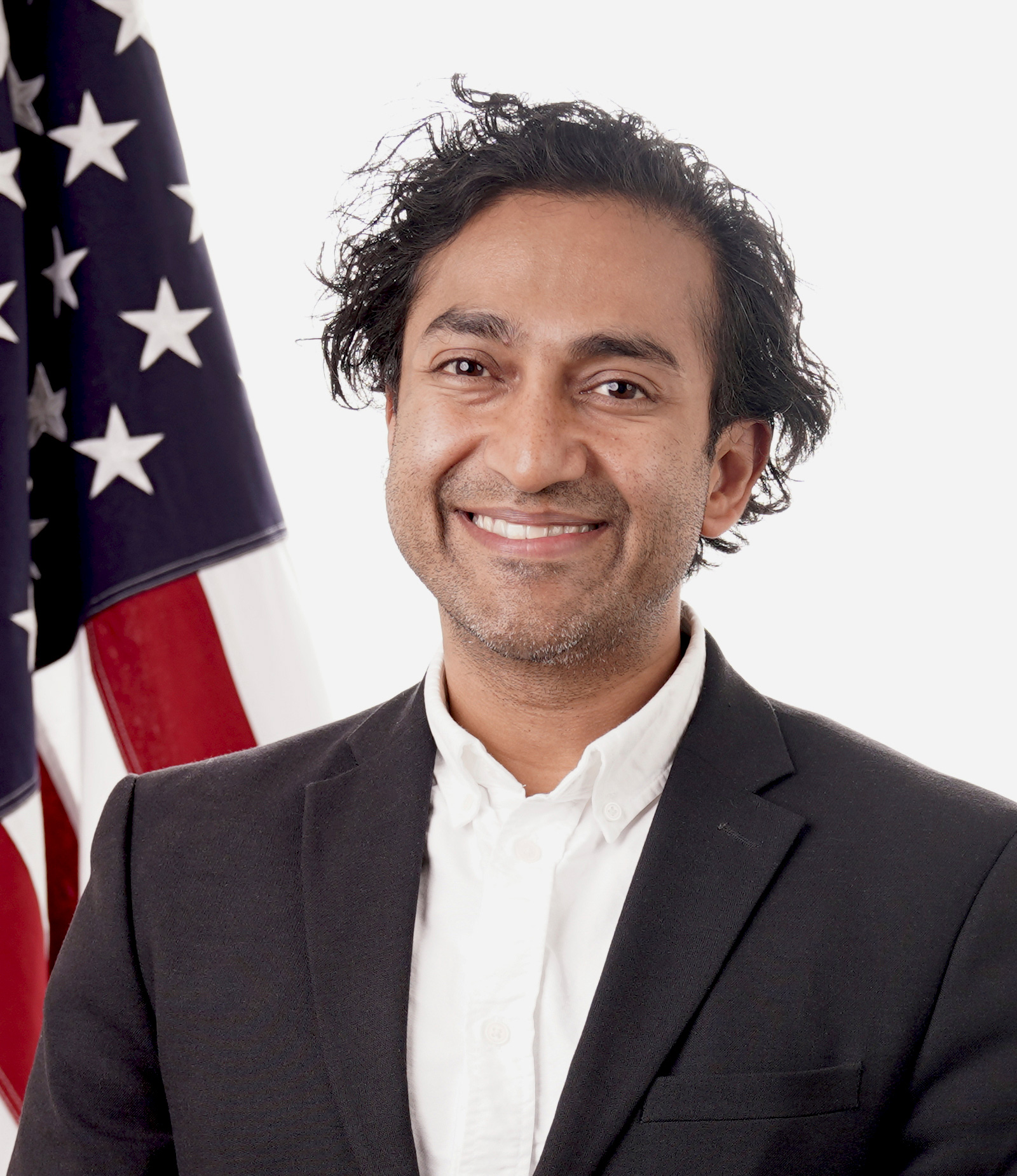
Vinay Prasad smiles for his official portrait. The U.S. flag is behind him.
Vinay Prasad heads the FDA’s Center for Biologics Evaluation and Research. (U.S. FDA via AP)

The former FDA leaders expressed alarm in the NEJM article. They said Prasad is exploiting public frustration over the federal response to covid to spark doubt about the entire childhood vaccine system, which could undo decades of success in protecting children from deadly diseases.

“This is really different. And it’s really dangerous. And people will be hurt, particularly by the vaccine decisions,” former FDA commissioner Robert Califf said in an interview. He also warned that Prasad’s proposed policies — which he noted echo positions on vaccines held by Health and Human Services Secretary Robert F. Kennedy Jr., a longtime anti-vaccine activist — could shake the entire vaccine market.

“The goal of RFK seems to be to make it impossible for vaccines to be available in the U.S.,” he said. If the proposals advance, he added, “it won’t be a viable business.”

Hilliard pushed back sharply on those concerns, writing: “The American people deserve evidence-based science. Prasad’s email lays out a philosophical framework that points us toward that higher standard. We will soon release documents laying out that framework and data confirming how the COVID vaccine resulted in children’s deaths that previous leadership failed to properly investigate.”

For generations, the childhood vaccine program has depended on clear rules, strong safety systems, and public trust. Experts say Prasad’s ideas, based on claims they argue are not supported by real evidence, could make it much harder to test, approve, and deliver vaccines to families.

Fueling Parental Doubt

Prasad’s memo indicates he considers VAERS reports as proof that vaccines caused children’s deaths. The system, though, is designed to be only an “” for potential safety issues with vaccines that can be investigated further.

“VAERS signals should never be taken as proof of true vaccine risks without careful, confirmatory studies,” said Katherine Yih, an epidemiologist and longtime investigator with the Vaccine Safety Datalink, a CDC program.

Doing so, scientists say, directly feeds public fear at a time when many parents are already unsure whom to trust.

“Causation requires converging evidence, not just one report or coincidence,” said Robert Hopkins, medical director of the National Foundation for Infectious Diseases.

Prasad’s framework, however, treats uncertainty as a reason to halt development entirely.

Experts fear this doubt won’t stay limited to covid vaccines. Once parents start to question the FDA’s honesty, they may begin doubting long-standing vaccines for measles, polio, or whooping cough — shots that have protected children for decades.

“Science must be transparent,” Gostin said. If families believe the FDA is misusing data or silencing experts, confidence in the entire vaccine system can collapse, he said. “There’s a public narrative that people have lost trust in science, but that’s not true. The vast majority want the FDA to make decisions based on the best scientific evidence. Once they believe that the agency is marginalizing scientists and cherry-picking evidence, their trust will plummet.”

Delicate Vaccine Pipeline

Prasad’s new framework will likely make it far harder for companies to produce or update vaccines. The 12 former FDA commissioners warned that requiring clinical trials for all new or updated shots would slow vaccine improvements and leave people unprotected. His plan, they wrote, “would impede the ability to update vaccines in a timely fashion, especially for respiratory viruses.”

For fast-changing viruses like flu and covid, this could be disastrous. There’s simply not enough time to run full clinical trials every time a virus mutates.

There are also major business effects. Vaccine development is costly, and companies may decide the U.S. is no longer worth the risk. If companies slow down or leave the market, families could face shortages, fewer innovations, and fewer protections for their kids.

‘Checks and Balances’

Science depends on open and public debate. Prasad’s memo warned his employees against it. In addition to demanding that FDA staff members who disagree with him resign, he said their disputes should stay private and called leaks “unethical” and “illegal.”

Susan Ellenberg, a former director of the FDA’s Office of Biostatistics and Epidemiology, warned that Prasad risks destroying the process that makes science credible. “If disagreement is treated as disloyalty, you lose the only mechanism that keeps science honest,” she said.

Without strong internal debate, safety reviews become weaker. “You lose the checks and balances that make vaccine safety science credible,” said Kathryn Edwards, a pediatric infectious disease specialist at Vanderbilt University Medical Center who served on the Clinical Immunization Safety Assessment Network during the covid pandemic.

Â鶹ŮÓÅ Health News is a national newsroom that produces in-depth journalism about health issues and is one of the core operating programs at Â鶹ŮÓÅ—an independent source of health policy research, polling, and journalism. Learn more about .

This <a target="_blank" href="/public-health/vaccine-uproar-fda-former-commissioners-vinay-prasad-memo-worldview/">article</a&gt; first appeared on <a target="_blank" href="">Â鶹ŮÓÅ Health News</a> and is republished here under a <a target="_blank" href=" Commons Attribution-NonCommercial-NoDerivatives 4.0 International License</a>.<img src="/wp-content/uploads/sites/8/2023/04/kffhealthnews-icon.png?w=150&quot; style="width:1em;height:1em;margin-left:10px;">

<img id="republication-tracker-tool-source" src="/?republication-pixel=true&post=2131639&amp;ga4=G-J74WWTKFM0&quot; style="width:1px;height:1px;">]]>
2131639
A Small Texas Think Tank Cultivated Covid Dissidents. Now They’re Running US Health Policy. /public-health/brownstone-institute-vaccines-acip-cdc-jeffrey-tucker-bhattacharya-kulldorff/ Wed, 19 Nov 2025 10:00:00 +0000 Martin Kulldorff, chair of the Trump administration’s reconstituted CDC vaccine panel, made a shocking — and misleading — statement as the group met in September. Referring to a clinical trial, Kulldorff, a biostatistician and former professor at Harvard Medical School, said eight babies born to women who received Pfizer’s covid vaccine while pregnant had birth defects, compared with two born to unvaccinated women.

“It is very concerning to have a fourfold excess risk of birth defects in these pregnant women,” Kulldorff then said.

Scientists criticized Kulldorff’s questions and remarks in that meeting because they suggested that the vaccine caused birth defects, which is . The birth defects would have occurred before the women received the vaccine, the scientists said. They say it was one of several scientifically unsubstantiated claims by newly appointed members of the Centers for Disease Control and Prevention’s Advisory Committee on Immunization Practices, an influential panel that guides which vaccines millions of people receive and whether insurance covers their cost.

Many of the new panel members share a connection to a little-known think tank making its mark in President Donald Trump’s Washington: the Brownstone Institute.

Libertarian author Jeffrey Tucker created the nonprofit institute in 2021, fueled by and other pandemic-era policies. “You cannot do something like that to the world and expect people just to sit by and go, ‘OK, that’s normal,’” Tucker said in an interview.

Tucker ; said of that “there is no evidence at all that the vaccines saved millions,” contradicting showing the opposite; and .

His institute’s covid contrarians seek to limit the government’s role in protecting Americans from disease. The Austin, Texas-based think tank from donors whose identities are shielded in tax filings. And in recent months, its associates have catapulted to the highest levels of government.

At least eight people with ties to the Brownstone Institute hold or recently held senior positions at federal health agencies or key roles advising the government, exercising significant authority over access to vaccines and scientific research.

They include Jay Bhattacharya, director of the National Institutes of Health, which has been racked by funding cuts and firings under the Trump administration, as well as senior Food and Drug Administration officials Vinay Prasad and Tracy Beth Høeg. Prasad has been involved in of covid vaccines. Høeg has about vaccine mandates and some childhood immunizations.

Bhattacharya was a senior scholar for the organization. Brownstone has published and writings on its website. Høeg has reported from the group.

The institute has and . Tucker that 2020 marked “the beginning of a long friendship” with Kulldorff “that continues to this day.” Three other ACIP members share connections with the organization: MIT operations management professor Retsef Levi, who as part of at least one Brownstone event; physician Robert Malone, who and ; and Case Western Reserve University professor and epidemiologist Catherine Stein, who in 2022 calling for an end to vaccine mandates at universities.

Thomas Buckley, a public relations professional who wrote for the institute, accepted a political appointment as a top NIH spokesperson after thousands of workers at the biomedical research agency were fired. Buckley that his “led to my new job.”

“That’s maybe his judgment,” Tucker said.

Buckley, when asked to elaborate, said in an email that he interviewed Bhattacharya “for a story that was later published on Brownstone — it was simply me being polite.” He said he resigned from the NIH on Sept. 30. NIH spokesperson Laci Williams declined to confirm his departure date.

Despite the ascendance of those with ties to his group, Tucker said that “anybody who thinks that somehow Brownstone is some big plot, it’s crazy.” He said he is not in regular contact with Health and Human Services Secretary Robert F. Kennedy Jr., whose department oversees the CDC, FDA, and NIH.

“I don’t have any influence,” Tucker said.

Sowing Vaccine Doubt

People with ties to the institute have sown doubt about covid vaccines or routine childhood immunizations, dismissing widespread evidence that they are safe and the benefits outweigh the risks.

“They’ve successfully placed their ideology inside the mechanism that determines U.S. vaccine policy,” said Jake Scott, a physician at Stanford Medicine who specializes in infectious diseases. “It’s very, very troubling.”

Tucker said that Brownstone “doesn’t have any operational impact on the ACIP committee at all” and that “if somebody wasn’t troubled by Brownstone, there’s probably no reason for us to exist.”

Tucker and Brownstone’s associates express libertarian views and , including public health authorities.

“The evidence is mounting and indisputable that MRNA vaccines cause serious harm including death, especially among young people. We have to stop giving them immediately!” Levi in 2023, referring to vaccines based on messenger RNA technology, which Pfizer-BioNTech and Moderna used to develop their covid shots. that covid vaccine mandates are “unethical” and not scientifically justified. Bhattacharya asserted on a podcast with Trump ally Stephen Bannon that mRNA technology for vaccines is “,” and he has overseen for scientific research.

Kennedy in June fired all 17 members of the CDC’s vaccine panel and has replaced them with 12 people so far, including individuals with connections to the Brownstone Institute. Tucker said that he did not propose to the White House or HHS that they be appointed and that Brownstone has not paid them over the past year.

During the September ACIP meeting, several new panel members expressed skepticism of vaccines and dismissed evidence — including the CDC’s own data — demonstrating that they are safe and effective.

That included Kulldorff’s questions and remarks about covid vaccines and birth defects.

In a Pfizer clinical trial, hundreds of pregnant women were given covid vaccines or a placebo of pregnancy. But the birth defects typically would have formed long before the vaccine was given, said Jeffrey Morris, a biostatistics and public health professor at the University of Pennsylvania Perelman School of Medicine.

“To say that this is a major safety risk,” Morris said, “is beyond a stretch.”

“This one really upsets me because it’s just so misleading,” he said.

have shown between covid vaccines and miscarriage, stillbirth, or birth defects.

In response to questions for this article, Kulldorff said: “In the randomized trial, there were four times as many birth defects in children born to mothers receiving the Pfizer covid vaccine during pregnancy compared to the placebo-receiving control group. To ensure vaccine confidence, it is the responsibility of ACIP to note and inquire about such discrepancies, and it is the manufacturer’s responsibility to thoroughly examine it through additional follow-up studies.”

Kulldorff said he is “not affiliated with the Brownstone Institute” but declined to respond to additional questions, including whether he is currently compensated by the organization or has donated to it. The Brownstone Institute paid Kulldorff $108,333 in 2022, according to .

Levi said he heard about the Brownstone Institute from social media. He said he is in contact with Tucker “once in a while” but said Tucker has not advised him on vaccines since he was named to the CDC’s vaccine panel. Levi said he has “never received any compensation,” “never had any affiliation,” and “never donated or given any money” to the group.

Bhattacharya did not respond to questions. Williams, the NIH spokesperson, who had earlier declined to respond, citing the federal government shutdown, did not respond to a query seeking comment after the shutdown ended Nov. 12.

Stein declined to comment and referred questions to HHS. Department spokesperson Andrew Nixon said in a statement that Stein’s ACIP appointment “reflects the Administration’s commitment to independent, evidence-based science. Her professional record speaks for itself.”

The Brownstone Institute’s website says “to support writers, lawyers, scientists, economists, and other people of courage who have been professionally purged and displaced during the upheaval of our times.”

“There’s a danger associated with a state-imposed orthodoxy,” Tucker said in the interview. “I think Brownstone has a moral obligation to care for dissidents and create settings in which they’re able to test their ideas against people with whom they disagree.”

He said that “there’s never harm that comes from open debate and open distribution of information and views.” But Brownstone’s critics say its associates make extreme claims about vaccines and promote anti-vaccine messages.

“They kind of position themselves as defending freedom, but they consistently platform covid minimizers and vaccine skeptics,” Scott said.

Tucker took issue with the description, saying “it presumes that we know exactly with scientific precision the severity of covid, and so anybody who falls short of explaining that with amazing precision is a minimizer.”

A close shot of a senior man with black round glasses.
Jeffrey Tucker was a speaker at the National Conservatism conference on Sept. 2 in Washington. (Dominic Gwinn/Middle East Images via AFP/Getty Images)

In early September, Scott testified at a Senate subcommittee hearing on vaccines alongside Toby Rogers, a political economist and Brownstone Institute fellow who any medical credentials. Rogers wrote last year that “vaccines are a civilization-destroying technology” and has promoted the that vaccines cause autism. “My belief is that the autism and chronic disease epidemics are primarily caused by toxicants — mostly from vaccines and about a dozen additional toxicants,” at the Senate hearing. there is no link between vaccines and autism.

Days later, members of Kennedy’s handpicked panel of CDC vaccine advisers “spent hours elevating these theories” about vaccines “that are not really based in solid evidence or high-quality studies,” Scott said. “They manufactured doubt about established vaccines, entertained all this speculation without any evidence — that’s the real damage.”

Levi, responding to that criticism, said: “For the first time in a long time we are issuing objective, evidence-based immunization recommendations through ACIP with honest and transparent discussion of the benefits, risks, and uncertainties.”

As the panel weighed whether to delay the hepatitis B shot given to most newborns, Høeg, a senior adviser for clinical sciences at the FDA, questioned whether the vaccine is safe. “We should have some humility and consider that we may not know all of the potential safety issues,” she said to the CDC panel.

shows that the hepatitis B newborn dose is safe and that the shot has very few side effects. Starting in 1991, that the first of three shots of hepatitis B vaccine be given to infants shortly after birth. The move virtually eliminated the potentially fatal disease among American children. Babies infected with the virus at birth have a of developing chronic hepatitis B.

In academic journals, Høeg has disclosed from the Brownstone Institute but did not specify . She has described Tucker as “.” Høeg did not respond to a request for comment for this article.

In an email, the FDA’s Prasad said that he “has received no money from Brownstone or any person(s) affiliated” and that all his content published on its website “was republished from his own personal Substack.”

Tucker said he has not advised Prasad or Høeg on vaccines since they became FDA officials. He described the latest CDC vaccine panel meeting as “a breath of fresh air.”

The Covid Contrarian Clubhouse

The Brownstone Institute, on its website, “the spiritual child of the Great Barrington Declaration,” the controversial pandemic treatise Bhattacharya, Kulldorff, and Oxford University epidemiologist Sunetra Gupta co-authored in October 2020 that argued against lockdown measures to prevent the covid virus from spreading.

They proposed that widespread immunity against covid could be achieved by allowing healthy people to get infected, known as herd immunity, with protective measures instituted for medically vulnerable people.

The proposal was criticized at the time by many public health experts and high-ranking government officials, including then-NIH Director Francis Collins, who called its authors “fringe epidemiologists,” the American Institute for Economic Research obtained through a Freedom of Information Act request. (Tucker was AIER from 2017 to 2021.)

“They’ve been willing to publish articles of some very extreme anti-vaccine people,” Dorit Reiss, a professor at University of California Law-San Francisco focused on vaccine-related legal and policy issues, said of the Brownstone Institute. “They’re trying to give a more respectable veneer to the result of the Great Barrington Declaration,” she added.

In response, Tucker said: “I don’t think being an extremist is a good basis on which to shut somebody’s thoughts down. We need provocations.”

Tucker said he did not propose that Bhattacharya — who was a senior scholar at the institute and from July 2021 through October 2024 — be nominated to lead the NIH. More than one-third of the articles were co-authored with Kulldorff, who became Brownstone’s senior scientific director in November 2021.

Kulldorff he was fired from the Harvard-affiliated Mass General Brigham hospital system and placed on leave at the university that month after he refused to be vaccinated against covid, saying he had natural immunity. Kulldorff said he was in early 2021.

The Brownstone Institute reported nearly $7.4 million in contributions, grants, and other payments between 2021 and 2024, with about 35% coming from tax-exempt foundations and donor-advised funds, according to an analysis of tax filings. Donor-advised funds allow people to secure tax deductions for anonymous charitable contributions. Tucker said the organization has 17,000 donors, most of them small, but declined to elaborate on funders.

The filings show the institute has also received funding from foundations run by people with backgrounds in business, including in tech, finance, law, and banking. According to a review of tax records, many of them have also given to anti-vaccine organizations; groups such as the Independent Medical Alliance, which promoted for covid; or prominent organizations in conservative politics, such as the Federalist Society, the Alliance Defending Freedom, and the Heritage Foundation. Brownstone in 2023 received , which funds conservative causes.

As of 2024, the Brownstone Institute’s board included David Stockman, a White House budget chief under President Ronald Reagan; libertarian economist Donald Boudreaux; and Roger Ver, an investor known as “.”

said he gave more than $1 million to the institute.

In 2024, Ver by a federal grand jury for allegedly committing tax fraud costing the IRS at least $48 million. On Oct. 14, the that Ver had entered into a deferred prosecution agreement to resolve federal tax charges against him and has paid the IRS nearly $50 million. The government has moved to dismiss the indictment against him.

‘People Are Very Skeptical’

Other than publishing posts on its website, the institute awards fellowships and convenes conferences and retreats. Its associates testify in front of Congress. And it holds a “Supper Club” series in cities throughout the country.

“The goal of Brownstone is to make possible wide-ranging conversations about the failure of the system and the solutions to it,” Tucker said.

Ashley Grogg, a registered nurse and founder of Hoosiers for Medical Liberty, spoke at a Supper Club on “informed decision-making,” primarily about vaccines.

“People are very skeptical,” Grogg said in an interview. “How do we trust people moving forward? Do we really think that we can trust the new leadership that’s coming in to do the right thing?”

She said she was connected to Brownstone through one of her members. Grogg said she does not think newborns should universally be given the hepatitis B vaccine shortly after birth and opposes vaccine mandates. “I don’t want to take anything away from anybody,” but people who refuse to be vaccinated should not be “withheld from society,” Grogg said.

In September, as the CDC’s vaccine advisers met, Tucker took to the social media platform X to amplify statements questioning vaccines, including from panel members with ties to the group he created. One was , “It’s clear that a significant population in the United States has significant concerns about vaccine policy and about vaccine mandates.” Another was from Levi, who, , said, “Most of us are extremely concerned about the safety and the lack of robust evidence both on safety and efficacy for not only pregnant women, but their babies.”

There is that mRNA and non-mRNA covid vaccines are safe for pregnant women. A mother’s vaccination while pregnant . CDC data that drew upon medical records in 12 states found that who were hospitalized with covid had mothers who did not get the vaccine while pregnant.

In response to questions for this article, Levi said in an email that “the claim that there is strong evidence for the efficacy and safety of covid vaccination during pregnancy in the absence of appropriate clinical trials is not consistent with fundamental regulatory principles” and that panel members “were also concerned by the potential safety signal in the single (small) clinical trial that was conducted, and other research.” Malone did not respond to questions for this article.

Kulldorff, the ACIP chair, said the panel will review vaccines given during pregnancy, childhood, and adolescence.

Less than a week after the ACIP meeting in Atlanta, Levi gave a Brownstone Institute talk about artificial intelligence systems.

Brownstone was a sponsor this month when Children’s Health Defense, a leading anti-vaccine nonprofit founded by Kennedy, held its in Austin.

And during the institute’s own annual conference recently in Utah, who received its first “Brownstone Prize.”

“I would think it represents a kind of integrity and courage in public life,” Tucker said, “and stand up for what you believe is the truth, even at some degree of personal risk.”

Â鶹ŮÓÅ Health News is a national newsroom that produces in-depth journalism about health issues and is one of the core operating programs at Â鶹ŮÓÅ—an independent source of health policy research, polling, and journalism. Learn more about .

This <a target="_blank" href="/public-health/brownstone-institute-vaccines-acip-cdc-jeffrey-tucker-bhattacharya-kulldorff/">article</a&gt; first appeared on <a target="_blank" href="">Â鶹ŮÓÅ Health News</a> and is republished here under a <a target="_blank" href=" Commons Attribution-NonCommercial-NoDerivatives 4.0 International License</a>.<img src="/wp-content/uploads/sites/8/2023/04/kffhealthnews-icon.png?w=150&quot; style="width:1em;height:1em;margin-left:10px;">

<img id="republication-tracker-tool-source" src="/?republication-pixel=true&post=2114495&amp;ga4=G-J74WWTKFM0&quot; style="width:1px;height:1px;">]]>
2114495
Conflicting Advice on Covid Shots Likely To Ding Already Low Vaccine Rates, Experts Warn /health-industry/covid-flu-vaccination-rates-virus-season-conflicting-guidance-immigration/ Fri, 14 Nov 2025 10:00:00 +0000

More than three-quarters of American adults didn’t get a covid shot last season, a figure that health care experts warn could rise this year amid new U.S. government recommendations.

The covid vaccine was initially popular. About 75% of Americans had received of the first versions of the vaccine by early 2022, Centers for Disease Control and Prevention data shows. But only about 23% of American adults got a covid shot during the 2024-25 virus season, well below the 47% of American adults who got a flu shot. The vaccination rates for , , and tetanus are also going down.

Yet covid remains a serious, potentially deadly health risk, listed as the primary cause of death on roughly 31,400 death certificates last year. By comparison, flu killed people and pneumonia, a common complication of the flu, killed , .

As millions of Americans decide whether to get a covid shot this season, public health researchers worry vaccination rates will slide further, especially because Hispanic and Black Americans and those under 30 have lower rates, exposing them to serious complications such as long covid. Under the Trump administration and Health and Human Services Secretary Robert F. Kennedy Jr., the federal government has narrowed its recommendations on the covid vaccine, leading to a hodgepodge of rules on pharmacy access, with Americans living in Republican states often facing more barriers to getting a shot.

“A lot of misinformation is going around regarding covid,” said , an assistant professor of health, society, and behavior at the University of California-Irvine. “Vaccine hesitancy is going to increase.”

In August, the FDA for covid vaccines to those 65 or older and to adults and children with at least one underlying condition that puts them at high risk for serious complications from covid.

A month later, the CDC’s Advisory Committee on Immunization Practices “shared clinical decision-making” on the vaccine, pulling back from advising all adults to get vaccinated. The committee advised doctors to emphasize to adults under 65 and children that the benefits of the vaccine are greatest for those with underlying health conditions.

The guidance is rebutted by infectious disease experts who say most adults and children should get both the flu and covid vaccines, which are safe, effective, and prevent serious illness. Several independent medical organizations like the American Academy of Family Physicians and the American Academy of Pediatrics have reiterated their support for broad adoption of covid vaccines.

More than two dozen states have taken steps to ensure most people can get a covid shot at the pharmacy without a prescription, with many states tying their policies to the advice given by medical organizations. And many of those states require insurers to cover vaccines at no cost, according to . In several other states, predominantly Republican-led, pharmacy access to vaccines may require a prescription.
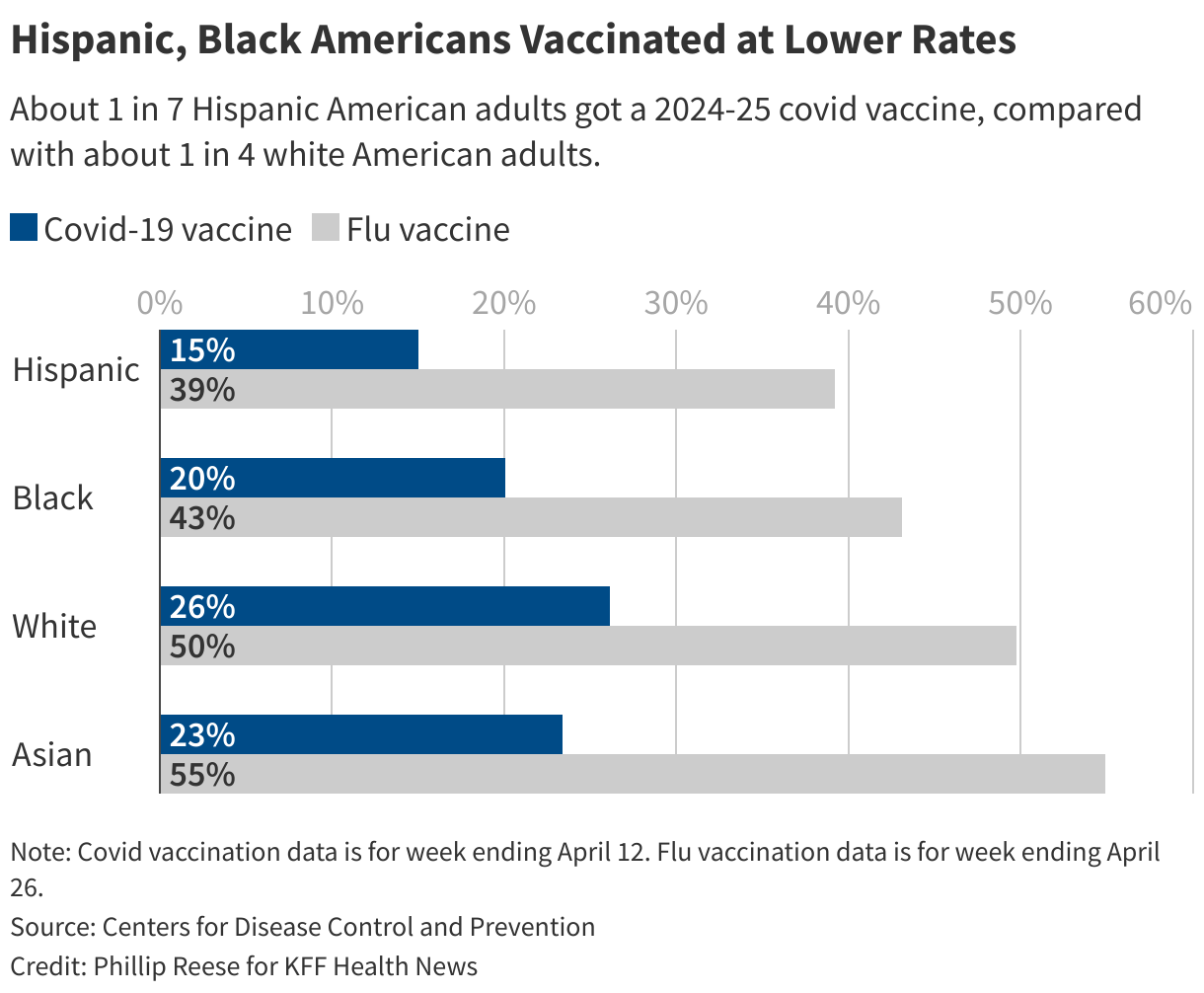
Hispanic, Black Americans Vaccinated at Lower Rates (Grouped Bars)

Among the most commonly cited reasons for covid vaccine hesitation are fears about side effects, long-term health consequences, and the effectiveness of the vaccine, and mistrust of pharmaceutical corporations and government officials, according to of multiple studies, published in the journal Vaccines.

Covid vaccine hesitancy in the 2024-25 virus season was higher among Latinos, African Americans, men, uninsured people, and people living in Republican-leaning states, CDC data shows.

Latino adults were significantly less likely than adults from most other racial and ethnic groups to get a covid shot last season, with a vaccination rate around 15%.

Some of that may be due to age: A of Latinos are young. But public policy actions may also be a factor. The first Trump administration, for example, tied Medicaid to “public charge,” a rule allowing the federal government to deny an immigrant a green card or visa based on their dependence on taxpayer-funded programs. Some Latinos may be afraid to sign up for social services even after the Biden administration reversed those first-term Trump actions.

Haro-Ramos co-authored published in 2024 that found many Latinos were hesitant to get vaccinated because of fears about their immigration status, and that experiencing health discrimination, like care denials or delays, increased their vaccine hesitancy.

“Do you trust the health care system, broadly speaking? Do you want to provide your information — your name, your address?” Haro-Ramos said. “Trust is critical.”

Haro-Ramos said the problem has likely worsened since her study was published. The Trump administration that it would give the personal information of Medicaid enrollees to Immigration and Customs Enforcement. Many Latinos are canceling doctor appointments to head off possible confrontation with immigration enforcement officials.

“People are avoiding leaving their homes at all costs,” Haro-Ramos said.

, an associate professor at the University of Georgia College of Public Health, recently of covid vaccination among nearly 1,500 African Americans living in south Georgia. The study found that participants were more likely to listen to their health care providers than faith leaders or co-workers when seeking advice on getting vaccinated.

More than 90% of those studied had received at least one dose of the vaccine, but those who were unvaccinated were more likely to agree with false statements that tied vaccines to miscarriages, to components’ remaining in the body for a long time, or even to the conspiracy that they implant a computer chip in the body.

“It’s the clinicians who can take the messages about vaccination — that these are myths,” Rajbhandari-Thapa said.
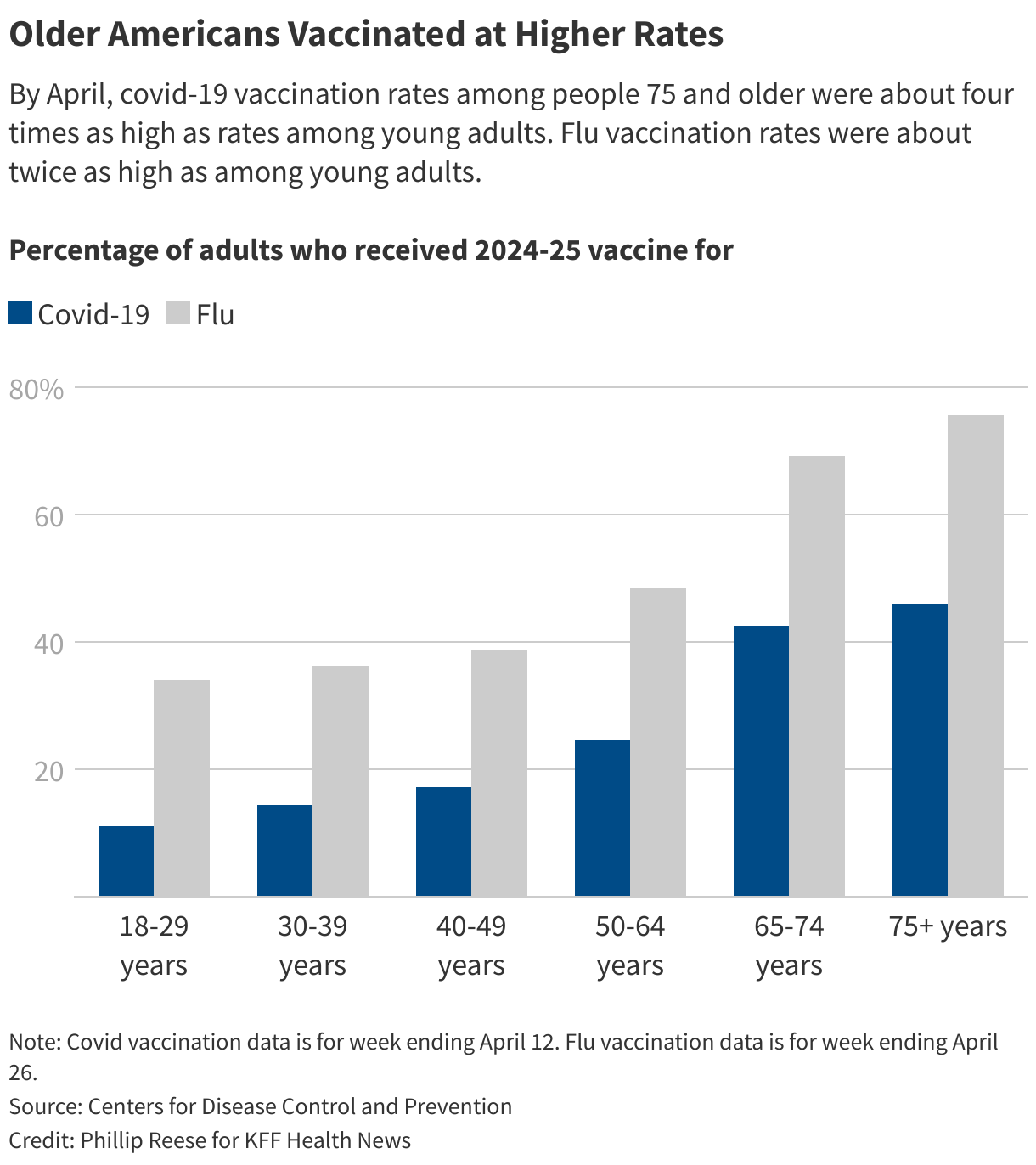
Older Americans Vaccinated at Higher Rates (Grouped column chart)

Even though covid hospitalization and death rates have fallen dramatically since the worst days of the pandemic, fatal complications related to covid remain most common among older people. of U.S. covid deaths last year were among people 65 and older, compared with of flu and pneumonia deaths.

As the pandemic falls into the rearview, young people have developed a sense of invincibility. Only 11% of Americans ages 18 to 29 received a vaccine during the 2024-25 virus season, the lowest vaccination rate among adult age groups. That’s far below the who got at least one dose of the initial covid vaccines by November 2023.

While many people get covid after receiving a covid shot, because the vaccine’s ability to prevent infection wears off pretty fast, some misunderstand the purpose of the shot, said , an infectious disease specialist at UCLA Health.

“They think, ‘Well, the vaccine didn’t prevent me from getting covid, so the vaccine didn’t work,’” Yang said. “And what they’re not seeing is that the vaccine prevented them from getting severely ill, which is ultimately the most important thing.”

And the vaccine can help prevent long covid, which is a problem for all ages, Yang said. A recent Northwestern University study younger adults suffer worse symptoms of long covid than older adults.

Ultimately, Yang said, it is not a consistent choice to get a flu vaccine but forgo a covid vaccine, since both are safe, effective, and prevent serious illness. It is clear, he added, that people with compromised immune systems and those at higher risk should get a covid shot. The decision is “a little bit less clear” for others, but “probably most adults should be getting vaccinated, just like it’s recommended for the flu vaccine, as well as most children.”

Phillip Reese is a data reporting specialist and an associate professor of journalism at California State University-Sacramento.

Â鶹ŮÓÅ Health News is a national newsroom that produces in-depth journalism about health issues and is one of the core operating programs at Â鶹ŮÓÅ—an independent source of health policy research, polling, and journalism. Learn more about .

This <a target="_blank" href="/health-industry/covid-flu-vaccination-rates-virus-season-conflicting-guidance-immigration/">article</a&gt; first appeared on <a target="_blank" href="">Â鶹ŮÓÅ Health News</a> and is republished here under a <a target="_blank" href=" Commons Attribution-NonCommercial-NoDerivatives 4.0 International License</a>.<img src="/wp-content/uploads/sites/8/2023/04/kffhealthnews-icon.png?w=150&quot; style="width:1em;height:1em;margin-left:10px;">

<img id="republication-tracker-tool-source" src="/?republication-pixel=true&post=2110742&amp;ga4=G-J74WWTKFM0&quot; style="width:1px;height:1px;">]]>
2110742
Is Covid During Pregnancy Linked to Autism? What a New Study Shows, and What It Doesn’t /public-health/covid-pregnancy-autism-research/ Wed, 05 Nov 2025 10:00:00 +0000 A large study from Massachusetts has found that were slightly more likely to have a range of neurodevelopmental diagnoses by age 3. Most of these children had speech or motor delays, and the link was strongest in boys and when the mother was infected late in pregnancy.

The increase in risk was small for any one child, but because millions of women were pregnant during the pandemic, even a small increase matters. The study doesn’t prove that covid infection during pregnancy causes autism or other brain conditions in the fetus, but it suggests that infections and inflammation during pregnancy can affect how a baby’s brain grows, something scientists have seen before with other illnesses. It’s a reason to help pregnant women avoid covid and to keep a close eye on children who were exposed in the womb.

What the Study Found

Researchers at Massachusetts General Hospital examined medical records from more than 18,000 mothers and their children born from March 2020 through May 2021, before vaccines were widely available to pregnant women. Because everyone giving birth during that period was tested for covid, the team could clearly see which pregnancies were exposed to the virus causing it.

About 5% of those mothers had covid while pregnant. Their children were modestly more likely to be diagnosed with a neurodevelopmental condition by age 3 than those whose mothers weren’t infected, even after accounting for differences in maternal age, race, insurance status, and preterm birth.

The link appeared strongest among boys and when infection occurred in their mother’s third trimester. Still, most children in both groups showed typical development.

“This was a very clean group to follow,” said Andrea Edlow, a maternal-fetal medicine specialist at Mass General and one of the study’s authors. “Because of universal testing early in the pandemic, we knew who had covid and who didn’t.”

Independent authorities say covid, which causes a powerful immune response in some people, fits the biological pattern seen with other infections in pregnancy. Alan Brown, a professor of psychiatry and epidemiology at Columbia University who studies maternal infection and brain development and was not involved in this research, explained, “Covid would be a very strong candidate for it to happen because the amount of inflammation is very extreme.”

How Might Infection Affect Brain Development?

Scientists are still piecing together how various infections during pregnancy can affect fetal development. Severe illness can cause inflammation that or can , which carries its own risks.

“There’s a long history of evidence showing that maternal infection can slightly raise the risk for many neurodevelopmental disorders,” said Roy Perlis, the vice chair for research in psychiatry at Massachusetts General Hospital and co-author of the new study.

Edlow’s lab is investigating how infection and inflammation may interfere with brain development. In a healthy brain, immune cells help shape developing neural circuits by trimming away extra or unnecessary connections, a process known as “synaptic pruning,” which sculpts the brain’s wiring. When a mother’s immune system is activated by infection, inflammatory molecules can reach the fetal brain and alter the pruning process.

support Edlow’s hypothesis. When scientists trigger inflammation in pregnant mice, their offspring often show changes in how brain cells grow and connect, changes that can alter learning and behavior.

Why Late Pregnancy and Why Boys?

In Edlow and Perlis’ study, the link between covid and developmental delays was strongest when infection occurred late in pregnancy, during the third trimester. That’s also when the fetal brain is growing most rapidly, forming and refining millions of neural connections.

“When we think of organ development, we think earlier in pregnancy, but the brain is an exception in this regard, where there’s a massive amount of brain development in the third trimester. And that continues after birth,” Perlis said. “It is entirely plausible that the third trimester is a period of vulnerability specifically for brain development.”

But not all researchers agree that the third trimester is uniquely vulnerable. Brian Lee, a professor of epidemiology at Drexel University, cautioned that because most mothers in the study were tested at delivery, there were simply more late-pregnancy infections to analyze. “That gives the study more power to find a difference in the third trimester,” he said. “It doesn’t prove earlier infections aren’t important.”

The study also found stronger effects in boys. That pattern is familiar: Boys are generally more likely than girls to have speech or motor delays and to be diagnosed with autism. Researchers suspect that male fetuses may be more susceptible to stress and inflammation, though the biology isn’t fully understood.

What the Study Can and Can’t Show

Edlow and Perlis are careful to say the study shows an association, not proof that covid infection in pregnancy causes developmental problems. could explain the correlation.

Mothers who get sick with covid may have other health issues, such as obesity, diabetes, or mental health conditions, that increase the risk of developmental delays in children. “Persons with are much more likely to get covid. Women with mental disorders are much ,” Lee said. “Mothers with are also at higher risk of having children with neurodevelopmental problems.”

Lee’s research has shown that , suggesting that shared genetics or environment, rather than the infection itself, could be at play. That’s why experts say much larger, longer studies are needed to understand the extent of any risk from the infection.

Edlow, Perlis, and their team plan to follow the children in their study as they grow older to see whether early differences persist or fade. They’re also studying how inflammation during pregnancy affects the placenta and fetal brain, and how to counteract these effects.

What About Vaccination?

Because this study followed pregnancies from early in the pandemic, it doesn’t answer whether vaccination changes the risk. But other research offers reassurance.

A large national study in Scotland between children whose mothers were vaccinated and those who weren’t. Another study in the U.S. : no link between prenatal covid vaccination and developmental delays through 18 months. Both align with decades of data showing that vaccination during pregnancy is safe for both the mother and the baby.

“Vaccination is a short spike … your immune system revs up, then it goes back to normal,” Edlow said. “Covid [infection] is much more prolonged, unpredictable, and people can get … a dysregulated immune phenomenon that really doesn’t exist in vaccine responses.”

What This Means for Parents and Clinicians

Since late 2020, there’s been widespread confusion and misinformation about the safety of covid vaccination during pregnancy. Some women have hesitated to get vaccinated out of fear it might harm their baby. But the evidence since then has been clear: Covid vaccines are safe in pregnancy. The American College of Obstetricians and Gynecologists to protect .

Experts say the broader lesson is that pregnancy is a period of vulnerability, and prevention matters, not only , but other infections as well.

Janet Currie, a professor of economics at Yale University, said these risks remain “underappreciated,” despite decades of evidence. “Even though the flu vaccine is recommended for pregnant women, very few pregnant women get it,” she said. “Physicians seem to be reluctant to vaccinate pregnant women.”

As Gil Mor, scientific director of the C.S. Mott Center for Human Growth and Development at Wayne State University in Detroit, put it, “Protecting the mother is protecting the long-term health of the offspring. … The best intervention is vaccination.”

A Century-Old Echo

The idea that what happens in the womb can shape life after birth took root with studies of famine, like the Dutch “Hunger Winter” in the final months of World War II. In 1944 and 1945, as German forces blockaded the western Netherlands, rations fell to just a few hundred calories a day. Thousands died of starvation, and women pregnant during that period gave birth to babies who later faced higher risks of , , and . The episode became a cornerstone of the “” idea, that deprivation or stress in pregnancy can have lifelong effects.

The broadened that idea to infection. Babies exposed to influenza in utero later showed small but lasting , a sign that illness during pregnancy could affect brain development. Researchers in , , , , and found similar consequences. Some argued that those findings reflected the disruptions of World War I, not the flu itself. But , including those from the and , have strengthened the case for a biological effect, reinforcing that the infection itself, not wartime upheaval, was the key driver.

“It isn’t simply influenza that can alter fetal neurodevelopment,” Kristina Adams Waldorf, a professor of obstetrics and gynecology at the University of Washington, explained. “Many types of infections … in the mother can be transmitted as a signal to the fetus, which can alter its brain development.”

A century later, the same question has returned with covid: Could infection during pregnancy subtly shape how children grow and learn? The new Massachusetts General Hospital study offers an early look at an answer.

Â鶹ŮÓÅ Health News is a national newsroom that produces in-depth journalism about health issues and is one of the core operating programs at Â鶹ŮÓÅ—an independent source of health policy research, polling, and journalism. Learn more about .

This <a target="_blank" href="/public-health/covid-pregnancy-autism-research/">article</a&gt; first appeared on <a target="_blank" href="">Â鶹ŮÓÅ Health News</a> and is republished here under a <a target="_blank" href=" Commons Attribution-NonCommercial-NoDerivatives 4.0 International License</a>.<img src="/wp-content/uploads/sites/8/2023/04/kffhealthnews-icon.png?w=150&quot; style="width:1em;height:1em;margin-left:10px;">

<img id="republication-tracker-tool-source" src="/?republication-pixel=true&post=2110770&amp;ga4=G-J74WWTKFM0&quot; style="width:1px;height:1px;">]]>
2110770
Despite the Hoopla, Vaccines Should Be in Reach This Cough-and-Cold Season /public-health/fall-vaccine-guide-explainer-schedule-covid-flu-rsv/ Wed, 22 Oct 2025 09:00:00 +0000 For people whose autumn agenda includes getting vaccinated against respiratory diseases — covid, flu, and, for some, RSV — this year may be surprisingly routine.

Following several confusing months this summer when federal officials announced and then retreated from changes to covid vaccine recommendations, the Centers for Disease Control and Prevention on Oct. 6 that are not that different from last year’s. That should clear the way for most people who want shots this fall to get them, public health experts say.

“From a patient’s experience, there shouldn’t be anything different from what they’ve experienced in the past, except maybe they’ll get a little more information from the pharmacist,” said , senior director of strategic initiatives at the National Community Pharmacists Association.

Here’s what you need to know:

Covid Vaccine

This fall, the covid vaccine is recommended , with one caveat. People need to have a conversation with their provider first, a model called “shared clinical decision-making.” Providers can be doctors, pharmacists, or the health professionals giving the shots. For people younger than 65, the CDC’s Advisory Committee on Immunization Practices emphasized that vaccination is generally more beneficial for those who are at higher risk for severe covid.

Although the shots are recommended for the same age range as last year, there are a few possible wrinkles. Even though the CDC’s approval is broad and means that health plans have to cover the shot without charging consumers for it, some providers may balk at giving the vaccine to people under 65 unless they have an underlying condition that puts them at risk for severe covid if they get infected. That’s what the for the covid vaccine advises.

“It’s a nuance that could occur in an interaction between a provider and a patient,” said , a senior vice president and the director of global and public health policy at Â鶹ŮÓÅ, a health information nonprofit that includes Â鶹ŮÓÅ Health News.

However, if a provider refused to administer the shot to a healthy person because doing so would be “off-label,” another provider would probably be willing to give someone the jab, experts said.

“They could go to a different pharmacy,” Kates said.

Many states have stepped in to ensure that people can get vaccines if they want them, according to . Twenty-one states and the District of Columbia have adopted recommendations that are broader than those of the federal government, Kates said.

However, the percentage of people opting to get the covid vaccine continues to drop. At the end of April, 23% of adults said they had received the current vaccine, .

With uptake so low, fewer pharmacies and doctors may choose to stock the shot this year, said , a primary care doctor who is the population health leader for the management consultancy WTW and an assistant professor at Harvard’s Chan School of Public Health.

Large chains, including CVS and Walgreens, say they have enough supply available to meet demand.

The additional hoops people might have to go through — such as having to find a different pharmacy or physician — could have an impact on uptake of the covid shot, though.

“To get more people to get vaccines, the key is making vaccination really easy and to take steps out,” Levin-Scherz said.

Influenza Vaccine

More people seek out the flu vaccine than the covid vaccine, but even so, only 47% of adults got a shot last flu season.

The that virtually everyone 6 months or older get a flu shot annually. This year is no different. The shots should be widely available at pharmacies and physician offices, and health plans will cover the shots without charging people for them.

The federal Department of Health and Human Services that flu vaccines must not contain thimerosal, a preservative that prevents bacterial growth in vaccines. There is that the mercury-based additive, which has been used for decades, is harmful, according to vaccine researchers. Last year, that only 6% of flu vaccines use thimerosal as a preservative.

RSV Vaccine

This vaccine protects against respiratory syncytial virus, a highly contagious that infects the lungs and respiratory tract. Although symptoms are typically mild, RSV can lead to serious lung infections, particularly in older people.

A vaccine . The for everyone 75 or older and for people 50 to 74 who have medical conditions that put them at risk for severe disease.

People who meet the criteria should be able to get the RSV vaccine at their local pharmacy, Fish said.

The RSV vaccine is not an annual vaccine. If you’ve already received it, you don’t need to get it again, according to current guidelines.

Â鶹ŮÓÅ Health News is a national newsroom that produces in-depth journalism about health issues and is one of the core operating programs at Â鶹ŮÓÅ—an independent source of health policy research, polling, and journalism. Learn more about .

This <a target="_blank" href="/public-health/fall-vaccine-guide-explainer-schedule-covid-flu-rsv/">article</a&gt; first appeared on <a target="_blank" href="">Â鶹ŮÓÅ Health News</a> and is republished here under a <a target="_blank" href=" Commons Attribution-NonCommercial-NoDerivatives 4.0 International License</a>.<img src="/wp-content/uploads/sites/8/2023/04/kffhealthnews-icon.png?w=150&quot; style="width:1em;height:1em;margin-left:10px;">

<img id="republication-tracker-tool-source" src="/?republication-pixel=true&post=2103220&amp;ga4=G-J74WWTKFM0&quot; style="width:1px;height:1px;">]]>
2103220
Amid Confusion Over US Vaccine Recommendations, States Try To ‘Restore Trust’ /public-health/vaccines-states-hhs-cdc-acip-recommendations-rfk/ Wed, 24 Sep 2025 09:00:00 +0000 When the CDC’s met last week, confusion filled the room.

Members admitted they didn’t know what they were voting on, first rejecting a combined measles-mumps-rubella-chickenpox vaccine for young toddlers, then voting to keep it funded minutes later. The next day, they reversed themselves on the funding.

Now Jim O’Neill, the deputy health and human services secretary and the Centers for Disease Control and Prevention’s acting director (a lawyer, not a doctor), must sign off. The panel’s recommendations matter, because insurers and federal programs rely on them, but they are not binding. States can follow the recommendations, or not.

In the West, California, Oregon, Washington, and Hawaii in the . Their first move was to issue joint recommendations on covid, flu, and RSV vaccines, going further than ACIP.

“Public health should never be a patchwork of politics,” said Sejal Hathi, Oregon’s state health director.

California’s health director, Erica Pan, described the goal as “demonstrating unity around science and values” while reducing public confusion.

The bloc is also exploring coordinated lab testing, data sharing, and even group purchasing. “Our intent is to restore trust in science and safeguard people’s freedom to protect themselves and their families without endless barriers,” Hathi said.

In the Northeast, New York and its neighbors created the . Democratic called it a rebuke to Washington, D.C.’s retreat from science.

“Every resident will have access to the COVID vaccine, no exceptions,” she said in .

The group has already gone beyond vaccines. After the CDC disbanded its infection-control advisory body, the Northeast states created their own return-to-work rules. Work groups now span vaccines, labs, emergency preparedness, and surveillance.

“Infectious diseases don’t respect borders,” said Connecticut’s health commissioner, Manisha Juthani. “We had to move in the same direction to protect our residents.”

The two blocs are in regular contact. “We communicate every day,” Hathi said.

“We can’t just sit by while federal agencies are hollowed out,” said acting New York City health commissioner Michelle Morse. “Public health is local, and we have to act like it.”

State leaders describe their coalitions as filling a vacuum left by Washington, D.C.

“You would think emerging from a pandemic, we would be embracing public health, but the federal government was heading in the opposite direction,” said James McDonald, New York state health commissioner.

Massachusetts commissioner Robbie Goldstein added: “The federal government has historically been the entity that held us all together. In January of this year, that tradition seemed to be going away.”

Boston University law professor Matt Motta summarized the dilemma: “States are taking matters into their own hands, sometimes to expand access to vaccines, sometimes to roll it back. That’s technically how the system works, but it risks inefficiency and confusion.”

Public health law has long tilted toward the states.

“If there was a public health issue, we’d say it’s for the states,” said Wendy Parmet of the Northeastern University School of Law.

States have mandated vaccines since the 1800s. Federal agencies can approve vaccines and fund programs, but they cannot force mandates except in very specific circumstances (e.g., federal employees).

UC Law-San Francisco’s Dorit Reiss agreed with Parmet: “Public health authority resides primarily with the states. Recommendations are recommendations.”

ACIP’s votes matter for coverage rules and insurance mandates, but states are free to diverge.

That divergence is already widening. Florida, led by Surgeon General Joseph Ladapo, childhood vaccine requirements altogether — a first-in-the-nation step. Georgetown Law’s Larry Gostin warned this could reopen century-old battles dating to Jacobson v. Massachusetts (1905), when the Supreme Court upheld state vaccine mandates for public safety.

Health leaders warn that competing systems risk causing confusion and costing lives. “Federal silence creates a vacuum, and states either step up together or splinter apart,” Hathi said.

Pan added that “without federal credibility, we’re left improvising.”

McDonald cautioned that partisan divides could grow sharper.

And Morse said that “blue and red states could each go their own way, leaving the public even more divided.”

Gostin put it bluntly: “That risks confusion, inefficiency, and ultimately lives.”

This state-by-state tug-of-war is not new. In the 1800s, local boards of health fought cholera with sewers and sanitation when federal authority was absent. In the 1950s, states organized mass polio clinics, with uneven uptake until federal funding smoothed disparities.

During the covid pandemic, Trump White House response coordinator Deborah Birx saw firsthand the limits of federal power. She visited 44 states, urging governors to adopt masks, closures, and vaccines.

“I was trying to get them to tailor responses to their populations, not just follow generic federal guidance,” she later recalled.

Supreme Court Justice Louis Brandeis once said that states are “laboratories of democracy,” where leaders could test out new ideas without putting the whole country at risk. But diseases don’t follow state lines. A virus that starts in Tallahassee could spread to Times Square by the next morning.

Today, states have become laboratories of public health. Each state is experimenting — some expanding protections, others cutting them back. And those choices could, for better or worse, affect us all.

Â鶹ŮÓÅ Health News is a national newsroom that produces in-depth journalism about health issues and is one of the core operating programs at Â鶹ŮÓÅ—an independent source of health policy research, polling, and journalism. Learn more about .

This <a target="_blank" href="/public-health/vaccines-states-hhs-cdc-acip-recommendations-rfk/">article</a&gt; first appeared on <a target="_blank" href="">Â鶹ŮÓÅ Health News</a> and is republished here under a <a target="_blank" href=" Commons Attribution-NonCommercial-NoDerivatives 4.0 International License</a>.<img src="/wp-content/uploads/sites/8/2023/04/kffhealthnews-icon.png?w=150&quot; style="width:1em;height:1em;margin-left:10px;">

<img id="republication-tracker-tool-source" src="/?republication-pixel=true&post=2092965&amp;ga4=G-J74WWTKFM0&quot; style="width:1px;height:1px;">]]>
2092965
RFK Jr. Said ‘Everybody Can Get’ a Covid Vaccine. Is That True? /public-health/rfk-jr-covid-vaccine-access-fact-check/ Wed, 10 Sep 2025 09:00:00 +0000
“Everybody can get” the covid-19 vaccine.
Robert F. Kennedy Jr. on Sept. 4 in a Senate Finance Committee hearing Politifact Rating

When health secretary Robert F. Kennedy Jr. testified before the Senate Finance Committee on Sept. 4, several senators criticized him for restricting the covid-19 shots after promising in November he wouldn’t “take away anybody’s vaccines.”

“Did you hold up a big sign saying that you were lying when you said that?” Sen. Elizabeth Warren (D-Mass.) asked Kennedy.

On Aug. 27, the its covid , limiting the groups of people approved to get the updated shot to anyone 65 or older and any person at least 6 months old who has at least one underlying health condition that increases their risk of a severe covid infection.

Kennedy pushed back. “Anybody can get the booster,” he said, later adding that “it’s not recommended for healthy people.”

Warren said, “If you don’t recommend, then the consequence of that in many states is that you can’t walk into a pharmacy and get one. It means insurance companies don’t have to cover the $200 or so cost.”

Warren and Kennedy continued to speak over each other, debating the vaccines’ availability.

“It depends on the states,” Kennedy said. “But they can still get it. Everybody can get it. Everybody can get it, senator.”

Asked for evidence, the Health and Human Services Department pointed to an on the social platform X from Kennedy that said, “These vaccines are available for all patients who choose them after consulting with their doctors.”

Kennedy’s blanket statement to senators is misleading and premature.

Under current guidance, healthy people under 65 might need a doctor’s prescription to get the shot. If they successfully get a prescription, they may need to pay out-of-pocket.

Further, whether the vaccine is available at pharmacies and covered by insurance is largely dependent on a vaccine panel that has so far issued no recommendations.

What was the status quo for years — that most Americans, regardless of age, could easily make an appointment at their local pharmacy for the vaccine at little to no out-of-pocket cost — is no longer guaranteed in the 2025-26 season.

Limited Approval, No Guidance

The FDA’s approval is not the only step in the process of making vaccines available to the public.

The Advisory Committee on Immunization Practices, a panel of independent experts that guides vaccine policy, has not voted on or issued current guidance. Typically, the Centers for Disease Control and Prevention recommends vaccines based on the .

And that guidance affects insurance coverage and vaccine access. Federal law requires that most health insurance plans vaccines recommended by the CDC. also require these recommendations before they allow vaccines to be offered over-the-counter at pharmacies.

On June 9, Kennedy fired all 17 members of the CDC’s immunization advisory committee and with new members, many of whom have expressed anti-vaccine views. CDC Director Susan Monarez Aug. 27 over what Monarez described as a .

According to the CDC’s website, the advisory panel is Sept. 18 to 19.

Access Varies by State

People in the FDA-approved groups should be able to schedule vaccinations as soon as authorized health care providers receive supplies, likely in the next few weeks.

Even if you are in these approved groups, where you can get a covid shot varies by state. By law, pharmacies in certain states won’t be able to offer the vaccine or will administer it only with a doctor’s prescription until the CDC’s vaccine advisory panel .

That means despite the FDA having issued its approval for some groups, in 18 states and Washington, D.C., “pharmacists cannot administer it because it isn’t on the CDC immunization schedule yet,” Brigid Groves, the American Pharmacists Association’s vice president of professional affairs, .

As of Sept. 4, the scheduling apps for Walgreens and CVS notified patients in some locations that they could not schedule a covid vaccine appointment because of state restrictions, inventory, or the need for a prescription.

‘Off-Label’ Prescriptions

People not in the FDA’s approved group are not banned from getting a covid vaccine, per se. But accessing the vaccine will likely require navigating barriers.

Doctors can legally prescribe a covid vaccine for people who fall outside the FDA categories.

That’s true for adults and children — and the practice of prescribing medications and vaccines for “off-label” use is fairly common in pediatrics, William Schaffner, a Vanderbilt University Medical Center professor of infectious diseases, PolitiFact.

That requires making and paying for a doctor’s appointment, and finding a doctor willing to prescribe it off-label.

Depending on ACIP’s guidance, pharmacists might be able to vaccinate people not in an FDA-approved group through a process called “.”

That means, for example, “if you were 52 years old and otherwise healthy, but you nonetheless wanted to get the vaccine, you could discuss that with your doctor — shared clinical decision-making — and you could receive the vaccine,” Schaffner said.

Pharmacists are considered clinicians who can conduct shared decision-making, Groves said.

But again, without CDC recommendations, “we don’t know if that provision is still there,” Schaffner said.

Waiting on the CDC

Insurance coverage for the vaccine is still up in the air, too, and will largely depend on what the CDC recommends.

Insurance coverage is more probable for people in an FDA-approved category. But, if the CDC recommendations include giving vaccines to healthy people through the shared clinical decision-making process, insurance companies will generally honor that, Schaffner said.

Covid vaccines cost about $142, according to the . It’s unclear whether that would be the out-of-pocket cost for patients receiving a covid vaccine not covered by insurance.

Our Ruling

Kennedy said “everybody can get” a covid vaccine.

The FDA limited the groups of people eligible for the covid vaccines, which has already diminished the shots’ drugstore availability in some states. People who are not in those groups aren’t banned from getting a shot, but are likely to face additional barriers. For example, people may need a doctor to prescribe the vaccine “off-label,” making the process more challenging and potentially more costly.

Kennedy’s blanket statement also is premature.

A CDC vaccine panel has not issued recommendations for the vaccines. The group’s guidance might affect insurance coverage and over-the-counter access.

The statement contains an element of truth — the vaccine has not been banned and some people are approved to get it. But it ignores critical facts about the barriers others could face in accessing and paying for it. We rate it Mostly False.

PolitiFact staff writer Madison Czopek contributed to this report.

Our Sources

Email statement from the Department of Health and Human Services, Sept. 4, 2025.

PolitiFact, “” Aug. 29, 2025.

, Aug. 27, 2025.

Centers for Disease Control and Prevention, “,” Aug. 8, 2025.

NBC News, “,” Aug. 21, 2025.

PBS NewsHour, “,” Sept. 3, 2025.

USA Today, “,” Sept. 3, 2025.

PolitiFact, “,” June 18, 2025.

The Washington Post, “” Aug. 28, 2025.

Center for Infectious Disease Research & Policy, “,” Aug. 28, 2025.

Centers for Disease Control and Prevention, “,” June 18, 2025.

Centers for Disease Control and Prevention, “,” Jan. 7, 2025.

Centers for Disease Control and Prevention, , Sept. 1, 2025.

PBS News, “,” Sept. 3, 2025.

Â鶹ŮÓÅ Health News is a national newsroom that produces in-depth journalism about health issues and is one of the core operating programs at Â鶹ŮÓÅ—an independent source of health policy research, polling, and journalism. Learn more about .

This <a target="_blank" href="/public-health/rfk-jr-covid-vaccine-access-fact-check/">article</a&gt; first appeared on <a target="_blank" href="">Â鶹ŮÓÅ Health News</a> and is republished here under a <a target="_blank" href=" Commons Attribution-NonCommercial-NoDerivatives 4.0 International License</a>.<img src="/wp-content/uploads/sites/8/2023/04/kffhealthnews-icon.png?w=150&quot; style="width:1em;height:1em;margin-left:10px;">

<img id="republication-tracker-tool-source" src="/?republication-pixel=true&post=2085000&amp;ga4=G-J74WWTKFM0&quot; style="width:1px;height:1px;">]]>
2085000
Journalists Discuss Fallout of CDC Turmoil and Recap Bitter RFK Senate Hearing /on-air/on-air-september-6-2025-cdc-monarez-rfk-senate-finance-covid-vaccinations/ Sat, 06 Sep 2025 09:00:00 +0000

Céline Gounder, Â鶹ŮÓÅ Health News’ editor-at-large for public health, discussed recommendations for covid-19 vaccinations for children on NPR’s “Morning Edition” on Aug. 20. Gounder then discussed the infant mortality crisis in Mississippi on CBS News’ “CBS Evening News Plus” on Aug. 22. She also discussed the resignation of top Centers for Disease Control and Prevention officials after the ousting of agency director Susan Monarez on CBS News’ “CBS Mornings” on Aug. 28.

  • Read Gounder’s “.”

Â鶹ŮÓÅ Health News national public health correspondent Amy Maxmen discussed how Trump administration officials interfered in the CDC’s ability to respond to the West Texas measles outbreak on CBS News’ “CBS News Chicago” on Aug. 25 and on WNYC’s “The Brian Lehrer Show” on Sept. 2.

  • Read Maxmen’s ““

Â鶹ŮÓÅ Health News Nevada correspondent Jazmin Orozco Rodriguez discussed how Medicaid changes may affect Native American communities on KPFA’s “UpFront” on Aug. 27.

  • Read Orozco Rodriguez’s “.”

Â鶹ŮÓÅ Health News chief Washington correspondent Julie Rovner discussed Health and Human Services Secretary Robert F. Kennedy Jr.’s latest appearance in front of a Senate committee on WBUR’s “Here & Now” on Sept. 4.


Â鶹ŮÓÅ Health News is a national newsroom that produces in-depth journalism about health issues and is one of the core operating programs at Â鶹ŮÓÅ—an independent source of health policy research, polling, and journalism. Learn more about .

This <a target="_blank" href="/on-air/on-air-september-6-2025-cdc-monarez-rfk-senate-finance-covid-vaccinations/">article</a&gt; first appeared on <a target="_blank" href="">Â鶹ŮÓÅ Health News</a> and is republished here under a <a target="_blank" href=" Commons Attribution-NonCommercial-NoDerivatives 4.0 International License</a>.<img src="/wp-content/uploads/sites/8/2023/04/kffhealthnews-icon.png?w=150&quot; style="width:1em;height:1em;margin-left:10px;">

<img id="republication-tracker-tool-source" src="/?republication-pixel=true&post=2082781&amp;ga4=G-J74WWTKFM0&quot; style="width:1px;height:1px;">]]>
2082781
Covid Archives - Â鶹ŮÓÅ Health News /tag/covid/ Â鶹ŮÓÅ Health News produces in-depth journalism on health issues and is a core operating program of Â鶹ŮÓÅ. Wed, 15 Apr 2026 23:46:38 +0000 en-US hourly 1 https://wordpress.org/?v=6.8.5 /wp-content/uploads/sites/8/2023/04/kffhealthnews-icon.png?w=32 Covid Archives - Â鶹ŮÓÅ Health News /tag/covid/ 32 32 161476233 Trump’s Covid Views Don’t Track With Reality That Recent Studies Suggest /public-health/the-week-in-brief-covid-19-research-long-term-effects/ Fri, 30 Jan 2026 19:30:00 +0000 More than two years since the official end of the covid pandemic, a growing body of research continues to reveal information about the virus and its ability to cause harm long after initial infections resolve. The findings raise fresh concerns about the Trump administration’s decision to reduce recommendations about who should get covid vaccines and for the development of more-protective shots. 

Covid, for instance, is now linked in studies to in children of mothers who were infected during pregnancy, as well as a decline in mental cognition and greater risk of heart problems. It’s even been shown to trigger the awakening of dormant cancer cells in people who are in remission.  

Policies around covid and vaccination have economic ramifications. The annual average burden of the disease’s long-term health effects is estimated at $9,000 per patient in the U.S., according to a in November in the journal NPJ Primary Care Respiratory Medicine. In this country, the annual lost earnings are estimated to be about $170 billion. 

The virus that causes covid, SARS-CoV-2, leaves damage that can linger for months and sometimes years. In the brain, the virus leads to an immune response that triggers inflammation, can damage brain cells, and can even shrink brain volume, according to published in March 2022 in the journal Nature.  

, a clinical epidemiologist who has studied longer-term health effects from covid, estimated the virus may have increased the number of adults in the U.S. with an IQ less than 70 from 4.7 million to 7.5 million — dealing with “a level of cognitive impairment that requires significant societal support,” he wrote. 

Meanwhile, data from more than a suggests covid vaccines can help reduce risk of severe infection as well as longer-lasting health effects, although researchers say more study is needed. But last May, Health and Human Services Secretary Robert F. Kennedy Jr. said on X that the Centers for Disease Control and Prevention would for , citing a . The FDA has since issued new guidelines limiting the vaccines to people 65 and older and individuals 6 months or older with at least one risk factor, though many states continue to make them more widely available. 

Â鶹ŮÓÅ Health News is a national newsroom that produces in-depth journalism about health issues and is one of the core operating programs at Â鶹ŮÓÅ—an independent source of health policy research, polling, and journalism. Learn more about .

This <a target="_blank" href="/public-health/the-week-in-brief-covid-19-research-long-term-effects/">article</a&gt; first appeared on <a target="_blank" href="">Â鶹ŮÓÅ Health News</a> and is republished here under a <a target="_blank" href=" Commons Attribution-NonCommercial-NoDerivatives 4.0 International License</a>.<img src="/wp-content/uploads/sites/8/2023/04/kffhealthnews-icon.png?w=150&quot; style="width:1em;height:1em;margin-left:10px;">

<img id="republication-tracker-tool-source" src="/?republication-pixel=true&post=2149664&amp;ga4=G-J74WWTKFM0&quot; style="width:1px;height:1px;">]]>
2149664
Trump Policies at Odds With Emerging Understanding of Covid’s Long-Term Harm /public-health/covid-long-term-effects-risks-trump-policies-vaccines-research-hhs-rfk/ Tue, 27 Jan 2026 10:00:00 +0000 /?post_type=article&p=2145436 Possible risk of autism in children. Dormant cancer cells awakening. Accelerating aging of the brain.

Federal officials in May 2023 declared an end to the . But more than two years later, a growing body of research continues to reveal information about the virus and its ability to cause harm long after initial infections resolve, even in some cases when symptoms were mild.

The discoveries raise fresh concerns about the Trump administration’s covid policies, researchers say. While some studies show covid vaccines offer protective benefits against longer-term health effects, the Department of Health and Human Services has drastically limited recommendations about who should get the shot. The administration also aimed at developing more protective covid vaccines.

The federal government is curtailing such efforts just as researchers call for more funding and, in some cases, long-term monitoring of people previously infected.

“People forget, but the legacy of covid is going to be long, and we are going to be learning about the chronic effects of the virus for some time to come,” said , an epidemiologist who directs the University of Minnesota’s Center for Infectious Disease Research and Policy.

The Trump administration said that the covid vaccine remains available and that individuals are encouraged to talk with their health providers about what is best for them. The covid vaccine and others on the schedule of the Centers for Disease Control and Prevention remain covered by insurance so that individuals don’t need to pay out-of-pocket, officials said.

“Updating CDC guidance and expanding shared clinical decision-making restores informed consent, centers parents and clinicians, and discourages ‘one size fits all’ policies,” said HHS spokesperson Emily Hilliard.

Although covid has become less deadly, because of population immunization and mutations making the virus less severe, researchers say the politicization around the infection is obscuring what science is increasingly confirming: covid’s potential to cause unexpected, possibly chronic health issues. That in turn, these scientists say, drives the need for more, rather than less, research, because over the long term, covid could have significant economic and societal implications, such as higher health care costs and more demands on social programs and caregivers.

The annual average burden of the disease’s long-term health effects is estimated at $1 trillion globally and $9,000 per patient in the U.S., according to a in November in the journal NPJ Primary Care Respiratory Medicine. In this country, the annual lost earnings are estimated to be about $170 billion.

One study estimates that the flu resulted in $16 billion in direct health costs and $13 billion in productivity losses in the 2023-2024 season, according to , an online platform that publishes work not yet certified by peer review.

Covid’s Growing Reach

Much has been learned about covid since the virus emerged in 2019, unleashing a pandemic that the World Health Organization reports has killed more than . By the spring of 2020, the term “long covid” had been coined to describe chronic health problems that can persist post-infection.

More recent studies show that infection by the virus that causes covid, SARS-CoV-2, can result in heightened health risks months to more than a year later.

For example, researchers following children born to mothers who contracted the virus while pregnant have discovered they may have an , delayed speech and motor development, or other neurodevelopmental challenges.

found babies exposed to covid in utero experienced accelerated weight gain in their first year, a possible harbinger of metabolic issues that could later carry an increased risk for cardiovascular disease.

These studies suggest avoiding severe covid in pregnancy may reduce risk not just during pregnancy but for future generations. That may be another good reason to get vaccinated when pregnant.

“There are other body symptoms apart from the developing fetal brain that also may be impacted,” said Andrea Edlow, an associate professor of obstetrics, gynecology, and reproductive biology at Harvard Medical School who was involved in both studies. “We definitely need more research.”

Epidemiologists point to some specific, emerging challenges.

A in the New England Journal of Medicine found people who from mild covid infections experienced a cognitive deficit equal to a three-point drop in IQ. Among the more than 100,000 participants, deficits were greater in people who had persistent symptoms and reached the equivalent of a nine-point IQ drop for individuals admitted to intensive care.

, a clinical epidemiologist who has studied longer-term health effects from covid, did the math. He estimated covid may have increased the number of adults in the U.S. with an IQ of less than 70 from 4.7 million to 7.5 million — dealing with “a level of cognitive impairment that requires significant societal support,” he wrote.

“People get covid-19, some people do fine and bounce back, but there are people who start experiencing problems with memory, cognition, and fuzzy brain,” he said. “Even people with mild symptoms. They might not even be aware.”

Diane Yormark, 67, of Boca Raton, Florida, can relate. She got covid in 2022 and 2023. The second infection left her with brain fog and fatigue.

“I felt like if you had a little bit too much wine the night before and you’re out of it,” said Yormark, a retired copywriter, who said the worst of her symptoms lasted for about three months after the infection. “Some of the fog has lifted. But do I feel like myself? Not like I was.”

Data from more than a suggests covid vaccines can help reduce risk of severe infection as well as longer-lasting health effects, although researchers say more study is needed.

But vaccination rates remain low in the U.S., with only about 17% of the adult population reporting that they got the updated 2025-2026 shot as of Jan. 16, based on .

Trump administration officials led by Health and Human Services Secretary Robert F. Kennedy Jr. have reduced access to covid vaccines despite the lack of any new, substantiated evidence of harm. Though the shots were a hallmark achievement of the first Trump administration, which led the effort for their development, Kennedy has said without evidence that they are “.”

In May he said on X that the CDC would for , citing a . The Food and Drug Administration has since issued new guidelines limiting the vaccine to people 65 or older and individuals 6 months or older with at least one risk factor, though many states continue to make them more widely available.

The Trump administration also halted for mRNA-based vaccines. Administration officials and a number of Republicans question the safety of the Nobel Prize-winning technology — heralded for the potential to treat many diseases beyond covid — even though clinical trials with tens of thousands of volunteers were performed before the covid mRNA vaccines were made available to the public.

And numerous studies, including new research in 2025, show covid vaccine benefits include a , although the protective effects wane over time.

Following the Findings

Researchers say more and broader support is important because much remains unknown about covid and its impact on the body.

The growing awareness that, even in mild covid cases, the possibility exists for longer-term, often undetected also warrants more examination, researchers say. A in eBioMedicine found people with neurocognitive issues such as changes in smell or headaches after infection had significant levels of a protein linked to Alzheimer’s in their blood plasma. EBioMedicine is a peer-reviewed, open-access journal published by .

In the brain, the virus leads to an immune response that triggers inflammation, can damage brain cells, and can even shrink brain volume, according to that was published in March 2022 in the journal Nature.

An of advanced brain images found significant alterations even among people who had already recovered from mild infections — a possible explanation for that may persist for years. Lead study author Kiran Thapaliya said the research suggests the virus “may leave a silent, lasting effect on brain health.”

Al-Alay agreed.

“We don’t know what will happen to people 10 years down the road,” he said. “Inflammation of the brain is not a good thing. It’s absolutely not a good thing.”

That inflammatory response has also been linked to blood clots, arrhythmias, and higher risk of cardiovascular issues, even following a mild infection.

A University of Southern California study published in October 2024 in the journal Arteriosclerosis, Thrombosis, and Vascular Biology found the risk for a remains elevated nearly three years after covid infection. The findings held even for people who were not hospitalized.

“We were surprised to see the effects that far out” regardless of individual heart disease history, said James R. Hilser, the study’s lead author and a postdoctoral fellow at the UCLA David Geffen School of Medicine.

Covid can also and trigger a relapse, according to research published in July in the journal Nature. Researchers found that the chance of dying from cancer among cancer survivors was higher among people who’d had covid, especially in the year after being infected. There was nearly a twofold increase in cancer mortality in those who tested positive compared with those who tested negative.

The potential of the covid virus to affect future generations is yielding new findings as well. Australian researchers looked at male mice and found that those who had been from covid experienced changes to their sperm that altered their offspring’s behavior, causing them to exhibit more anxiety.

Meanwhile, many people are now living — and struggling — with the virus’ after-effects.

Dee Farrand, 57, of Marana, Arizona, could once run five miles and was excelling at her job in sales. She recovered from a covid infection in May 2021.

Two months later, her heart began to beat irregularly. Farrand underwent a battery of tests at a hospital. Ultimately, the condition became so severe she had to go on supplemental oxygen for two years.

Her cognitive abilities declined so severely she couldn’t read, because she’d forget the first sentence after reading the second. She also had to leave herself reminders that she is allergic to shrimp or that she likes avocados. She said she lost her job and returned to her previous occupation as a social worker.

“I was the person who is like the Energizer bunny and all of a sudden I’d get so tired getting dressed that I had to go back to bed,” Farrand said.

While she is better, covid has left a mark. She said she’s not yet able to run the five miles she used to do without any problems.

Â鶹ŮÓÅ Health News is a national newsroom that produces in-depth journalism about health issues and is one of the core operating programs at Â鶹ŮÓÅ—an independent source of health policy research, polling, and journalism. Learn more about .

This <a target="_blank" href="/public-health/covid-long-term-effects-risks-trump-policies-vaccines-research-hhs-rfk/">article</a&gt; first appeared on <a target="_blank" href="">Â鶹ŮÓÅ Health News</a> and is republished here under a <a target="_blank" href=" Commons Attribution-NonCommercial-NoDerivatives 4.0 International License</a>.<img src="/wp-content/uploads/sites/8/2023/04/kffhealthnews-icon.png?w=150&quot; style="width:1em;height:1em;margin-left:10px;">

<img id="republication-tracker-tool-source" src="/?republication-pixel=true&post=2145436&amp;ga4=G-J74WWTKFM0&quot; style="width:1px;height:1px;">]]>
2145436
Inside the FDA’s Vaccine Uproar /public-health/vaccine-uproar-fda-former-commissioners-vinay-prasad-memo-worldview/ Fri, 19 Dec 2025 10:00:00 +0000 Six days after a senior FDA official sent a claiming that covid vaccines had caused the deaths of “at least 10 children,” 12 former FDA commissioners released an in the Dec. 3 issue of the New England Journal of Medicine.

They wrote that the claims and policy changes in the memo from Vinay Prasad, the head of the FDA’s Center for Biologics Evaluation and Research, pose “a threat to evidence-based vaccine policy and public health security” and break sharply from long-standing scientific norms.

What is unfolding inside the FDA is not a narrow dispute over covid vaccines. It is an attempt, according to critics and vaccine scientists, to rewrite the rules governing the entire U.S. vaccine system — how risks are weighed, how benefits are proved, and how quickly lifesaving shots reach the public. Former agency leaders warn that if these changes take hold, the consequences could be lasting: fewer vaccines, slower updates, weakened public trust, and more preventable outbreaks.

Prasad made clear he sees the moment as corrective. “Never again will the US FDA commissioner have to himself find deaths in children for staff to identify it,” he wrote, telling employees the agency’s mission, and its “worldview,” would change.

Prasad’s email reopened old arguments about covid vaccines, using what is generally considered weak and misleading science in the peer-reviewed research community. He claimed that FDA staff had found “at least 10” deaths in children that happened “after and because of” covid vaccination, using reports from the .

The VAERS system is notoriously crowdsourced, meaning anyone can contribute, and scientists say it serves only as a clearinghouse for reports. For example, a person could file a report saying that after getting a flu shot, their hair turned purple. Though that report would remain in the database until it was reviewed, it cannot prove the cause of medical events. But Prasad argued that the true number of deaths was likely higher because many cases go unreported.

On Substack, that Prasad used incomplete information and that a Dec. 5 internal FDA memo set the pediatric death toll from covid shots somewhere between zero and seven. Department of Health and Human Services spokesperson Emily Hilliard wrote, “The FDA’s investigation into deaths caused by Covid vaccines is still ongoing and there’s no final count yet of those deaths.”

Prasad also accused the FDA and the Centers for Disease Control and Prevention of downplaying the risk of heart inflammation, called myocarditis, in young men; criticized the agency for approving shots for teenagers; and suggested that school and workplace vaccine mandates may have “harmed more children than we saved,” adding that “we do not know if we saved lives on balance.”

By comparison, died of covid itself since the pandemic began, the CDC reported.

Based on his erroneous and misleading claims about covid vaccines, Prasad proposed a major overhaul of how vaccines are approved. He said the FDA should stop relying on immune markers to establish the efficacy of shots, such as antibody levels, and instead require large placebo-controlled randomized trials that track hospitalizations and deaths before approving most new vaccines.

Many immunologists and vaccine experts say it’s unethical to test vaccines known to be effective against disease with a control group that would receive a placebo, exposing them to infection.

“There is a rock-solid principle in bioethics that it is unethical to test any drug or vaccine against a placebo if it is known to be safe and effective. The reason is that such placebo-controlled trials would effectively deny patients access to a vaccine that could prevent a dangerous infectious disease,” said Lawrence Gostin, a professor of global health law at Georgetown University.

Prasad called the current flu vaccine system an “evidence-based catastrophe,” questioned the approval of vaccines for pregnant women based on immune response alone, and raised concerns about giving multiple vaccines at once. He told staff to rewrite FDA guidelines to match his new “worldview” and said anyone who disagreed with his “core principles” should resign.

Vinay Prasad smiles for his official portrait. The U.S. flag is behind him.
Vinay Prasad heads the FDA’s Center for Biologics Evaluation and Research. (U.S. FDA via AP)

The former FDA leaders expressed alarm in the NEJM article. They said Prasad is exploiting public frustration over the federal response to covid to spark doubt about the entire childhood vaccine system, which could undo decades of success in protecting children from deadly diseases.

“This is really different. And it’s really dangerous. And people will be hurt, particularly by the vaccine decisions,” former FDA commissioner Robert Califf said in an interview. He also warned that Prasad’s proposed policies — which he noted echo positions on vaccines held by Health and Human Services Secretary Robert F. Kennedy Jr., a longtime anti-vaccine activist — could shake the entire vaccine market.

“The goal of RFK seems to be to make it impossible for vaccines to be available in the U.S.,” he said. If the proposals advance, he added, “it won’t be a viable business.”

Hilliard pushed back sharply on those concerns, writing: “The American people deserve evidence-based science. Prasad’s email lays out a philosophical framework that points us toward that higher standard. We will soon release documents laying out that framework and data confirming how the COVID vaccine resulted in children’s deaths that previous leadership failed to properly investigate.”

For generations, the childhood vaccine program has depended on clear rules, strong safety systems, and public trust. Experts say Prasad’s ideas, based on claims they argue are not supported by real evidence, could make it much harder to test, approve, and deliver vaccines to families.

Fueling Parental Doubt

Prasad’s memo indicates he considers VAERS reports as proof that vaccines caused children’s deaths. The system, though, is designed to be only an “” for potential safety issues with vaccines that can be investigated further.

“VAERS signals should never be taken as proof of true vaccine risks without careful, confirmatory studies,” said Katherine Yih, an epidemiologist and longtime investigator with the Vaccine Safety Datalink, a CDC program.

Doing so, scientists say, directly feeds public fear at a time when many parents are already unsure whom to trust.

“Causation requires converging evidence, not just one report or coincidence,” said Robert Hopkins, medical director of the National Foundation for Infectious Diseases.

Prasad’s framework, however, treats uncertainty as a reason to halt development entirely.

Experts fear this doubt won’t stay limited to covid vaccines. Once parents start to question the FDA’s honesty, they may begin doubting long-standing vaccines for measles, polio, or whooping cough — shots that have protected children for decades.

“Science must be transparent,” Gostin said. If families believe the FDA is misusing data or silencing experts, confidence in the entire vaccine system can collapse, he said. “There’s a public narrative that people have lost trust in science, but that’s not true. The vast majority want the FDA to make decisions based on the best scientific evidence. Once they believe that the agency is marginalizing scientists and cherry-picking evidence, their trust will plummet.”

Delicate Vaccine Pipeline

Prasad’s new framework will likely make it far harder for companies to produce or update vaccines. The 12 former FDA commissioners warned that requiring clinical trials for all new or updated shots would slow vaccine improvements and leave people unprotected. His plan, they wrote, “would impede the ability to update vaccines in a timely fashion, especially for respiratory viruses.”

For fast-changing viruses like flu and covid, this could be disastrous. There’s simply not enough time to run full clinical trials every time a virus mutates.

There are also major business effects. Vaccine development is costly, and companies may decide the U.S. is no longer worth the risk. If companies slow down or leave the market, families could face shortages, fewer innovations, and fewer protections for their kids.

‘Checks and Balances’

Science depends on open and public debate. Prasad’s memo warned his employees against it. In addition to demanding that FDA staff members who disagree with him resign, he said their disputes should stay private and called leaks “unethical” and “illegal.”

Susan Ellenberg, a former director of the FDA’s Office of Biostatistics and Epidemiology, warned that Prasad risks destroying the process that makes science credible. “If disagreement is treated as disloyalty, you lose the only mechanism that keeps science honest,” she said.

Without strong internal debate, safety reviews become weaker. “You lose the checks and balances that make vaccine safety science credible,” said Kathryn Edwards, a pediatric infectious disease specialist at Vanderbilt University Medical Center who served on the Clinical Immunization Safety Assessment Network during the covid pandemic.

Â鶹ŮÓÅ Health News is a national newsroom that produces in-depth journalism about health issues and is one of the core operating programs at Â鶹ŮÓÅ—an independent source of health policy research, polling, and journalism. Learn more about .

This <a target="_blank" href="/public-health/vaccine-uproar-fda-former-commissioners-vinay-prasad-memo-worldview/">article</a&gt; first appeared on <a target="_blank" href="">Â鶹ŮÓÅ Health News</a> and is republished here under a <a target="_blank" href=" Commons Attribution-NonCommercial-NoDerivatives 4.0 International License</a>.<img src="/wp-content/uploads/sites/8/2023/04/kffhealthnews-icon.png?w=150&quot; style="width:1em;height:1em;margin-left:10px;">

<img id="republication-tracker-tool-source" src="/?republication-pixel=true&post=2131639&amp;ga4=G-J74WWTKFM0&quot; style="width:1px;height:1px;">]]>
2131639
A Small Texas Think Tank Cultivated Covid Dissidents. Now They’re Running US Health Policy. /public-health/brownstone-institute-vaccines-acip-cdc-jeffrey-tucker-bhattacharya-kulldorff/ Wed, 19 Nov 2025 10:00:00 +0000 Martin Kulldorff, chair of the Trump administration’s reconstituted CDC vaccine panel, made a shocking — and misleading — statement as the group met in September. Referring to a clinical trial, Kulldorff, a biostatistician and former professor at Harvard Medical School, said eight babies born to women who received Pfizer’s covid vaccine while pregnant had birth defects, compared with two born to unvaccinated women.

“It is very concerning to have a fourfold excess risk of birth defects in these pregnant women,” Kulldorff then said.

Scientists criticized Kulldorff’s questions and remarks in that meeting because they suggested that the vaccine caused birth defects, which is . The birth defects would have occurred before the women received the vaccine, the scientists said. They say it was one of several scientifically unsubstantiated claims by newly appointed members of the Centers for Disease Control and Prevention’s Advisory Committee on Immunization Practices, an influential panel that guides which vaccines millions of people receive and whether insurance covers their cost.

Many of the new panel members share a connection to a little-known think tank making its mark in President Donald Trump’s Washington: the Brownstone Institute.

Libertarian author Jeffrey Tucker created the nonprofit institute in 2021, fueled by and other pandemic-era policies. “You cannot do something like that to the world and expect people just to sit by and go, ‘OK, that’s normal,’” Tucker said in an interview.

Tucker ; said of that “there is no evidence at all that the vaccines saved millions,” contradicting showing the opposite; and .

His institute’s covid contrarians seek to limit the government’s role in protecting Americans from disease. The Austin, Texas-based think tank from donors whose identities are shielded in tax filings. And in recent months, its associates have catapulted to the highest levels of government.

At least eight people with ties to the Brownstone Institute hold or recently held senior positions at federal health agencies or key roles advising the government, exercising significant authority over access to vaccines and scientific research.

They include Jay Bhattacharya, director of the National Institutes of Health, which has been racked by funding cuts and firings under the Trump administration, as well as senior Food and Drug Administration officials Vinay Prasad and Tracy Beth Høeg. Prasad has been involved in of covid vaccines. Høeg has about vaccine mandates and some childhood immunizations.

Bhattacharya was a senior scholar for the organization. Brownstone has published and writings on its website. Høeg has reported from the group.

The institute has and . Tucker that 2020 marked “the beginning of a long friendship” with Kulldorff “that continues to this day.” Three other ACIP members share connections with the organization: MIT operations management professor Retsef Levi, who as part of at least one Brownstone event; physician Robert Malone, who and ; and Case Western Reserve University professor and epidemiologist Catherine Stein, who in 2022 calling for an end to vaccine mandates at universities.

Thomas Buckley, a public relations professional who wrote for the institute, accepted a political appointment as a top NIH spokesperson after thousands of workers at the biomedical research agency were fired. Buckley that his “led to my new job.”

“That’s maybe his judgment,” Tucker said.

Buckley, when asked to elaborate, said in an email that he interviewed Bhattacharya “for a story that was later published on Brownstone — it was simply me being polite.” He said he resigned from the NIH on Sept. 30. NIH spokesperson Laci Williams declined to confirm his departure date.

Despite the ascendance of those with ties to his group, Tucker said that “anybody who thinks that somehow Brownstone is some big plot, it’s crazy.” He said he is not in regular contact with Health and Human Services Secretary Robert F. Kennedy Jr., whose department oversees the CDC, FDA, and NIH.

“I don’t have any influence,” Tucker said.

Sowing Vaccine Doubt

People with ties to the institute have sown doubt about covid vaccines or routine childhood immunizations, dismissing widespread evidence that they are safe and the benefits outweigh the risks.

“They’ve successfully placed their ideology inside the mechanism that determines U.S. vaccine policy,” said Jake Scott, a physician at Stanford Medicine who specializes in infectious diseases. “It’s very, very troubling.”

Tucker said that Brownstone “doesn’t have any operational impact on the ACIP committee at all” and that “if somebody wasn’t troubled by Brownstone, there’s probably no reason for us to exist.”

Tucker and Brownstone’s associates express libertarian views and , including public health authorities.

“The evidence is mounting and indisputable that MRNA vaccines cause serious harm including death, especially among young people. We have to stop giving them immediately!” Levi in 2023, referring to vaccines based on messenger RNA technology, which Pfizer-BioNTech and Moderna used to develop their covid shots. that covid vaccine mandates are “unethical” and not scientifically justified. Bhattacharya asserted on a podcast with Trump ally Stephen Bannon that mRNA technology for vaccines is “,” and he has overseen for scientific research.

Kennedy in June fired all 17 members of the CDC’s vaccine panel and has replaced them with 12 people so far, including individuals with connections to the Brownstone Institute. Tucker said that he did not propose to the White House or HHS that they be appointed and that Brownstone has not paid them over the past year.

During the September ACIP meeting, several new panel members expressed skepticism of vaccines and dismissed evidence — including the CDC’s own data — demonstrating that they are safe and effective.

That included Kulldorff’s questions and remarks about covid vaccines and birth defects.

In a Pfizer clinical trial, hundreds of pregnant women were given covid vaccines or a placebo of pregnancy. But the birth defects typically would have formed long before the vaccine was given, said Jeffrey Morris, a biostatistics and public health professor at the University of Pennsylvania Perelman School of Medicine.

“To say that this is a major safety risk,” Morris said, “is beyond a stretch.”

“This one really upsets me because it’s just so misleading,” he said.

have shown between covid vaccines and miscarriage, stillbirth, or birth defects.

In response to questions for this article, Kulldorff said: “In the randomized trial, there were four times as many birth defects in children born to mothers receiving the Pfizer covid vaccine during pregnancy compared to the placebo-receiving control group. To ensure vaccine confidence, it is the responsibility of ACIP to note and inquire about such discrepancies, and it is the manufacturer’s responsibility to thoroughly examine it through additional follow-up studies.”

Kulldorff said he is “not affiliated with the Brownstone Institute” but declined to respond to additional questions, including whether he is currently compensated by the organization or has donated to it. The Brownstone Institute paid Kulldorff $108,333 in 2022, according to .

Levi said he heard about the Brownstone Institute from social media. He said he is in contact with Tucker “once in a while” but said Tucker has not advised him on vaccines since he was named to the CDC’s vaccine panel. Levi said he has “never received any compensation,” “never had any affiliation,” and “never donated or given any money” to the group.

Bhattacharya did not respond to questions. Williams, the NIH spokesperson, who had earlier declined to respond, citing the federal government shutdown, did not respond to a query seeking comment after the shutdown ended Nov. 12.

Stein declined to comment and referred questions to HHS. Department spokesperson Andrew Nixon said in a statement that Stein’s ACIP appointment “reflects the Administration’s commitment to independent, evidence-based science. Her professional record speaks for itself.”

The Brownstone Institute’s website says “to support writers, lawyers, scientists, economists, and other people of courage who have been professionally purged and displaced during the upheaval of our times.”

“There’s a danger associated with a state-imposed orthodoxy,” Tucker said in the interview. “I think Brownstone has a moral obligation to care for dissidents and create settings in which they’re able to test their ideas against people with whom they disagree.”

He said that “there’s never harm that comes from open debate and open distribution of information and views.” But Brownstone’s critics say its associates make extreme claims about vaccines and promote anti-vaccine messages.

“They kind of position themselves as defending freedom, but they consistently platform covid minimizers and vaccine skeptics,” Scott said.

Tucker took issue with the description, saying “it presumes that we know exactly with scientific precision the severity of covid, and so anybody who falls short of explaining that with amazing precision is a minimizer.”

A close shot of a senior man with black round glasses.
Jeffrey Tucker was a speaker at the National Conservatism conference on Sept. 2 in Washington. (Dominic Gwinn/Middle East Images via AFP/Getty Images)

In early September, Scott testified at a Senate subcommittee hearing on vaccines alongside Toby Rogers, a political economist and Brownstone Institute fellow who any medical credentials. Rogers wrote last year that “vaccines are a civilization-destroying technology” and has promoted the that vaccines cause autism. “My belief is that the autism and chronic disease epidemics are primarily caused by toxicants — mostly from vaccines and about a dozen additional toxicants,” at the Senate hearing. there is no link between vaccines and autism.

Days later, members of Kennedy’s handpicked panel of CDC vaccine advisers “spent hours elevating these theories” about vaccines “that are not really based in solid evidence or high-quality studies,” Scott said. “They manufactured doubt about established vaccines, entertained all this speculation without any evidence — that’s the real damage.”

Levi, responding to that criticism, said: “For the first time in a long time we are issuing objective, evidence-based immunization recommendations through ACIP with honest and transparent discussion of the benefits, risks, and uncertainties.”

As the panel weighed whether to delay the hepatitis B shot given to most newborns, Høeg, a senior adviser for clinical sciences at the FDA, questioned whether the vaccine is safe. “We should have some humility and consider that we may not know all of the potential safety issues,” she said to the CDC panel.

shows that the hepatitis B newborn dose is safe and that the shot has very few side effects. Starting in 1991, that the first of three shots of hepatitis B vaccine be given to infants shortly after birth. The move virtually eliminated the potentially fatal disease among American children. Babies infected with the virus at birth have a of developing chronic hepatitis B.

In academic journals, Høeg has disclosed from the Brownstone Institute but did not specify . She has described Tucker as “.” Høeg did not respond to a request for comment for this article.

In an email, the FDA’s Prasad said that he “has received no money from Brownstone or any person(s) affiliated” and that all his content published on its website “was republished from his own personal Substack.”

Tucker said he has not advised Prasad or Høeg on vaccines since they became FDA officials. He described the latest CDC vaccine panel meeting as “a breath of fresh air.”

The Covid Contrarian Clubhouse

The Brownstone Institute, on its website, “the spiritual child of the Great Barrington Declaration,” the controversial pandemic treatise Bhattacharya, Kulldorff, and Oxford University epidemiologist Sunetra Gupta co-authored in October 2020 that argued against lockdown measures to prevent the covid virus from spreading.

They proposed that widespread immunity against covid could be achieved by allowing healthy people to get infected, known as herd immunity, with protective measures instituted for medically vulnerable people.

The proposal was criticized at the time by many public health experts and high-ranking government officials, including then-NIH Director Francis Collins, who called its authors “fringe epidemiologists,” the American Institute for Economic Research obtained through a Freedom of Information Act request. (Tucker was AIER from 2017 to 2021.)

“They’ve been willing to publish articles of some very extreme anti-vaccine people,” Dorit Reiss, a professor at University of California Law-San Francisco focused on vaccine-related legal and policy issues, said of the Brownstone Institute. “They’re trying to give a more respectable veneer to the result of the Great Barrington Declaration,” she added.

In response, Tucker said: “I don’t think being an extremist is a good basis on which to shut somebody’s thoughts down. We need provocations.”

Tucker said he did not propose that Bhattacharya — who was a senior scholar at the institute and from July 2021 through October 2024 — be nominated to lead the NIH. More than one-third of the articles were co-authored with Kulldorff, who became Brownstone’s senior scientific director in November 2021.

Kulldorff he was fired from the Harvard-affiliated Mass General Brigham hospital system and placed on leave at the university that month after he refused to be vaccinated against covid, saying he had natural immunity. Kulldorff said he was in early 2021.

The Brownstone Institute reported nearly $7.4 million in contributions, grants, and other payments between 2021 and 2024, with about 35% coming from tax-exempt foundations and donor-advised funds, according to an analysis of tax filings. Donor-advised funds allow people to secure tax deductions for anonymous charitable contributions. Tucker said the organization has 17,000 donors, most of them small, but declined to elaborate on funders.

The filings show the institute has also received funding from foundations run by people with backgrounds in business, including in tech, finance, law, and banking. According to a review of tax records, many of them have also given to anti-vaccine organizations; groups such as the Independent Medical Alliance, which promoted for covid; or prominent organizations in conservative politics, such as the Federalist Society, the Alliance Defending Freedom, and the Heritage Foundation. Brownstone in 2023 received , which funds conservative causes.

As of 2024, the Brownstone Institute’s board included David Stockman, a White House budget chief under President Ronald Reagan; libertarian economist Donald Boudreaux; and Roger Ver, an investor known as “.”

said he gave more than $1 million to the institute.

In 2024, Ver by a federal grand jury for allegedly committing tax fraud costing the IRS at least $48 million. On Oct. 14, the that Ver had entered into a deferred prosecution agreement to resolve federal tax charges against him and has paid the IRS nearly $50 million. The government has moved to dismiss the indictment against him.

‘People Are Very Skeptical’

Other than publishing posts on its website, the institute awards fellowships and convenes conferences and retreats. Its associates testify in front of Congress. And it holds a “Supper Club” series in cities throughout the country.

“The goal of Brownstone is to make possible wide-ranging conversations about the failure of the system and the solutions to it,” Tucker said.

Ashley Grogg, a registered nurse and founder of Hoosiers for Medical Liberty, spoke at a Supper Club on “informed decision-making,” primarily about vaccines.

“People are very skeptical,” Grogg said in an interview. “How do we trust people moving forward? Do we really think that we can trust the new leadership that’s coming in to do the right thing?”

She said she was connected to Brownstone through one of her members. Grogg said she does not think newborns should universally be given the hepatitis B vaccine shortly after birth and opposes vaccine mandates. “I don’t want to take anything away from anybody,” but people who refuse to be vaccinated should not be “withheld from society,” Grogg said.

In September, as the CDC’s vaccine advisers met, Tucker took to the social media platform X to amplify statements questioning vaccines, including from panel members with ties to the group he created. One was , “It’s clear that a significant population in the United States has significant concerns about vaccine policy and about vaccine mandates.” Another was from Levi, who, , said, “Most of us are extremely concerned about the safety and the lack of robust evidence both on safety and efficacy for not only pregnant women, but their babies.”

There is that mRNA and non-mRNA covid vaccines are safe for pregnant women. A mother’s vaccination while pregnant . CDC data that drew upon medical records in 12 states found that who were hospitalized with covid had mothers who did not get the vaccine while pregnant.

In response to questions for this article, Levi said in an email that “the claim that there is strong evidence for the efficacy and safety of covid vaccination during pregnancy in the absence of appropriate clinical trials is not consistent with fundamental regulatory principles” and that panel members “were also concerned by the potential safety signal in the single (small) clinical trial that was conducted, and other research.” Malone did not respond to questions for this article.

Kulldorff, the ACIP chair, said the panel will review vaccines given during pregnancy, childhood, and adolescence.

Less than a week after the ACIP meeting in Atlanta, Levi gave a Brownstone Institute talk about artificial intelligence systems.

Brownstone was a sponsor this month when Children’s Health Defense, a leading anti-vaccine nonprofit founded by Kennedy, held its in Austin.

And during the institute’s own annual conference recently in Utah, who received its first “Brownstone Prize.”

“I would think it represents a kind of integrity and courage in public life,” Tucker said, “and stand up for what you believe is the truth, even at some degree of personal risk.”

Â鶹ŮÓÅ Health News is a national newsroom that produces in-depth journalism about health issues and is one of the core operating programs at Â鶹ŮÓÅ—an independent source of health policy research, polling, and journalism. Learn more about .

This <a target="_blank" href="/public-health/brownstone-institute-vaccines-acip-cdc-jeffrey-tucker-bhattacharya-kulldorff/">article</a&gt; first appeared on <a target="_blank" href="">Â鶹ŮÓÅ Health News</a> and is republished here under a <a target="_blank" href=" Commons Attribution-NonCommercial-NoDerivatives 4.0 International License</a>.<img src="/wp-content/uploads/sites/8/2023/04/kffhealthnews-icon.png?w=150&quot; style="width:1em;height:1em;margin-left:10px;">

<img id="republication-tracker-tool-source" src="/?republication-pixel=true&post=2114495&amp;ga4=G-J74WWTKFM0&quot; style="width:1px;height:1px;">]]>
2114495
Conflicting Advice on Covid Shots Likely To Ding Already Low Vaccine Rates, Experts Warn /health-industry/covid-flu-vaccination-rates-virus-season-conflicting-guidance-immigration/ Fri, 14 Nov 2025 10:00:00 +0000

More than three-quarters of American adults didn’t get a covid shot last season, a figure that health care experts warn could rise this year amid new U.S. government recommendations.

The covid vaccine was initially popular. About 75% of Americans had received of the first versions of the vaccine by early 2022, Centers for Disease Control and Prevention data shows. But only about 23% of American adults got a covid shot during the 2024-25 virus season, well below the 47% of American adults who got a flu shot. The vaccination rates for , , and tetanus are also going down.

Yet covid remains a serious, potentially deadly health risk, listed as the primary cause of death on roughly 31,400 death certificates last year. By comparison, flu killed people and pneumonia, a common complication of the flu, killed , .

As millions of Americans decide whether to get a covid shot this season, public health researchers worry vaccination rates will slide further, especially because Hispanic and Black Americans and those under 30 have lower rates, exposing them to serious complications such as long covid. Under the Trump administration and Health and Human Services Secretary Robert F. Kennedy Jr., the federal government has narrowed its recommendations on the covid vaccine, leading to a hodgepodge of rules on pharmacy access, with Americans living in Republican states often facing more barriers to getting a shot.

“A lot of misinformation is going around regarding covid,” said , an assistant professor of health, society, and behavior at the University of California-Irvine. “Vaccine hesitancy is going to increase.”

In August, the FDA for covid vaccines to those 65 or older and to adults and children with at least one underlying condition that puts them at high risk for serious complications from covid.

A month later, the CDC’s Advisory Committee on Immunization Practices “shared clinical decision-making” on the vaccine, pulling back from advising all adults to get vaccinated. The committee advised doctors to emphasize to adults under 65 and children that the benefits of the vaccine are greatest for those with underlying health conditions.

The guidance is rebutted by infectious disease experts who say most adults and children should get both the flu and covid vaccines, which are safe, effective, and prevent serious illness. Several independent medical organizations like the American Academy of Family Physicians and the American Academy of Pediatrics have reiterated their support for broad adoption of covid vaccines.

More than two dozen states have taken steps to ensure most people can get a covid shot at the pharmacy without a prescription, with many states tying their policies to the advice given by medical organizations. And many of those states require insurers to cover vaccines at no cost, according to . In several other states, predominantly Republican-led, pharmacy access to vaccines may require a prescription.

Hispanic, Black Americans Vaccinated at Lower Rates (Grouped Bars)

Among the most commonly cited reasons for covid vaccine hesitation are fears about side effects, long-term health consequences, and the effectiveness of the vaccine, and mistrust of pharmaceutical corporations and government officials, according to of multiple studies, published in the journal Vaccines.

Covid vaccine hesitancy in the 2024-25 virus season was higher among Latinos, African Americans, men, uninsured people, and people living in Republican-leaning states, CDC data shows.

Latino adults were significantly less likely than adults from most other racial and ethnic groups to get a covid shot last season, with a vaccination rate around 15%.

Some of that may be due to age: A of Latinos are young. But public policy actions may also be a factor. The first Trump administration, for example, tied Medicaid to “public charge,” a rule allowing the federal government to deny an immigrant a green card or visa based on their dependence on taxpayer-funded programs. Some Latinos may be afraid to sign up for social services even after the Biden administration reversed those first-term Trump actions.

Haro-Ramos co-authored published in 2024 that found many Latinos were hesitant to get vaccinated because of fears about their immigration status, and that experiencing health discrimination, like care denials or delays, increased their vaccine hesitancy.

“Do you trust the health care system, broadly speaking? Do you want to provide your information — your name, your address?” Haro-Ramos said. “Trust is critical.”

Haro-Ramos said the problem has likely worsened since her study was published. The Trump administration that it would give the personal information of Medicaid enrollees to Immigration and Customs Enforcement. Many Latinos are canceling doctor appointments to head off possible confrontation with immigration enforcement officials.

“People are avoiding leaving their homes at all costs,” Haro-Ramos said.

, an associate professor at the University of Georgia College of Public Health, recently of covid vaccination among nearly 1,500 African Americans living in south Georgia. The study found that participants were more likely to listen to their health care providers than faith leaders or co-workers when seeking advice on getting vaccinated.

More than 90% of those studied had received at least one dose of the vaccine, but those who were unvaccinated were more likely to agree with false statements that tied vaccines to miscarriages, to components’ remaining in the body for a long time, or even to the conspiracy that they implant a computer chip in the body.

“It’s the clinicians who can take the messages about vaccination — that these are myths,” Rajbhandari-Thapa said.

Older Americans Vaccinated at Higher Rates (Grouped column chart)

Even though covid hospitalization and death rates have fallen dramatically since the worst days of the pandemic, fatal complications related to covid remain most common among older people. of U.S. covid deaths last year were among people 65 and older, compared with of flu and pneumonia deaths.

As the pandemic falls into the rearview, young people have developed a sense of invincibility. Only 11% of Americans ages 18 to 29 received a vaccine during the 2024-25 virus season, the lowest vaccination rate among adult age groups. That’s far below the who got at least one dose of the initial covid vaccines by November 2023.

While many people get covid after receiving a covid shot, because the vaccine’s ability to prevent infection wears off pretty fast, some misunderstand the purpose of the shot, said , an infectious disease specialist at UCLA Health.

“They think, ‘Well, the vaccine didn’t prevent me from getting covid, so the vaccine didn’t work,’” Yang said. “And what they’re not seeing is that the vaccine prevented them from getting severely ill, which is ultimately the most important thing.”

And the vaccine can help prevent long covid, which is a problem for all ages, Yang said. A recent Northwestern University study younger adults suffer worse symptoms of long covid than older adults.

Ultimately, Yang said, it is not a consistent choice to get a flu vaccine but forgo a covid vaccine, since both are safe, effective, and prevent serious illness. It is clear, he added, that people with compromised immune systems and those at higher risk should get a covid shot. The decision is “a little bit less clear” for others, but “probably most adults should be getting vaccinated, just like it’s recommended for the flu vaccine, as well as most children.”

Phillip Reese is a data reporting specialist and an associate professor of journalism at California State University-Sacramento.

Â鶹ŮÓÅ Health News is a national newsroom that produces in-depth journalism about health issues and is one of the core operating programs at Â鶹ŮÓÅ—an independent source of health policy research, polling, and journalism. Learn more about .

This <a target="_blank" href="/health-industry/covid-flu-vaccination-rates-virus-season-conflicting-guidance-immigration/">article</a&gt; first appeared on <a target="_blank" href="">Â鶹ŮÓÅ Health News</a> and is republished here under a <a target="_blank" href=" Commons Attribution-NonCommercial-NoDerivatives 4.0 International License</a>.<img src="/wp-content/uploads/sites/8/2023/04/kffhealthnews-icon.png?w=150&quot; style="width:1em;height:1em;margin-left:10px;">

<img id="republication-tracker-tool-source" src="/?republication-pixel=true&post=2110742&amp;ga4=G-J74WWTKFM0&quot; style="width:1px;height:1px;">]]>
2110742
Is Covid During Pregnancy Linked to Autism? What a New Study Shows, and What It Doesn’t /public-health/covid-pregnancy-autism-research/ Wed, 05 Nov 2025 10:00:00 +0000 A large study from Massachusetts has found that were slightly more likely to have a range of neurodevelopmental diagnoses by age 3. Most of these children had speech or motor delays, and the link was strongest in boys and when the mother was infected late in pregnancy.

The increase in risk was small for any one child, but because millions of women were pregnant during the pandemic, even a small increase matters. The study doesn’t prove that covid infection during pregnancy causes autism or other brain conditions in the fetus, but it suggests that infections and inflammation during pregnancy can affect how a baby’s brain grows, something scientists have seen before with other illnesses. It’s a reason to help pregnant women avoid covid and to keep a close eye on children who were exposed in the womb.

What the Study Found

Researchers at Massachusetts General Hospital examined medical records from more than 18,000 mothers and their children born from March 2020 through May 2021, before vaccines were widely available to pregnant women. Because everyone giving birth during that period was tested for covid, the team could clearly see which pregnancies were exposed to the virus causing it.

About 5% of those mothers had covid while pregnant. Their children were modestly more likely to be diagnosed with a neurodevelopmental condition by age 3 than those whose mothers weren’t infected, even after accounting for differences in maternal age, race, insurance status, and preterm birth.

The link appeared strongest among boys and when infection occurred in their mother’s third trimester. Still, most children in both groups showed typical development.

“This was a very clean group to follow,” said Andrea Edlow, a maternal-fetal medicine specialist at Mass General and one of the study’s authors. “Because of universal testing early in the pandemic, we knew who had covid and who didn’t.”

Independent authorities say covid, which causes a powerful immune response in some people, fits the biological pattern seen with other infections in pregnancy. Alan Brown, a professor of psychiatry and epidemiology at Columbia University who studies maternal infection and brain development and was not involved in this research, explained, “Covid would be a very strong candidate for it to happen because the amount of inflammation is very extreme.”

How Might Infection Affect Brain Development?

Scientists are still piecing together how various infections during pregnancy can affect fetal development. Severe illness can cause inflammation that or can , which carries its own risks.

“There’s a long history of evidence showing that maternal infection can slightly raise the risk for many neurodevelopmental disorders,” said Roy Perlis, the vice chair for research in psychiatry at Massachusetts General Hospital and co-author of the new study.

Edlow’s lab is investigating how infection and inflammation may interfere with brain development. In a healthy brain, immune cells help shape developing neural circuits by trimming away extra or unnecessary connections, a process known as “synaptic pruning,” which sculpts the brain’s wiring. When a mother’s immune system is activated by infection, inflammatory molecules can reach the fetal brain and alter the pruning process.

support Edlow’s hypothesis. When scientists trigger inflammation in pregnant mice, their offspring often show changes in how brain cells grow and connect, changes that can alter learning and behavior.

Why Late Pregnancy and Why Boys?

In Edlow and Perlis’ study, the link between covid and developmental delays was strongest when infection occurred late in pregnancy, during the third trimester. That’s also when the fetal brain is growing most rapidly, forming and refining millions of neural connections.

“When we think of organ development, we think earlier in pregnancy, but the brain is an exception in this regard, where there’s a massive amount of brain development in the third trimester. And that continues after birth,” Perlis said. “It is entirely plausible that the third trimester is a period of vulnerability specifically for brain development.”

But not all researchers agree that the third trimester is uniquely vulnerable. Brian Lee, a professor of epidemiology at Drexel University, cautioned that because most mothers in the study were tested at delivery, there were simply more late-pregnancy infections to analyze. “That gives the study more power to find a difference in the third trimester,” he said. “It doesn’t prove earlier infections aren’t important.”

The study also found stronger effects in boys. That pattern is familiar: Boys are generally more likely than girls to have speech or motor delays and to be diagnosed with autism. Researchers suspect that male fetuses may be more susceptible to stress and inflammation, though the biology isn’t fully understood.

What the Study Can and Can’t Show

Edlow and Perlis are careful to say the study shows an association, not proof that covid infection in pregnancy causes developmental problems. could explain the correlation.

Mothers who get sick with covid may have other health issues, such as obesity, diabetes, or mental health conditions, that increase the risk of developmental delays in children. “Persons with are much more likely to get covid. Women with mental disorders are much ,” Lee said. “Mothers with are also at higher risk of having children with neurodevelopmental problems.”

Lee’s research has shown that , suggesting that shared genetics or environment, rather than the infection itself, could be at play. That’s why experts say much larger, longer studies are needed to understand the extent of any risk from the infection.

Edlow, Perlis, and their team plan to follow the children in their study as they grow older to see whether early differences persist or fade. They’re also studying how inflammation during pregnancy affects the placenta and fetal brain, and how to counteract these effects.

What About Vaccination?

Because this study followed pregnancies from early in the pandemic, it doesn’t answer whether vaccination changes the risk. But other research offers reassurance.

A large national study in Scotland between children whose mothers were vaccinated and those who weren’t. Another study in the U.S. : no link between prenatal covid vaccination and developmental delays through 18 months. Both align with decades of data showing that vaccination during pregnancy is safe for both the mother and the baby.

“Vaccination is a short spike … your immune system revs up, then it goes back to normal,” Edlow said. “Covid [infection] is much more prolonged, unpredictable, and people can get … a dysregulated immune phenomenon that really doesn’t exist in vaccine responses.”

What This Means for Parents and Clinicians

Since late 2020, there’s been widespread confusion and misinformation about the safety of covid vaccination during pregnancy. Some women have hesitated to get vaccinated out of fear it might harm their baby. But the evidence since then has been clear: Covid vaccines are safe in pregnancy. The American College of Obstetricians and Gynecologists to protect .

Experts say the broader lesson is that pregnancy is a period of vulnerability, and prevention matters, not only , but other infections as well.

Janet Currie, a professor of economics at Yale University, said these risks remain “underappreciated,” despite decades of evidence. “Even though the flu vaccine is recommended for pregnant women, very few pregnant women get it,” she said. “Physicians seem to be reluctant to vaccinate pregnant women.”

As Gil Mor, scientific director of the C.S. Mott Center for Human Growth and Development at Wayne State University in Detroit, put it, “Protecting the mother is protecting the long-term health of the offspring. … The best intervention is vaccination.”

A Century-Old Echo

The idea that what happens in the womb can shape life after birth took root with studies of famine, like the Dutch “Hunger Winter” in the final months of World War II. In 1944 and 1945, as German forces blockaded the western Netherlands, rations fell to just a few hundred calories a day. Thousands died of starvation, and women pregnant during that period gave birth to babies who later faced higher risks of , , and . The episode became a cornerstone of the “” idea, that deprivation or stress in pregnancy can have lifelong effects.

The broadened that idea to infection. Babies exposed to influenza in utero later showed small but lasting , a sign that illness during pregnancy could affect brain development. Researchers in , , , , and found similar consequences. Some argued that those findings reflected the disruptions of World War I, not the flu itself. But , including those from the and , have strengthened the case for a biological effect, reinforcing that the infection itself, not wartime upheaval, was the key driver.

“It isn’t simply influenza that can alter fetal neurodevelopment,” Kristina Adams Waldorf, a professor of obstetrics and gynecology at the University of Washington, explained. “Many types of infections … in the mother can be transmitted as a signal to the fetus, which can alter its brain development.”

A century later, the same question has returned with covid: Could infection during pregnancy subtly shape how children grow and learn? The new Massachusetts General Hospital study offers an early look at an answer.

Â鶹ŮÓÅ Health News is a national newsroom that produces in-depth journalism about health issues and is one of the core operating programs at Â鶹ŮÓÅ—an independent source of health policy research, polling, and journalism. Learn more about .

This <a target="_blank" href="/public-health/covid-pregnancy-autism-research/">article</a&gt; first appeared on <a target="_blank" href="">Â鶹ŮÓÅ Health News</a> and is republished here under a <a target="_blank" href=" Commons Attribution-NonCommercial-NoDerivatives 4.0 International License</a>.<img src="/wp-content/uploads/sites/8/2023/04/kffhealthnews-icon.png?w=150&quot; style="width:1em;height:1em;margin-left:10px;">

<img id="republication-tracker-tool-source" src="/?republication-pixel=true&post=2110770&amp;ga4=G-J74WWTKFM0&quot; style="width:1px;height:1px;">]]>
2110770
Despite the Hoopla, Vaccines Should Be in Reach This Cough-and-Cold Season /public-health/fall-vaccine-guide-explainer-schedule-covid-flu-rsv/ Wed, 22 Oct 2025 09:00:00 +0000 For people whose autumn agenda includes getting vaccinated against respiratory diseases — covid, flu, and, for some, RSV — this year may be surprisingly routine.

Following several confusing months this summer when federal officials announced and then retreated from changes to covid vaccine recommendations, the Centers for Disease Control and Prevention on Oct. 6 that are not that different from last year’s. That should clear the way for most people who want shots this fall to get them, public health experts say.

“From a patient’s experience, there shouldn’t be anything different from what they’ve experienced in the past, except maybe they’ll get a little more information from the pharmacist,” said , senior director of strategic initiatives at the National Community Pharmacists Association.

Here’s what you need to know:

Covid Vaccine

This fall, the covid vaccine is recommended , with one caveat. People need to have a conversation with their provider first, a model called “shared clinical decision-making.” Providers can be doctors, pharmacists, or the health professionals giving the shots. For people younger than 65, the CDC’s Advisory Committee on Immunization Practices emphasized that vaccination is generally more beneficial for those who are at higher risk for severe covid.

Although the shots are recommended for the same age range as last year, there are a few possible wrinkles. Even though the CDC’s approval is broad and means that health plans have to cover the shot without charging consumers for it, some providers may balk at giving the vaccine to people under 65 unless they have an underlying condition that puts them at risk for severe covid if they get infected. That’s what the for the covid vaccine advises.

“It’s a nuance that could occur in an interaction between a provider and a patient,” said , a senior vice president and the director of global and public health policy at Â鶹ŮÓÅ, a health information nonprofit that includes Â鶹ŮÓÅ Health News.

However, if a provider refused to administer the shot to a healthy person because doing so would be “off-label,” another provider would probably be willing to give someone the jab, experts said.

“They could go to a different pharmacy,” Kates said.

Many states have stepped in to ensure that people can get vaccines if they want them, according to . Twenty-one states and the District of Columbia have adopted recommendations that are broader than those of the federal government, Kates said.

However, the percentage of people opting to get the covid vaccine continues to drop. At the end of April, 23% of adults said they had received the current vaccine, .

With uptake so low, fewer pharmacies and doctors may choose to stock the shot this year, said , a primary care doctor who is the population health leader for the management consultancy WTW and an assistant professor at Harvard’s Chan School of Public Health.

Large chains, including CVS and Walgreens, say they have enough supply available to meet demand.

The additional hoops people might have to go through — such as having to find a different pharmacy or physician — could have an impact on uptake of the covid shot, though.

“To get more people to get vaccines, the key is making vaccination really easy and to take steps out,” Levin-Scherz said.

Influenza Vaccine

More people seek out the flu vaccine than the covid vaccine, but even so, only 47% of adults got a shot last flu season.

The that virtually everyone 6 months or older get a flu shot annually. This year is no different. The shots should be widely available at pharmacies and physician offices, and health plans will cover the shots without charging people for them.

The federal Department of Health and Human Services that flu vaccines must not contain thimerosal, a preservative that prevents bacterial growth in vaccines. There is that the mercury-based additive, which has been used for decades, is harmful, according to vaccine researchers. Last year, that only 6% of flu vaccines use thimerosal as a preservative.

RSV Vaccine

This vaccine protects against respiratory syncytial virus, a highly contagious that infects the lungs and respiratory tract. Although symptoms are typically mild, RSV can lead to serious lung infections, particularly in older people.

A vaccine . The for everyone 75 or older and for people 50 to 74 who have medical conditions that put them at risk for severe disease.

People who meet the criteria should be able to get the RSV vaccine at their local pharmacy, Fish said.

The RSV vaccine is not an annual vaccine. If you’ve already received it, you don’t need to get it again, according to current guidelines.

Â鶹ŮÓÅ Health News is a national newsroom that produces in-depth journalism about health issues and is one of the core operating programs at Â鶹ŮÓÅ—an independent source of health policy research, polling, and journalism. Learn more about .

This <a target="_blank" href="/public-health/fall-vaccine-guide-explainer-schedule-covid-flu-rsv/">article</a&gt; first appeared on <a target="_blank" href="">Â鶹ŮÓÅ Health News</a> and is republished here under a <a target="_blank" href=" Commons Attribution-NonCommercial-NoDerivatives 4.0 International License</a>.<img src="/wp-content/uploads/sites/8/2023/04/kffhealthnews-icon.png?w=150&quot; style="width:1em;height:1em;margin-left:10px;">

<img id="republication-tracker-tool-source" src="/?republication-pixel=true&post=2103220&amp;ga4=G-J74WWTKFM0&quot; style="width:1px;height:1px;">]]>
2103220
Amid Confusion Over US Vaccine Recommendations, States Try To ‘Restore Trust’ /public-health/vaccines-states-hhs-cdc-acip-recommendations-rfk/ Wed, 24 Sep 2025 09:00:00 +0000 When the CDC’s met last week, confusion filled the room.

Members admitted they didn’t know what they were voting on, first rejecting a combined measles-mumps-rubella-chickenpox vaccine for young toddlers, then voting to keep it funded minutes later. The next day, they reversed themselves on the funding.

Now Jim O’Neill, the deputy health and human services secretary and the Centers for Disease Control and Prevention’s acting director (a lawyer, not a doctor), must sign off. The panel’s recommendations matter, because insurers and federal programs rely on them, but they are not binding. States can follow the recommendations, or not.

In the West, California, Oregon, Washington, and Hawaii in the . Their first move was to issue joint recommendations on covid, flu, and RSV vaccines, going further than ACIP.

“Public health should never be a patchwork of politics,” said Sejal Hathi, Oregon’s state health director.

California’s health director, Erica Pan, described the goal as “demonstrating unity around science and values” while reducing public confusion.

The bloc is also exploring coordinated lab testing, data sharing, and even group purchasing. “Our intent is to restore trust in science and safeguard people’s freedom to protect themselves and their families without endless barriers,” Hathi said.

In the Northeast, New York and its neighbors created the . Democratic called it a rebuke to Washington, D.C.’s retreat from science.

“Every resident will have access to the COVID vaccine, no exceptions,” she said in .

The group has already gone beyond vaccines. After the CDC disbanded its infection-control advisory body, the Northeast states created their own return-to-work rules. Work groups now span vaccines, labs, emergency preparedness, and surveillance.

“Infectious diseases don’t respect borders,” said Connecticut’s health commissioner, Manisha Juthani. “We had to move in the same direction to protect our residents.”

The two blocs are in regular contact. “We communicate every day,” Hathi said.

“We can’t just sit by while federal agencies are hollowed out,” said acting New York City health commissioner Michelle Morse. “Public health is local, and we have to act like it.”

State leaders describe their coalitions as filling a vacuum left by Washington, D.C.

“You would think emerging from a pandemic, we would be embracing public health, but the federal government was heading in the opposite direction,” said James McDonald, New York state health commissioner.

Massachusetts commissioner Robbie Goldstein added: “The federal government has historically been the entity that held us all together. In January of this year, that tradition seemed to be going away.”

Boston University law professor Matt Motta summarized the dilemma: “States are taking matters into their own hands, sometimes to expand access to vaccines, sometimes to roll it back. That’s technically how the system works, but it risks inefficiency and confusion.”

Public health law has long tilted toward the states.

“If there was a public health issue, we’d say it’s for the states,” said Wendy Parmet of the Northeastern University School of Law.

States have mandated vaccines since the 1800s. Federal agencies can approve vaccines and fund programs, but they cannot force mandates except in very specific circumstances (e.g., federal employees).

UC Law-San Francisco’s Dorit Reiss agreed with Parmet: “Public health authority resides primarily with the states. Recommendations are recommendations.”

ACIP’s votes matter for coverage rules and insurance mandates, but states are free to diverge.

That divergence is already widening. Florida, led by Surgeon General Joseph Ladapo, childhood vaccine requirements altogether — a first-in-the-nation step. Georgetown Law’s Larry Gostin warned this could reopen century-old battles dating to Jacobson v. Massachusetts (1905), when the Supreme Court upheld state vaccine mandates for public safety.

Health leaders warn that competing systems risk causing confusion and costing lives. “Federal silence creates a vacuum, and states either step up together or splinter apart,” Hathi said.

Pan added that “without federal credibility, we’re left improvising.”

McDonald cautioned that partisan divides could grow sharper.

And Morse said that “blue and red states could each go their own way, leaving the public even more divided.”

Gostin put it bluntly: “That risks confusion, inefficiency, and ultimately lives.”

This state-by-state tug-of-war is not new. In the 1800s, local boards of health fought cholera with sewers and sanitation when federal authority was absent. In the 1950s, states organized mass polio clinics, with uneven uptake until federal funding smoothed disparities.

During the covid pandemic, Trump White House response coordinator Deborah Birx saw firsthand the limits of federal power. She visited 44 states, urging governors to adopt masks, closures, and vaccines.

“I was trying to get them to tailor responses to their populations, not just follow generic federal guidance,” she later recalled.

Supreme Court Justice Louis Brandeis once said that states are “laboratories of democracy,” where leaders could test out new ideas without putting the whole country at risk. But diseases don’t follow state lines. A virus that starts in Tallahassee could spread to Times Square by the next morning.

Today, states have become laboratories of public health. Each state is experimenting — some expanding protections, others cutting them back. And those choices could, for better or worse, affect us all.

Â鶹ŮÓÅ Health News is a national newsroom that produces in-depth journalism about health issues and is one of the core operating programs at Â鶹ŮÓÅ—an independent source of health policy research, polling, and journalism. Learn more about .

This <a target="_blank" href="/public-health/vaccines-states-hhs-cdc-acip-recommendations-rfk/">article</a&gt; first appeared on <a target="_blank" href="">Â鶹ŮÓÅ Health News</a> and is republished here under a <a target="_blank" href=" Commons Attribution-NonCommercial-NoDerivatives 4.0 International License</a>.<img src="/wp-content/uploads/sites/8/2023/04/kffhealthnews-icon.png?w=150&quot; style="width:1em;height:1em;margin-left:10px;">

<img id="republication-tracker-tool-source" src="/?republication-pixel=true&post=2092965&amp;ga4=G-J74WWTKFM0&quot; style="width:1px;height:1px;">]]>
2092965
RFK Jr. Said ‘Everybody Can Get’ a Covid Vaccine. Is That True? /public-health/rfk-jr-covid-vaccine-access-fact-check/ Wed, 10 Sep 2025 09:00:00 +0000
“Everybody can get” the covid-19 vaccine.
Robert F. Kennedy Jr. on Sept. 4 in a Senate Finance Committee hearing Politifact Rating

When health secretary Robert F. Kennedy Jr. testified before the Senate Finance Committee on Sept. 4, several senators criticized him for restricting the covid-19 shots after promising in November he wouldn’t “take away anybody’s vaccines.”

“Did you hold up a big sign saying that you were lying when you said that?” Sen. Elizabeth Warren (D-Mass.) asked Kennedy.

On Aug. 27, the its covid , limiting the groups of people approved to get the updated shot to anyone 65 or older and any person at least 6 months old who has at least one underlying health condition that increases their risk of a severe covid infection.

Kennedy pushed back. “Anybody can get the booster,” he said, later adding that “it’s not recommended for healthy people.”

Warren said, “If you don’t recommend, then the consequence of that in many states is that you can’t walk into a pharmacy and get one. It means insurance companies don’t have to cover the $200 or so cost.”

Warren and Kennedy continued to speak over each other, debating the vaccines’ availability.

“It depends on the states,” Kennedy said. “But they can still get it. Everybody can get it. Everybody can get it, senator.”

Asked for evidence, the Health and Human Services Department pointed to an on the social platform X from Kennedy that said, “These vaccines are available for all patients who choose them after consulting with their doctors.”

Kennedy’s blanket statement to senators is misleading and premature.

Under current guidance, healthy people under 65 might need a doctor’s prescription to get the shot. If they successfully get a prescription, they may need to pay out-of-pocket.

Further, whether the vaccine is available at pharmacies and covered by insurance is largely dependent on a vaccine panel that has so far issued no recommendations.

What was the status quo for years — that most Americans, regardless of age, could easily make an appointment at their local pharmacy for the vaccine at little to no out-of-pocket cost — is no longer guaranteed in the 2025-26 season.

Limited Approval, No Guidance

The FDA’s approval is not the only step in the process of making vaccines available to the public.

The Advisory Committee on Immunization Practices, a panel of independent experts that guides vaccine policy, has not voted on or issued current guidance. Typically, the Centers for Disease Control and Prevention recommends vaccines based on the .

And that guidance affects insurance coverage and vaccine access. Federal law requires that most health insurance plans vaccines recommended by the CDC. also require these recommendations before they allow vaccines to be offered over-the-counter at pharmacies.

On June 9, Kennedy fired all 17 members of the CDC’s immunization advisory committee and with new members, many of whom have expressed anti-vaccine views. CDC Director Susan Monarez Aug. 27 over what Monarez described as a .

According to the CDC’s website, the advisory panel is Sept. 18 to 19.

Access Varies by State

People in the FDA-approved groups should be able to schedule vaccinations as soon as authorized health care providers receive supplies, likely in the next few weeks.

Even if you are in these approved groups, where you can get a covid shot varies by state. By law, pharmacies in certain states won’t be able to offer the vaccine or will administer it only with a doctor’s prescription until the CDC’s vaccine advisory panel .

That means despite the FDA having issued its approval for some groups, in 18 states and Washington, D.C., “pharmacists cannot administer it because it isn’t on the CDC immunization schedule yet,” Brigid Groves, the American Pharmacists Association’s vice president of professional affairs, .

As of Sept. 4, the scheduling apps for Walgreens and CVS notified patients in some locations that they could not schedule a covid vaccine appointment because of state restrictions, inventory, or the need for a prescription.

‘Off-Label’ Prescriptions

People not in the FDA’s approved group are not banned from getting a covid vaccine, per se. But accessing the vaccine will likely require navigating barriers.

Doctors can legally prescribe a covid vaccine for people who fall outside the FDA categories.

That’s true for adults and children — and the practice of prescribing medications and vaccines for “off-label” use is fairly common in pediatrics, William Schaffner, a Vanderbilt University Medical Center professor of infectious diseases, PolitiFact.

That requires making and paying for a doctor’s appointment, and finding a doctor willing to prescribe it off-label.

Depending on ACIP’s guidance, pharmacists might be able to vaccinate people not in an FDA-approved group through a process called “.”

That means, for example, “if you were 52 years old and otherwise healthy, but you nonetheless wanted to get the vaccine, you could discuss that with your doctor — shared clinical decision-making — and you could receive the vaccine,” Schaffner said.

Pharmacists are considered clinicians who can conduct shared decision-making, Groves said.

But again, without CDC recommendations, “we don’t know if that provision is still there,” Schaffner said.

Waiting on the CDC

Insurance coverage for the vaccine is still up in the air, too, and will largely depend on what the CDC recommends.

Insurance coverage is more probable for people in an FDA-approved category. But, if the CDC recommendations include giving vaccines to healthy people through the shared clinical decision-making process, insurance companies will generally honor that, Schaffner said.

Covid vaccines cost about $142, according to the . It’s unclear whether that would be the out-of-pocket cost for patients receiving a covid vaccine not covered by insurance.

Our Ruling

Kennedy said “everybody can get” a covid vaccine.

The FDA limited the groups of people eligible for the covid vaccines, which has already diminished the shots’ drugstore availability in some states. People who are not in those groups aren’t banned from getting a shot, but are likely to face additional barriers. For example, people may need a doctor to prescribe the vaccine “off-label,” making the process more challenging and potentially more costly.

Kennedy’s blanket statement also is premature.

A CDC vaccine panel has not issued recommendations for the vaccines. The group’s guidance might affect insurance coverage and over-the-counter access.

The statement contains an element of truth — the vaccine has not been banned and some people are approved to get it. But it ignores critical facts about the barriers others could face in accessing and paying for it. We rate it Mostly False.

PolitiFact staff writer Madison Czopek contributed to this report.

Our Sources

Email statement from the Department of Health and Human Services, Sept. 4, 2025.

PolitiFact, “” Aug. 29, 2025.

, Aug. 27, 2025.

Centers for Disease Control and Prevention, “,” Aug. 8, 2025.

NBC News, “,” Aug. 21, 2025.

PBS NewsHour, “,” Sept. 3, 2025.

USA Today, “,” Sept. 3, 2025.

PolitiFact, “,” June 18, 2025.

The Washington Post, “” Aug. 28, 2025.

Center for Infectious Disease Research & Policy, “,” Aug. 28, 2025.

Centers for Disease Control and Prevention, “,” June 18, 2025.

Centers for Disease Control and Prevention, “,” Jan. 7, 2025.

Centers for Disease Control and Prevention, , Sept. 1, 2025.

PBS News, “,” Sept. 3, 2025.

Â鶹ŮÓÅ Health News is a national newsroom that produces in-depth journalism about health issues and is one of the core operating programs at Â鶹ŮÓÅ—an independent source of health policy research, polling, and journalism. Learn more about .

This <a target="_blank" href="/public-health/rfk-jr-covid-vaccine-access-fact-check/">article</a&gt; first appeared on <a target="_blank" href="">Â鶹ŮÓÅ Health News</a> and is republished here under a <a target="_blank" href=" Commons Attribution-NonCommercial-NoDerivatives 4.0 International License</a>.<img src="/wp-content/uploads/sites/8/2023/04/kffhealthnews-icon.png?w=150&quot; style="width:1em;height:1em;margin-left:10px;">

<img id="republication-tracker-tool-source" src="/?republication-pixel=true&post=2085000&amp;ga4=G-J74WWTKFM0&quot; style="width:1px;height:1px;">]]>
2085000
Journalists Discuss Fallout of CDC Turmoil and Recap Bitter RFK Senate Hearing /on-air/on-air-september-6-2025-cdc-monarez-rfk-senate-finance-covid-vaccinations/ Sat, 06 Sep 2025 09:00:00 +0000

Céline Gounder, Â鶹ŮÓÅ Health News’ editor-at-large for public health, discussed recommendations for covid-19 vaccinations for children on NPR’s “Morning Edition” on Aug. 20. Gounder then discussed the infant mortality crisis in Mississippi on CBS News’ “CBS Evening News Plus” on Aug. 22. She also discussed the resignation of top Centers for Disease Control and Prevention officials after the ousting of agency director Susan Monarez on CBS News’ “CBS Mornings” on Aug. 28.

  • Read Gounder’s “.”

Â鶹ŮÓÅ Health News national public health correspondent Amy Maxmen discussed how Trump administration officials interfered in the CDC’s ability to respond to the West Texas measles outbreak on CBS News’ “CBS News Chicago” on Aug. 25 and on WNYC’s “The Brian Lehrer Show” on Sept. 2.

  • Read Maxmen’s ““

Â鶹ŮÓÅ Health News Nevada correspondent Jazmin Orozco Rodriguez discussed how Medicaid changes may affect Native American communities on KPFA’s “UpFront” on Aug. 27.

  • Read Orozco Rodriguez’s “.”

Â鶹ŮÓÅ Health News chief Washington correspondent Julie Rovner discussed Health and Human Services Secretary Robert F. Kennedy Jr.’s latest appearance in front of a Senate committee on WBUR’s “Here & Now” on Sept. 4.


Â鶹ŮÓÅ Health News is a national newsroom that produces in-depth journalism about health issues and is one of the core operating programs at Â鶹ŮÓÅ—an independent source of health policy research, polling, and journalism. Learn more about .

This <a target="_blank" href="/on-air/on-air-september-6-2025-cdc-monarez-rfk-senate-finance-covid-vaccinations/">article</a&gt; first appeared on <a target="_blank" href="">Â鶹ŮÓÅ Health News</a> and is republished here under a <a target="_blank" href=" Commons Attribution-NonCommercial-NoDerivatives 4.0 International License</a>.<img src="/wp-content/uploads/sites/8/2023/04/kffhealthnews-icon.png?w=150&quot; style="width:1em;height:1em;margin-left:10px;">

<img id="republication-tracker-tool-source" src="/?republication-pixel=true&post=2082781&amp;ga4=G-J74WWTKFM0&quot; style="width:1px;height:1px;">]]>
2082781