


Uncle Sam wants your doctor to go digital. And the federal government is backing up that goal by offering money to practices if they start using digital records systems.
Nearly half of all physicians in America still rely on paper records for most patient care, and time is running out to take advantage of the government incentive payments. So practices like are scrambling to get with the program.
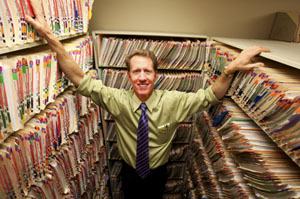
Dr. James Kinsman stands in the practice’s records room, surrounded by patients files that date back only two years (Photo by Barry Gutierrez/For KHN).
Nearly 200 patients will cycle through the office on any given day. Doctors and staff pop in and out of exam rooms and offices constantly, carrying big stacks of manila folders holding patient charts.聽
Just behind the front desk, Dr. Jay Kinsman stands at the practice’s information nerve center.聽
“There鈥檒l be probably 500 pieces of paper come in on the fax, two times, three times a day,” he chuckles.聽 “If that goes down we might as well close.”
He is only half-joking. They have a back-up fax machine just in case.
About a year ago the practice decided it鈥檚 time to switch to an electronic health record system, or EHR, and Kinsman took charge of shopping for the right one. He quickly felt overwhelmed.
“Do we really need 250 different EHRs, and 30 fairly widely used ones and 15 really big ones?” he asks. “Could we get by with one? Would we do better with just one product?”
Actually, there鈥檚 closer to a thousand products out there. The market exploded when the federal government started offering doctors to buy them.聽 The government also said that those who don鈥檛 go digital will face payment penalties in the future.
So, all across the country, doctors like Kinsman are taking sales calls. His decision will directly impact not only his and his partners鈥� days, but also everyone鈥檚 incomes.

Heather Garris, a custodian of medical records, organizes patients files at the Colorado Springs Internal Medicine in Colorado Springs, Colo. (Photo by Barry Gutierrez/For KHN).
He explains, “When we were starting to think about this, we were hearing dollar figures on the order of $40,000 per physician to purchase an EHR and install it, and then lost revenue in the first two or three or four months. Basically we鈥檙e planning on seeing only half as many patients a day for the first two to four weeks.”
There are also decisions about computer hardware — laptops or tablets in the exam room? Host the system on their own server, or in the cloud? Hire an IT specialist, or outsource it? 聽
Vexing as all that is, the practice鈥檚 business manager, Vicky Bonato, says it鈥檚 probably not even their biggest challenge.
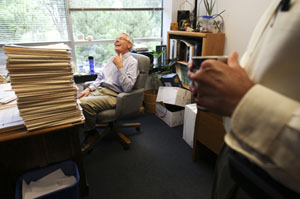
Dr. Michael Spangler, who has been practicing medicine for 40 years, is happy using paper records. He isn’t convinced that going digital will be an improvement (Photo by Barry Gutierrez/For KHN).
“Having everybody have a positive attitude to do it. If we could all keep positive and just get through it and learn it, I think we鈥檒l be OK,” she says.
Not every doctor in the practice is equally enthusiastic about switching to electronic records. Dr. Mike Spangler has been practicing medicine for 40 years. He鈥檚 not convinced that going digital is going to improve things.
“It’s going to take a lot of time, it’s going to decrease productivity,” he says. “And it’s going to be very expensive. So, it means kind of three strikes against it and not as many strikes for it.”
Spangler isn’t just griping. Margret Amatayakul, a who’s written about digital health records, says the experience .
“Especially when people are finding that they bought a product and now are not happy with it. It wouldn’t surprise me if there would be two or three times a replacement process before things settle down for any given practice,” she says.
The message from the federal government is much more upbeat. It says American medicine is towards reaping the of the digital age. The White House says more than half of U.S. doctors are now using electronic records in a way, and the Obama administration鈥檚 of health information technology says digital records will transform the practice of medicine.
This piece is part of a reporting partnership among , and Kaiser Health News.


