


How do you tell the difference between someone who needs to be taken to jail and someone who needs to be taken to the hospital?
That’s a big concern in Connecticut, where the intersection of law enforcement and mental health has been a huge issue since the Sandy Hook Elementary School shootings in Newtown in 2012.
Lance Newkirchen is a regular patrol officer in the nearby town of Fairfield. But he’s also an officer who is specifically trained to respond to mental health calls. On a recent weekday, he headed in his patrol car on a follow-up call.
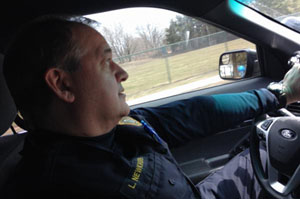
Officer Lance Newkirchen on his way to visit the family of a man who, two days earlier, considered suicide (Photo by Jeff Cohen/WNPR).
“We’re going to go meet with a father whose 21-year-old son, two days earlier, at three o’clock in the morning, through his depressive disorder, was having suicidal thoughts,” Newkirchen explains.
Fairfield has 107 officers, and 18 are trained like Newkirchen. They’re part of what’s called a . It’s a program that began in Fairfield about three years ago, and the department’s target is to train 20 percent of its force. The Fairfield team is one of about , a fraction of the 18,000 state and local law enforcement jurisdictions in the country.
In Fairfield, police say they want to make sure families have as much support as they can. They also want to make sure police have as much information as they can, in case they ever have to go back.
“They know they’re dealing with someone who is depressed,” Newkirchen says. For instance, officers might know “that they’re dealing with someone who may have a samurai sword collection in their basement. They know that they’re dealing with someone whose parents are divorced and the father is very anti-police and the mother is pro-police.”
It’s the kind of information that makes it easier for cops like Newkirchen to do their jobs. “There’s all these things that will get somebody — an officer responding, as he’s walking up the front walk — get him 90 percent of the information he needs to be effective,” he says.
The family of the depressed man, who had been hospitalized, agreed to let NPR attend the interview – but they didn’t want to be identified. Inside their home, Newkirchen talked through a brochure of services – people and agencies that could help them out if they needed it, and went through a two-page list of questions about their son’s diagnosis.
Newkirchen says doing this job means being a good listener. But it doesn’t mean being soft or forgetting police tactics. It just means adding to them.
“It’s easy to interview and to get the person who just stole four tires from BJ’s to really tell you what’s going on,” he says. “And it’s incredibly difficult to get someone who believes they have an assignment from the FBI to really admit that they don’t and they do need help and it’s time to go and talk to somebody at the hospital. So that’s the skills set.”
A few weeks ago, Newkirchen along with 50 or so officers from across the state gathered for the first day of a five-day seminar.. It touched on everything from making suicide assessments to talking to people who may fall on the autism spectrum. They also discuss forging partnerships with community mental health providers and understanding de-escalation techniques.
“The characteristic of your work that sets you apart from every other professional is that you never know what you’re walking into,” says . She’s with the Yale School of Medicine. Her first goal is to give the officers an understanding of various types of behavioral health issues. Psychotic illnesses, for instance, are the ones that make a person unable to tell the difference between thought and reality.
To illustrate, she confesses something many people feel when giving a public talk — she’s nervous, and worried about how people will react. But she knows those are her thoughts — and no one else’s.
“As long as I know I’m thinking it, I have a choice on how to change my behavior. But if I were mentally ill, particularly if I had a mental illness that interfered with what we call reality testing, I think, ‘Because you’re staring at me, you’re thinking I’m stupid.’”
This training is an eye opener for third-year Fairfield Officer John McGrath.
“You know, protocol for a police officer is always, ‘Protect yourself,’” McGrath says. “To be able to learn what they’re thinking and what’s going on in their mind, kind of gives you a better perspective of what’s going on and what you’re able to do to further protect yourself and to protect them to not hurt themselves.”
Officer Newkirchen says that the training these officers are getting is extremely practical. He probably gets two or three mental health-related calls in an eight-hour shift.
Back in the cruiser, he says not all calls go as well as the visit with the family of the man who was suicidal. But a lot of them do.
“I would say 50 percent of the time are calls like this, where we are making, I think, a huge difference… that family has a very different sense of what we do as police officers.
Late Wednesday night, Connecticut lawmakers passed a bill ensuring that all police in the state can get some kind of training like Newkirchen’s.
This story is part of a reporting partnership that includes , and Kaiser Health News.


