


Two years and into the government’s effort to get doctors to take their practices digital, some unintended consequences are starting to emerge. One is a lot of unhappy doctors. In a this summer 38 percent of the doctors polled said they were unhappy with their electronic medical records system.
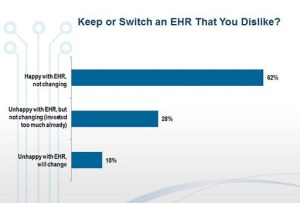
Source: Medscape EHR Report 2012
Dr. Mary Wilkerson is one of those doctors. Her small family practice in Denver made the leap to an electronic health record five years ago, with some pretty high expectations.
“We were told by sales people that we would make more money, because we’d be more efficient, and you’d be able to see more patients,” says Wilkerson. “We’d be able to bill faster, get the money in the bank at the push of a button. And none of that panned out.”
Instead, Wilkerson’s practice found that electronic records actually slowed things down, and the doctors could see fewer patients.
“Within six months of our purchase, one of the partners just did not like it at all, did not like dealing with the computer, and actually left the practice, and we鈥檇 hoped she鈥檇 contribute to the loan that we’d taken out” to pay for the electronic system, says Wilkerson.
Wilkerson’s problems with the system are a stark contrast to the experience of other doctors who have embraced electronic records and patients who have good reviews of them, too.
Marina Blake of Denver is one of those patients. Blake uses a lot of health care, and she likes that the specialists she sees can all call up the same health record that her primary care doctor uses. She can also call up her own record anytime.
“It does add definitely a layer of customer service to my experience that is really awesome,” says Blake, who belongs to a .聽 “For me it鈥檚 part of being an educated consumer. If I have more information, then I can ask better questions.”
The federal government wants every patient to see the same benefits from electronic records Blake does. It鈥檚 per physician to go digital.聽
But Wilkerson鈥檚 practice didn’t get much government money, because payments to go digital are tied to seeing a lot of Medicare patients, which Wilkerson and her partners didn鈥檛 do. They took out a loan because each for digital records systems. So losing income from not being able to see as many patients was hard on Wilkerson’s practice. The expense and the hassle was part of the reason that she and her partners ultimately decided to sell their practice.
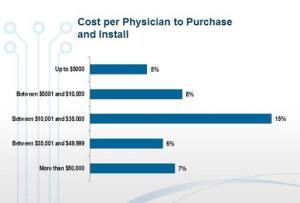
Source: Medscape EHR Report 2012
The American Academy of Family Physicians supports the switch to digital but acknowledges that it has been difficult for many doctors.
“Right now we鈥檙e in a transitional time. Transitional times are tough,” says
Cain says electronic records improve care, and notes that Medicare will start cutting payments to doctors who haven鈥檛 gone digital starting in 2015. He鈥檚 somewhat critical of the government鈥檚 strategy.
“The challenge for the family doctor with the carrot-and-stick approach Medicare鈥檚 using is, the carrot鈥檚 kind of hard to get to,” says Cain.
For its part, Medicare is now worried that part of the digital efficiency it’s encouraging is also making it easier for doctors to generate bills, and charge it too much. Doctors say it should be no surprise that systems designed to catch things like medication errors are also catching missed opportunities to get paid.
That unanticipated argument over billing is playing out as federal payments begin to ramp down. They鈥檙e being offered until 2021
This story is part of a reporting partnership that includes聽,听 and Kaiser Health News.


