


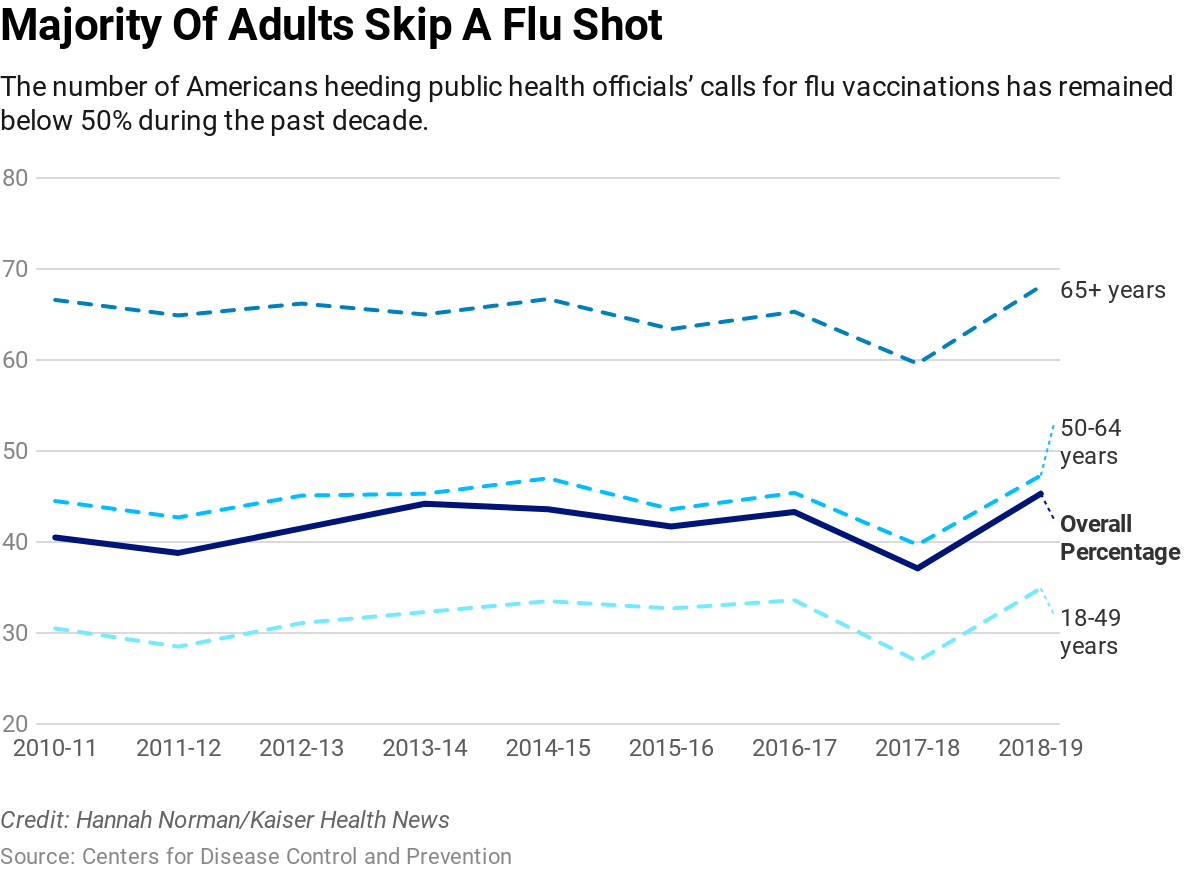
It鈥檚 free and available everywhere. Yet most Americans skip the annual flu shot 鈥� with the number of dispensed vaccines barely changed in the past decade, despite government removal of cost and access obstacles.
鈥淲e are kind of spinning our wheels trying to reach a larger portion of the population,鈥� said Dr. William Schaffner, an infectious-disease specialist at Vanderbilt University Medical Center in Nashville, Tenn., and medical director of the National Foundation for Infectious Diseases.
Public health officials recommend that get the flu shot.
The 2010 Affordable Care Act required all insurers to for plan members for the vaccinations and, in the past few years, all to administer the shots, which have made them available in drugstores, grocery chains and big-box stores.
The flat immunization rates worry public health officials who say the vaccine is the best weapon to prevent the flu, which caused as many as during the last flu season and hundreds of thousands of hospitalizations.
鈥淭he number of Americans being vaccinated is not optimal,鈥� Dr. Daniel Jernigan, director of the influenza division at the federal Centers for Disease Control and Prevention, told the on Wednesday.
A key reason people choose not to get the flu vaccine is they perceive it doesn鈥檛 work, Jernigan said, although studies have found it is usually 40% to 60% effective. CDC and other officials at the hearing stressed that even when the vaccine doesn鈥檛 prevent infection, it can still reduce complications that land people in the hospital and cause death.
About 45% of adults received the flu shot last year, up from about 41% in 2010, according to . Immunization rates have stayed in the 40% to 45% range for the past decade. Among people 65 and older, who are most at risk for complication of the flu, 68% were inoculated last year, up from 67% in 2010.
Vaccination rates, however, have risen for children 鈥� increasing to 73% last year from 64% in 2011.
While getting a flu shot generally takes less than 10 minutes 鈥� most of that time just filling out forms 鈥� having to get the immunization each year makes it challenging compared with other vaccinations, which can last a decade or more. Public health officials remake the flu vaccine each year to keep up with its constantly mutating versions of the virus.
The federal government is working on creating a long-acting flu vaccine that can work against all known strains of the virus, but it鈥檚 at least several years away. The began on a small scale this year at the National Institutes of Health.
Another factor that limits people from getting vaccinated is they don鈥檛 realize how dangerous flu and its complications, such as pneumonia, can be.
鈥淭here is a perception that flu is a little worse than the common cold and there is not a huge level of worry,鈥� said Dr. Jeff Salvon-Harman, chief patient safety officer at Presbyterian Healthcare Services, an integrated health plan in New Mexico with 590,000 health plan members.
People with flu often have that make even the healthiest individuals feel tired for up to a week.
In addition, flu can make chronic medical problems worse. For example, people with asthma may have attacks while infected with the flu.
Public health officials said they face other long-standing challenges, such as myths that the vaccine can cause the flu (it can鈥檛) and that it contains dangerous levels of mercury (it doesn鈥檛 鈥� and people can request vaccines with no mercury).
Ge Bai, who holds a doctorate in accounting and is an associate professor of health policy at the Johns Hopkins Bloomberg School of Public Health, doesn鈥檛 get the flu shot.
鈥淚 think I can make myself much less vulnerable to flu by eating right, resting well and working out,鈥� she said. 鈥淚 don鈥檛 think the incremental reduction of the estimated chance for me to get flu is worth my time to get the shot.鈥�
Heath care workers also often skip the vaccination, and if they become infected, they can spread the flu to people they treat, who likely already have serious health issues.
In Pennsylvania last winter, long-term care facilities reported of flu affecting more than 3,400 residents and staff. The state found only 69% of staff and 78% of residents were vaccinated.
鈥淲e need to do a better job of producing convincing messages鈥� about the importance of the flu shot, said Dr. Sharon Watkins, the Pennsylvania epidemiologist and president of the Council of State and Territorial Epidemiologists. 鈥淲e had hoped the rates would have changed.鈥�


