


Hope that the health law鈥檚 online insurance marketplaces will work well enough to enroll millions this fall had already faded before the administration disclosed results Wednesday. News that only 27,000 had signed up for private coverage on the federally run marketplaces through October amplified the doubts.
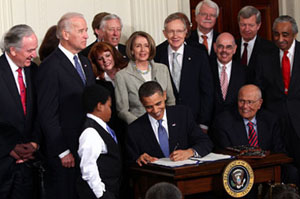
President Barack Obama signs the Affordable Care Act during a ceremony at the White House in March 2010 (Photo by Win McNamee/Getty Images).
Experts increasingly doubt the federal site serving 36 states will function properly by the White House鈥檚 self-imposed Nov. 30 deadline — or maybe even by Jan. 1, when insurance coverage is scheduled to begin. Some state-built sites, which enrolled 79,000 in October, have their own problems.
Web portals selling insurance directly to Americans lacking affordable, comprehensive coverage are the heart of the Affordable Care Act.
How much does their early failure jeopardize President Barack Obama鈥檚 marquee law? Are functioning insurance portals essential to other goals of the law? Kaiser Health News asked analysts for a damage report.
Q: Can the federal portal be fixed in time?
A: Many don鈥檛 think so, and some worry about the consequences.
鈥淕iven where they are right now, it would be an unbelievable feat if they were to be ready鈥� even by Jan. 1, said Bill Copeland, a top health care consultant at Deloitte.
The administration faces a credibility problem if it fails to meet the Nov. 30 deadline, said Dr. Ezekiel Emanuel, a former White House health care adviser. Signup delays could distract consumers from the benefits of coverage and cause many to tune out, he said.
Q: Why not wait until the websites are fixed and then have people line up? Or extend the enrollment period for individuals to gain coverage into the middle of next year?
A: Many can鈥檛 wait. Their policies expire Dec. 31, and they fear a gap in coverage. Others are uninsured and had expected ACA benefits starting in 2014.
Waiting worries insurers, too. They designed and priced marketplace policies based on the idea that consumers would enroll between Oct. 1 and March 31 for coverage starting as early as Jan. 1. Delaying signup could leave carriers with disproportionately sicker and more expensive customers, they say.
Q: What about a bigger fix? Let people keep the policies they have for another year. Or create a bailout pool for those who need emergency coverage until the websites presumably work in 2015.
It鈥檚 getting late even for extending this year鈥檚 policies. In many cases neither insurers nor state regulators are prepared.
鈥淚f we had known this was going to happen in September, early renewing (of existing plans) probably was going to be the answer,鈥� said Joseph Antos, a health economist at the American Enterprise Institute. 鈥淣ow that we know in November it鈥檚 not looking too great.鈥�
Anything more ambitious, such as a new, national 鈥渞isk pool鈥� similar to the temporary coverage given those with existing illness starting in 2010, would probably require Congress to pass a new legislation.
鈥淪ince Congress can鈥檛 agree on big things like debt ceilings and a budget,鈥� said Copeland, 鈥淚 don鈥檛 know how this is going to get solved.鈥�
Q: What鈥檚 the worst-case scenario for those unable to sign up?
A: Millions, including those with existing illness, could have trouble getting coverage. The administration may be working on a plan to have consumers contact insurers directly, but some worry they could end up buying the wrong policies if they don鈥檛 see the full online menu.
鈥淲e have had concerns about direct enrollment,鈥� said Judith Solomon, vice president for health policy at the Center on Budget and Policy Priorities, which supports the law. 鈥淐onsumers won鈥檛 have the full ability to shop in the short term.鈥�
Those who do obtain insurance could have trouble gaining online premium subsidies, which so far are available through the government portals.
If computer breakdowns disproportionately deter the young and healthy from joining the ranks of the covered, insurers could lose money. That could set the stage for premium spikes and the kind of instability in the individual insurance market that the health law was supposed to solve.
Q:聽 What about the law鈥檚 safety valves for unexpectedly large claims in the early years?Measures to compensate insurers with high initial expenses are supposed to keep them from making it up with higher prices for the first three years.
A: Because a quick solution for signup bottlenecks seems increasingly unlikely, those buffers could become more important. Even with extremely low first-year enrollments, some experts argue they could keep prices stable until portals are fixed for a smooth launch in 2015.
鈥淚n the long run, our view is that the exchanges and the entire ecosystem are going to be fine,鈥� said Bryce Williams, a health benefits and technology consultant at Towers Watson. 鈥淏ut you鈥檇 have to talk about a two- to three-year horizon.鈥�
Successful websites and signup efforts in big states such as California and New York will show that the online marketplace can work and should lead to acceptance elsewhere despite short-term problems, said James Morone, a political science professor at Brown University who specializes in health policy.
鈥淏ottom line: No, they won鈥檛 be working鈥� soon, Morone said of many marketplace portals. 鈥淎nd double no, they are not going away.鈥�
Q: How badly do Web failures threaten other aspects of the Affordable Care Act?
A: The health law didn鈥檛 just offer commercial insurance on the Web. It expanded Medicaid for low-income consumers in states that chose to accept it. Because the programs have years of enrollment experience, Medicaid expansion is progressing better in many states than efforts to expand access to private insurance.
While the federal site 鈥渉as been nowhere near as easy to use and efficient as anybody would have dreamed, we鈥檙e hopefully in the early innings鈥� of the larger goal of expanding coverage, said Bob Kocher, a partner at venture capital firm Venrock and a former Obama health adviser.
Nor may Web problems have much effect on the health law鈥檚 other grand goal of containing costs and making care safer and more efficient.
鈥�Accountable care organizations鈥� that reward better care have been formed across the country. Medicare is penalizing hospitals with too many readmissions of recently discharged patients.
Online government insurance portals have inspired similar, private sites that are transforming employer-sponsored coverage.
鈥淭he notion that one website associated with one part of the law is up late 鈥� that the whole law should be thrown out 鈥� is an extreme reaction,鈥� said Alan Weil,聽executive director of the National Academy for State Health Policy.


