
HHS Seeks $600 Million For Health Law Enrollment Efforts

HHS Seeks $600 Million For Health Law Enrollment Efforts
Just in case Congress doesn鈥檛 pass President Barack Obama鈥檚 fiscal 2015 plan, officials at the Department of Health and Human Services say they have other options for finding the money they need to implement the health care law.
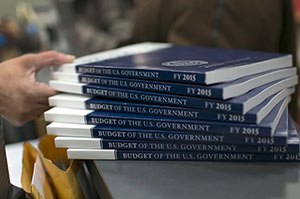
Copies of U.S. President Barack Obama’s fiscal year 2015 budget are shown for sale at the Government Printing Office in Washington (Photo by Win McNamee/Getty Images).
The law is expected to generate $1.2 billion in user fees鈥攊ncluding those on health insurers who participate in its online marketplaces, or exchanges. The administration鈥檚 budget requests an additional $600 million to help run the federal marketplace, call centers and other outreach efforts, said Ellen Murray, assistant HHS secretary for financial resources.
If Congress doesn鈥檛 agree, she said, the secretary鈥檚 office has the authority to transfer funds from existing accounts, or to tap the agency鈥檚 non-recurring expense fund, which allows the agency to take money from expired accounts and use it for information technology and other capital investments.聽
鈥淲e would be looking at all those resources, as we are doing this year,鈥� Murray said at a news briefing Tuesday about the budget. 鈥淏ut our expectation and hope is that Congress will provide the dollars we need.鈥�
Funding for the federal exchange has been a trouble spot before. The health law provided funding for states to run their own exchanges, but because of strong Republican opposition to the law, more than half the states opted to let the federal government do that job instead. The law did not have adequate funding for such a large effort, and HHS officials have taken the money from other accounts.
Congressional Republicans, who have tried to defund all or part of the health law, balked before at adding money for the health law and are highly unlikely to approve an administration request for additional implementation funding.聽 In addition, in December the House and Senate Budget Committee chairs, Rep. Paul Ryan, R-Wis., and Sen. Patty Murray, D-Wash., agreed to a budget deal that set federal government spending caps for fiscal 2015 and rolled back some of the automatic spending cuts known as 鈥渟equestration.鈥澛�
Ryan and House Republicans are to put forth and pass a fiscal 2015 budget plan to outline the party鈥檚 spending priorities before midterm elections this fall where they are fighting to win control of the Senate and maintain or increase their majority in the House. Murray 聽 she is not pursuing a budget resolution this spring. 鈥淭his budget year is settled and it wouldn鈥檛 be productive to relitigate it so soon after our two-year deal,鈥� she said.
As it laid out its fiscal 2015 budget plans Tuesday, the administration also said it is proposing trimming $402 billion from Medicare, Medicaid and other federal health programs 鈥渂y implementing payment innovations and other reforms that encourage high quality and efficient care.鈥�
Some of those provisions were contained in previous budget plans, including last year鈥檚 proposal. Those ideas include:
- Asking higher-income Medicare beneficiaries to pay more for coverage.
- Requiring future retirees to pay higher copays for outpatient services such as doctor’s visits and home health care.
- Reducing hospitals鈥� and other providers鈥� Medicare reimbursements.
- Increasing the rebates that drug makers are required to pay for drugs dispensed to Medicare’s poorest beneficiaries.
Obama鈥檚 budget would also extend for an extra year a provision in the health law that pays Medicaid primary care providers at the same rates as those in Medicare.
Groups representing Medicare recipients expressed concern that the 2015 budget proposal may be shifting costs to the elderly.
鈥淚nstead of shifting additional costs onto Medicare beneficiaries, we must look for savings throughout the entire health care system, as the rising cost of health care threatens people of all ages,鈥� said AARP Executive Vice President Nancy A. LeaMond. 聽聽
Hospitals, doctors and other Medicare providers, already dealing with payment reductions mandated by the health law and sequestration cuts, said Obama鈥檚 plan would cause additional harm. 鈥淓ven before these new reductions, Medicare and Medicaid reimburse hospitals for less than the cost of providing services.聽 Moreover, one in four hospitals operate totally in the red,鈥� American Hospital Association President Rich Umbdenstock said in a 鈥淭he administration鈥檚 proposal would impact access to the latest treatments and technologies, and may bring about longer waits for care and fewer caregivers to treat our nation鈥檚 sickest patients.聽鈥�
House Ways and Means Committee Chairman Dave Camp, R-Mich., criticized the Obama for ignoring 鈥渨hat he once saw as a crisis in our entitlement programs.鈥� He added, in a statement, 鈥淏y leaving out any reforms to protect and preserve Social Security and Medicare, the President has chosen to provide political cover in an election year rather than provide solutions for our nation鈥檚 seniors and future generations.鈥�


