


If the National Rifle Association鈥檚 plan to curb violence is, in part, arming school聽employees with guns, President Barack Obama wants to arm them with something quite different: mental health training. The president鈥檚 plan centered largely on training teachers and others who work with children, teens and young adults to recognize mental illness as it鈥檚 developing.聽
“I think this is really putting the focus on children鈥檚 mental health as a child issue,” says Dr. Paramjit Joshi, the president-elect of the American Academy of Child聽& Adolescent Psychiatry. She notes that “about 50 percent of lifetime mental illness starts before the age of 14.”聽聽
Dr. Joshi says 3 out of 4 people with mental illness develop their condition聽— including bipolar disorder, depression and schizophrenia — by young adulthood when the intricate structures of the brain are taking shape. But fewer than half receive treatment.聽
The president has called for a new initiative聽— which would need congressional approval — that would provide mental health first aid training for teachers and set up a robust referral system for children with mental health and behavioral problems.聽
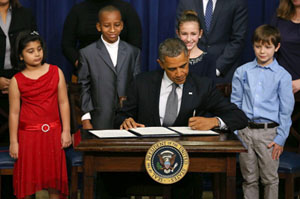
President Barack Obama signs a series of executive orders about the administration’s new gun law proposals (Photo by Mark Wilson/Getty Images).
Mike Fitzpatrick, executive director of the National Alliance on Mental Illness,聽says that training is critical: “People say: ‘Oh, we saw the signs,’ but no one knows what the next steps are. And that includes families and caregivers and teachers and resource officers. So to go into the communities and offer training on what to look for, how to spot the signs of mental illness and where do you go to get assistance: This, in many ways, would be a game changer.”聽
Obama鈥檚 proposal also points out that a startling number of children have direct experience with gun violence: 22 percent of 14 to 17 year olds in the U.S. have witnessed a shooting in their lifetime, and the plan calls on Congress to direct some $25 million to help traumatized students.聽
A separate initiative would aim support at older teens and young adults — ages 16 to 25 — in need of help who can get lost in the tumble of college or a first job.聽
But mental health experts say that while it鈥檚 critical to recognize the first signs of mental illness, it鈥檚 just as important that children聽and their families have health insurance that guarantees them coverage for聽treatment.
That problem was supposed to be addressed, in part, in 2008 when then-President George W. Bush signed the Mental Health Parity and Addiction Equity Act. It requires employers with more than 50 workers to offer mental health coverage that is on par with medical benefits. But writing the regulations has proved difficult: There has聽been disagreement, for example, over a lifetime cap on the number of therapy visits for people with depression.聽
In the meantime, advocates say that people with mental illness have languished under temporary rules that have barred patients from a full range of mental health services.聽聽That鈥檚 set to change now. One of the executive actions the president signed yesterday included a vow to issue final rules sometime next month.
Chuck Ingoglia of the National Council for Community Behavioral Healthcare says the rules will apply to nearly every type of insurance, from state Medicaid programs to employer coverage to individual health plans sold under the Affordable Care Act. Among the so-called “essential benefits” will be mental health care.聽 “We鈥檙e hoping a final rule on parity will make it very clear about the scope of services that are offered. … The whole intent of the parity law was that if you need mental health and addiction services, that it should be available to you.”
Those rules won鈥檛 require congressional approval, but much of the president鈥檚 plan to improve mental health services 鈥� and his other gun-related proposals 鈥� will hinge on support from House Republicans, who vociferously oppose the administration’s health policies, especially implementing and funding the 2010 federal health law.聽
Still, the NRA聽and a number of Republicans have said they support addressing the nation鈥檚 fractured mental health system, and advocates for the mentally ill say they anticipate far less political resistance. The total package of mental health proposals in the president鈥檚 plan total some $155 million in federal spending.聽And the modest scale, those advocates say, might just be something everyone can agree on.


